
Translated material
The legs of the Queen Nefertari
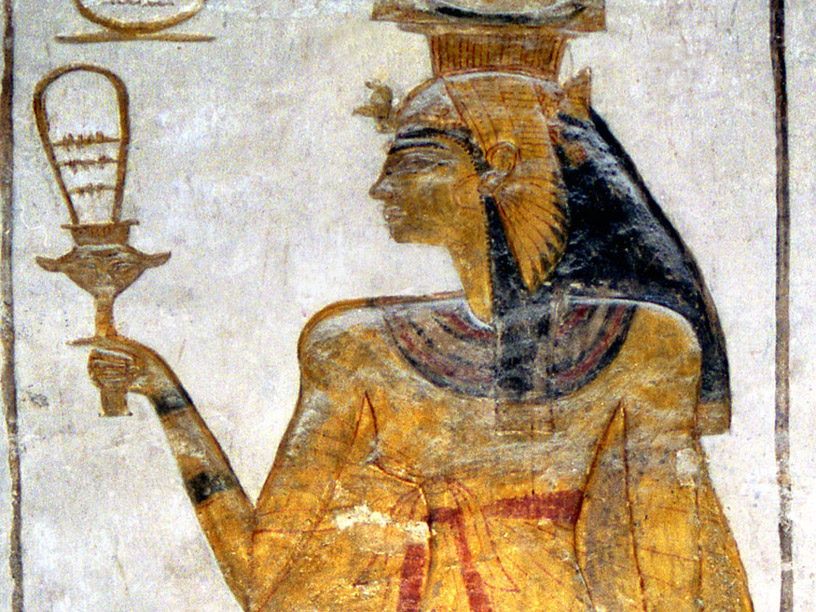
Nefertari received the title of “great wife”, which proves her special status among the wives of Ramses. Her statues were often installed next to her husband's statues. One of the two temples of Abu Simbele erected by Ramses II was dedicated to Nefertari, where she was revered in the form of the goddess Huthor. At the entrance to it, next to the two statues of Ramses, there is a statue of Nefertari, about ten meters high. And the inscription at the entrance reports: “Ramses, he erected a temple carved in grief on forever, for the sake of the great wife of the royal Nefertari, beloved Mut, in Nubia, in eternity and infinity.”
Nefertari at the game of Senet (image from the tomb qv66)
Nefertari died in 1255 BC. e. at the age of 44, and her husband built a luxurious tomb for her. At the entrance to the first chamber of the underground tomb, the titles of the deceased are listed: “Hereditary nobility, great mercy, beauty, sweetness and love, the mistress of the upper and lower Egypt, the rested, mistress of both lands, Neferma, beloved mut, right -handed before Osiris.” The total area of wall murals is 520 square meters. They illustrate the Egyptian "Book of the Dead" and show the path of Nefertari in the afterlife. Because of these images, the tomb of Nefertari was nicknamed the "Sistine Chapel of Ancient Egypt."
The interior of the tomb QV66
The scheme of the tomb QV66
Nefertari in prayer pose (image from the tomb qv66)
The tomb of Nefertari, who received the designation of QV66 from archaeologists, was discovered in 1904 by an outstanding Italian Egyptologist Ernesto Schiaparelli (cousin of the famous astronomer Giovanni Schiaparelli). Alas, all the contents of the tomb were looted even in ancient times and, possibly, repeatedly. In addition to wall images, only small objects remained for scientists: fragments of ceramics carved from scarabs stone, pieces of granite sarcophagus cover, 34 wooden figures of Eschebti and two wicker sandals.
Sandals from the tomb of QV66
And archaeologists have found fragments of two mummified legs. Three fragments: large, medium and small. A large one is a left knee cup with parts of the femur and large bone bones. The middle is part of the large berets, and the small is a small part of the femur. Together with other finds of Ernesto Schiaparelli, the bones hit the Egyptian museum in Turin, which he led. Since they were found in the tomb of Nefertari, they were automatically considered the remains of the queen, but they were never subjected to scientific research.
Legs in the exposition of the Egyptian Museum of Turin
Recently, a team of archaeologists and anthropologists from Switzerland, France, Great Britain, Italy and Australia led by Frank J. Rühli from the Institute for Evolutionary Medicine of Zurich University took these bones. They subjected the remains to the radiocarbon, chemical, x -ray, genetic and anthropological study.
According to experts in physical anthropology, the bones belonged to a woman tall from 165 to 168 centimeters. Now such growth seems small to us, but, according to Frank Ryoli, if you compare it with the average growth of women of the era of the new kingdom, it turns out that the owner of the bones was higher than 84 % of her contemporaries.
A chemical analysis of traces of substances used in embalming confirmed the correspondence of the technology used in the Ramses II era and its descendants. And X -ray pointed to the signs of arteriosclerosis, which indicates old age. Presumably the woman was from 40 to 60 years old.
X -ray study of the knee joint. Signs of arthritis are shown on the left, on the right are traces of calcinosis in the tibia arteries.
All data obtained correspond to the hypothesis that the bones really belonged to Nefertari. The only discrepancy is given by radiocarbon dating. According to him, bones for about two centuries of the ancient period of the life of Nefertari according to traditional chronology. But, as one of the authors of the study, Michael E. Habicht), it is very likely that the dates of the reign of Egyptian pharaohs, known from ancient sources, are incorrectly attached to the chronological scale. The possibility of such a discrepancy in dating is now widely discussed. The scientist recommends that the radiocarbon dating of other tsarist and Neval remains of the period of the New Kingdom in order to clarify the existing dates.
Unfortunately, researchers were not able to single out samples of ancient DNA. Genetic pollution of bones was too strong.
But in general, scientists believe that now the belonging of Nerbertari bones has been proven. Moreover, they tend to believe that the sandals found in the tomb also belonged to her (earlier many Egyptologists believed that the sandals were forgotten by robbers). The technique of weaving sandals (type C1 according to the classification of Veldmeyer) belongs to the period of the 18th-19th dynasties. On the upper side of the sole there are traces of wear. They correspond to 39-40 modern size. Having evaluated the parameters of the foot on the dents on the straw, the scientists came to the conclusion that their owner was about 165 centimeters. In favor of the fact that the queen wore sandals, says high quality of material and weaving.
The results of the study are published in the electronic scientific journal PLOS One.