
Translated material
"The totalitarian nightmare is actually an extremely attractive thing."
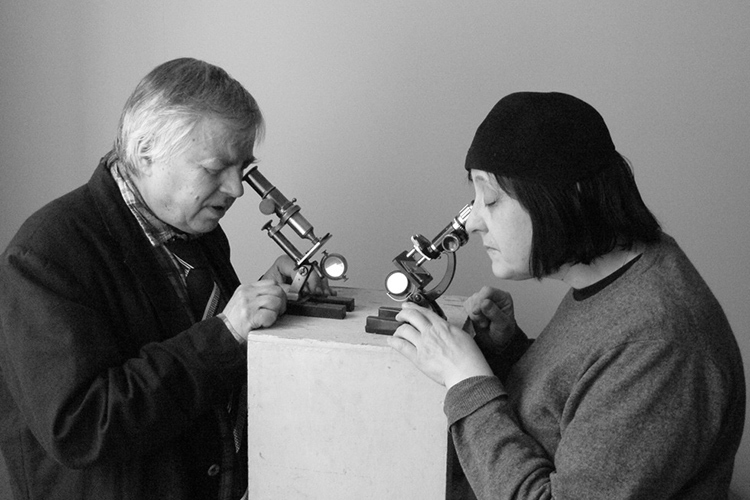
In the new issue of dialogs created as part of the joint project of Colta.ru and the VAC Foundation - the Center for Experimental Museology, Arseny Zhilyaev talked with artists Elena Elagin and Igor Makarevich.
Arseny Zhilyaev: Igor, Elena, you are known mainly as artists working in a conceptual way with death aesthetics. In an amazing way, recently this topic has gained extreme importance for Russian society as a whole and cultural production in particular. A day later, scandals arise around teenage publics on social networks dedicated to suicide and dying, which, contrary to hysteria in the media, were not very ethical, but still a creative project. Today, every second teenager and every third adult knows what the “sea of whales” is or “wake me up at 4:20”, just as, probably, once every people who entered the Moscow conceptualist circle knew what “rotten pins” were. Of course, the interactiveness and relative openness of social networks as a medium for artistic expression with their special subcultural flaler differ from conceptualist art and rather closed reflection on it. But if you do not even take into account the mass cultural manifestations like suicidal groups on the Internet, there are a lot of examples of appeal to necroecestatics in contemporary art. And here it is mainly we can talk about artists affiliated with Russian cosmism, for example, the unification of "Up!" Although they were more likely from Fedorov and immortality to necrorealism. In your case, cosmism arose in the 2000-2010s as a result of the conceptualization of Soviet cemetery aesthetics.
In general, it seems to me that you are one of the first in the domestic context (if you do not take the kinetists of the 1970s and artists of the Amaravell group , who began their activity at the sunset of the historical avant-garde) turned to the artistic study of the philosophy of Nikolai Fedorov. Be that as it may, for me personally, the aesthetic component of cemeteries, and even more so Russian cosmism, was inextricably linked with the hints of the museum. Whether it is a bureaucratic dying of things in an institutional context or, on the contrary, its wonderful resurrection thanks to the efforts of artists, scientists and all the brothers and sisters of Planet Earth. I would first like to ask about the origin of your aesthetic preferences. Were they somehow connected with the museum or, more widely, bureaucratic culture of the late USSR?
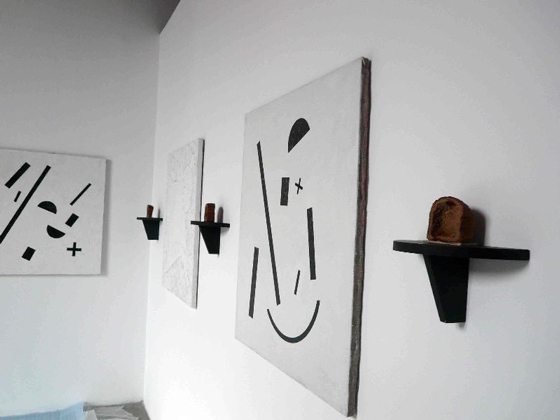 "General business", Biennale in Thessaloniki, 2009, type of exposition
Igor Makarevich: Most of my life passed during the dominance of Soviet ideology, which monopolized all the concepts of death and imposed a strict ban on any deviations from the established provisions. The secret part of the communist religion is the cult of the deceased leader, whose mummy was in a particular center of the main city of the world. The mummy is enclosed in a reduced copy of the Egyptian pyramid, which served as a pedestal for the chosen leaders of the huge Soviet empire. From early childhood, I often secretly took out a voluminous volume from the bookcase, interwoven in a black dermatin, on a shabby roof of which could still be clearly read by a large inscription derived by silver: “At the Great Grave”. It was a book of mourning 1924. With light nausea, with horror, I examined the photos at the full turn, on which in different angles the head of a man with a small beard, which already had signs of fumigation, was shot in different angles. On the street, I sometimes saw funeral processions, led by people dressed in dark, cherry banners with a familiar profile carried cherry color. Gradually, in my mind, a “department” arose, where signals received about the significant and gloomy phenomenon that adults spoke clearly reluctantly and which was in a completely incomprehensible way associated with the signs of the supreme power: with a chilling voice of Levitan on the radio, with the letters of the USSR on an old globe, with an alarming half -time of the guests. Therefore, when I became an artist, among the first those who began to pop up from the depths of consciousness, this one, which injured me in the distant past, surfaced. And I tried - albeit somewhat straightforwardly - to answer myself a number of questions that have been accumulating for many years.
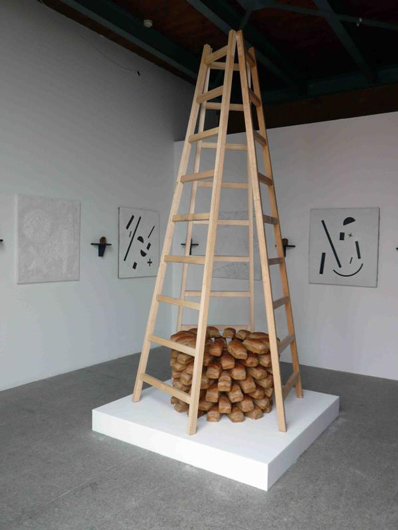 "General business", Biennale in Thessaloniki, 2009, type of exposition
Elena Elagina: Everything you just said refers to the literal form of death, slightly romanticized and endowed with some ideological decorations. But by the time we did our first joint work, your views were distinguished by the great presence of sarcasm.
This topic is also related to children's memories. Once in the first grade, our teacher entered the tragic expression and announced: "Children, there was a great misfortune: Ilyich in the Mausoleum began to deteriorate, his legs were already closed." I perfectly remember my bewilderment about this. I thought: why his legs closed him, because the fish rush from his head. Even then, my attitude to solemnly-ritual events was ironically-integrated. After all, both the mausoleum and many memorial complexes, including a mourning Leninist train, were a kind of necromeuse. It was the concept of the museum gradually in one form or another that began to dominate in our work. What can you say about this?
A totalitarian nightmare is actually an extremely attractive thing.
Makarevich: We observe the widespread change in the status of the museum. The museum has long ceased to be a palace, in the beautiful halls of which there are beautiful collections of paintings or rare objects. A truly revolutionary project by Nikolai Fedorov about the creation of a total museum, where not only the useless objects surrounding us will be collected, but also all the atoms of the bodies of the deceased fathers, if it was not fully realized, served as the basis for the new concept of the Museum of the twentieth century.
The museum loses its specific space, now it is a container of certain ideas in different areas of human life - in art, philosophy, science. On the other hand, grandiose museums of contemporary art on the courage of architecture can compete with Gothic cathedrals: these are altars of democracy, obvious evidence of the manifestation of the religion of capitalism, they have turned into a kind of religious buildings, new temples. In them, multilingual tourists, modern pilgrims, respectfully examine the mountains of trash placed in the dazzling whitish of spacious halls.
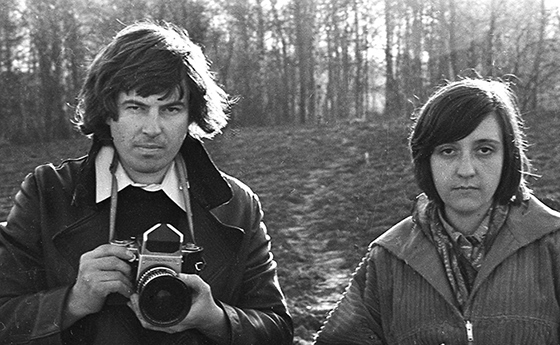 © from the personal archive of I. Makarevich and E.Lagina Igor Makarevich and Elena Elagina
Zhilyaev: I have repeatedly heard the opinion that the concept of the museum at Fedorov is totalitarian in the sense that it involves the mandatory fixation and preservation of information about all people living with the subsequent unification of people in the general business, which cannot but limit the freedom of a single person. You can go further and say that the Fedorov project does not make it possible to turn off it even through death. In a sense, we are dealing with the radicalization of the trends described by Foucault in the terms of bivos: total control of bodies in order to complete their inclusion in capitalist production. Death and dying become a form of resistance. This idea is already in the literary work of Alexander Bogdanov, who, as a theorist, just acted as the author of the theory of management, designed to fight with any form of disobedience. The hero of his story “Feast of Immortality” refuses eternal life as too boring and deprived of meaning. You can easily imagine a suicidal strike movement in the world of eternal life, which consists of coercion to work. Although it is worth noting that Fedorov himself opposed capitalism, as well as against any kind of violence against man and nature. In this regard, I would like to know your opinion about the potential dangers of the Fedorov project. The mention of Elena Sarcasm is quite important in this case. Is there a critical distance in your projects in relation to Fedorov constructions or today you perceive them in a more affirmative way?
Elena and I can say that we followed the Fedor's methodology, resurrecting the marginal texts of the Soviet ideological machine from oblivion, breathing new life in them.
Makarevich: When answering this question, one must take into account a certain historical retrospective attitude to the Fedorov project and to the figure of Fedorov himself. Ascet, humbly held a modest position in the Rumyantsev library, aroused a keen interest among many outstanding people of his time, including Tolstoy and Dostoevsky. It was highly paradoxical teaching that the entire atheistic potential of the 19th century embodied in itself, the desire of a person to take on the functions that were previously assigned to the divine fishing. In my opinion, the “philosophy of the common cause” is directly related to many provisions of Great Utopia. In Soviet times, Fedorov’s name was turned into a kind of scarecrow, and his ashes, interestingly, was rolled up under the asphalt of the sports ground. Half a century ago, everything associated with the name of Fedorov had irresistible attractiveness. Now many thoughts of the Russian philosopher can be attributed to the area, called science fiction. We can evaluate the courage of his radical sentences, but, as in many utopian projects, their practical background actually turns into a grandiose inhumanity. At the same time, everything related to the museum in Fedorov’s understanding continues to arouse interest and has real development potential. The collection and storage of low -value things, in essence of unnecessary things, is the assertion of the continuation of their life, and since the human body and its atoms in Fedorov’s understanding are also things that should be stored accordingly and, if necessary, restore and bring into proper form, such a perception of the museum and museum business is now a purely creative area. Elena and I can say that we followed the Fedor's methodology, resurrecting the marginal texts of the Soviet ideological machine from oblivion, breathing new life in them.
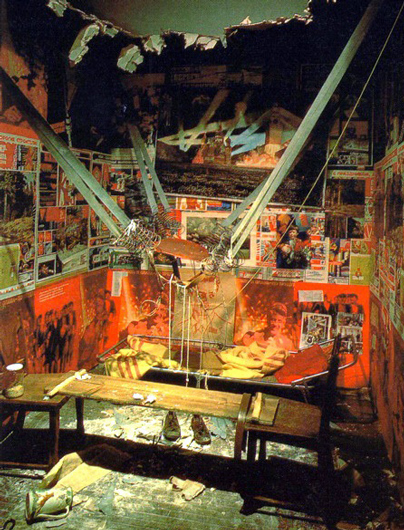 Ilya Kabakov. "A man who flew into space from his apartment", 1986
Zhilyaev: Colleagues told me - and in the public domain you can find materials in which Ilya and Emilia Kabakovs are extremely negatively speaking about any utopian projects of the past and present, in particular, Russian cosmism. In their opinion, their place is a museum, and not a reality in which they are doomed to turn into a totalitarian nightmare. Although, of course, the Kabakov obsession in relation to the Soviet heritage even in its museum -free impulse holds a powerful utopian potential. So, the installation of “a man who flew into space from his apartment” could, as it seems to me, appear only as a result - albeit critical - acquaintance with Russian cosmism, missed through the prism of Soviet everyday life. In your case, the border is built even less clearly. Since, in my opinion, the interest in Fedorov’s figure is logical precisely based on the development of internal impulses of your work. I was always interested in how artists working with this problem relate to the possibility of the real embodiment of immortality and creativity, understood as the resurrection and transformation of the Universe. Could you imagine yourself as an eternally living artistic duo? And if so, how could your art change?
Elagina : A totalitarian nightmare is actually an extremely attractive thing. No wonder Mao Zedong believed that communism could defeat throughout the world only with totalitarian methods. Russian cosmism is a beautiful myth based on the ideas of Fedorov, whose works became the property of Russian philosophical thought of the 19th century. He practically solved the problem of death, which attracted the whole host of our religious philosophers and outstanding writers-thoughts. Kabakovsky utopianism to a large extent is ironic, and his man flew into space just from a totalitarian nightmare.
And the art duet in a millennium in the millennium loses all internal dynamics, not only creative productivity automatically disappears in it, but also any intelligible logical justification. All manifestations of art known to us are based on the concept of time. Immortality relieves the existence of time as a measurement. It is of little interest to represent yourself always living, especially an art duet.
Now all utopia is inseparable in our minds from the experience of concentration camps, communal apartments, the horror of total informing and the destruction of culture.
Makarevich: We often hear reproaches in close relations of Moscow conceptualism with the concept of death. In his last book, the Life of the Military Artists, Alexander Brener repeatedly concerns this topic: “But the Glabovs were Bulatov, Prigov, and Boris Orlov, Chuikov, and Skersis, even Kabakov ... Moscow conceptualism all stinks of a grave ...” Yuri Leiderma passionately convicted his colleagues in the same sin, although in his work he gave a noticeable tribute to Tanatos. If you accept these accusations, what is the reason for such a gloomy addiction of individual artists? I am talking about this in connection with the fact that the Russian heroic avant -garde, which was the forerunner of modern post -Soviet art, was clearly in close relations with Fedorov ideas about physical immortality. Perhaps this phenomenon (interest in death as such) can be explained precisely by the 70-year experience in the implementation of utopian ideas, which seemed so attractive at the beginning of the twentieth century.
But human civilization is embarrassed by fatigue from full -scale historical experiments. Now all utopia is inseparable in our minds from the experience of concentration camps, communal apartments, the horror of total informing and the destruction of culture. Now we know in practice, which means the slogan “You cannot wait for mercy from nature ...” Any initiative in violation of natural cycles has far -reaching negative consequences. In such a popular plot of horror films about the “living dead”, one can see the answer of modern society to the idea of physical resurrection of previous generations. The endless development of a creative duet does not seem to me an attractive idea, and I understand the motivation for the hero’s final act in Bogdanov’s story.
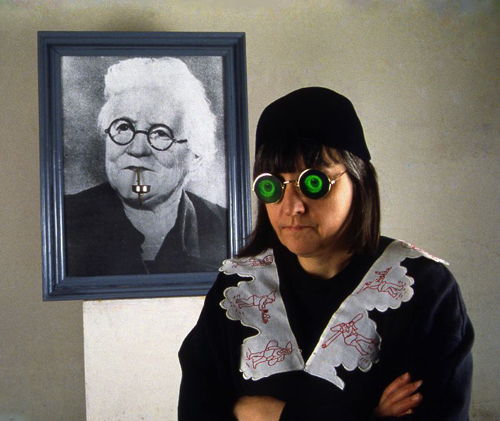 "Within the limits of the beautiful"
Zhilyaev: What, in your opinion, is the connection between the fixation of Moscow conceptualism in literature, on the text and aesthetics of dying? After all, not only the museum is often accused of the burial of the living, but also the text as such. Like, if you call a thing, if you give it a name in the text, it already ceases to exist. There is an opposite line of reasoning according to which it is thanks to literary creativity that life receives its highest embodiment. Your art is quite characteristic of an appeal to the tradition of Russian realism, which in itself, as it seems to me, for the domestic context of contemporary art, especially until some point, was quite rare. What is the role of literature in your creative experiments with death aesthetics?
Makarevich : Logocentrism of Russian art has become a common place. Russian fine art has always been secondary. To some extent, his provinciality gave him a kind of attractiveness: sincere, national theme, sentimentality. All this contributed to a shorter distance with the viewer, in a word, created the atmosphere of Bidermaier. Only the Russian avant -garde was able to destroy this situation. Unlike visual traditions, Russian literature of the 19th century not only became fully European, but also in many ways ahead of all the limits established in this area. This ratio fell into the basic concepts of domestic culture and to a certain extent explains the success of our conceptual school. But literature is difficult to blame for a preferential attitude to death. This topic, although sometimes it went off scale (like the Symbolists), was a legalized area of that grandiose panorama of being, which Russian writers and poets managed to create. Returning to the traditions of Moscow conceptualism, which Boris Groys awarded the epithet “romantic” , it is necessary to distinguish clearly literary trends that have become a significant part of its overall design. First of all, this is a character, carefully developed by the founders of Kabakov, Komar and Melamide . In their studies, the influence of the Oeriuses is noticeable, and the latter had a fairly short relationship with the theme of death.
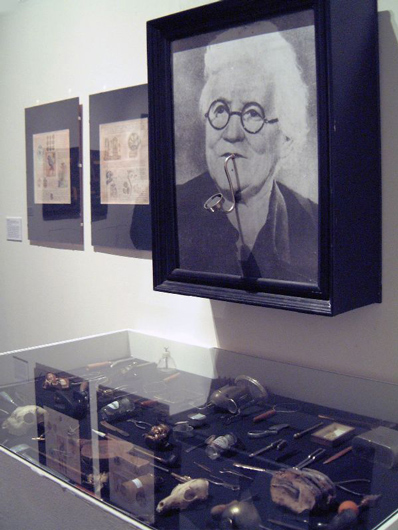 "Within the Great", GTG, Moscow, 2002
In our work, character also plays a significant role: Elena has developed images of false scientists, great magicians and wizards of Stalinism-Lysenko and Lepeshinskaya, who, despite the optimistic demagogy, in some ways contacted the concept of death. Лепешинская обещала вождю продлить срок человеческой жизни до немыслимых пределов, но именно эти сроки, их абсолютная несовместимость с реальной физиологией человека, выработанной в течение тысячелетий, делают невежественные опыты выдающейся советской ученой пародией на утопические проекты и лишь подтверждают параметры жизни, положенные человеку естественной смертью. Лысенко брался обеспечить материальные ресурсы, необходимые для безоблачного существования грядущих поколений, вполне реально осознавая, что для этого необходимо умертвить всю генерацию окружавших его ученых.
В моем творчестве существенную роль играет фигура Николая Ивановича Борисова (на мой взгляд, имеющего родство с некоторыми персонажами Николая Васильевича Гоголя), скромного бухгалтера, который обуян желанием прекратить свое человеческое существование и превратиться в дерево. Для этого он готовит ряд приспособлений, которые можно назвать машинами смерти, — пыточные кресла и ложе, шкаф со встроенной в него деревянной гильотиной и т.д.
Наконец, мы отдали много творческой энергии созданию «федоровского проекта», разработав ряд инсталляций, где «могильная» тематика играет существенную роль. Однако, используя в своих работах гробы, горы земли и прочую атрибутику смерти, мы всегда осознавали чисто декоративное значение этих предметов, опирались прежде всего на всевозможные аллюзии, иронию и различного рода рефлексию.