
Translated material
Great opportunities
The “human” story differs from the “large” in that a person who has fallen into its focus lives his own - individual, similar or not similar to other, standard or exceptional - life, the boundaries of which can only coincide with the border of the “great history” by chance: where one “era” ends and the other begins, all the same human life continues.
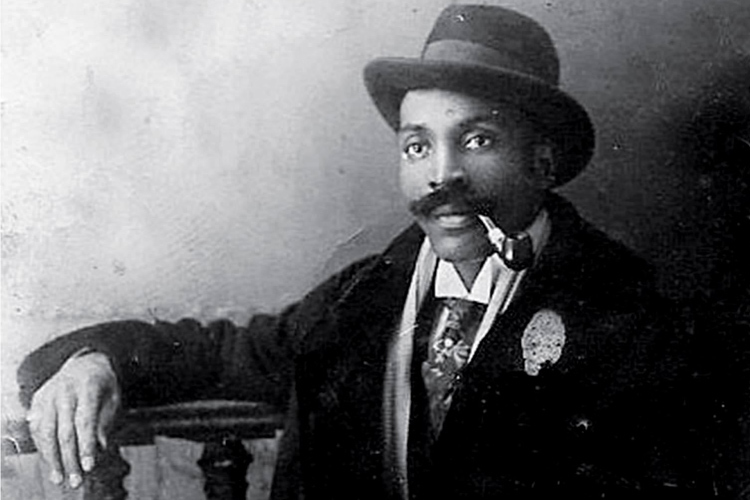
Frederick Bruce Thomas (1872-1928), the character of the book of Vladimir Alexandrov, will not be able to determine briefly: he is an American, but at the same time an African American that will create in his own eyes in the early 1920s. Great difficulties with confirmation of American citizenship, because, as he complained, “in Mississippi, Negram did not give birth certificates” - however, here he will be wrong, believing that this is why he could not get his American passport. True, he will become a subject of the Russian Empire - having chosen the most unsuccessful moment for this, the beginning of the First World War - and then he will carefully try to forget about it. He will be married twice or three times - a question -free question, because with his second wife he will divorce in Moscow in 1918 in the framework of new Soviet law and at the same time, he said, he will enter into a third marriage: all this is known from his words and words of his third wife (the American diplomat preferred in this case to use quotation marks to designate the status of a woman) - according to his own story, he found his second wife in the very unfair position, But here his story is more reminiscent of stories that were abundantly published in the anti -Bolshevik press of those years that, however, does not make them all by definition, but does not make any way to determine where the truth ends in a particular story and where fantasies about “women and commissars” begin. It’s not that nothing is known about the religion-rather, too much is known to determine it: in childhood and youth, he went to the Evangelical Church (built on the earth that his father gave; at school, he taught, most likely, his first wife was married in a Roman Catholic Church, in his luxurious club on Taxima, it was true in the hall, in entertainment, entertaining in the hall, entertaining Tourists and regulars - prayer, turning to face Mecca. So it is difficult to say as a result of whether he believed in something besides himself-and his luck, which rarely failed him until the last years.
 © New Literary Review, 2017
He crosses the spaces that are delimited from each other politically and culturally, God knows how many languages (at least exactly speaks English, French, Russian, Italian, most likely - German), communicates with representatives of various spheres. It is simultaneously an exception and at the same time a certain, not very common, but existing type, but existing at this time: those who perceive the established rules and habit not as what needs to be followed and reproduced, but as the conditions of the game - which give the opportunity to switch from one system of rules to another or using the arising uncertainty.
At the same time, Thomas’s biography demonstrates how a social elevator acts: after all, if you can say that it has risen from the bottom, another angle will show the inaccuracy of such a judgment. Indeed, he had to start an independent life with a workshop in the American south and then move farther to the north and east of America, serving as a waiter and lackey. But his parents belonged to the number of very few descendants of the former slaves who managed not only to acquire land, but also to make a large farm with hired workers - only a few others can be compared with them, rich enough to patronize the local church community, to conduct business for hundreds of thousands of dollars in a modern course, to educate his son. Due to the conflict with the local white landowner, they lost the land, but were with sufficient support to win the process with him in the district court and then continue the lawsuit in the state court; The process cost them most of the condition, but by no means everything - at least forced to move to the city, they had sufficient funds to become homeowners and let the residents; One of them became the killer of Frederick's father, taking revenge for trying to intercede for his wife and attracted the police. The death of her father soon scattered a family - but after many years, apparently, the mother tried to help her son in his affairs when he tried to start his job in London; At least then, already in the 1890s, she laid the land that was owned by her-the acquisition made after she became the widow.
Frederick began with the bottom, but at the same time, unlike those who were originally below, he possessed other social experience and other horizons - in that he inherited in the family and that the family managed to give him, without which he could not have rising.
If for most Europeans America seemed to be a country of “great opportunities”, then for the black inhabitants of the United States, the situation looked completely different. In America of the last decades of the 19th century, especially after the end of the 1870s, a new compromise of the north and south was reached, which established the segregation regime, for the African American prospects were not only very limited, but, more importantly, at any time he, unlike the Irish, Jew or Pole, could receive an official reminder of his inferiority. For Frederick, thanks to his light, characterizing the character, the ability to find a common language with different people and a tendency to travel Europe was a promised land. Having spent several years in London, Paris, Monaco and Italy, having worked in Germany and in Austria-Hungary, he ended up in Russia in 1899, eventually firmly settled in Moscow. Here he caused not rejection, but surprise, curiosity, favorable interest - that in the New World stigmatized him, here turned out to be an advantage.
After a dozen years, having worked as a waiter, and then by the meter -on at the best restaurants of the capital - the Aquarium and the legendary Yara, he accumulated enough funds to try himself in the same field, where the Aquarium had been leased to this time. Over the five years that preceded the beginning of world won, he became one of the most famous entrepreneurs of the old capital, he was looking for the best numbers for his program in other European megacities, he began to look closely at St. Petersburg to open his own institution, conducted some things in Odessa where he acquired the villa. The war made Frederick only richer: thanks to the ban on the sale of alcohol introduced in the Russian Empire since November 1914, a huge black market arose, and customers of its establishments were ready to generously pay for prohibited drinks. For fifteen years in Russia, Frederick not only acquired a family, home, villa - first, becoming a wealthy, and then a rich member of society - but also began to perceive it as a native country, replacing citizenship with the outbreak of war and now officially becoming “Fedor Fedorovich”:
“This turned out to be something more than the desire to adapt, corresponding to the interests of the Moscow business world; This became part of the individuality of Frederick even inside his family. Two of his grandchildren, who now live in France, did not know his American name. They believed that Fedor is the only name that he had, because they always called him his father, the first son of Fedor, in family oral history ”(p. 105-106).
The life of Frederick/Fedor from the 1890s and until the 1917 was the existence in the stable world-he himself was changeable, infinitely maneuvering, inventing, moving from the country to the country and from the continent to the continent, accepting the language in which they spoke around him, and seeing the possibilities in a stable order that did not notice or did not know how to use the local ones. In 1917, everything changed: the very foundations of the reality that Fedor Fedorovich was able to live - now his previous skills did not bring their previous success: he still continued to act with faith that everything would return to his own circles, agreed on long -term rental and discussed payments, while in his entertaining institution the romance of the revolution was staged instead of French reference plays. The tragedies performed classical music for the working class and soldiers, confident that they were artificially excommunicated from “high art” with the previous regime and will now experience the joy of familiarization.
He will be able to escape from Moscow to Odessa in 1918 - forced to leave together with his second wife, the very one that he discovered with the “commissar”, one of his daughters from his first marriage - and then, in April 1919, he was already running from Odessa, having lost another daughter in the city (he will be able to restore contact with her only a couple of years later). Constantinople will become for him in subsequent years the place of new hopes (and at the same time hopes to return back to Russia, which will have to be said in 1921). The city, occupied by the late autumn of 1918 by the troops of the Allies, for almost five years turned out to be an “intermary” - the reality to which Frederick had no need to get used to. The Kemalist revolution became another turn of fate, which Frederick was not ready - he did not fit into new orders and at the same time could not, without a passport, to leave the city, he tried to expand his affairs, hoping for great success, losing the money that he managed to save earlier.
But he finally ruined, having fled from Constantinople to Ankara, he again tries to start at first - not being able to open the next entertainment institution, Frederick returns to the beginning of his path, again entering the service by the waiter. Now, however, the fact that over the previous decades was an unchanged dignity-an abundance of dating, attracting attention to the appearance and tendency to like-was a drawback: his Istanbul lenders found him, and they had nothing to pay, and now they did not believe in his prospects, a tired black man in fifty-that he would get to his feet again. They either wanted to avenge the money lost with him, or thought that he had something in store for a rainy day - with which he would part if he threatened him with a prison. They were mistaken in this: all that he managed to save from the creditors, running away from Constantinople, he spent in an unsuccessful attempt to open a night club - so on June 12, 1928 he would die in the Istanbul prison and will be buried at the meager funds collected by friends (he was invariably rich in them).
In the story told, it is especially clear how a small person is not only a victim or object of certain “big processes”, not only is under the rule of certain orders, economic, cultural and political, but also uses them - he acts tactically or tries to build a certain long -term strategy, evades or, on the contrary, actively interacts, but invariably demonstrates, which does not fall without a single category, but does not fall into one category, which the big world imposes on him. Frederick ultimately defeated: his Istanbul club, named in memory of the largest Moscow success “Maxim” (and under this name, who existed, replacing the owners, until the end of the 1970s), could not stand the competition with the huge casino, which opened in the former Sultanian Palace of Yyldyz. But it is noteworthy that the same story could well have turned out to be a completely different finale: just a few months after Frederick was forced to close his club on Taxima, new Turkish authorities, without sharing something with the owners of the Yyldyz or for what other reason, closed it-and Maxim, which now changed the sign and became Yeni Maxim , that is, “new Maxim”, has been visible to the “new maxim”. For many years. Only a few months and several thousand dollars separate the real story of Frederick from the textbook “Success Story”.
Vladimir Alexandrov. Black Russian: the story of one fate / authorizis. per. from English. V. Tretyakov. - M.: New Literary Review, 2017. - 336 p.: Ill.