
Translated material
Lisokot. "Mole"
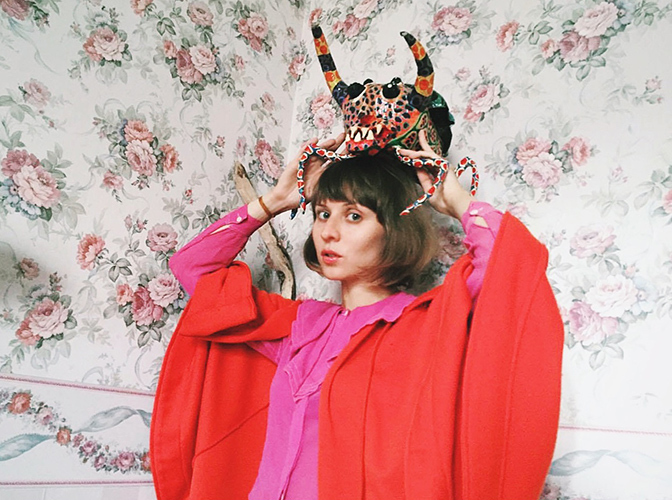
The singer and performance performance Varya Pavlova, better known as Lisokot , releases the new single single on the Aelita Records label, which was organized by the creator of Hyperboloid Records Dmitry Garin and the musician of the Glintshake group Yevgeny Gorbunov. The animator Sasha Svirsky, the winner of the Etiuda & Anima Festival festival, made a clip that perfectly conveying the psychedelic spirit of this literary and musical composition:
The best commentary on the single and the clip will be a conversation about the role of moles in culture and history, which took place between Varya Pavlova and the artist Pavel Pepperstein.
Lisokot and Pavel Pepperstein. Conversation about the mole
Pavel Pepperstein: We will talk about a wonderful audio work that you did. It, of course, really excites the imagination and is a reason for discussion. Because we have something balancing on the verge between telling fairy tales and music, created in almost one voice. It can be compared with some experiments by Lori Anderson as a kind of public-speaker, turning into shamanistic forms of work with voice and sound. What kind of sources of this work are in your soul, are they subject to verbalization and what can you say about this?
Lisokot: You know, when I think about it, the most striking image that pops up in my memory is, of course, the Krotik of the Czech multiplier Zdenek Milere. More precisely, the book “Mole in the City”, which impressed me very much in childhood. A company from a mole, hedgehog and hare, frolicing in the forest, is overtaken by the chainsaws that cut all the trees, then bulldozers come, uprooting the remains. And then the beasts are given a receipt that they have the right to an apartment in a block new building. There they are awaiting inflatable decorations of vegetation and the artificial sun under the ceiling.
Mole is one of my earliest fables. She appeared at the moment when I, while still a student of Stroganovka, began to realize myself as a public being, who should have an integral right to vote and self -expression. At this time, the spirit of the well-fed zero still dominated the country, but somewhere in the distance it began to squeam the alarming glow of something coming and gloomy. Already much later, I also learned about the Hegelian “Mole of History” - the expression based on the Hamlet’s replica: “You are catchively digging, the old mole!” In Hegel, it means the logic of historical events, not subject to human awareness. And about much more associated directly with moles.
Pepperstein: Yes, I would also like to recall the wonderful story of Franz Kafka “Giant Mole” about a mole in the size of a mountain.
Lisokot: Exactly. I recently found out about this story.
Pepperstein: In turn, I would like to share the fact that in childhood I was very afraid of the Czech cartoon about the mole, he stirred me in some mysterious psychedelic state. You just mentioned the right of voice, and in this sense, I was very scared by Czech cartoons. They scared that there often the characters did not talk, but imitated speech, some kind of grunt or rustling occurred. Then I understood that, on the one hand, we are talking about a voice, it seems that the characters are talking. But at the same time, it was clearly not a language. It reminded me of such states that I was very frightening that I experienced at the moments of somnambulism. I woke up in a lunatic, suspended state, wandered and could not collect my consciousness in any way. It simply multiplied in an audible sense and was a kind of echo of some endless voices that grunt or rustling somewhere. As if some large community is talking, but you cannot catch a word-how you hear some slurred rumble through the wall. And in this slurred hum, I was always located until the moment I met some person who spoke to me. That is, it was enough for me to hear someone's voice, more or less intelligible, as I immediately came out of this state of somnambulism and my consciousness also became, in turn, in a voice, intertwined into a pig and thus gained the ability to dialog. Including dialogue with oneself.
So, the world of audio in the context of this character becomes especially sharpened, because the character is blind. What still terrified me in these cartoons is that we all look at a creature that in itself cannot watch.
The voice is also a mole. He always breaks through his move.
Lisokot: But what do you think, what is the role of a mole in the history of Russia?
Pepperstein: Apparently, it is a giant, like a giant mole in the story of Kafka. Moles, in particular, were called informers and decoy ducks.
Lisokot: ha! Imagine, at the time of the birth of this story - and the moment was quite short, literally a few minutes, I remember well - so, at the time of writing the Mole, I did not know about anything of the above. It turns out that I got in touch with the archetype, and he, in turn, was not averse to seeming to me.
Pepperstein: absolutely for sure. In general, an appeal to any animal is always a touch of a very powerful archetype. Animals are totems, and the Mole Totem, of course, is quite influential. In this context, I recall the wonderful children's work of Vasily Aksenov “My grandfather is a monument”, which describes some islands called large empires. Among them there is an island of evil Big Karbunkul, and the inhabitants of this island are called moles, because their national sport is a digging of holes. And, of course, a mole, like all night, blind and intra -earthly creatures, is associated with the world of the dead.
Lisokot: And here the fairy tale about Thumbelina, who is married to Mole comes to mind. By the way, it is noteworthy that in Mole and City Milera, three white swan save from the absorbing the city of Smoga, taking them away from the roof of the skyscraper on their backs.
Peppershtein: The health of Malera, of course, managed to create the most psychedelic image, because there is simply a mole in the context of civilization. There is, for example, a series of Mole and Chemistry. Have you watched?
Lisokot: It seems not.
Pepperstein: Be sure to look! By the way, it is interesting that you immediately began to talk about the political context. After all, democracy in modern Western form, which we know it, is inextricably linked with the concept of voice. In political discourse, we often hear “to find our voice” or “stole our voices”. The very word "voting", of course. That is, there is a certain thought form of the forum, where voices sound and politically conscious citizen always fights for his voice. He has an integral feeling that he has this voice. In the context of this mythologist, it is clear that all this has nothing to do with political practice - this is a pure fiction, something like a modern fairy tale. So, therefore, it makes sense to consider this mythologist in the context of other fairy tales, and here we recall the reverse story of the loss of voice, about the sacrifice of them. In the terminology of the elections, there is also the phrase "give your voice." Here we can consider a well -known example of the sacrifice in the name of love, namely the fairy tale “The Little Mermaid”. Where a mermaid in order to find an opportunity to become a woman is losing a voice. But it turns out that as a result, she will not be able to communicate with the prince. It turns out that she follows the path described in the Mandelstam poem: “Stay foam, Aphrodite, and return to the music in a word.” And it becomes sea foam. And there is no legs to be with the prince, and neither the voice nor the tail to be the daughter of the sea king.
Lisokot: So, in general, this finale is the most beautiful: after all, in fact, it reaches nirvana, dissolves in space and becomes what love arises from.
Pepperstein: Yes, that’s right. From a creature who wanted to join love, she turns into a source of love. After all, it was from the sea foam that Aphrodite was born.
Thus, it turns out, saying something or “belief” a song (I don’t know if it is possible, but I would really like it; although there is no such word, but we can find it)-you use your voice, but at the same time you sacrifice it, because you translate it into the external register and the voice is separated from you. And you can’t assign it back to yourself.
Lisokot: And I, in fact, be glad for this, because I do not consider the voice at all my belonging. And the whole process of “sacrifice” is almost the most pleasant of all possible processes.
Pepperstein: In the classical opera there is an idea that the voice should separate from the singer in order to find his own body hanging in the air at some distance from the person producing him. And at some point it should become visible to the listener. Being not at all like the body of the one who produces it. A voice, like a dragon or swallow, flies out of the cave or from the nest, which is the body of the singing. Therefore, we can say that, of course, the voice is also a mole. He always breaks through his move.
Lisokot: And he is blind and sensitive! Amazing. It is only not clear whether I need to rejoice now or vice versa. Ha ha! (Everyone laughs.)