
Translated material
One day with "Rus Sitting"
More recently, the active human rights activists did not go to the new composition of the PMC almost throughout Russia. An important way of communication with prisoners is lost. But this does not mean that human rights activists turned the work and refused all their projects. We spent one day in the office of the Rus Sitting Human Rights to find out how one of the most famous public defenders in the country
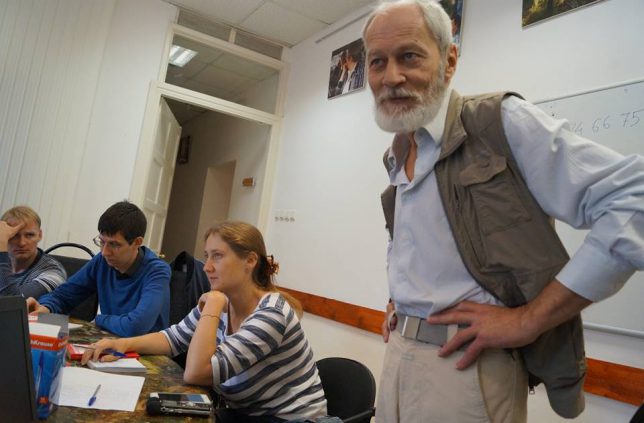
The working day begins on 11. The door to the office is opened by Ilya Gushchin - the defendant of the “Swamp case”, who was sentenced to three and half years of the general regime colony by the decision of the Zamoskvoretsky court. Ilya was released on August 5, 2015.
Now he works in the "sitting Rus'".
In the corridor, everything is forced by boxes with soap, canned food, diapers: some of them are only profitable - they are sent by people who want to help prisoners, some of the boxes, on the contrary, are ready to be sent to the colony.
School of Public Defender
In addition to Gushchin, in the morning, the office of the Foundation is the office Sergei Sharov-Delone, he is engaged in one of the main projects of “Rus Sitting”-a school of public defender (Shoz).
Sergey has been working tightly on a “swamp business” as a public defender for several years: in the Zamoskvoretsky court, he represented Andrei Barabanov, sentenced in 2014 to 3 years and 7 months of a colony of general regime. Now Sharov-Delon also represents the interests of Ivan Nepomnya-also a defendant in the “swamp business”, sentenced in 2015 for two and a half years of a general regime colony.
According to Sharov-Velon, there are not enough public defenders, there are also few lawyers who are ready to leave right away: and there are still enough activists delayed on shares.
Shoz is a global project, in the Sakharov Center, human rights activists, lawyers, lawyers give lectures and share all legal and legal knowledge, necessary to provide services to the persons to the defendants of various cases during the detention, investigation, court and during the execution of sentence on the sentence.
“It is very important to teach a human rights activist not only how to behave in court or investigator, but also not to abandon his ward after the sentence is announced, as state defenders often do,” explains Sharov-Delon.
The course of lectures lasts a week: the first three days are devoted to the conduct of criminal cases from the moment of detention to receipt of UDO - the last moment where the defender can help and influence the course of the case. Thursday is assigned to special topics: photo, video and linguistic evidence on ships.
“We worked out photo and video evidence on the“ swamp business ”, but linguistic evidence has been made into fashion recently- in connection with an increase in cases of posts on social networks,” shares the experience of balls-deelon.
On Friday, lectures are devoted to administrative affairs.
According to Delona, most often people come to Shoz who in one way or another the Russian justice system affected, and now they want to independently protect their relatives in court. Usually this is due to the fact that the state defender is not able to provide proper assistance - either does not work at all, or works to the side of the prosecution and frankly “drowns” his client in court.
Not all students of Shoz are politically savvy and legally educated people. We have to explain the basics. Sergei Sharov-Delon noted several main rules that need to be conveyed to their clients and on which they emphasize special attention at the school of a public defender.
The first rule: if you have a heart -hearted conversation with the investigator, remember: you do not remember anything but 51 articles of the Constitution, according to which you are not obliged to testify against yourself and your loved ones. After the phrase “I'll explain everything to you now,” you are doomed, and any word will be used against you.
Rule second: closed pockets. In open, it is too easy to throw drugs, for example.
The third rule: if you have mail on mail.ru, and communication with friends through VKontakte, be prepared for the fact that your correspondence is open not only for you, but also for the investigator. Better go to Gmail.com and Facebook.
The future defenders themselves are taught to draw up protocols, participate in investigative actions, and prepare witnesses. Separately, they teach how the court works, how to communicate with the judge and conduct interrogation.
Guests of Rus' sitting
The premises of the “Rus Sitting” - an office 10 minutes walk from the Taganskaya metro station. On the walls of photographs of employees, Boris Nemtsov, a poster with the inscription "Caution, prison!" Wi-Fi password-Putinvor.
The first guest on this day is Maria Sereda, a beautiful brunette who used to work in the International Memorial, and now - in the Prague Civil Center. In “Rus sitting” she came to offer contacts-IT specialists who would improve the organization’s website; Security specialists, organizers of international conferences devoted to prison reforms in Russia. All this in the "sitting" Rada in "Rus', Olga Romanova talked with the girl for more than an hour.
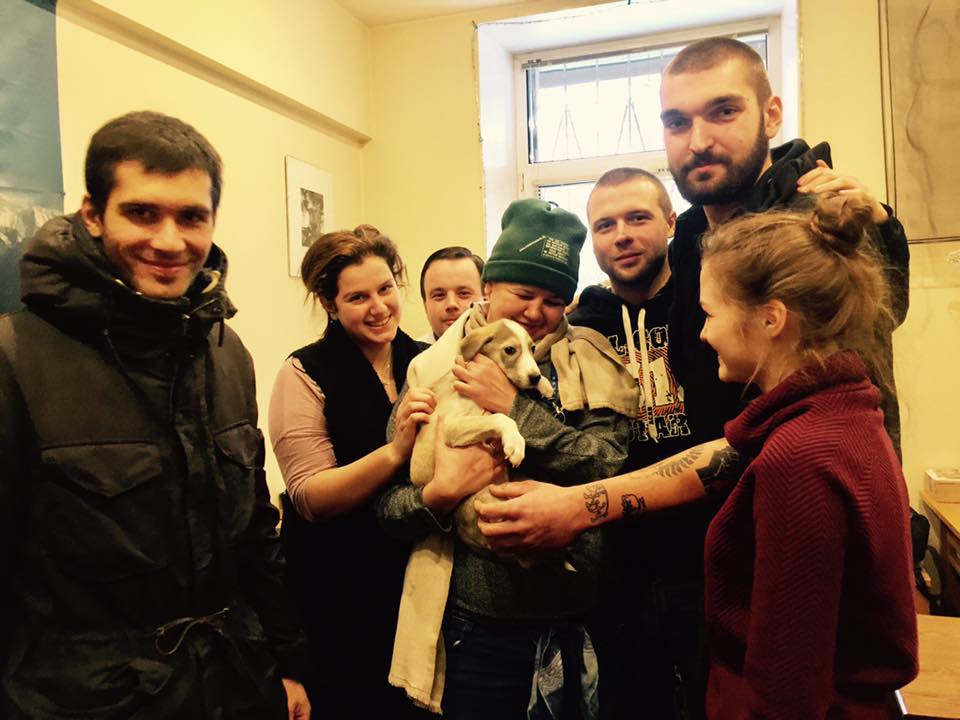
At this time, two more swamps came to the office - Stepan Zimin and Andrei Barabanov. Both work here, and Andrei “Sitting Rus'” recently sent to study in the Czech Republic with Denis Lutkevich, who also spent on the “Swamp business”.
The next guests are called “Save-help” here-they come with a story about their fate. Inna Bazhibina is responsible for the first reception, evaluates things and wonders how to help here: they give advice to someone, they are looking for a lawyer for someone, they can’t influence someone’s business and the maximum that can be done-to allocate humanitarian aid to the prisoner family, especially if the prisoners have children or elderly parents.
The girl Natalya and her daughter Sonya came to drink tea in “Rus Sitting”: Natalya turned to her husband for help. On this, her troubles did not end - while her husband was sitting, the house burned down. While collecting money for repairing the house, the husband went out. When the husband went out, he took only the house rebuilt and drove out of there Natalya and her daughter. Now Natalya is renting a room, working and sometimes visits those who supported her in difficult times. Ilya Gushchin pours Natalia tea, her daughter Sonya, along with Andrei Barabanov, glues stamps on letters to prisoners.
Katya’s girl left prison recently, having served 6 years. She has a hard gait, short hair and a folder with very beautiful drawings. Katya served according to the 228 article of the Criminal Code (“Storage and distribution of narcotic drugs”) and is now looking for work - after that she is in “Sitting Rus'”. He answers questions about the colony monosyllabic, says that female colonies are tougher than male: “Women are easier to suppress than men. And we also have less corruption, because women are talkative, everyone is handing over all. It is easier for women to live clearly according to the rules than to shut up. ”
“That is,” the NT correspondent clarifies, “are the rules are tougher in the female colony?”
“They are observed in the female,” Katya says with pressure on the last word.
Letters in "Rus sitting"
The flow of guests in the office does not stop until the evening. But when everyone listened, they drove tea and sent home, the analysis of correspondence begins.
Part of the letters comes directly to the office, part - in the name of Olga Romanova.
"Dear" Rus sitting "! You have never encountered such a lawlessness ... ” - Romanova says that letters with such words come almost every day.
As the employees of Rus explain, many prisoners just want to talk and share their story, they do not even expect help, but count on the answer.
Some are still needed help: they ask to send soap, diapers, baby food - all that is missing in the colonies. Often people who have already left prison and do not know where to go now.
However, the employees of the organization shrugged only with their hands on some letters: “... In 2009, I was taken into custody in the courtroom for theft of the car, was serving a sentence in a penal colony of general regime, and in 2011 was released at the end of the deadline. In 2012, he also received a new term for theft of the car and two thefts. In 2015, he was released at the end of the deadline. In 2015, he received a new term for theft of the car and two thefts. In 2021, I was released at the end of the deadline, and I have absolutely nowhere to go. Based on the above, I ask you to help me in the purchase of housing and financial resources. ”
Romanova explains such, also a lot: someone is sure that they can buy an apartment or car, and someone will “be excited” from the prison: they, as a rule, try to convince human rights defenders of their innocence, hiding some details of the case. They refuse to help them - it is impossible to help one who in the first letter begins to lie.
To the question of who else “sitting” most often does not help, Inna Bazhibina replies: “Former police officers. I still did not have a single business where the policeman was innocent. More than we do for them is humanitarian assistance to families. If there are small children, we must help. And do not take them to protect them. Ex-officials have recently got into the same category. ”
“We hate prisons and zones, do not tolerate injustice, insults of Russian laws and citizens,” it is written on the website of “Rus' Sitting”.
There are human rights organizations that are engaged only in political prisoners. "Sitting Rus'" helps everyone. Today in Russia about 700 thousand prisoners. Sergei Sharov-Delone explains: “This, you know, as in a joke: a third sits for nothing, a third for nothing and only a third for business.” But everyone needs help: and innocent, arrested in order to get rid of the "hanging"; and guilty, but planted for what they are not to blame; And even absolutely guilty, but affected by rights in court or in the zone.
Photo: zekovnet.ru