
Translated material
Without fanaticism
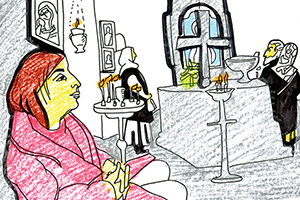
Separated or not?
The influence of the Church in Armenia and in Georgia
Recently, it is often necessary to deal with the invasion of the Russian Orthodox Church in various spheres of life: in education, culture, family, urban space ... And how does the church act in other post -Soviet countries, how much it remains separated from the state? It seemed to me interesting to investigate this topic in the Orthodox, but oriented to Europe and in Armenia, the country, largely dependent on Russia, but with its own church.
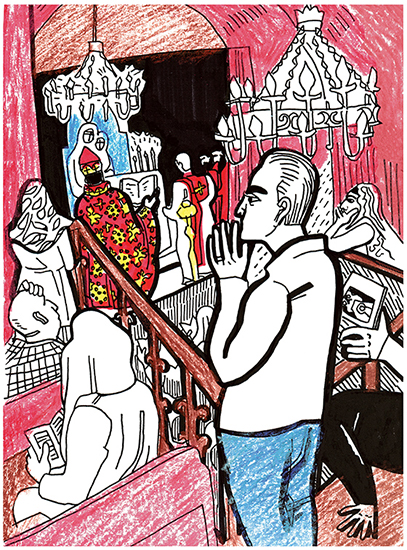 © Victoria Lomasco
Armenia. Without fanaticism
Unrelevant art
In Yerevan, I met with my colleague, artist Vahe Nersesyan. He is one of the founders of the independent news site Medialab , on which many news are presented in the form of caricatures.
Vahe admits that he likes to draw cartoons on churchmen most of all: “They lead a double life, such a two -faced is already funny.” Probably, in Russia, Wahe's work would fall under a criminal article 148 about the insult of the feelings of believers and the artist would have threatened either a fine, or forced work, or imprisonment.
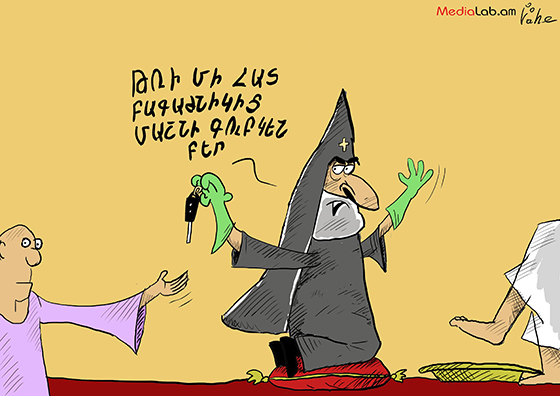 © Vahe Nersesyan Caricature of Vahe about how, in imitation of the Pope, who washed and kissed the legs of refugees, the Armenian Catholicos Garen II wiped the foot of the seminarians with a sponge. Translation: "Run over the lip in the trunk"
This summer, the Medialab editorial office arranged an exhibition published on the website of the cartoons in one of the Yerevan parks, many of which were on anticlerical topics. The exhibition was called "AMPLEMENT." Readers of the site, in support, hung prints on themselves and served as live stands. After the exhibition, the caricature was left in a car belonging to the editorial office, and at night unknown, breaking glasses, stole printouts. “Probably, someone thought that we would show the exhibition by regions. They did not understand that these were not originals, ”Vahe believes,“ after that they hacked our site, although the server is in America. ”
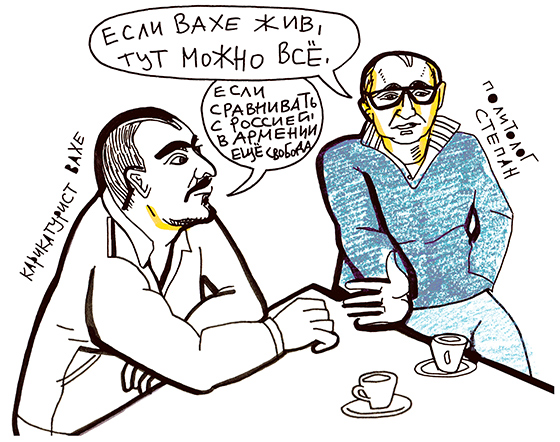 © Victoria Lomasco conversation with Vahe and his friend, political scientist Stepan Danielyan
“Theft of Medialab caricatures is a unique situation! You can't imagine the best PR! " - Comments the incident by another Yerevan artist Samvel Sagatelan.
In 2001, Samvel participated in the collective exhibition of contemporary art “behind the picture”, which was held in the State Gallery and was blessed by the Ararat diocese as part of the cultural program for the 1700th anniversary of the adoption of Christianity in Armenia. The artist put a series called “Primary Body: Ghostly Phallos”: from the windows and doors of various historical buildings, associated simultaneously with spirituality and power, huge phalluses are protruded.
Before the official opening, the exhibition was watched by the Bishop of Ararat Navasard Kchoyan and, despite the provocative nature of the majority of works, refrained from any comments.
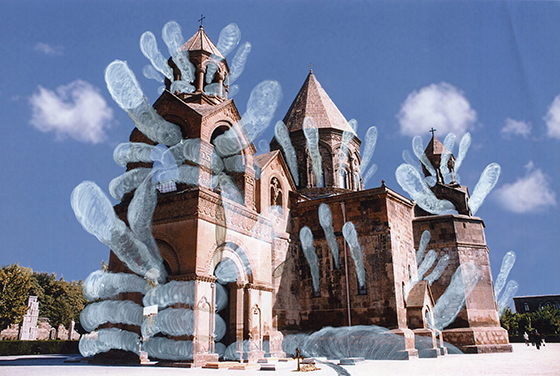 © Samvel Sagatelan's work Samvel Sagatelan from the series “Primary Body: Ghost Fallos” with the image of Echmiadzin, the main Armenian monastery. Work technique - acrylic painting on top of the photo. The reaction of the audience to this image was different: someone offered to beat the artist, others were delighted.
Now the work is in the collection of the web designer Momik Vardanyan. Momik graduated from the Art Academy in Yerevan with a degree in art critic, and before that he studied at the seminary, but quit. I decided to interview him like a former seminar.
- How did you decide to enter the seminary?
- Just like many: from hopelessness. I am from the small city of Sisian, there was no money to get somewhere else. The seminary has free study, housing and meals.
- You were a believers when you went to the seminary?
- I still do not know whether I am a believer or not. But even if I were a believer, I would have stopped believing in the seminary.
- Why, if in Armenia such unemployment, do you say that seminarians mainly go from hopelessness? This is a guaranteed stable job.
- Ordinary priests are also dissatisfied with their lives, they have a minimum - food and shelter over their heads. Catholicos decides everything: very respected priests are sent to the places where the reputation of the church is sent, and where it is necessary to collect money, they put priests who may agree with the oligarchs.
- How does the Armenian Catholicos relate to Patriarch Cyril and the Georgian Patriarch Elijah II?
- Catholicos treats your Cyril as our government to Putin - with fear and reverence. And to Elijah applies as most Armenians to Georgians - condescendingly.
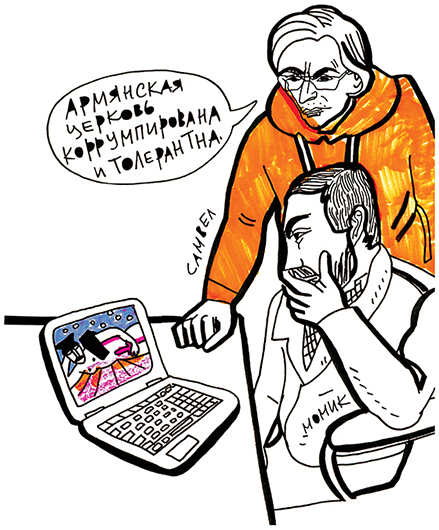 © Victoria Lomasco Samvel and Momik show me a series of Transromance on the Internet
In 2013, at the apartment of his friends, Samvel put up a series of Transromance about gender and sexuality. Information about the event dispersed on social networks, and the ill -wishers awarded Samvelu the title “Honored Gender”, thinking that “gender” and “gay” are synonyms. The chairman of the Union of Artists and one of the priests gave an interview in which the exhibition was convicted. This ended.
Believers
Together with Lilik, the cousin of my friend, I went to serve in the Armenian Church of St. Zorava. “Here I was baptized. I come here and when I feel bad, and when it is good - this church knows me, knows everything that I survived, ”says Lilik.
There is no confession institution in the Armenian church, and the communication of parishioners with priests often boils down to the order of ritual services. Lilik only once spoke with the priest. “I speak with God in my mind,” she believes.
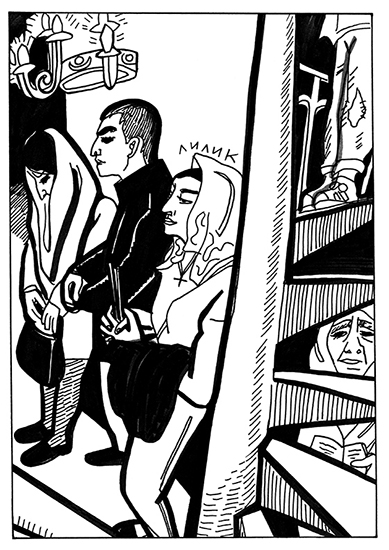 © Victoria Lomasco
Lilik graduated from law university. According to her, "everyone believed on the course, but somewhere half the students went to church." Lilik fundamentally has no atheist friends, and when choosing the second half, it is important for her to be a believers.
This is Emilia, grandmother Lilik, the most religious in their family. Since 2000, she has been going to the Evangelist Church, where she sacrifices tithe. In Armenia, Armenian churchmen publicly call the Protestant churches heresy, but Emilia is sure that they will soon change their opinion: “Young people who have received religious education in the Evangelist churches begin to go to Armenian. Otherwise, I wouldn’t go. ”
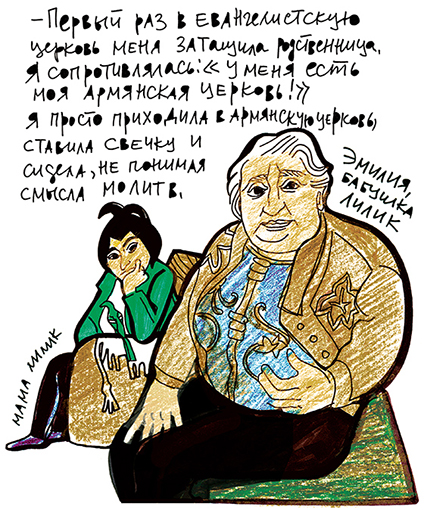 © Victoria Lomasco
Emilia likes that in the evangelist church they are explained to them the meaning of the Bible and teach them the simplest words to talk with God: “One woman prayed to God for her problem with the water supply. Now she has no problems with the water supply. ” Due to the ailment, Emilia rarely leaves the house, so communication is especially valuable to her: "Different people come to the Armenian church, and the same, we have the same as one family."
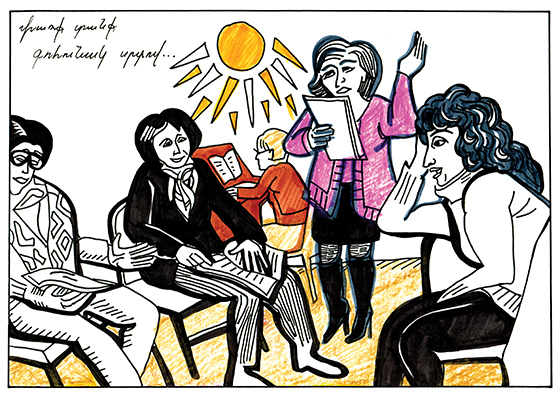
Having found out the program of events in the Protestant churches, I went to the weekly occupation of the women's group on Bagramyan Avenue, to the Armenian missionary association of America.
The lesson took place in an ordinary room, decorated with children's collages. The spiritual leader of the group, a woman over forty named Eliza, asked if I was a Christian. It was enough to say that I was Orthodox to be allowed to stay.
First, the group members sang prayers, and the spiritual leader accompanied them on the piano. Then we held hands and prayed in a circle, composing our own prayers. In conclusion, the “Our Father” sang in chorus. The action lasted about three hours.
 © Victoria Lomasco
In Armenia, many are poorly related to visiting Protestant churches, considering this to be a rejection of Armenism, so after class I asked women what exactly the Evangelist Church gives them. A woman named Nelya said that she came here with her sister in 2011: “We do not know the ancient Armenian language in which they pray in the Armenian Church, but wanted to literally understand the Bible.” A woman named Naira said that she had recently seriously hurt, almost died: “Our girls came to me, looked after me. We not only pray together, but also friends. ”
The opinion of experts
It was not possible to talk with any of the clergy of the Armenian church: letters to their press centers remained unanswered, and by telephone the priests referred to great employment-many ritual rites should be done.
But it turned out to talk with several experts who analyze the interaction of the church and society.
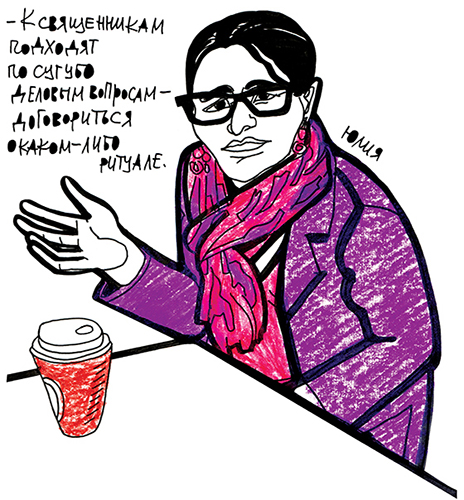
Anthropologist Julia Antonyan, the author of scientific works on modern religious processes, believes that Armenians and Georgians have a different attitude towards religion: “Easter in Georgia is a theatrical action, which at some point reaches the climax. And in Yerevan, an ignorant person would never say that tomorrow is Easter. ” According to Julia, their own feelings in a particular church are important, while communication with priests does not matter much.
 © Victoria Lomasco
“Most of our priests are secular people, they say about them: this bully, this businessman. The priests need only a service - the implementation of church rituals, ”said political analyst Stepan Danielyan.
In Armenia, a country with low incomes and with a high level of unemployment, many people annoy the lifestyle of the church elite, annoying how much money is spent on priests. For example, chaplains, serving in the army, receive a salary of 300,000 drams (about 40,000 rubles) from the state: this is more than the salary of officers. The church in Armenia is completely exempted from taxes, and the liberal environment is trying to organize the campaign in order to force it to pay.
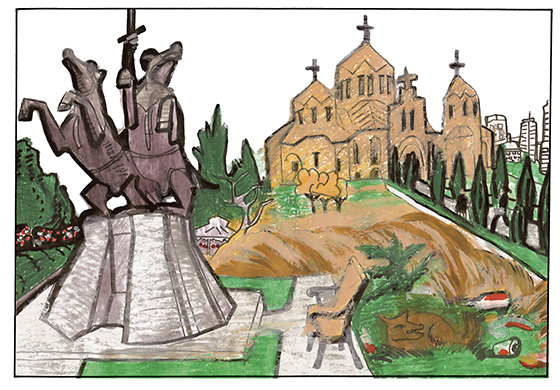 © Victoria Lomasco Cathedral of St. Gregory of the Educator. Construction began in 1997, was financed by Armenian entrepreneurs. After Tsmind, Sameba in Tbilisi is the largest Christian cathedral in the Caucasus.
Some are dissatisfied with the construction of more and more churches in a situation where there are not enough hospitals, kindergartens, and normal roads. “The construction of hospitals is taxed, the construction of churches is not. Therefore, the construction of churches is a good reason to launder money, ”explains Julia Antonyan.
“In April of this year, during the“ four -day war ”, a question arose in society for the church: if we do not have money for tanks and planes, why build so many churches?” - says Stepan Danielyan, referring to new military clashes in Nagorno -Karabakh.
The largest conflict around the construction of the new church occurred in 2010, when the Yerevaners collected about 20 thousand signatures against the demolition of the summer hall of the Moscow cinema and the restoration of St. Peter and Paul, destroyed by the Bolsheviks in its place.
On the one hand, experts described the church as a kind of “hostile power, which has some business in business”, on the other hand, emphasized that the churchmen do not interfere in everyday life and even formally oppose the LGBT, for the box.
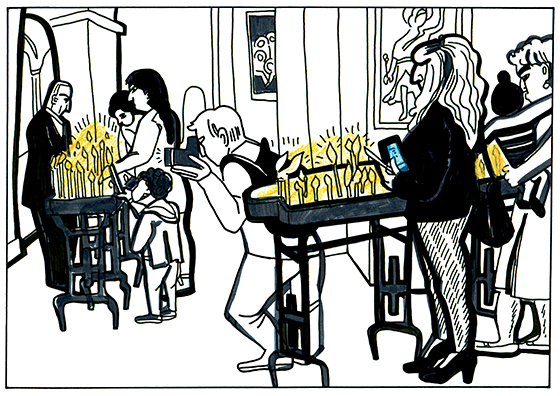 © Victoria Lomasco visitors Echmiadzina
Without much authority, the priests do not try to influence protest movements, but still some of them were present at Elekterevan, large rallies in 2015 against raising tariffs for electricity. Yuri Manveliyan, a journalist for an independent news site Epress.am , described how this happened: “The priests were on the police side and through the police loudspeakers called for peace. Protesters reacted aggressively. When the churchmen come to rallies and claim to be influence on public life, people are angry: “Do you think we have forgotten who you are? Watch your business further!” ”
Yuri recalled only one case when the priest successfully influenced the crowd - in 2015 in Gyumri after the murder of a whole Armenian family, Bishop Mikael Achapakhyan was able to stop the angry residents heading towards the Russian military base. “Mikael Achapakhyan, one of the few charismatic leaders, is a dissident in the eyes of the Church,” says Julia Antonyan, “our Catholicos and the president did not comment on the tragedy in Gyumri.”
Diaspora
 © Victoria Lomasco
Collecting the material in Yerevan, I have heard many times the opinion that the main role of the Armenian Church is to unite Armenians.
“The influence of the Armenian Church in the Armenian diasporas is very strong,” said Cultural Stated Vardan Dzhaloyan, author of the article “Church and the Mafia”, “after the genocide and the arrival of Soviet power, the Church became the chief institution for foreign Armenians. In Armenia itself, those who were not part of the Communist Party baptized children. This meant that the child became an Armenian. The nation and the church are often identified. ”
Stepan Danielyan, to the question of the role of the Church in Armenia and in Georgia, replied that the Georgian constitution says about the "role of the Church for Georgia", and in the Armenian - "about the role of the Church for the Armenian people." “We have a church outside the territory, for the nation,” Stepan emphasized.
Returning to Moscow, I went to the Armenian church. In Sunday service in the huge cathedral of the transformation of the Lord in the middle of a crowd of parishioners, I was not alone of Armenian nationality. Several times, not assuming the presence of outsiders, they turned to me in Armenian.
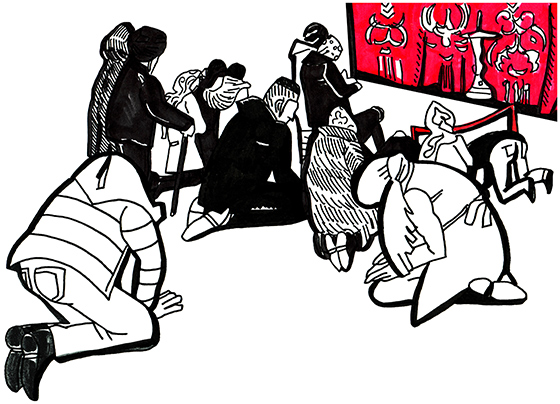
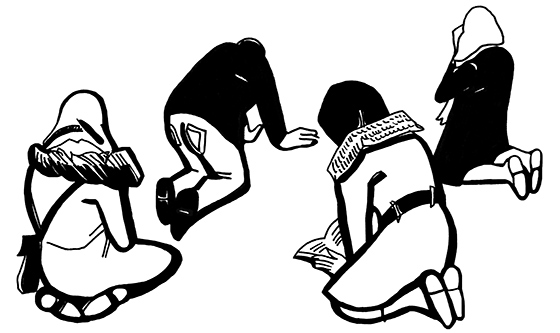
Unlike Russian churches, there were a lot of young people around. Fashionable young men in hipster glasses and hairstyles during prayers knelt down. A large company of guys prayed next to me, in the appearance of sixteen to eighteen years. I asked them to explain the meaning of church ceremonies - for example, why everyone was on their knees in front of a closed curtain - and one of them readily explained. The guys said they were trying to go to church every week.
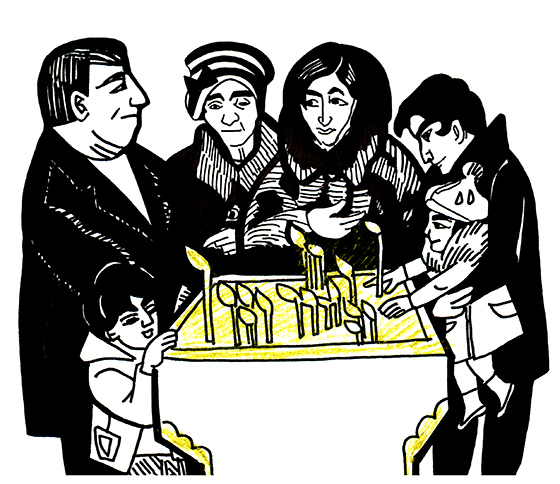
Many couples were with young children, many came whole families. And, when several generations of Armenians surrounded tables with candles, it looked like an illustration to the words of Vardan and Stepan.
 © Victoria Lomasco
After the service, I went to the Armenian Museum of Moscow and the culture of nations located on the territory of the temple complex. The constant exposition of the museum combines two topics: Armenian genocide and Armenia relations with Russia. The names of the stands sounded like this: “The Armenian massacre in Cilicia in 1909 and the reaction of Russia”, “Russia and the orphan orphans”, “Armenian genocide through the eyes of a Russian soldier”, “Armenian genocide and Russian poetry”, “In the service of Russia”. The museum was attended by people and other nationalities: Russian securities were looking for order, and the dressing room and cleaning lady were from Central Asia.
 © Victoria Lomasco
Tbilisi. The power of the patriarch
"There is a very big difference between faith and religion"
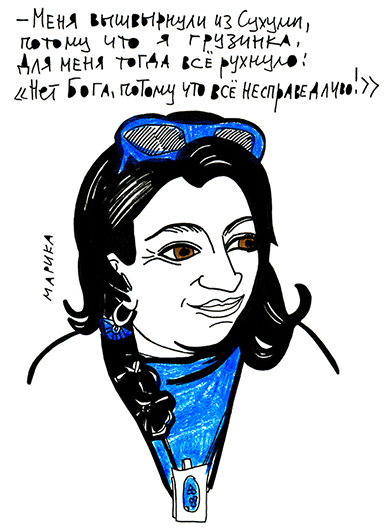
It was easy to find believers among the acquaintances of the Georgians. Here are fragments of a conversation with Marika Sigadze. She was born in Sukhumi, lives in Tbilisi, works as a guide:
“The first time I had an appeal to the church in 1989, when Georgia decided to separate from the Soviet Union. I was 21 years old. I was a member of the Communist Party and really believed in the idea. ”
On April 9, Marika visited relatives in Tbilisi, who did not let her in a demonstration for the independence of Georgia. At the thousands of thousands of Patriarch Elijah II, knowing that he was preparing power acceleration, urged people to disperse, but they did not listen to him. Parts of the Soviet Army were introduced into the city, the military dispersed the protesters, using poisonous gas and sapper blades. About twenty participants in the rally died.
The next morning, Marika went to the place of the tragedy: “On the walls of the houses there were inscriptions“ Communists - killers ”. People brought their party tickets, tore and burned them. It was dangerous. I realized that they could plant me and drive my father out of work, but I also threw my party ticket into a heap.
On the 40th day, I first went to church to put candles for those killed at a rally. I accidentally hit the chant and was surprised: “Wow! How beautiful!” In the church, a service in four languages was simultaneously: Georgian, Russian, Abkhaz and Greek. Fifteen people sang in the Russian choir, and only three in Georgian. Behind me, Georgians discussed this: “Our patriotism is only in words ...” Hearing these words, I immediately went upstairs to the choir and said: “I can sing, I want to sing with you.” I was happy to take me. "
During the Georgian-Abkhaz war, the Marika family could not leave Sukhumi in time. Father dies on her hands from a heart attack. Together with her mother, sister and friend, Marika moved to Tbilisi, where unfamiliar people, regretting refugees, let them live in their empty apartment.
 © Victoria Lomasco
Once in the city of Marika, she accidentally collided with a priest from the Sukhuma Church, in which she used to sang: “He understood how bad it was for me, announced in his church that the family of refugees needed help, recognized my address and began to constantly come - bring food and things. He brought us six chairs to the sixteenth floor on his back. It was a real priest.
The priest asked me to do a single thing-to come to church once and stand in the choir. For two months I stood in the choir, but did not sing. Two months later, I wanted to sing, I sang one phrase and burst into tears. “What are you singing?! Your whole life has collapsed, and you sing!” I thought. The whole choir cried with me, the whole church cried, the service stopped, the father came out and hugged me. I cried my woe once and for all and began a new life. ”
Now Marika regularly goes to church, and she has a priest. She treats the Patriarch of Georgia Elijah with great respect. One of his serious merits Marik calls the restoration of almost all churches and monasteries in Georgia. In monasteries, according to her, potential suicides find a shelter, drug addicts can also turn there for help.
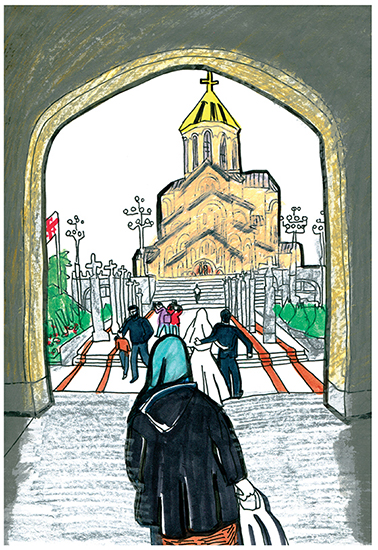
The largest cathedral in Georgia Tsminda Sameba (“Blessed Trinity”) was built at the insistence of the Patriarch. «Патриарх сказал, что мы наказаны за свои грехи, поэтому надо построить одну большую церковь во искупление вины, — объяснила Марика, — среди моих знакомых нет никого, кто бы не пожертвовал на строительство. Я с гордостью могу сказать своим детям, что мы тоже строили эту церковь. Это единственная в Грузии златоглавая церковь — символ того, что “мы упали, но мы встали”».
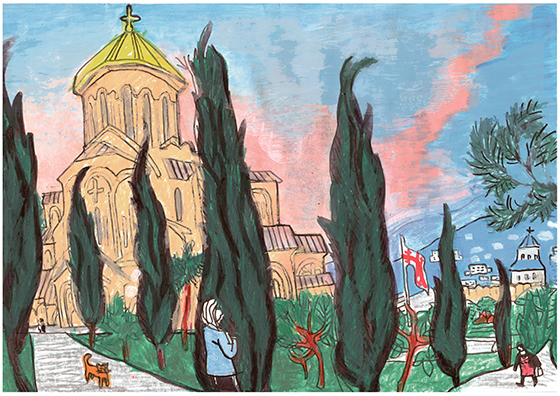 © Виктория Ломаско Цминда Самеба. Собор заложен в 1995 году, завершилось строительство в 2004 году
«А что ты скажешь про разгром в центре Тбилиси ЛГБТ-митинга в 2013 году, когда на ЛГБТ-активистов и сочувствующих им напала толпа в 20—30 тысяч человек во главе со священниками?» — попыталась я смутить Марику.
«Если бы я знала заранее, то сказала бы батюшкам: “Сделаем коридор — будем держать свечи и молиться за души этих детей”, — отвечала Марика. — Если бить человека палкой по голове, разве он одумается? Это сделала религия, а между верой и религией очень большая разница. Я человек верующий, а не религиозный».
 © Виктория Ломаско
Феминистский взгляд на церковь
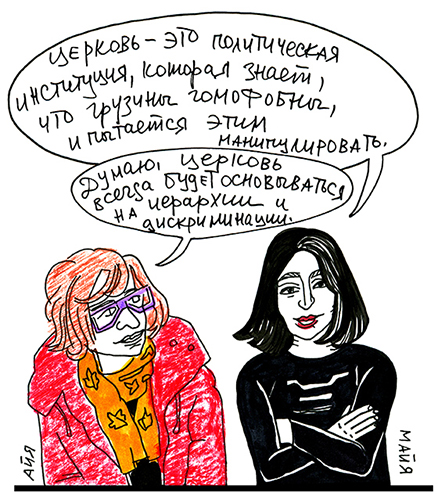
О влиянии Грузинской православной церкви на жизнь общества со мной поговорили феминистки Майя и Айя. Обе учатся на гендерных исследовательниц, Майя работает в ЛГБТ-организации Women's Initiatives Supporting Group (WISG) .
«У нас церковь — самая неконтролируемая в регионе. Ваша церковь подчиняется Путину, наша церковь сама независимый агент, — считает Майя, — наше государство старается создать демократическую атмосферу, но вынуждено торговаться с церковью. Ежегодно 25 миллионов лари (около 600 миллионов рублей) — это дотации церкви, компенсация за советский период. Никто не знает, на что тратятся деньги, они не отчитываются. Если спросишь, станешь врагом нации».
 © Виктория Ломаско
Мой рассказ про противостояние в московском парке Торфянка, где жители района уже больше года препятствуют строительству церкви, Майя и Айя прокомментировали так: «У нас здесь подобное невозможно! Даже самые радикальные активисты не могут активно противостоять церкви».
На вопрос про антиклерикальное искусство они ответили, что не знают в Грузии никаких художников, кроме Лии Уклебы, которые бы сделали откровенные высказывания о религии.
«Ваш Кирилл даже представить не может, какая власть у Илии II. Половина населения родилась при нем, он патриарх уже около сорока лет. В нашей церкви нет ни одного епископа, который не был бы назначен Илией II. Много мелких политических партий заявляет о своей любви к патриарху, но его интересуют только крупные властные игроки, — рассказывали Майя и Айя, — патриарх поддерживает и европеизацию, но хочет влиять на то, как будет проходить этот процесс. Он все время смотрит на тенденции в народе, если ему что-то выгодно, начинает это поддерживать с религиозной точки зрения. Например, почти все в Грузии гомофобны, но очень многие женщины делают аборты — кто-то не предохраняется, потому что нет денег на презервативы, другие не знают о различных способах контрацепции. Поэтому священники постоянно делают гомофобные высказывания, но аборты особенно не трогают».
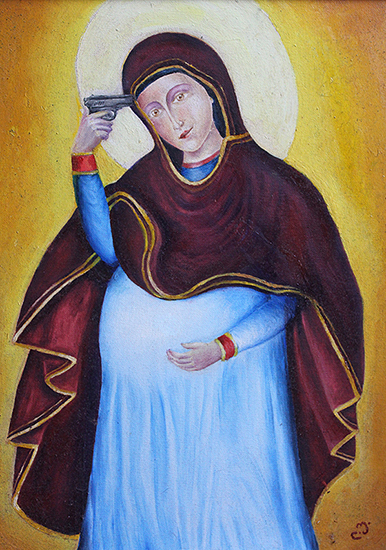 © Лия Уклеба Картина грузинской художницы Лии Уклебы «Богородица с игрушечным пистолетом» (в народе картина прозвана «Богоматерь-самоубийца»), 2015 г. Картина вызвала агрессивные дискуссии в интернете и оскорбления художницы. Патриархия Грузии призвала к ответу университет Ильи, где была организована выставка художницы, однако в Грузии нет аналогов российским законам о «возбуждении ненависти либо вражды» и об «оскорблении религиозных чувств верующих».
Еще одна тбилисская феминистка Иа Бахтадзе, художница, переводчица и атеистка, показала мне свою любимую церковь Анчисхати.
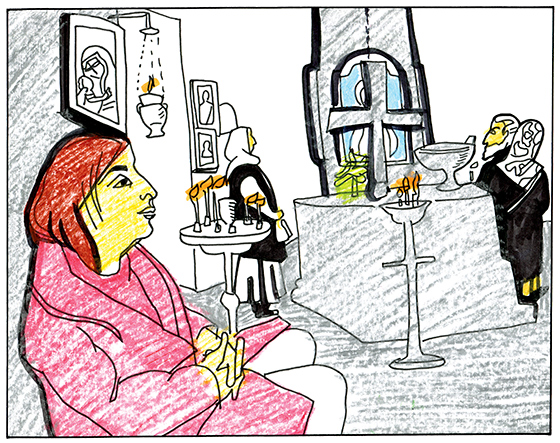 © Виктория Ломаско
«Это самая старая церковь в Тбилиси. Мой прапрадед был в Анчисхати главным священником, — рассказывала Иа, — я чувствовала там связь со своими родственниками, потому и ходила. Когда я подросла, то стала ощущать двойной стандарт со стороны церкви: для женщин — что надеть, какой макияж делать, а от мужчин ничего не требовалось. В церкви мне несколько раз делали замечания — “Прикройся, девушка”, один парень, мой ровесник, подошел и сказал: “Вынь руки из карманов, это неприлично”.
У нас церковь имеет особый статус. Многие молодые люди идут в церковь не по религиозным соображениям, а чтобы получить власть. В первую очередь — власть над женщинами. Церковь видит единственную роль для женщины в рождении и воспитании детей. Женщин, которые сделали аборт, церковники называют убийцами и говорят, что они должны гореть в аду. Очень многие клиники отказываются делать аборт после серьезных антиабортных кампаний церкви. Церковники также выступали против того, чтобы социальные службы забирали детей из семей, где есть домашнее насилие».
Еще Иа рассказала про вмешательство церкви в принятие закона «Об устранении всех форм дискриминации». Представители духовенства вместе с некоторыми политиками требовали убрать из закона упоминание о гендерной идентичности и сексуальной ориентации. Упоминания оставили, но закон не предполагает какое-либо наказание для нарушителей.
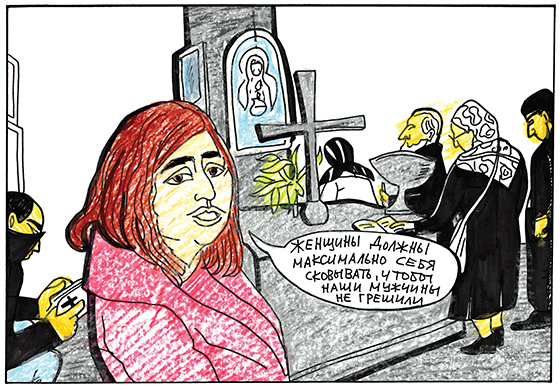 © Виктория Ломаско
Показывая церковь, Иа вспомнила про одноименную икону Анчисхати (другое название — «Спас Нерукотворный»), хранящуюся в Государственном музее искусств Грузии. Патриарх Илия II настаивает, что эта икона — «настоящий Эдесский образ, который чудесно изобразился на полотне», и требует, чтобы икону вернули Грузинской православной церкви.
Вместе с Ией мы отправились к музею, на входе в который уже несколько лет разбит лагерь православных активистов. Несмотря на поздний вечер, мы застали дежурных и нескольких прохожих, молящихся большой копии иконы Анчисхати.
Со стороны церкви
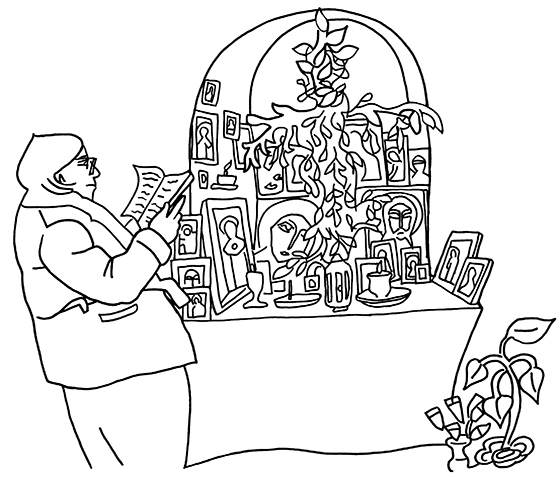 © Виктория Ломаско
В последующие дни, бывая в центре, я специально проходила мимо Государственного музея — к иконе постоянно подходили приложиться, помолиться и поставить свечку обычные тбилисцы.
Молодая православная активистка, дежурившая в лагере, объяснила мне ситуацию: «Это так же как у вас церковь требует от Третьяковской галереи вернуть иконы. Мы молимся рядом с музеем с 2000 года — в музее много икон, и они не могут оставаться без молитв. Лагерь устроен в 2008 году. Дежурства длятся круглосуточно в любую погоду. Я дежурю по семь часов».
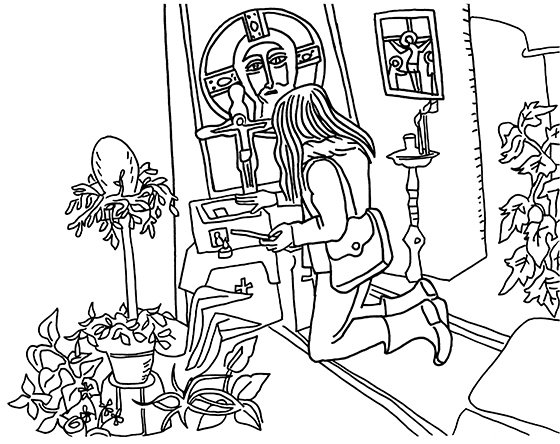 © Виктория Ломаско
Другая, пожилая, дежурная сказала: «Иконы — это живые существа, их нельзя держать в музее». Она представилась художницей и заявила, что все ее знакомые художники и искусствоведы поддерживают требование патриарха вернуть иконы церкви.
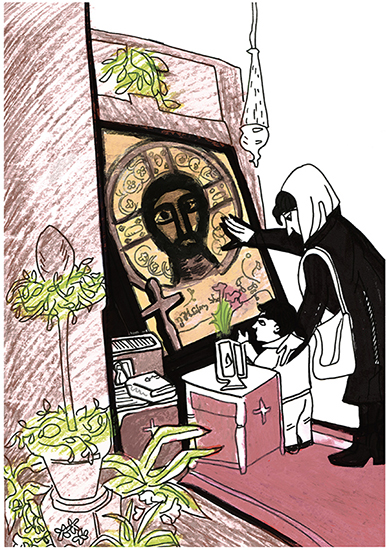 © Виктория Ломаско
Благодаря помощи знакомых мне удалось поговорить со священниками храма Святого Давида Гареджийского на горе Мтацминда — это один из самых известных храмов в Тбилиси.
Как православной журналистке из Москвы, мне показали часовню с намоленной водой (слезы св. Давида), но были разочарованы тем, что я ничего не знаю про московские церкви и про работающих там священников.
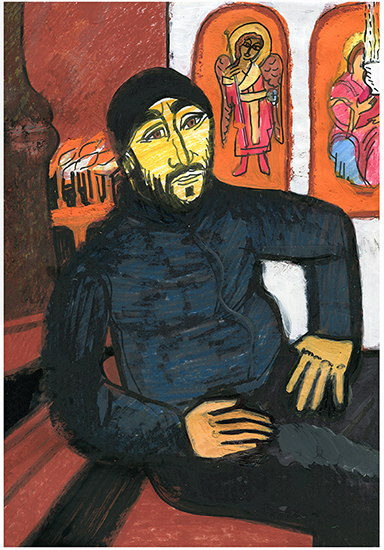 © Виктория Ломаско
На вопросы согласился ответить отец Давид.
— Что происходило с грузинской церковью в советское время?
— В советское время в Тбилиси было только пять или шесть открытых церквей. В 1977 году, когда патриарх взошел на трон, было три епархии — сейчас за пятьдесят.
— Какие на сегодняшний день отношения между русской и грузинской церквями?
— В Грузии есть две группы священников: кто-то хочет сближаться с греческой церковью, но большинство — с русской церковью, так как это позиция патриарха.
— Прошло две недели с момента визита папы римского в Тбилиси. Я слышала, что стадион, где проходила встреча, был полупустым, а Союз православных родителей (самая радикальная православная организация Грузии) осудил Илию II за встречу с папой римским.
— Да, были плакаты наиболее радикальных людей «Не добро пожаловать!», но Илия II просто встретил папу римского как гостя Грузии.
— В чем выражается влияние грузинской церкви на светское общество?
— Патриарх всегда выступает против абортов. Многие врачи в клиниках отказались делать аборты и стали верующими. Все время патриарх открывает церкви, семинарии и академии, умножается число верующих и духовных людей. Каждый третий ребенок в семье — крестный патриарха, уже около 30 000 таких детей в Грузии.
— Многие считают, что сохранение в Грузии института девственности — это заслуга церкви. Как вы видите роль и положение грузинской женщины?
— Женщины должны слушаться родителей и церкви. Мы в церкви многим помогаем познакомиться и создать семью. А если какие-то женщины не вышли замуж, значит, им предлагали, но они не соглашались.
— Как вы прокомментируете разгон в 2013 году ЛГБТ-демонстрации в центре Тбилиси, когда разъяренную многотысячную толпу возглавили священники?
— В тот день была провокация. Я считаю, их не надо было бить. Их надо лечить, но не медикаментами, а в церкви. Это Европа заставляет, чтобы у нас были гей-парады.
Материал создан в ходе участия в некоммерческом проекте «Трансграничная журналистика» программы повышения квалификации журналистов.