
Translated material
The “President-Othele” recalled the first president of Russia
In society
 The “President-Othele” recalled the first president of Russia
December 15, 2016 Boris Kolymagin
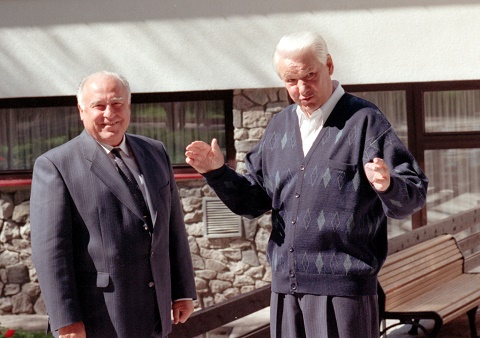
In Moscow, a traditional, already fifth in a row, Yeltsin-forum, dedicated to the 25th anniversary of the new Russia and the 85th anniversary of Boris Yeltsin, was held. It can be considered “our answer to Chamberlain,” that is, Mikhalkov. In any case, I took him just like that. And although the conference seemed to be an academic character, many raised problems touched the living.
The host of the round table, the former Secretary of State of the RSFSR Gennady Burbulis, emphasized in the introductory word on the culture of memory. Without naming names, he spoke about those who are engaged in the restoration of the Soviet past. The culture of memory, according to him, is not only conscientious knowledge and understanding of how the formation of the new Russia has passed. This is the ability to endure the empathy of that era to date.
Burbulis did not pass by the constitution, which they constantly try to blur. In particular, he recalled the 21st article that reads: “The dignity of the person is protected by the state. Nothing can be the basis for its diminution. ”
Remembering the Belovezhsky agreement, the former Secretary of State noted that it avoided the Yugoslav script. “Today, 25 years later, there is nothing more important than learning a dialogue, an agreement, the world,” he concluded his speech and handed the floor to the professor of the Higher School of Economics Grigory Tulchinsky.
The professor reflected on the injuries of historical memory, such as World War I, Civil War, repression, the collapse of the USSR. Inexperienced injuries, he argued, constantly return. To get rid of them, efforts are required at the level of historical understanding and symbolic presentation.
Economist Dmitry Travin wondered: was the Yeltsin-Gaidar reform alternative to the reform? And he replied that the real practice of 1991 did not allow to change something differently.
The Bolsheviks built a militarized economy. Could such an economy go without serious losses? Many turned out to be victims of inevitable transformations. In the zero years, thanks to the reforms, our country has achieved certain successes. And ordinary people began to think that all the problems were in Yeltsin-Haidar. This is a very simplified logic, the speaker believes. “Such logic stimulated the events of 1917,” he said.
Political scientist Dmitry Oreshkin recalled that the first president of Russia was the president of large cities. While Putin is the president of the periphery: in megacities, the party in power supports 20-30 % of the electorate, no more. We are still not observing a clear conflict between those who focus on the USSR, to Asian values (in the narrow sense of the word), and European oriented citizens. The speaker admitted that he is scared by the lack of institutions that can provide a legitimate transfer of power. And to Chernyshevsky the question "What to do?" He answered the Lenin formulation: "To declare the truth is our best politics."
The theme “President Boris Yeltsin VS President Vladimir Putin” constantly flashed in speeches. Some are still trying to solve Putin: what is in his head, what are the goals, what are the fears? Others, such as political analyst Alexander Sungurov, called for a view of the situation wider and not to connect all the world problems with one person. In this regard, Sungurov noted that the concept of punishment of authoritarian leaders and their accomplices has its disadvantages, since we are facing the problem of the leader’s voluntary departure from power.
Personally, I was surprised by the performance of the former chairman of the Supreme Council of Belarus Stanislav Shushkevich, who said that he supported the call of Gennady Burbulis to help President Putin get out of an impasse.
The thought of Burbulis, by the way, sounded not in Moscow, but in Kyiv, and a little earlier - December 1, 2016. The first Baltic and Black Sea forum was held in the capital of Ukraine with the participation of politicians such as Leh Valens, Leonid Kravchuk, Arnold Ryutel, Leonid Kuchma, Peter Luchinsky. Politicians in a joint statement called for "contributing to the formation of a system of values on the basis of a platform of joint actions that will ensure mutual understanding and mutual support, timely and fruitful dialogue of ideas and people, generations and worldviews, peoples and states."
In the conclusion of the Yeltsin forum, politician Viktor Sheinis unexpectedly stated: "We are the remnants of a broken army that suffered a complete defeat." The audience froze in bewilderment, but the moderator, referring to the time limit, did not let the brewing discussion turn around. He only expressed his disagreement. Like, we will still serve the new Russia.