
Translated material
Maxim Russo: Mouse Rejuvenation
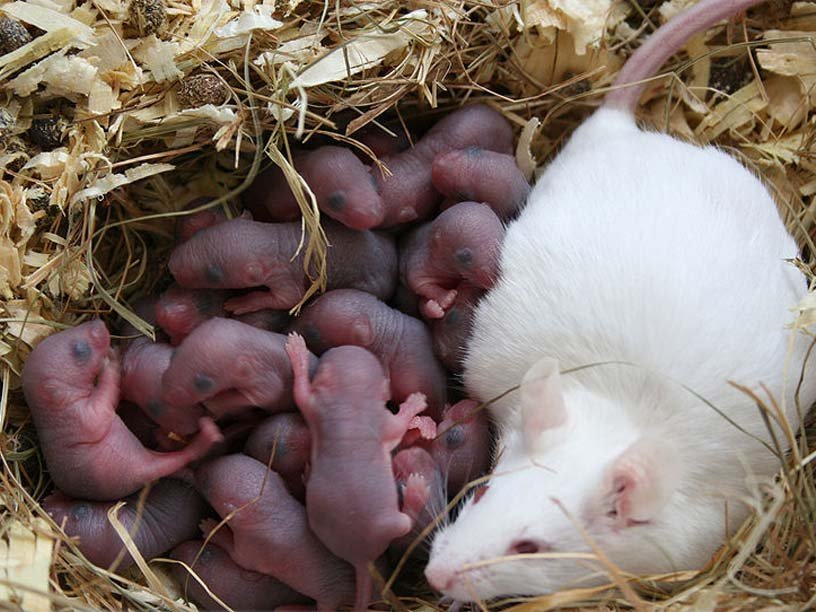
Maxim Russo  Wikimedia Commons laboratory mouse
 Wikimedia Commons laboratory mouse
Researchers from the Salk Institute for Biological Studies in San Diego were able to save experimental mice from some changes in the fabrics caused by aging, affecting their genes.
In 2006, the Japanese scientist Sinya Yamanaka for the first time managed to turn somatic mice cells into stem cells that can give the beginning of cells of various types (this discovery can be read in more detail in a special essay ). The cells obtained in this way are called induced pluripotent stem cells (IPS cells). But, as it turned out, the aging of the cells is an obstacle to the way to turn them into an IPS cell. As you aged, various epigenetic mechanisms that regulate the activity of the genes in the cell change, therefore, for its “rejuvenation”, these mechanisms must be somehow reprogrammed. In 2011, a group of scientists managed to do this in cellular culture. Human cells received from people for more than a hundred years, after exposure to their genes, “threw their settings” and returned to the young state. At the same time, telomeres of chromosomes, the profiles of genes expression changed, the consequences of oxidative stress have disappeared. But since then it was unclear whether it would be possible to perform such an operation not in the Petri cup, but in a living organism.
Such an attempt was now successful for the development specialist of Huan Carlos Ipsua-Belmont (Juan Carlos Izpisóa Belmonte) and his colleagues. In their experiment, mice were used, in which the analogue of human disease - the syndrome of Hatchinson - Gilford, or children's Prigheria, was genetically programmed. The manifestations of this rare genetic disease resemble accelerated aging. Children with Khatchinson -Gilford syndrome suffer from ailments characteristic of older people, for example, osteoporosis and atherosclerosis, and die in adolescence, most often from heart attack or stroke. The mice, whose genes were appropriately changed, also demonstrated signs of premature aging.
But the mice participating in the study made another genetic change. In response to the antibiotic doxycycline, they included four genes associated with reprogramming the cell (turning it into an IPS-cell). As a result of this, the mice decreased manifestations of aging: thinning of the skin, malfunctions in the work of spleen and kidneys, violation of cardiac activity. During the experiment, these mice lived a third longer than mice from the control group.
In another experiment, the recipesua-cellmont and his colleagues confirmed the ability of reprogrammed cells to restore the consequences of muscle tissue damage. Scientists also tested this method on mice, which had no beta-cells of the pancreas, responsible for the production of insulin. As it turned out, IPS cells that occur in the body after exposure to four key gene were able to restore beta cells in experimental mice.
True, the game with epigenetic settings has side effects. Previous studies have shown that the inclusion of stem cell genes in adult mice can lead to cancer or the appearance of terata - pathological formations from tissue that is atypical for this place in the body. But now scientists have found that they are able to prevent the appearance of such tumors, adjusting the dose of doxycycline.
The results of the study are published in the journal Cell. “I think proof of the concept has been obtained that partial reprogramming can rejuvenate some fabrics,” says Clive Svendsen, who has not taken part in the study, from the Cedin-Sinai Medical Center in Los Anjeles. But Svender considers the most interesting tasks to obtain evidence that the discharge of epigenetic settings increases life expectancy in healthy animals and that it also works in the central nervous system and other parts of the body, where cell replacement is slow. These questions have to answer future research.
See also: Alexandra Bruther began a test of a new generation of stem cells Maxim Russo Barbone cells in 2013 studies by Alexander Bruther “Minipochka” was grown in the laboratoryby scientists managed to grow stem cells in a living mouse