
Translated material
Mysticism and bureaucracy
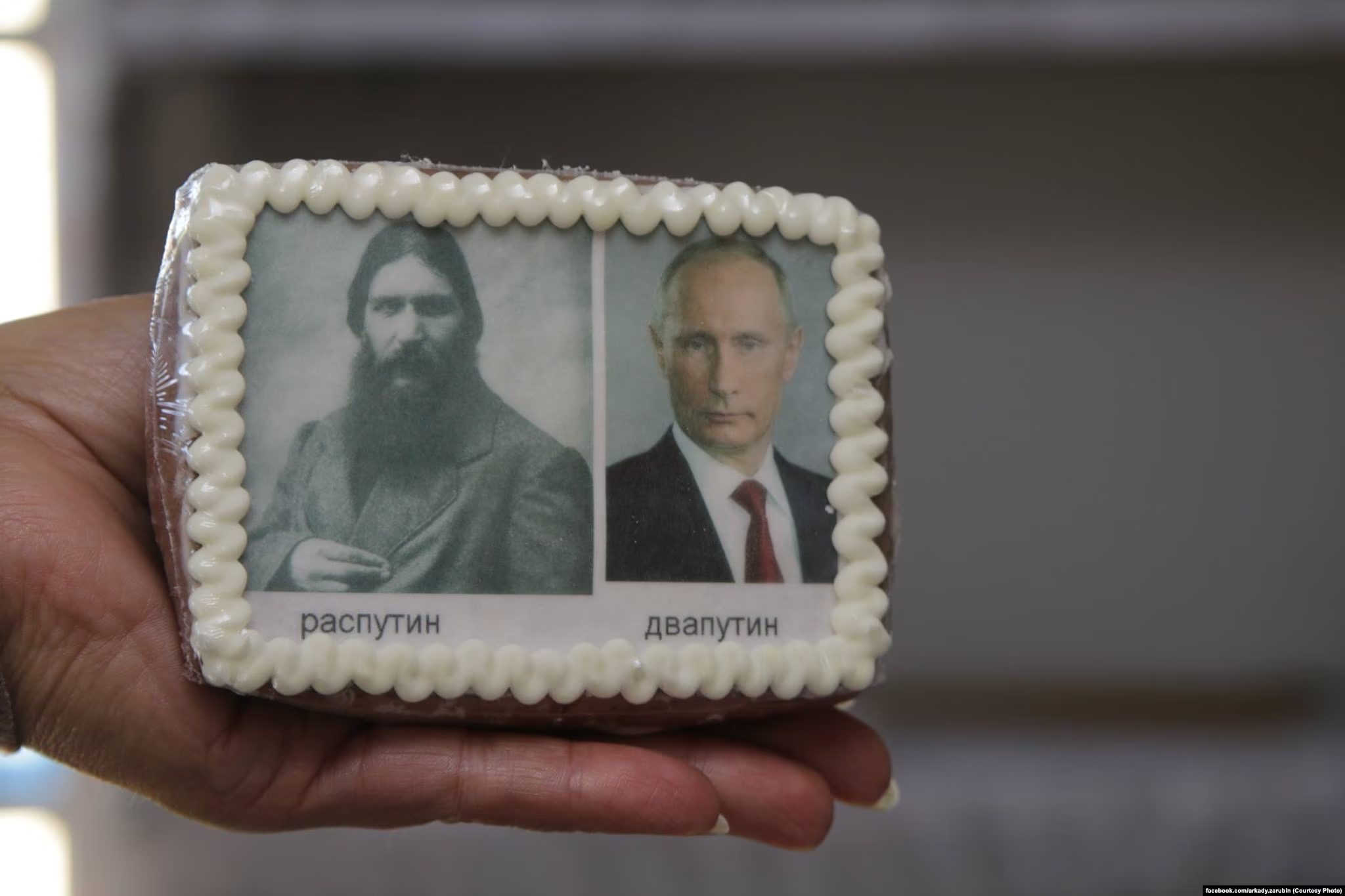
To the centenary of the murder of Grigory Rasputin
A hundred years ago, on December 17, 1916, Grigory Rasputin was killed, an self -proclaimed prophet, who predicted the end of the dynasty of the Romanov and tsarist power in Russia. “I will not be, and you will end,” he said to the kings. And so it happened: two months after his murder - and the Romanovs ended, the tsarist power disappeared.
Grigory Efimovich Rasputin-New was a complex figure. In no case can he be called just a crook and a mystifier, who subjugated a weak royal family to his spell. He was undoubtedly mystically gifted. He was a kind of sorcerer, shaman. Still, he, and not highly scientific St. Petersburg professors, stopped bleeding at the hemophilia of the heir-prince Alexei. This circumstance has already made him a man, for the royal family, a primarily valuable, one might say, vital. Rasputin did not fit into the framework of rational consciousness, this was mysterious, and this annoyed his many opponents, we can say - the whole educated, enlightened Russia. Yes, and in the royal family there was a lot of enemies: no Klaka would tolerate the monopoly closeness to the government of a single person, and even such a suspicious-illiterate peasant from somewhere in the Tobolsk province. Rasputin created an occult atmosphere in the highest spheres of state power. It could not be tolerant. And in the end, one of the member of the royal family was among his killers.
People do not like and are afraid of the sacraments, they are afraid of irrational. And in the approach of a dark man, this frightening irrationality was present to the throne. And the point is not only in the conversation of the blood of a sick heir. Irrational sentiments owned the king and queen, were an integral part of their moods, their worldview. They owned the myth of the super -generated, mystical connection of the autocracy with the strata of the masses. Strictly speaking, the autocracy in Russia was not at least with Peter at least: Russia was controlled by an extra -genital bureaucracy, as well as now. And the kings periodically mastered the thirst to penetrate through this isolation layer and connect directly to the people, with the masses. This was clearly evident already on the example of Nikolai the Great: the notorious third department, which became nothing more than a secret police, was conceived just with the aim of leaving the supreme power directly to the masses, bypassing the bureaucratic layer. It was the fight against bureaucracy by bureaucratic means. But Nicholas II had an illusion of such a connection with the people in the order of mystical communication. And the mysterious man Grigory Rasputin seemed to the link in such communication. The king, so to speak, fell to the ground, hoping to be fulfilled by its primitive power. Change the bureaucracy with mysticism is a tuning for the reign of the last Russian emperor. He tried to revive the myth of the autocracy as the power of the people, as the connection of the king with the Earth.
People do not like and are afraid of the sacraments, they are afraid of irrational. And in the approach of a dark man, this frightening irrationality was present to the throne
This galvanization of mythical schemes in the era of widespread scientific progress and through and through secularized culture was most annoyed - and all: both advanced liberals and members of the royal family. The irrational degeneration of power was perceived as its deepest crisis, as a sign of the inevitable end. Berdyaev then wrote an article under the name "Dark Wine" about Rasputin: about the intoxication of power, about the loss of any adequacy with it. And the case went so deeply that even the very elimination of Rasputin could no longer save this power.

What is today's lesson Rasputin, what is the relevance of a centenary? Of course, there is now no self-proclaimed prophet in the highest floors of power, it is very rational in its own way, as it should be to be any bureaucracy. The current elevation of the Church, many and fairly irritating, cannot be considered such a pathogenic factor as the former Rasputin. The dominant church is also rational in its own way, it very cleverly adapts to the kingdom of this world: like any active structure, it does not like impostors and all kinds of self-official initiatives. Rasputin is not and will not be now, but there is this dangerous tendency to the game with mythical images of Russian history and life, for applied mythology as a trend in state policy. Fantasies about the Russian past are replaced by rational work in the Russian present. On this path it is easy to lose mind. And God, as you know, punishes the mind. And there is no mysticism, and twice two four.