
Translated material
Garbage or you: who?
The text continues the joint project of Colta.ru with the official website of Sweden in Russia Sweden.ru - “For example, Sweden” .
With us
From the beginning and mid-90s, my early childhood, I remembered, among other things, plastic bags on a linen rope-a neat row is dried after they were washed. Judging by the issuance of search engines , this is quite a sign of that time: packages, the invasion of which in the Soviet Union began only in the late 70s, were still a relative rarity, and they were cherished. Dense and strong packages - for valuable things, I remember, even specially bought in the market. I personally chose a packet of wow for the school "shift".
Then, when the 90s ended, this washing of packages seemed to me a symptom, if not poverty, then some frank despondency and pathological savings: in my head people, washing bags, did not remove the packaging film from the TV remote control and poured every tea bag with boiling water four times. And then in passing I told this story to foreign friends - and in response I received a decisive “wow how Soviet citizens ecologically thought!”
Soviet citizens, of course, hardly were so worried about the state of the ocean, hanging bags on clothespins. (Meanwhile, according to ecologists , if you do not change the current situation, by 2025 - in less than 10 years - in the ocean for every three tons of fish there will be a ton of plastic garbage.) Just good packages were valuable: they were difficult to get and they cost money. In general, not environmental consciousness moved fellow citizens, but the needs below the Maslow pyramid.
Of the iPhones and iPads handed over to their owners, Apple in 2015 obtained almost a ton of gold and about three more tons of silver.
When the packages lost their romantic fleur of early capitalism, they stopped washing them. And the image of the bags on the linen rope was replaced by another - as in the photograph of the garbage field at the entrance to Akhtubinsk , which Vladimir Putin did not like very much .
At the same meeting of the Human Rights Council in early December, Greenpeace invited the presidentto ban the production of plastic packages in Russia . This topic is not at all new: three years ago, as many as the Russian Union of Industrialists and Entrepreneurs, first proposed to completely ban free packages, and then completely abandon the bio -produced plastic in the package. Then the RSPP counted in only one Moscow “turnover” of 100 thousand tons of packages per year. A big step from washing and clothespins, what can I say.
Everyone
We have never lived so long, satisfying, easily and conveniently as in the last 100 years - armed with new materials, conveyor production and a global division of labor.
Even the economists did not immediately realize that in this lightness there is some cunning - now it is usually called environmental externalities and “hidden costs”, which, instead of manufacturers and consumers, silently carries the environment. A striking, but only recently throughout the world they began to understand that things that have outlived their own are not for free on landfills - those who drink dirty water are paying for this, breathing dirty air, getting sick, forced to look at an unpleasant sight and so on. All this can be counted in money if you set up such a goal.
Swedes have to purchase 700 thousand tons of garbage per year in other countries.
So, if the price of your purchases laid the cost of processing garbage, the true price of wood, taking into account all the benefits that a person receives from a living forest, and so on - you would never buy a package of “gold” paper towels or are from one -time plates without extreme necessity. Or buy toilet paper from the primary bleached cellulose, which all over the world on the day is washed into the sewer for about 27 thousand trees .
Garbage is also an expensive pleasure in a different sense: without processing it, we send to landfills not only cellulose and plastic, which also cost something, but also non-ferrous metals and even gold. Of the iPhones and iPads handed over to their owners in exchange for newer devices, Apple in 2015 got almost a ton of gold and about three more tons of silver. If you look closer to the homeland, then the Chelyabinsk company Megapolisresurs likes to tell that from the point of view of the percentage of manganese and zinc, these metals are theoretically profitable to extract from the batteries that they process than from any ore.
At the Swedes
In Sweden, which even other developed countries are equal to the processing of garbage, less than 1% of all household waste falls on landfills (in Russia the situation is almost mirror). About half is burned in modern garbage plants for heat and electricity production - there are so many of them in the country that Swedes have to purchase 700 thousand tons of garbage in other countries a year .
Since 2002 in Sweden, it is simply forbidden to throw away to the landfills what you can get energy from. The “garbage” even works as the industry itself: the Swedish garbage trucks go on a biogas received from waste, or on the same electricity.
I repaired the refrigerator for 100 kroons - paid 50 kroons less tax.
The Swedes themselves admit that burning garbage is not an ideal option: to burn an old thing and make a new “from scratch”, you need more energy and resources than for resounding. In addition, when burning garbage, even the most environmentally friendly way, CO2, greenhouse gas, which causes climate change, will still get into the atmosphere.
Therefore, the population in every possible way encourage sorting garbage and handing it to processing: the convenience of environmentally friendly Swedes care even atthe points of taking containers in supermarkets, where there is a sink, hand dryer and, of course, packets in which bottles and banks were brought. Panta Mera , “process more” is an almost separate genre of commercials and music videos, where they are called to do this. In 2014, even the stars of the main Swedish musical television show recorded their version of the response anthem .
And around such an established infrastructure, a whole ecosystem of businesses that use it grows. Someone sells lead obtained from batteries, someone makes fiber fibers and artificial football lawns from tires, and someone, like Znogg , turns old newspapers into ecological blades for cleaning dogs and cats.
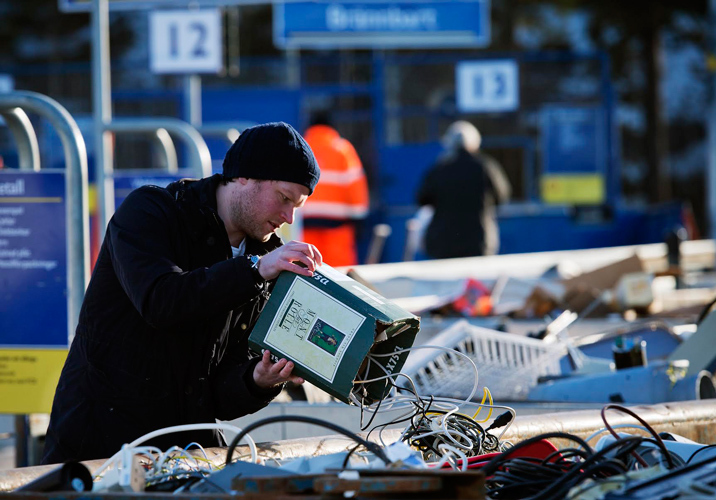
Technologically advanced Swedes love gadgets and other electronics: per year they buy, according to some sources, 32 kilograms of equipment per person - and throw on average amazing 17 kilograms . Electronic garbage is at the same time one of the most dangerous and most expensive, so its processing is so important. The Swedes, according to Eurostat , collect and process more than 70% of such garbage and believe that this is not enough. Since 2014, all retail sellers in the country are required to accept broken and outdated devices for processing.
A bright ecological future is a circular economy. The “linear” production takes resources from the environment and returns them there as garbage on landfills. The circular hopes to make a bagel out of this pipe.
And from next year, the repair of refrigerators, washing machines and other household appliances can become much cheaper. The government proposes to allow the Swedes to reduce income tax worth the amount of up to half the cost of these services: I repaired the refrigerator for 100 kroons - paid 50 kroons less tax. VAT for services for the repair of clothing, shoes and bicycles (the country's priorities are immediately visible, of course) are also offered to reduce twice - to 12%.
Here you can add the growing popularity of all kinds of sincial services , where instead of buying things and proudly owned by them (and alone to bear all the costs), people together use everything that is possible from cars and housing to skis and, yes, bicycles. At the beginning of 2016, in Sweden, even launched a hashtag # ShaareWear to exchange clothes: just take a picture of the bored thing that is ready to give and find her a new owner. To support the project, the most fashionable Swedish designers have released special collections, things from which can be obtained for free - provided that in a week you will pass them on.
A bright environmental future in Swedish is the so-called circular economy. The traditional “linear” production now, in fact, takes resources from the environment and ultimately returns them there, but already like garbage on landfills. The circular, cyclic or circular economy hopes to make a bagel out of this pipe: to process all or almost all waste, to use this raw materials again for the production of things or energy - and so on endlessly while it turns out.
One of the global leaders of the cyclic economy in everyday life is IKEA , the “facade” of Sweden for countless people around the world. In his stores in Belgium, France, Denmark and Sweden, a furniture giant is already calling buyers to return to them with sofas, curtains and other things to hand them over to pay new purchases, repaid, update or simply sacrifice. Russian chain stores are still accepting batteries and energy -saving lamps and refused plastic dishes in restaurants and dining rooms for staff.
In many kindergartens in Sweden, children learn to make a garden compost of potato peel, and resiping is a separate item in the classes, next to physical education and music.
In general, the banging "is not where they clean it, but where they do not litter" it is just right to modernize: purely where they repair, divide and process. For example, in Sweden.
But this works not because the Swedes are some alien creatures, and the garbage in Stockholm himself escapes from landfills for processing. In 1975, while Soviet citizens got acquainted with the culture of the plastic package, a little more than 60% of all waste fell into the training grounds. The study that Swedish economists from the University of Luleo published in 2009 showed : yes, moral reasons to sort garbage in the name of goodness and justice are important - but their importance falls significantly when comfortable garbage tanks and other infrastructure appear near the house. And the Swedes are more willing to process garbage if they see that their neighbors do it. People are like people, in general.
In many kindergartens in Sweden, children learn to make a garden compost of potato peel and other food waste, and resipping is a separate item in a class program, next to physical education and music. And this is right: after all, it is much more difficult to abandon the bad habits in adult life than from childhood to remember that excess packaging, disposable devices or uncertained garbage is literally money for a garbage wind.
And again with us
Russia is far from a non -waste Swedish life. But even simply by moving on to more effective industry management and modern technologies, we, according to experts of the international financial corporation, could easily reach the current almost invisible shares of up to 40 percent garbage processing-by 2025.
To do this, however, you need to go to the next stage of the relationship with the package: refuse to take it at the box office in the store even for free, that is, change consciousness. Without this, there is a risk that the directive measures that environmentalists are discussing simply will not work, even if they come from the very top. In 2013, when the country had a year of environmental protection, the president and government instructed the entire executive branch to switch to separate collection of garbage - as the same “Greenpeace” found out this year, only four departments out of 23 coped with the task.
We all scold the state, but I still want to ask: who throws 70 million tons of household waste a year?
In a situation where the problem seems to be obvious ( 100 billion tons of garbage on four million hectares is difficult not to notice), but how to approach it is not very clear, it is useful to start with yourself and your relationship. And there, you look, and the inertia of large structures will be able to overcome. The slogan of the Swedish National Association for Waste Management, Avfall Sverige , whose members serve 99.9% of the country's population-“there is no garbage,” and believe me, this is not because this business has some kind of special morality. I just don't want to bury money in the ground.
2017 in Russia will again be devoted to ecology. And if you personally are one of those who gives yourself New Year's promises, now is the time to decide in the coming year to go shopping with their bags and not throw off at least batteries, glass and metal into the “common” garbage. Do not print what you can work with electronic form with. In the end, to refuse, terribly convenient, but impermissiblely expensive, as we have already found out, paper towels.
This is much simpler than it seems: in Russia there are already dozens of public organizations and projects that will gladly help you fulfill such a New Year's promise. Read Recycle , study the interactive map "Greenpeace" , look for like -minded people through the Garbage . Demand organizing separate garbage collection in your area, at least completely primitive, if it is not there yet - the worse you are worse than Mytishch and in general, suburbs, after all.
Open the internal Swedes in yourself, who want to wash the stained, but a whole bag and, going to the store, return home for a forgotten bag for products. Because, re -heating Dovlatov, we all scold the state, but I still want to ask: who throws 70 million tons of household waste a year?