
Translated material
The death of the post -Soviet project. Part 1. Games with corpses and advertising instead of ideology
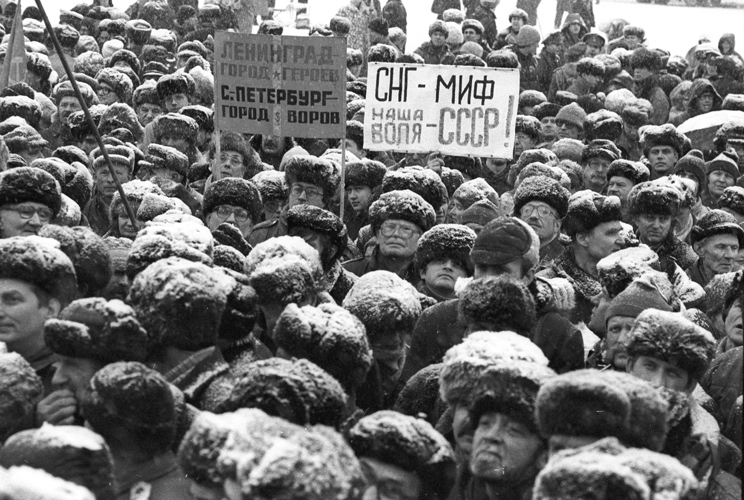
Kirill Kobrin columns as part of his project “25 years later (1991-2016). The death of the post -Soviet project in Russia ”was originally published on the website of our colleagues and partners of Opendemocracy Russia. For colta.ru, Kobrin combined them into a single text, which will be published in three parts during this week. Today is the first, dedicated to how Marxism-Leninism bend in the USSR and from which the Putin’s “conservative cention” grew from.
Especially for the texts that are trying to realize the twentieth and 21st centuries in Russia, we made a new section “Remember everything” , where the texts of Alexei Tsvetkov and Andrei Arkhangelsky were already published.
In it, we also publish the text of Kobrin (we are grateful to the editorial offices of the Opendemocracy Russia for the possibility of its recovery).
What and why this text
By the end of 2016, nothing left, how to discuss his sad events. It is acidic to joke about Trump, sigh of Brexit, hope for the well -made stability of the Germans to the impudent lies of populists. At some point, the unpleasant becomes obvious: it is interesting to talk about the above at least, but no about Russian affairs. For what? And everything is also clear.
However, having said this, it makes sense to think about what is “clear”. At first glance, the situation in Russia is becoming more strange and dangerous: fabulous elections to the State Duma, scattering in the Kremlin and on Okhotny Ryada, bombing in Syria, the death of a liberal opposition, miserable impotence of national law, when it tries to reach Chechen life, but you never know what else. Add the economic crisis, “the growth of dissatisfaction of the workers” (as they would say in the USSR), the sluggish failure of “import substitution”. But no, all this ceased to be keenly interested in, becoming a boring background on which dramas are more important - and all these dramas occur outside of Russia. Why? Because the above -mentioned unpleasant things are originating from the previous historical period.
I have a clear belief that the period of the history of Russia, which is called the "post -Soviet", is completed. That is why people and processes from the previous time lose their relevance. Yes, they are still in sight and still act, sometimes even dangerous, but all this is as relevant as in 1919 to discuss disputes in the III State Duma. The current shift, of course, is not so rapid and catastrophically total, but nothing is repeated in history, even like a farce.
The main loss for 70 years of Soviet power is the idea of building an absolutely fair society, given as the direct goal of the existence of the state and all citizens.
What exactly has changed? Public agenda. The hierarchy is important and unimportant for society. What is considered appropriate and even desirable by default. And, most importantly, the project of the present and the future. The old post -Soviet project that was relevant for almost 25 years, since 1991, has been exhausted - primarily because, oddly enough it sounds, it was fulfilled. Another thing is that almost no one is in a hurry to recognize its fruits in Russia.
That is why it is worth starting to summarize the results of the Russian post -Soviet project - which is dedicated to this essay. The post -Soviet project began with a public gesture - with abandoning Soviet ideology. He ended, drowning in the pseudo -eideological swamp of security. So, ideology, culture, public sphere in general-this is what to concentrate on to understand what happened in 1991-2016. In particular, they will talk about them, but not only.
As an introduction-a small outline of the history of ideology, real ideology, Marxist-Leninsky, the very one that was allegedly rejected by the freedom-loving Soviet people in the late 1980s, ideology, in which, as is commonly believed, "the Soviet Empire was based." After that, we will talk about what happened to this ideology, discuss the possibility of new ideologies, make several assumptions about the state of minds in the current Russian society. Then - about the social, sociocultural and even foreign policy side of the issue.
Portrait of ideology in the prime
In the story of Arthur Conan Doyle “Silver” simple -minded Dr. Watson asks advice from the penetrating Holmes:
-Are there any other points that you would advise me to pay attention to?
- On the strange behavior of the dog on the night of crimes.
- To the behavior of the dog? But she did not behave in any way!
“It's strange,” said Holmes.
If you ask people who, at a conscious age, had the opportunity to survive the most rapid and muddy period of the latest history of the Soviet space - three and a half months of 1991 between the failure of the August coup and Blovezhsky agreements of December 8 - about how the Soviet ideology “behaved” then, they will answer about the same. No way. Ideology did not behave in any way. And with regard to ideology, no one behaved in any way.
The object of political struggle in the territory of the Russian Federation, Ukraine (officially left the USSR 08/24/1991), Belarus (did not announce the withdrawal to Belovezhsky agreements), Turkmenistan (10/27/1991), Tajikistan (09/09/1991), Kazakhstan (12/16/1991) and Kyrgyzstan (31.08.1991), its theme and content of its theme and content There was a story about national independence, about the status of these republics, about the future of the Union, about the attitude to the metropolis and the world around him-but not Marxism-Leninism.
On the one hand, the barricades (thank God, most often rhetorical) were talking about Russian colonialism, about the imperial consciousness of Moscow and about the unsurpassed qualities of the title nation of this national republic. On the other hand, that Russia “feeds” everyone and that in fact there were no states a , b , C , etc., it was never enough to look into the last article in the journal “Young Guard”. That “they” are artificially created administrative units, that their languages are adverbs of other big languages, that the great Russian culture is above local.
The first to inflict a powerful, virtually fatal blow on Soviet ideology was Stalin. Stalinism is trying to look like an ideology, but it should be sought not in the library of political literature, but in the offessor of the ruler.
Typical rhetoric of the collapse of multinational empires and the construction of national states with amendments to specific realities; Similar speeches could be heard in Hungary1848, Poland1918, India1947 and so on. The phenomenon characteristic of the era of "modernity", for the period, which historians call the new time.
But the fact is that the collapse of the USSR (and its final stage, August - December 1991) is a seemingly event of a completely different historical era. The end of the Soviet Union is considered to be the end of the ideological project , the collapse of communist ideology, the event of postmodern - the majority of explanations of what happened in 1985-1991 is still full of similar formulations.
My task is not at all to propose a new concept of the “collapse of the USSR” here. This is a separate topic, and it requires a completely different volume and intentions. I am interested in something else: the “absence” of Soviet ideology in the events of the fall of 1991-and if you think about it, then during the previous two to three years-it affected its absence in the post-Soviet 1990s, as well as to process the current Russian regime (or even to construct anew) ideology in the past 16 years.
The question is not idle. If we are dealing with a society that suddenly, for incomprehensible reasons, “lost” a powerful ideology, then his desire to fill this gaping with something is quite understandable. And then the ideological construction of the times of Putin acquires the features of a natural, natural process. If there was no living ideology at the time of the supposedly unexpected collapse of the USSR, then talking about the subsequent ideological vacuum in Russia does not make sense. Then it can be argued that the posteological era in the territory of the former USSR began earlier. And in this case, it is more useful to look around Russia, and not peer into its Soviet history - current events in Europe and the United States give rich food for thought.
What was the “Soviet ideology” for 70 years of the “Soviet regime”? It is no secret that in this case it is very difficult to talk about any one ideology: they were somewhat consistent, but under the same name. The starting point of the history of Soviet ideology is crystal clear-this is a classic Marxism-Leninism, which combines the utopian vision of the future non-class society with effective political tools for practical application.
But Marxism-Leninism, unlike the Marxism of the middle of the 19th century, did not be an eschatological nature-Lenin did not prophesy that after the victory of communism “the story will end” (or only then it will actually “begin”, according to another Marx version, in this case it is the same thing). It was only about the fact that a non -class society will be built in the future, in which - and here, various kinds of non -combatant dreamers have already made additions - not only the nature of human society will undergo radical changes, but also human nature itself.
In addition to the intelligentsia, who did not suspect that, together with the Soviet government, it bursts its own social status, the main actor of perestroika was the “petty -bourgeois element”.
Lenin avoided futuristic insights, content with a statement: under communism there will be no classes, operation, private property, which is a condition for universal justice. Lenin rarely used the word "happiness", which can be found in the works of utopian socialists of the 19th century and his contemporaries and associates in the main revolution of the 20th century. At the starting point of the history of Soviet ideology, Marxism-Leninism, we discover only one idea-the idea of the upcoming universal justice, which many perceived religiously and even mystically, but actually it was a question quite, as it seemed to Lenin, practical things. In order to achieve this - albeit bold, but, as the Bolsheviks seemed to be achievable, a goal, it was necessary to destroy the old world in its economic, social, political and cultural foundations and create a new one on new foundations.
Around the implementation of each of these directions, a fierce discussion raged, but one way or another, the parties converged as follows:
The state, being an instrument of class oppression, will die.
Property should be universal.
All people - regardless of origin, gender and nationality - will be equal and will have equal opportunities.
Disputes were conducted about how to achieve the desired state. The Leninist point of view won, combining the most practical approach with the ruthless follow of the utopian ultimate goal. In tactical matters, Lenin was ready to sacrifice many - but he never exaggerated the significance of those intermediate measures and institutions that had to endure (or even introduce) in order to maintain power and move the country to communism. Peace and trade with imperialists instead of the World Revolution. NEP. The distribution of the Earth to the peasants for individual use. The use of "old personnel" in science, industry, culture (propaganda, to be precise), state apparatus and in the army. Finally, the recognition of national movements with “revolutionary allies” - with the corresponding political conclusions.
If we look at the “Soviet ideology” of the sample, conditionally, 1984, before the start of perestroika, we will find that, in fact, there is absolutely nothing left of Marxism-Leninism. Ideology has survived a grandiose transformation. The main loss for 70 years of Soviet power is the idea of building an absolutely fair society, given as the direct goal of the existence of the state and all citizens. And this loss occurred long before the whole country was “lost”.
Manipulations with corpses
The transformation of Soviet ideology consisted in the gradual process of disappearance from its composition of the “ideology” itself. Ideology is not applied, it precedes political practice, determining its direction and discourse. It is imprinted in every smallest gesture of power and in every return replica of society. The ideology is total and a priori.
The first to inflict a powerful, virtually fatal blow on Soviet ideology was Stalin. It was he who laid a set of temporary measures provided for by Lenin, the basis of his permanent internal and external course. Lenin arranged a terror in order to defeat in the civil war, limiting it in this way in time, - Stalin was introduced by Permanent Terror. Lenin considered the coexistence of the socialist state with the capitalist world of a temporary measure - Stalin recreated the historical Russian empire, which played the foreign policy game according to the imperial rules. Lenin was forced to go to the temporary permission of the class society and operation (NEP) - Stalin created a new caste society with a giant property abyss between the new nobility and ordinary people, primarily workers and peasants.
Finally, Lenin for tactical purposes supported the national movements that destroyed the empire - Stalin became the father of the nationalist course, but only Russian. In some ways, he went beyond the limits of temporary Leninist measures-in anti-Semitism, as well as in alliance with official Russian Orthodoxy.
But the main thing is not this. The main thing is that - despite the pseudo -ministry chatter of official ideologists and the pompous cult of Lenin - Stalin tried to create a new ideology, but she was not ideology. It was a combination of political, socio-economic and cultural instruments derived from the category of everyday political practice and endowed with the status of the eternal foundation of the state-it is the “state”, because, unlike Lenin, Stalin never had “society” as something that has independent value. Stalinism tried - and tries to look like an ideology, but in fact it should be sought not in the library of political literature, but in the offessor of the ruler. That is why, by virtue of his practicality, he turned out to be much more tenacious than Marxism-Leninism.
The “post -Soviet project” was erected on two supports - nationalism and extreme social egoism. His amazing feature was a mixture of embarrassment and awkwardness about his own grounds.
Instead of “communism”, “socialism” was proposed to the Soviet man-again, previously perceived as something intermediate and temporary on the way to a non-class society. They talked a lot about communism, the party itself was called communist, but from the beginning of the 30s, a system was built as a system of Marx and Lenin, a typical system for its time. For external use - a superpower dividing with others the world into spheres of influence, for the internal - a repressive state with total state property and attempts on a detailed social policy.
The next fifty years were devoted to the decoration of precisely these key positions that had nothing to do with “ideology” as such. The exception was the short but picturesque rebellion of Khrushchev, who tried to return the Soviet state and society to the region of the real, from its point of view, communist ideology. I think this attempt was the main reason for its overthrow - and not at all the ridiculous administrative measures and the unpredictable behavior of the leader.
The Brezhnev rule turned out to be a synthesis of two previous periods-the majority (softened, however) of the Stalinist principles of the establishment of power in combination with Khrushchev’s wide social democratic, in fact, measures (massive life support program, other social support measures, revision to the more fair side of the wage system). But the main thing was that in the second half of the 1970s, the Brezhnev leadership of quiet Sapa completely abandoned communism as a goal. The concept of “developed socialism” was first invented, and then the concept of “improving developed socialism”.
Anyone who was not too lazy to think about new political slogans clearly saw that the process described in them would last forever. So, there is no communism to see.
By the time of the beginning of perestroika, Soviet society lost its communist perspective; Accordingly, no “Soviet ideology” in a living form in the first half of the 1980s did not exist. The ideology, confused by millions of pages of official party books and brochures, lay in the mausoleum next to the corpse of its creator. The picture, worthy of the solemn ending of Peter Greenae's film "A cook, thief, his wife and her lover."
However, the mummy of Soviet ideology was useful in the first years of perestroika.
Advertising instead of ideology
First of all, the legitimate social dissatisfaction of the Soviet man who underwent more worsening material life was quite quickly transferred from the then power to “Soviet ideology”, to Marxism-Leninism, to the communist idea as such. It was only at first the “foremen of perestroika” demanded to wash crystal Leninism from the muddy spots of Stalinism. Но потом — причем стремительно — процесс обратился против самого создателя Советского государства, что было исключительно выгодно как националистическим движениям внутри СССР, так и тем, кто на самом деле был врагом — только не коммунизма, которого давно уже не было в живых, а «развитого социализма».
Помимо идеалистически настроенной интеллигенции, не подозревавшей, что вместе с советской властью она хоронит собственный социальный статус и образ жизни, главным актором перестройки была та самая бесформенная «мелкобуржуазная стихия», о которой много писали основоположники марксизма-ленинизма. В конце концов характерный, скорее, для конца XIX — первой половины XX века национализм слился с этой стихией — и СССР рухнул.
«Постсоветский проект» на большей части территории бывшего СССР возводился как раз на этих двух опорах — национализме и крайнем социальном эгоизме. Удивительной его чертой была смесь смущения и неловкости по поводу собственных оснований. В 90-е годы национализм и дошедший до социального цинизма крайний индивидуализм в публичной сфере были не комильфо. Так возникла необходимость в красивых, цивилизованных, убедительных, современных словах, которые отводили бы внимание от вполне наглядного содержания «постсоветского проекта» куда-то в сторону, по возможности в сторону от нынешней страны и нынешнего ее населения.
Поэтому попытки 90-х (не забудем, в России их начал Ельцин, а не кто-то иной) сформулировать идеологические ориентиры, относительно которых стоит выстраивать прекрасную новую жизнь, предлагали нечто, находящееся за пределами — либо за географической границей (Запад), либо за временной: «Россия, которую мы потеряли», то есть 1913 года, до революции. Эта новая идеология вообще не была идеологией — ее сочиняли постфактум, для того, чтобы оправдать существующее, сложившееся положение вещей.
В конце концов — уже в XXI веке — для ее сочинения понадобились не философы, историки или даже политологи, что бы это слово ни значило, а «политтехнологи», то есть те, чья профессия как раз и заключается в том, чтобы всучить политический товар равнодушному, а то и враждебно настроенному, населению. Эта новая разновидность политического продукта — не идеология, а некий идеологический сантимент , который пытаются вызвать у общества с помощью преимущественно картинок — телевизионных или компьютерных.
Так что любые разговоры о «возрождении в России советской идеологии» смысла не имеют, ибо ее, как и Ленина, можно возродить только в каком-нибудь новом «Властелине колец». То, что сейчас можно было бы назвать «идеологическим обиходом (поздне)путинского режима», есть лишь действительно поддерживаемое с помощью пиар-уловок общественное настроение, бесформенный консервативный сантимент, тщательно выведенный из любой практической административно-государственной или экономической (в России, впрочем, это почти одно и то же) сферы деятельности.
Новая разновидность политического продукта — не идеология, а идеологический сантимент.
Перед нами несколько подправленная в соответствии с интеллектуальным уровнем нынешнего потребителя риторика российской власти времен Николая I, Александра III и Леонида Брежнева, которая подается в виде коммерческой рекламы.
В 90-е для банка «Империал» была снята забавная серия рекламных роликов с историческими сюжетами — имперского, конечно содержания, ибо название финансовой институции обязывало. Сейчас того же рода реклама — прикидывающаяся журналистикой, кинематографом, литературой — рекламирует российское государство как таковое. Вся разница между этой идеологической практикой и подобными образцами конца XIX века укладывается в разницу между выпускником советского МГИМО Владимиром Мединским и выпускником Императорского училища правоведения Константином Победоносцевым.
Однако тут есть одна проблема, которая, по сути, закрывает «постсоветский проект» в России как особый историко-идеологический период. Мы уже говорили, что повсеместное представление о нехватке некоей универсальной идеологии возникло из желания замаскировать истинные основания постсоветского общества и государства — национализм и мелкобуржуазную стихию. Сегодня это странное властное и общественное неудобство по поводу собственной физиогномии полностью прошло.
Как выяснилось, так можно , так принято , такое носят — не только в «дикой России», но и в «просвещенной Европе» и демократичнейших Штатах. Национализм плюс безудержный популизм — явление, конечно, не новое, достаточно вспомнить классический анализ этой комбинации в «18 брюмера Луи Бонапарта» Маркса. За последующие 160 лет оно никуда не ушло, составляя фон политической жизни западных стран. Другое дело, что в послевоенной Европе властные элиты делали все, чтобы, с одной стороны, «гуманистически просветить обывателя», воспитать его прогрессивным, толерантным, «открытым», а с другой, не допустить прямого влияния массы тех же обывателей (ибо их — и небезосновательно! — подозревали в деструктивных эмоциях) на принятие политических решений. То, что мы наблюдаем сегодня в Великобритании, Соединенных Штатах, некоторых других странах, — одновременно провал «послевоенного гуманистического просвещения масс» и катастрофа правящего класса.
Никто так не радуется этому, как российская власть и российский обыватель. Когда Дональд Трамп несет опасную околесицу, которую американский обыватель не предполагал услышать с экрана телевизора до конца своих дней, когда британские консерваторы берут все новые рубежи старой доброй ксенофобии — зачем тогда нужно нам, в России, прикрывать тот факт, что единственными ценностями нашего государства и нашего общества являются представления о собственном превосходстве и умение ловко обобрать слабого соседа?
Но тут возникает серьезная проблема. Оба вышеперечисленных качества ничуть не помогут в столь популярном сегодня занятии, как национальная самоидентификация, — ведь чужие обладают ими в той же мере. Это качества, универсальные для мира модерности, для периода новой и новейшей истории. В результате на наших глазах складывается новый, удивительный интернационал ксенофобов-обывателей, интернационал, в котором в домотканой ненависти друг к другу слились американец, британец, чех, венгр, русский, немец и много кто еще.
Что же до столь влиятельного еще недавно неолиберализма, глобализма и других могущественных теоретических изобретений завершающейся мировой эпохи, то их уже спешно бальзамируют трудами Хайека и Фридмана, чтобы потом отнести в тот же самый Мавзолей, где уже больше 80 лет лежат две мумии коммунизма — физическая и интеллектуальная.
Вторая часть «Смерть постсоветского проекта. Ностальгия атомов по молекулам» будет опубликована на COLTA.RU 21 декабря