
Translated material
"I am a sacred worm"
Stone books, Nenets legends and songs of mosquitoes: Creative biography of Anna Nerkagi
Anna Nerkagi (born 1952) is a Nenets writer, author of art and popular science works about life in the tundra, Nenets culture and local myths. Nercagi is not only the author, but also the enlightener-thanks to her, a school for Nenets orphans and the temple of Mikhail Archangel opened in the Baydarastsky tundra; Anna Nerkagi creates not only traditional paper books, but also unusual - stone. Next year, all eight of her books published in small circulations will be reprinted. At the request of Gorky, Doctor of Philology, Professor of Tyumen State University, Natalya Palace, described the intermittent creative and educational path of Nerkagi, the writer's concern for the plants and beasts of Yamal and her pagan reception of Christianity.The image of a free life
Two months a year, from mid -November to January 14, in the Baydarastskaya tundra on Yamal, where the Nenets writer Anna Nerkagi lives, a polar night lasts. According to Nerkagi, in these months the Nenets (the word "nenets" means "man") one task - to survive. Winter here lasts much longer than a polar night: “ For the long nine months of winter, cold, we are literally orphan. We cry and yearn in the sun and heat, like small children. And no one in the whole world loves the sun as we <...> As soon as the warm moles of the earth, aromatic pair toughs, appear on her body, we kneel down and kiss her, the earth, like a mother, as a god, as a salvation. "
It may be because life on Yamal (Nenets. “Earth’s edge”) is so harsh, the connection with the native land among the Nenets is so strong - and so incomprehensible to people from the great land. According to Nerkagi, “the lifestyle of the Nenets only an ignorant person seems to hell because of his severity, remoteness from the world, cold, sometimes hunger. In fact, this is an image of a free life and remotely resembles a paradise. ” In 2015, for the “mythologism of prose and passionate upholding of the cultural identity of the Small Northern People” Anna Nekrag, was nominated by the Ural Federal University for the Nobel Prize in Literature.
On the border of words and silence
The Nenets writer writing in Russian, Anna Nerkagi is the author of four small stories (“Aniko from the genus”, 1976; Ilir, 1979; “White Yagel”, 1995; “Silent”, 1996) and four of the same small non-fiction works (“Wise sayings of the Nenets people”, 2014; “Legends and Traditions”, 2015; "Song to the Creator. “ The Nenets are people of pauses , ” says Nekrag, explaining the many years of writing between “Ilir” and “white lamb” (16 years), between “silent” and “wise sayings of the Nenets people” (17 years old). Nerkagi lives a typical life of a Russian writer, for whom the creation of life is more important than the composition of books. Its main work is the “Land of Hopes” in the Baydarastskaya tundra, ethno-resistance and school for Nenets orphans; Something that has never happened in the tundra and that it is difficult to explain to existing concepts like a world-building myth or a vital-growing-thorgic project.
Anna Nerkagi and the very phenomenon is unprecedented. Existing on the border of myth and literature, Nenets and Russian languages, paganism and Christianity, life -making and writing, it is absolutely holistic - and this regal integrity causes passionate admiration for some and the fierce rejection of others.
On the native land
As adopted in the tundra, at the age of six, Nercagi sent to study at a boarding school. In the book “My grandmother’s riddles”, she tells how every year the last days of August turned to children “into little hell” . These days, “children's collectors” flew to the tundra and took them to the boarding school, tearing them away from their native land and language for as long as nine months - in the boarding school they were forbidden to speak Nenets. As Nerkagi explains, the school "ate and eats our children so far, swallowing one after another." The school, which was discovered by Nerkagi itself, arose from awareness, "as in fact, the education system, still taking away children from the parents."
The internal conflict of a person who is forced to leave the native land to the Big City with its capabilities and temptations will become the basis of its early works “Aniko from the genus” and “White Yagel”. But if Aniko from the genus is at a crossroads, not knowing what to choose, then Nercagi from the genus of the stiff (as the writer’s last name is translated from the Nenets), like the hero of the story “White Yagel” Aleshka, chooses life in the tundra according to the laws of his ancestors. Today she writes about life in the tundra: “ When you walk on the ground, you read its tragedy as a book. Less less on the banks of our native river and lakes of plague. The shores of our favorite river and lakes are empty, orphan. The lakes cry, the rivers are yearning, the rivers die <...> longing and silence settled in the hills. Firewords do not warm the chest of their native land. Many plagues have fallen and do not get up. But we, the remaining, try our best. Love, create, raise ... " .
Silent
The most important event in the creative fate of Anna Nerkagi was the story “Silent”. It can be understood as the myth of the cultural hero-demiurge and at the same time the myth of the dying and resurrecting God. However, the essence of the story is that the author’s mythological consciousness is reflected in the mirror of the face of Christ. The story stands on a par with the Perm wooden gods, who do not just represent a synthesis of paganism and Christianity - the main thing is that the face of Christ is highlighted in the simple faces of the newly chosen Bashkirs and Permyakov. Nerkagi tells about the birth of a “silent”: “I, to the end, to the very last lines, did not know what the silent screaming about. What is he asking to see the poor Skopians? What does he see himself? What do they not see? He, or something, sees when he screams “Look!”? <...> And suddenly the thought came: He saw Christ! He saw Christ, whom the Skopians still do not see. "
The story "Silent" will cause disputes for a long time. It is unclear whether this is a work of an artist or a fool, a visionary? It is no coincidence that it is dedicated to "the memory of the murdered Daniil Andreev." “Silent” is a testimony of the special spiritual vision of Nerkagi, which opens not only “darkness itself”, but also “living fire”, “staircase of light”, “invisible brilliant wings of a person” and “unhealthy beauty”. The "silent" changed the writer's optics of Anna Nerkagi. To the horizontal of the mythological, social, historical in its art world, the vertical of the transcendental was added.
Song of a gentle Madu
Most of the circulation of the "silent" lay for a long time in a warehouse in the city of Labytnangi, and then ended up in a trash. “ My beloved son“ Silent ”burned down in a human trash , ” says Nerkagi, explaining his rebellion against literature and the creative crisis, from which she came out, presenting four new works over the past two years - about legends, legends, songs, riddles and wise sayings of the Nenets people. Here is one of the songs entering the Creator Song. Yarabz Numa ":
Maducochas ', Maducocha',
Nenetai "Syandacocham".
Golden Taryuychi,
Nyancam Passkaya.
Yab Tanyab, Hatskguv,
Yab Yatsgov, Sertatsgov.
I am a sacred worm
And not a fly, not a cricket.
I have a gold fur coat on me
And my fate is like that!
I create happiness to people
And I give out all the unfortunate.
Meda worm is “a sweet gentle creature in a silky golden little one”, “we love and adore the Nenets <...> the appearance of Madu in the plague is already a joy.” The songs of dragonflies, gagar, mosquitoes, a cake, deer, wolf, a wolf, a worm Pui-Puiko, a sea wave, a nimble stream, the pike river, the sulfur mountain, the angry pike, the fire, and the mother ground are also pleasing to the “ invisible common life of people, deer, and fires ” . The book of Genesis with its joy about the world and the Creator is connected by the “Yarabet Numa” with the revelation of the future of the world, not about the end, but about its restoration - apocatastasis.
1/3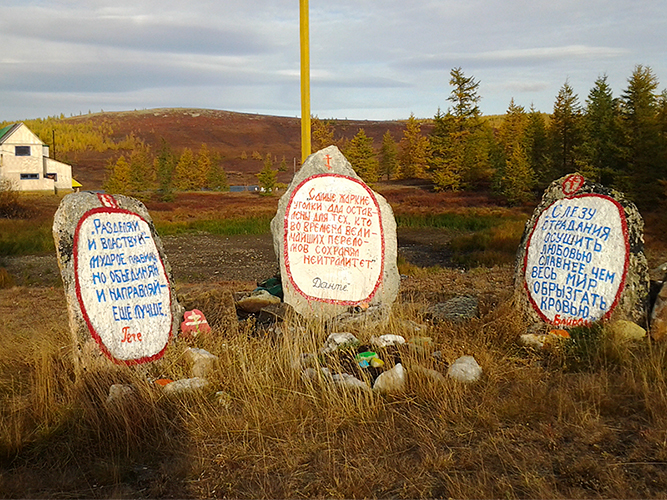 Stone books of Anna Nerkagi Photo: Igor Emelyanov 2/3
 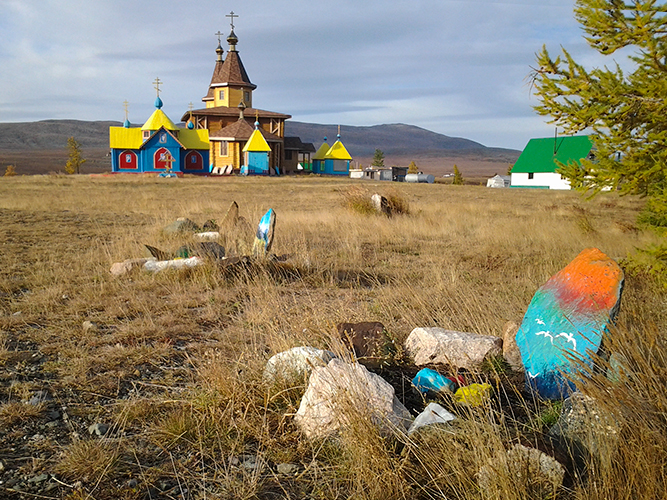 Photo: Igor Emelyanov 3/3
 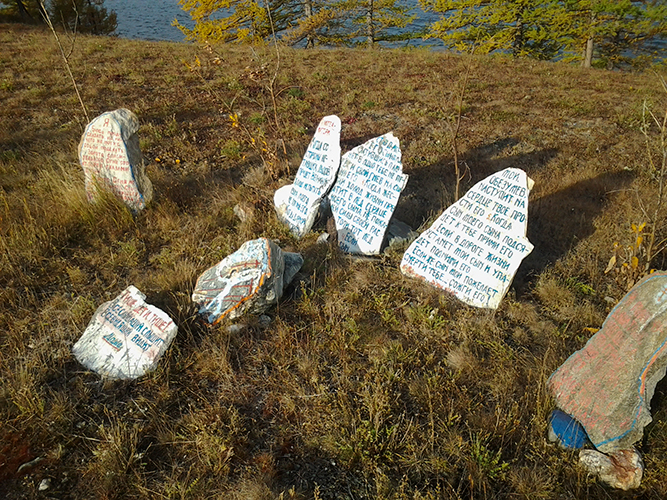 Photo: Igor Emelyanov
 Stone books
Nercagi writes out sayings, riddles and small songs in Nenetsk and Russian, accompanying them with short stories, more often with parables: “After the“ silent ”, my beloved son, who burned out in the garbage dump, said:“ Mom, do not occupy a human soul and attention, as your property, write briefly, so that people immediately understand you, ”I began to write very short works.” Together with her children, she writes short texts not only on paper, but also on stones lying in the tundra. These stone books in the Baydarastskaya tundra are usually called petroglyphs or tablets. Answering why she writes on stones, Nercagi, smiling, tells the story of how one day the wind carried the sheets of the book that she wrote: " The stones will not fly away . "
In the legend of Saurai (“Legends and Traditions”), the highest grief of the polar Urals, there is another explanation. Once upon a time, the Creator instructed his most beloved creatures to build a church on Earth for people. But they betrayed the creator and the church remained unfinished. Saurai, like other mountains of the polar Urals, are dilapidated churches: “For me, these mountains, which I see every morning, are unfinished churches <...> If our churches are equipped with iconostases only inside, then the church of the past and future, as the Lord thought, should be with iconostases on the outside.” Stone and paper books, the temple of Mikhail Archangel, built thanks to Nerkagi in the Baydarastskaya tundra, a school for Nenets children - all these are moments of a single plan to create “land of hope” on the edge of the Earth, the hope that “ death is only a small bundle of eternity” , that “for death is life ” and you need to prepare for it now.
The voice of God
Nerkagi calls his native land “the land of a humble, marked sign of hope”: “For us, Nenets, the body of the mother-earth is still inviolable. We do not make terrible, deep holes in her to suck her blood from the womb of her mother. We do not cut it with knives, do not poke in vain with shovels, do not chop with axes <...> and only when we give into her arms the dead, with a prayer and fear we cut her skin and at the same time carefully ask-take a child, mother-earth. ”
The most touching words of Anna Nerkagi are about the Brothers of the Nenets: deer and dogs. “Old people, old dogs, old deer in Nenets life become as if saints during their lifetime. Olens in recent days lived in the rank of people . ” She sees the tragedy of the tundra in the fact that deer, the Brothers of the Nenets in life, ceased to be friends, became the subject of acquisitions and mercilessly destroyed. “Blue tears of deer, like precious diamonds, are collected from the Lord in the palm of his hand,” says the writer about the dead beasts, whose souls turn to God. Having created the Cosmos of Nenets life, Nerkagi nevertheless refuses to recognize himself in the voice of his people.
“I am the voice of God,” she says.
PS: The latest books of Nercagi were published from 30 to 300 copies. The Tyumen publisher Miroslav Bakulin is preparing a book for printing, which will include all eight of its works and will be published in a circulation of 1000 copies in early 2017.