
Translated material
Zemo-nicos. So we live
Our project was implemented as part of the Decembrists peacekeeping art resident, or Dekabristen EV , is a German non-governmental organization created by Russian-speaking activists in 2012 in Berlin in order to develop a dialogue between civil societies of Germany and Eastern Europe. Their activities are aimed at supporting civilian initiatives, projects in the field of art, independent journalism and social innovations in the post -Soviet space. 15 young artists from Russia, Ukraine, Azerbaijan, Armenia and Georgia met in Georgia, where a number of seminars about the influence of art on the political situation, on peacekeeping mechanisms, passed. After the seminars, the artists parted through residence to try to comprehend political conflicts through the art. Artists from Georgia, Azerbaijan and Armenia went to work in Russia and Ukraine, and artists from Russia and Ukraine were partly in Georgia, partly went to Armenia and Azerbaijan. According to the results of the project, the work of the participants will be presented at the festival in Berlin.
My project investigated the consequences of hostilities in the border zones of Georgia. For the inhabitants of these places, there is a large injury associated with the loss of land. Hundreds of refugees from Abkhazia and South Ossetia still cannot return to their native houses, and they build their personal stories, entering the traumatic losses caused by the war. Many Georgians showed me a clear idea that their enemies are Russian politicians, and not the people of the conflicting side: “Previously, we were brothers with the Abkhazians, now we are enemies, and this is all the big policy that comes from the Kremlin.”
Over the year, the “creeping border” moved to them by 1.5 kilometers, cutting off the gardens from local residents or cutting the graves in the cemetery in half.
My project includes the territories of the Tskhinvalsky district occupied by Russia, what is called South Ossetia after the 2008 Georgian-Ossetian conflict. The Russian side does not just call for the fact that Abkhazia and the Tskhinvalsky region will not return to Georgia, but arbitrarily tolerates the boundaries. Local residents claim that over the past year the “creeping border” has moved to them by1.5 kilometers, cutting off the local residents of the vegetable garden or cutting the graves in the cemetery in half. Many residents of the region talk about great fear to fall asleep in Georgia, and wake up in Russia, that the Russian side provokes Georgia and is trying to draw it into an armed conflict. They repeat: "We do not see the solution to this problem, we do not want war."
All these people are united by the total non -structure of life: the war broke its usual move, and it can never return to the previous direction. The memory of this will be passed on from generation to generation at the household level. "So we live, but what to do." This is the phrase pronounced by people who have suffered a war, and it does not matter how much time passed since the end of military operations. If it was in Abkhazia after 23 years or on the border with Ossetia after 8 years.
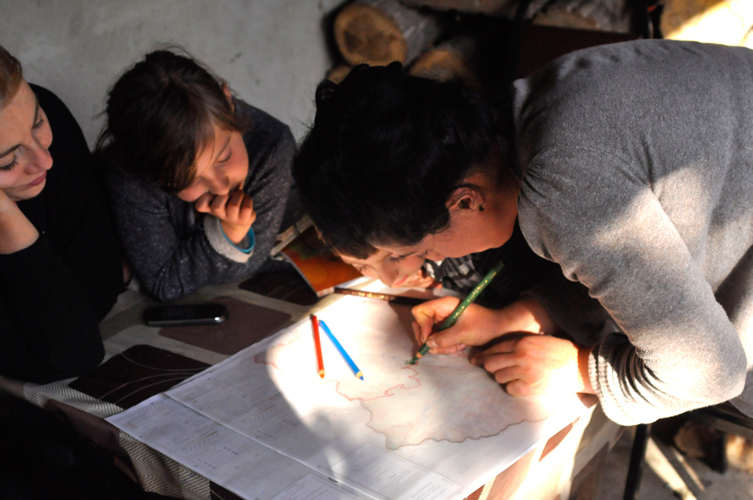
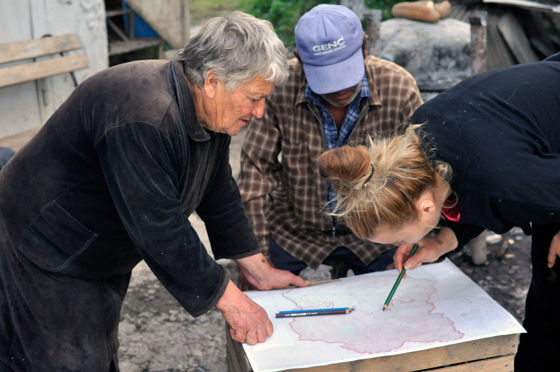
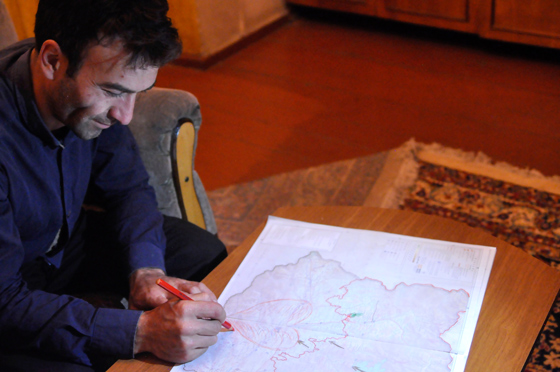
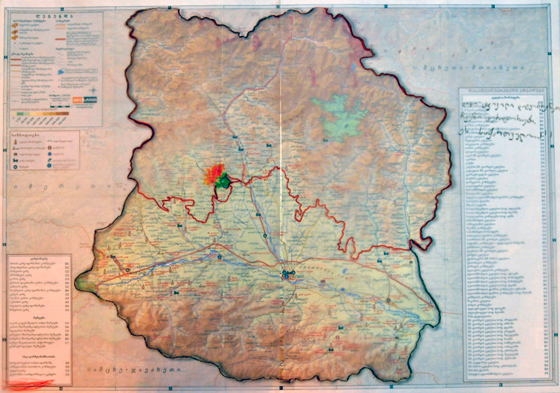
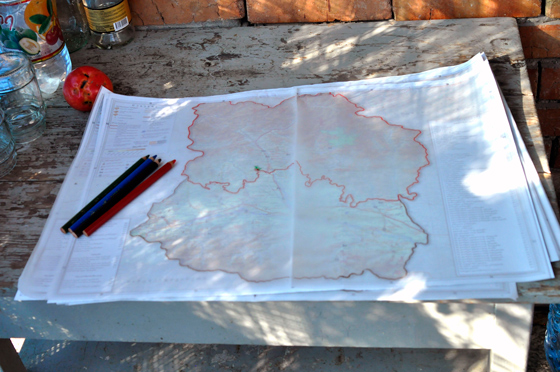
On September 20, 2016, I arrived in the village of Zemo-Nicosi, which is in the immediate vicinity of the border with the Tskhinvalsky region. She settled in the family of the former chairman of this village with his many sisters and nephews. His name is Elijah, he is 33 years old. I told him about my project: to distribute cards to the inhabitants of this village on which they can designate scorched lands and lost gardens. Elijah became my guide: we went to visit his neighbors, and they willingly talked about their misfortune. I offered them colored pencils and cards of the Gorya region, on which I pasted transparent tracing paper, where I outlined the occupation area with a red line. The neighbors drew behind this fat red line what was considered lost.
Before showing what happened to the cards, I will give one of the fragments of the conversation in the house of Elijah.
 © Natalya Nikulenova
* * *
Elijah: We have not talked to anyone in Russian for several years, since 2008, because no one has been talking in Russian here - everyone is talking in Georgian. I spoke Russian in Tskhinvali. Lost contacts with whom you can speak. There were friends and relatives in Tskhinvali, we had a close relationship. They stayed there to live there. Now it is Ossetia, and before there was Georgia. After the war, we returned to this house. During the war, we fled to Tbilisi. They did not give ordinary citizens weapons, they said: this is not your business, we have an army in Georgia. I do not want to kill anyone, but if I have to protect my house, then why not? But when everyone is fighting, as Georgia with Abkhazia fought, and when everyone has weapons, I do not justify this. Someone will drink vodka, go and shoot everyone.
Nino: We left here on August 8, we did not know that the war would be! A lot of died here: both local residents and the military. We were in Tbilisi for two months. Our whole family was in Tbilisi. Bullets fell into our house. We fixed the roof, and the doors remained so.
I'm very tired, but what to do? You always need to work. All the time at the stove. I studied at the university, graduated from a medical university, worked there, gave lectures. My brother Elijah is a lawyer, my sister Tamriko is an English teacher at school. We always lived here and will live. We used to all work in Tskhinvali. Four days a week I give lectures, and the rest of the time I am here at home, I have to cook everything, then I have to wash everything. Men cannot do this, they know nothing, the kitchen is a female business. And in the kitchen there can be only one woman.
They broke our doors, broke off the handles from the door, we still have no pens on the doors, there is no money to buy them. We do not know who broke, maybe Russians, Georgians, Ossetians or Chechens.
Tamriko: Everything remained after the war, we did almost nothing, there was no money. Everyone in the houses was like that. They burned the house there, and they also burned there. They came, all stolen, the motorcycles were stolen, the tractors stole, chairs, tables, cows and pigs and toilets too, cut the Internet cable, and even dentitions were stolen in the same house: we don’t know who did it-Georgians or Ossetians, just came here and all stolen. They broke our doors, broke off the handles from the door, we still have no pens on the doors, there is no money to buy them. We do not know who broke, maybe Russians, Georgians, Ossetians or Chechens. We don't know!
Elijah: In our village everywhere there were traces of tanks on the asphalt, traces of bullets in fences and houses. When our army ran away, Russian tanks entered here. There was such an order that our army should retreat, I don’t know whose order was this order, maybe the main thing, Saakashvili. Everything was destroyed here, destroyed. There were a lot of dead on the streets, war is the worst thing that is in the world when people kill each other. There is a creeping border here, our fence does not crawl, here, as the cameras and the fence were set in 2008, it is worth it, but there are other villages, it crawls there. This is Dirby, Two, here there is the village of Ditsi, somewhere 20 kilometers from here, my relatives live there, their gardens remained behind the fence. I also had a garden here, which is on the other side, somewhere15 hectares. In these villages, the border moves each time by 100, 200 meters towards Tbilisi, and never moves towards Russia. This is Russian soldiers, what kind of order they have, so they will make, but where is the order from? From the Kremlin or from where, no one knows. The Georgian authorities say that we are against this, that you can’t move the border like that, but they can’t do anything or do not want to. It will be scary when you fall asleep in Georgia, and wake up in Russia. God forbid that there was no more war, as in 2008, no longer repeated. As I think, Russian people, and Ossetians, and Abkhazians, and Georgians should say: "The end of the war, let's live together, we do not need war." Not one or two people, but all together - and everything will work out, just nothing happens. Russia must withdraw its troops from here, it should be so. Maybe someday it will be. About 30 Ossetian families or even more live in Nikosi. A woman from Kirov lives near Kirov. We must love each other. I think there will still be five to ten or fifteen years-and we will be all together again, Georgia will be together with Russia and Abkhazia. We have a lot of holes in our house from shells, we all again bought: carpets and furniture all. They came and took the toilets on the tanks. My father taught accounting at the university in Tskhinvali, he was a professor. I worked here the chairman of the three villages: zemo-nicos, kvemo-nicosia and zemo-hut. Three years ago I was released from work: a new government came, and they told me that you would no longer work. I could do everything here.
There were a lot of dead on the streets, the war is the worst that is in the world.
One old man, who was 90 years old, fell asleep in Georgia, and woke up already in Russia. Our neighbors and his relatives give him food because he remained abroad on the Russian side. There remained one person and one dog, just funny. From here they give him food and water, a pension too. His relatives take a pension and hand him over the fence as a terminal. He still lives there, the dog is also with him. And in the village of Dirby, the cemetery is cut in half, half of the grave on the Russian side, and half on the Georgian side. We have such a tradition on Easter - an uprising for Christ: we collect red eggs and bring to the graves, and on the side, which is among the Russians, you can’t walk, and red eggs are transferred through the fence. There was one case that the egg fell into the stone on which the person is depicted, and the one who threw said: "Oh, right in the top ten." In the village of Tamarasheni, the Cossacks torn their stomachs for pregnant women, Russian soldiers did not know that we were Christians, and when they entered here and saw crosses and icons, asked: “Where we got, we were told that the Georgians were not Christians, we did not know with whom we fought with Christians or not.” Our ancestors loved Russia and Russian people, the time will come - we will live together.
* * *
 © Natalya Nikulenova
Below I give cards drawn by residents of the village as part of my project, with their comments.
Manana: I am Ossetian, I lived in Tskhinvali earlier, now I live here because I am married to Georgian. I can’t go to Tskhinvali now, despite the fact that close people remain there, my aunt lives there, my mother was also born in Tskhinvali, but now he lives here too. We do not know how they live there and what the situation is there, we have lost contacts and phones.
Khvich, 56 years old: somewhere here there was our territory too, and now this place has already been attached to Russia, it will be poorly visible on the map if I draw, since the border here shifted several times a half to two kilometers over the past year and a half.
 © Natalya Nikulenova
Tamaz, 65 years: here is South Ossetia. I live on the border between South Ossetia and Georgia, now the former Georgia. Here is my house, which stands on the border. And here is this large territory, where there were large fields with wheat and corn, and here is a cemetery, right across which the border is now going on.
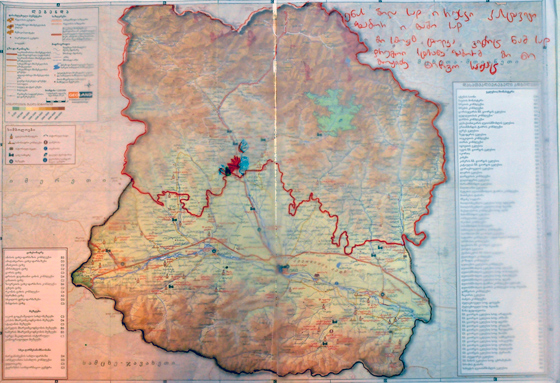 © Natalya Nikulenova
Sergio, 21 years old: here is Tskhinvali, Russian soldiers occupied our lands. I will draw on this map traces of Russian soldiers. There used to be a green area, now it is black after the fire.
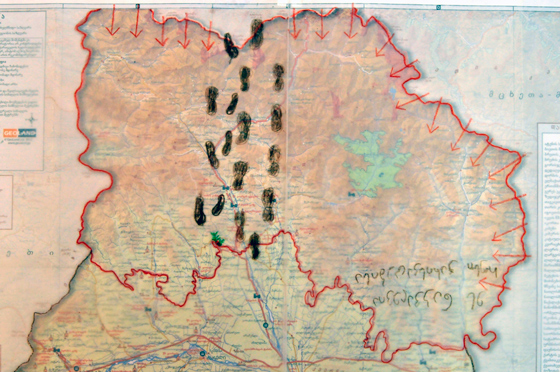 © Natalya Nikulenova
Nino: Somewhere there was our garden here, it is small, there were trees grew there, everything was burned.
Friend Nino: My garden remained there too, he was very close to her garden, I will draw him too.
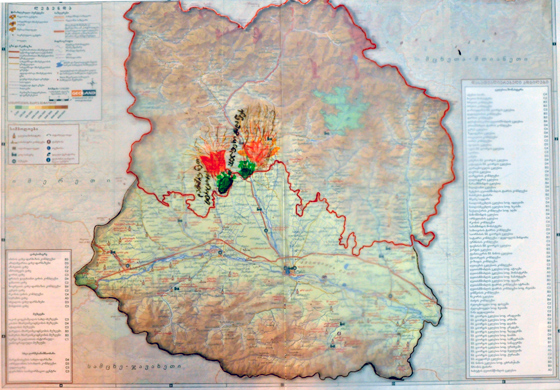 © Natalya Nikulenova
Levan, 36 years old: here are half - our territory, half we have already lost.
There were our lands here, and they cut off all. The cemetery was here, where the crosses were on this territory. There you can see on the spot what border they made, and here, too, our territory was. They took everything. Here, wheat, corn grew. Here in this territory, next to Tskhinvili, trees, apples, pears grew, here was our garden. And here, look, I had as many as nine hectares, I know for sure, there were apple gardens, all this was buried.
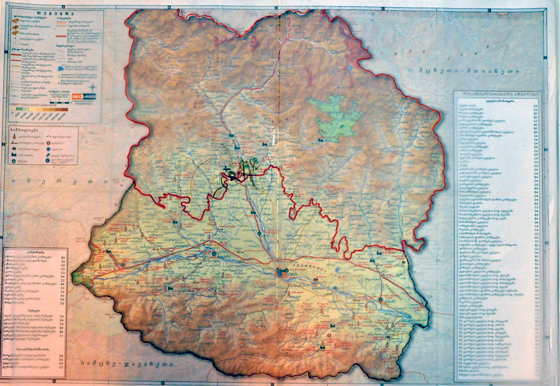 © Natalya Nikulenova
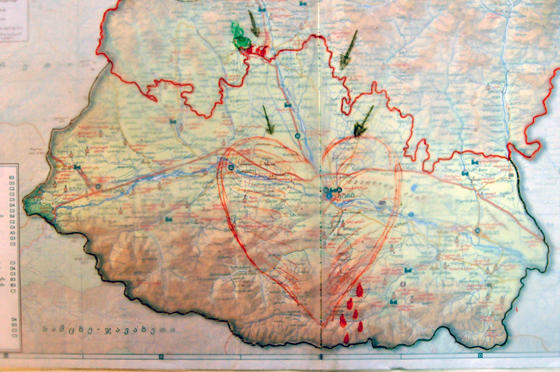
Elijah, 33 years: I draw arrows that fly from Russia fall directly into the heart of Georgia, and it bleeds.
 © Natalya Nikulenova
George, 26 years old: when there was a war, we lived in Tbilisi, we, like everyone else, left there. After the war, when we returned here, work began here, they began to make a fence. And our gardens remained behind the net. We grew apples, pears, wheat too.
 © Natalya Nikulenova
Download the entire issue of the magazine "Disagreements" (No. 11) "Neither War, Nor Peace": PDF , MOBI , EPUB