
Translated material
In jail at large
The report of Mikhail Kaluga from the amazing prison of Vitsville was made as part of the joint project of the journal Reportagen and the Swiss Culture Culture “About Helvetia”. Its meaning: Swiss writers and journalists explore different countries where “about Helvetia” works, and write about this texts. In response to Switzerland, their colleagues from these countries go with the same mission: find the exceptional and tell about it. Here you can read (though in German) about the results of this project. In particular, writer Dmitry Gavrish traveled from Switzerland to Sochi, and Kaluga’s report will be published in the February issue of Reportagen.
We leave to smoke in the shadow. Today it's hot. Near the barns smells of hay. In the distance, the snowy tops of the Alps are visible.
“This one in your hair is like her ... well, they make honey,” says Misha. He from Lithuania and forgot the Russian language.
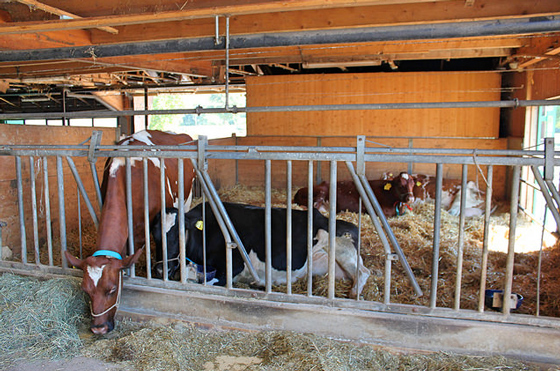
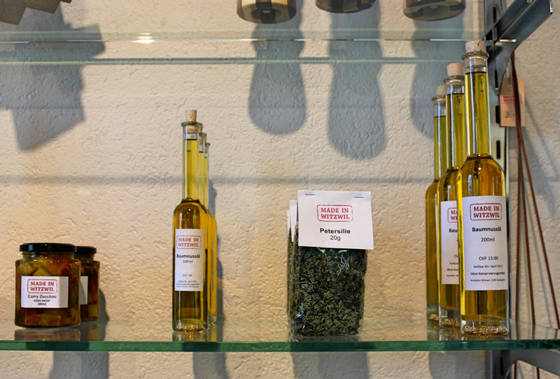
I look like a bee, one of 1 102 365 bees that live here. I wonder how you can calculate the bees? I didn’t ask anyone about this, but here they keep meticulous accounting for everything. Bees - 1 102 365, Ulyov - 26. And another 480 cows, 136 horses, 1200 pigs, 112 chickens. All this is located on 825 hectares. Vitsville is a large economy, they say the largest agrarian enterprise in Switzerland. In Vitsvil, fruits, flowers and vegetables are grown, a wide variety of products and drinks are made, they sew clothes, there is a carpentry and carpentry production. All this is sold under the Made in Witzwil brand. I have never drank such apple juice as here.
I look like a bee, one of 1 102 365 bees that live here. I wonder how you can calculate the bees?
Three people from the local can talk to me in Russian: Misha, Georgian Besik and Swiss Thomash. Tomash's parents came from Czechoslovakia in 1968. Misha and Tomash, they say, have recently got a fight, but now they are laughing, as if there was nothing.
- And what did you fight? I ask.
- Yes, by stupidity, drank.
- Where does alcohol come from ???
Misha, Besik and Tomash are laughing.
- Yes, from the weekend they have already come drunk.
- And what was you for that?
“Yes, it's okay,” they laugh. - The insulator, as expected.
My interlocutors are ordinary guys in various crumpled T -shirts, which are not a pity to stain during work. But all three in the same uniform gray pants with red inserts - only this gives out prisoners in them.
Venzvil is a prison, the second largest in Switzerland. Here are 186 prisoners. 52% of them are foreigners.
Tomash is here because of drugs and theft, he speaks about it calmly and with irony-they say, which of us did not do stupidity. My former compatriots are crumbling, but a verbose and hot Besik cannot restrain themselves:
- Yes, they were arrested for stupidity, listen! I made my way from Austria to France, and they detained me.
- So, after all, there and there - Schengen visas?
- Wah, but I had no visa!
A few minutes later, Besik admits that he was tried not only for violation of the visa regime, but also for theft. Misha sits for theft.
- Well, what, where is it better to sit - here or at home?
Misha smiles restrainedly - Lithuanian prisons are worse, Besik is excitedly waving his hands:
- What are you! Do not compare! This is a resort! There is work, they pay money, the conditions are excellent!
“So, here you like everything?”
- Well, almost everything. I have no vacation, but they have - they are citizens of the European Union.
“I don't like everything,” Tomash enters into conversation. - There are computers here, but without the Internet. Without Facebook, boring!
This is a prison in which the money is paid, there are computers, from here they release: 1240 times during the year, the Venzvila checkpoint is opened for those who have the right to leave-it lasts from 12 to 56 hours. When we agree and document, Besik, Tomash and Misha will go to load hay into a silage tower. Pitchfork. In Vitsvil, they are not afraid to give the prisoners a pitchfork, axes and large knives, and the guards constantly do not follow them. Here, in the production area, there are no guards at all. Vitsville is the most unusual of correctional institutions. Here, the life of prisoners is arranged in such a way that their degree of freedom - oddly enough this word for describing the prison is extremely high. And on how they take advantage of the freedom inside the prison, their life will depend not only during the term of imprisonment, but also after.
1240 times during the year, Venzvila’s checkpoint is opened for those who have the right to leave-it lasts from 12 to 56 hours.
* * *
Here nothing resembles a prison - the way I imagine it. However, my own prison experience was very short and now, thirty years later, it seems comic.
I spent a day at the regimental guardhouse by mistake. I served in the strange troops, such existed only in totalitarian countries where mobilization is the only means of solving even economic problems. These were construction troops, the very fact of which was legally dubious even from the point of view of Soviet laws - after the collapse of the USSR they were gradually canceled. There was an end to the 80s, and against the backdrop of the war in Afghanistan and a demographic decline in the army, students began to be called up, which was not before. I got to the construction regiment to the north of Uzbekistan, in the Kyzylkum desert. They mined gold and uranium. The main hard work was done by prisoners and military builders. At first, I was a carpenter-concrete and built a giant gold purification plant, and in the second year of service, the ability to print on a typewriter was unexpectedly useful to me. I reprinted the technical documentation in the construction of the construction department, and my comrades in the department, to which I was attributed, built a dining room in the city of Uchkuduk.
One of them caught the eye of the regiment commander, when he stood in line to a barrel of kvass - in Kyzylkum very, very hot. But it was strictly forbidden to leave the place of work. The colonel decided to immediately arrest the offender, he fled. There were more than a thousand of us in the regiment, it was impossible to remember everyone by names and people. The colonel returned to the unit and ordered me to arrest me and put me in a single camera for a week. I went to the guardhouse in horror and bewilderment. The loner was busy, I was put in a common camera, but the very next day my friend, trying to buy kvass, went to the regiment commander and admitted. He was forgiven, I was released.
Not every Soviet or post -Soviet person has such an experience, but a prison, a zone, a camp are constantly present in social life. The feeling that the prison was very close to the very fabric of culture and manifests itself in the widest spectrum: from the mafia nature of the state system and economic relations to the proverb “from Suma and from the prison, do not promise” and the phenomenally popular radio “Chanson”, whose listeners are passionate not at all in wandering and aphrous songs of the criminal and prison experience (for some reason is called this "Russian chanson").
In Switzerland, 6,000 prisoners, in Russia, according to the most modest estimates, are 644,000.
Most of my life I lived in Siberia. The prisoners built a lot in my native Novosibirsk - from a huge station to the famous Akademgorodok. The building of a psychiatric hospital two quarters from my house in the 30-50s was a transit prison of the Gulag. The zone came close to the campus of Tomsk University, where I studied. And I know that the prison is high fences, a lot of barbed wires, a system of rigid prohibitions and the harsh rules of the game outside of official norms. In Russia, they are planted for a small fault, and who got to prison for a fight or petty theft may come out of there with ideas formed by the criminal world.
Every minute of the day spent in Vitsvil, I compared my experience with just what I saw. But Besik is absolutely right: how can this be compared? What can be the grounds for these analogies? In Switzerland, 6,000 prisoners, in Russia, according to the most modest estimates, 644,000 - and Swiss thousandths of a percentage of prisoners from the total population are not comparable with a Russian half percent. I cannot compare prisons and penitentiary systems. I can compare only the different attitude of society to the person who violated the law. Prisons work as the state wants this.
* * *
Venzvil is surrounded by fields and gardens. Actually, these fields and gardens are part of the prison. But you can’t get there right away. Like not every convicted person immediately falls into the Vitsville.
The average socio-demographic portrait of the prisoner of this prison looks something like this: this is a 35-year-old man with the formation of 9 classes or unfinished professional. He often changes work, uses drugs and is associated with a criminal environment. Its average stay in Vitsvil is 230 days. About 65 percent of those who are here are sitting for drug trafficking, theft, illegal stay in Switzerland. 12-14% - rapists, including pedophiles, 10% - killers.
The ideal world that they wanted to build in a very ideologized totalitarian society in practice is a good prison.
Those who have committed light crimes may immediately end up in Vitsvil. The killers and rapists get here if they demonstrate positive dynamics and are ready to embark on the path of correction. So, a prisoner can spend four years in a regular prison or prison with a more stringent content, but the last two years of his term in Vitsvil.
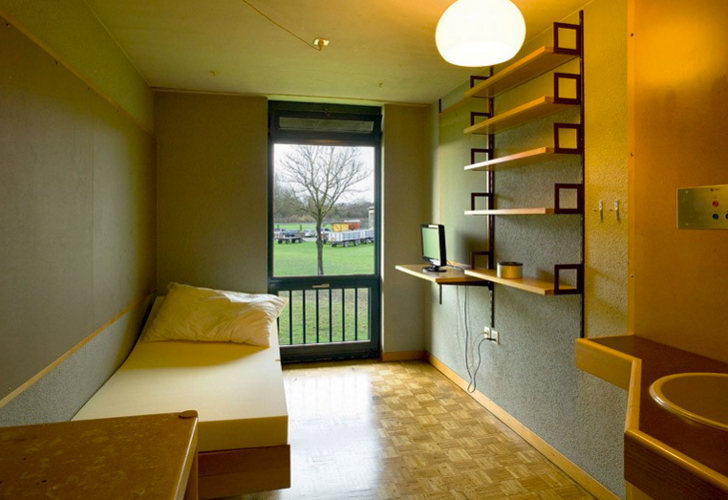
In any case, having got into the Vitsville, the prisoner first finds himself in its central part, where three -month quarantine passes. This is the most thoroughly protected section of the prison. Here, in small two -story buildings, prisoners spend weekends and evenings, here they eat. I go in one of - no, I can’t call it a “prison camera” - rooms. She looks like a full -fledged private space, a bed, a toilet, books, magazines, a TV, a computer. Yes, there is no Facebook and cannot be: you can only play on a computer, well, write. Do the prison employees follow the circle of reading their wards? Yes, and the convict for pedophilia is unlikely to be able to buy a catalog of baby underwear.
I wonder if I put me in such a room, I would probably be able to write a lot? There is no other thought. I can’t compare this room with a guardhouse: there I slept on a wooden sunbed right on the concrete floor.
* * *
The prisoners of Venzvil go to work, passing through the checkpoints. There are two working zones. One controlled: there is no guard in it, but it is surrounded by a fence with cameras and thermal imagers. There are workshops, workshops, stables and barns. Further - agricultural land, they are not guarded at all, once every three hours the team leader comes to check how the prisoners work and whether they are in place.
But, before getting to any work, the prisoners of Venzvil pass tests.
 © Mikhail Kaluzhsky
In the hangar, where psychologists responsible for professional orientation work, I meet a sad intelligent person with glasses that collects a large wooden puzzle. I begin to ask him questions, but he shakes his head: "No, I am not a psychologist, I am a prisoner, for several days here, I pass testing." Yes, if a person sits and uniforms are not visible, you cannot distinguish a prisoner here from an employee.
Those who are responsible for the professionalization of the inhabitants of Venzil, two. One to work here was a child psychologist, the second was a locksmith and a craft teacher. They are engaged in the fact that they conduct the initial career guidance courses that last from 2 to 10 days, and a monthly assessment. Prisoners fill the questionnaire on 17 pages, demonstrate their skills on a variety of machines and tools. After passing the tests, they may be recommended to get an education. Sometimes prisoners study outside the prison. A salary increase may depend on monthly tests, which consists of 80% of the main rate, a 10 percent allowance by decision of the foreman and another allowance on the recommendation of a psychologist. The basic rate for the prisoner is 26 francs, but the inhabitants of Venzil receive only 60% of the money earned in their hands: the rest will become starting capital for them when they are released.
These two psychologists are terribly pretty guys, and they are very passionate about their work. “It is so important that a person, even being here, makes his choice and learn something. Or realized in what he can. But no one cannot force anyone. Only independent decisions. "
In the meat workshop of the kitchen, I get acquainted with Carlos, an illegal from the Dominican Republic, a very carefully trimmed beard, a bright stone in Seryozha. He wields a huge knife, cutting the meat that will be packed and sold. He made his choice: “Here I gained vast experience - not every place can be seen as much as in Vitsvil, I’ve been here for 30 months. When I get rid of, I will return to the Dominican Republic, I cannot stay in Switzerland. But here I received the profession of a cook and will do this at home. Only there I will need to take a course on the preparation of vegetables. The meat is the same everywhere, but the tomatoes are different. ”
The inhabitants of Venzil receive only 60% of the money earned in their hands: the rest will become a starting capital for them when they will be released.
Besik complains to me that he is not allowed to work on a tractor, although he has rights.
- Why? They immediately try to work in the specialty?
- This is only for Europeans! Here, in general, everything is good only for Europeans. Priests are brought to the Catholics, Mullah, and I wanted to confess to the Muslims, asked the Orthodox father. Not necessarily Georgian, albeit Russian! No, they say, nowhere is there near the Orthodox Church.
* * *
In the controlled zone, Besik, Tomas and Misha shover hay along with their civilian partners - everyone works together: prisoners and employees, men and women. No, women are not serving a sentence here, but they work here. Besik, who behaves as an anecdotal southerner, is frankly happy that he waves his pitchfork side by side with a stately blonde - he frankly lacks female society.
Hans-Zelef Schwartz, director of Vitsvil, is convinced that the presence of women-and there are about a third of 157 employees-near the prisoners beneficial. The serving sentences begin to hold the language, speak quieter and support the ability to communicate, which is easy to lose. For six years in a regular prison, says Schwartz, the prisoner loses ordinary social skills. This is not the case in Vitsvil.
The gray -haired and tightened Schwartz was a school teacher, an officer in the tank division, worked for five years as a school principal in Colombia - the largest Swiss school abroad. Then he was the director of the prison in Lucerne for six years. For ten years he has been led by Vitsvil. Thanks to the army and Colombia, I know Schwartz what security is, thanks to pedagogy - what education is.
But in a few hours of our conversation, Schwartz almost does not talk about security. He with visible pleasure tells about the economic indicators of Venzil: with an annual circulation of 24 million francs, the institution earns 10 million. But with much more passion, Schwartz speaks of education. His mission is to return to the society of people who are completely resocialized.
Schwartz shows the schemes and tables, the ethical code of the employee of the Vitsville, speaks of the importance of the joint work of employees and prisoners, about an individual approach to each, that prisoners undergo psychotherapy three times a month, about the importance of the correct selection of a profession and training.
I ask the director of the institution whether they run away from here, because after all, work without the supervision of prison security should be a great temptation.
-Five-seven people are trying to run annually, but usually everyone is catching. Someone manages to escape abroad: for 10 years of my directorship, only 20 people were not returned to Venzvil. The risk of escape is the higher the harder the crime that the prisoner committed. But our task is to help a person change, and if he does not have serious mental problems, then this is possible.
- Do you agree with Rousseau that everyone is kind by nature?
- As an enlightened person, I think that any person is correcting. Everyone is looking for success, strong personal connections, recognition. And if I had not believed in the correction, I would not be able to work here. And if the Venzvil project will not develop, then the old prisons will return, the purpose of which was - and remains - not resocialization, but simply punishment. However, if you refer to Swiss Russo, then I will quote a Russian writer. Solzhenitsyn said that imprisonment and related suffering cleanse a person, make him better.
The director of the most unusual Swiss (and only Swiss?) Prison does not suspect that he was in one of the most sick points of the endless Russian dispute about crime and punishment. And I answer Schwartz that I myself am in this dispute on the side of not Solzhenitsyn, but much less known in the West Varlam Shalamov, who considered the prison an absolute evil and extremely negative experience. However, both of these writers were political prisoners.
“We are dealing with those,” says Schwartz, “who received not the best opportunities in life.” The criminal environment influenced their fate, but I hope that resocialization in Vitsvil will give an effect in a length of life. Correct environment and proper work help to start in a new way and give a chance.
И тут я понимаю, что мне напоминают слова и директора Вицвила, и тюремных психологов, отвечающих за профессиональную ориентацию. Это навеки выученная в школе фраза из советской конституции «От каждого по способностям, каждому по труду». Кажется, я не узнал ничего нового про Швейцарию в Вицвиле: все та же установка на эффективность, лишенный пафоса гуманизм, вера в свободу выбора, готовность постепенно улучшать мир. Но я понял важную вещь про собственное прошлое. Весь этот день я действительно сравнивал несопоставимое. Нужно было сравнивать не реальные исправительные заведения, а разные представления о наказании и исправлении. И тот идеальный мир, который хотели построить в сильно идеологизированном тоталитарном обществе, на практике оказывается хорошей тюрьмой.
 © Михаил Калужский
* * *
В принадлежащем учреждению магазине, где продавец — заключенный, я пью яблочный сок, покупаю кусок сыра и упаковку сушеных груш.
Вокруг — поля, где видны работающие люди. Пространство между ними и свободными землями кантона Берн разомкнуто, непреодолимых препятствий нет. Кажется, это идеальная тюрьма, где утопия иронически смыкается с антиутопией: заключенные не только не думают о побеге, но некоторые и хотят остаться. Впрочем, это не отвечает на вопрос, действительно ли они хотят ресоциализироваться. А 39% заключенных Вицвила сидят здесь повторно.
«Про Гельвеция» и редакция Reportagen благодарят Дмитрия Гавриша за помощь в создании материала.
COLTA.RU благодарит главного редактора журнала Reportagen Даниэля Пунтаса за предоставление права на публикацию текста.