
Translated material
Deader in Palmyra
In December, a monument to the Victory Soldier was solemnly opened in the lobby of the National Center for the Defense of the Russian Federation on the Frunze embankment. The facades of the new wings of the General Staff, completed in 2014, mimicize the Stalinist architecture of the old central building (architects Lev Rudnev and Vladimir Muntz). Fresh interiors are high -tech, in the best traditions of Hollywood cinema about the reflection of aliens attacks. But, apparently, so that the military did not think about such alien traditions, the synthesis of art is introduced into the restored building - not only a sculpture like a “soldier of victory”, but also stained glass and painting. The production organization of the Ministry of Defense, the studio of military artists named after Grekov, is engaged in the production of modern patriotic-realistic products for the Center.
The history of the studio began in the 1930s. Immediately after the death of Mitrofan Grekov, the pioneer of Soviet battal painting, the personal decree of his patron of Clement Voroshilov was established isomastern amateur performances of the Red Army. Amateur art has been systematically supported since the 1920s, and the imperative of the “culture” of the Soviet man demanded an indispensable demonstration of interest in the artistic creativity of people of various professions. In 1937, for example, an exhibition of amateur painting by the NKVD was held in Moscow. The military workshop at the division became a school where 20-30 talented Red Army soldiers and officers were trained. Since 1938, she began to be called a studio.
The Ministry of Defense could use the painting as Soft Power to solve current foreign policy problems.
According to legend, Semyon Budyonny, during the first exhibition of artists of the division, gave the idea that they should produce paintings, and not graphics or campaign art. This idea reinforced the demand for the professionalization of the team, and soon the first graduates of art universities were accepted there. The craft skill over time has become the main criterion for the quality of the works of the studio, and amateur origin began to be remembered as a period of unreasonable childhood. It is characteristic that not a single image has been preserved from this early period.
During the war, the departmental role of the studio finally developed, which fell into submission to the chief political administration of the Soviet Army and became a factory of the production of official images of battles and victory. A similar “army of art” existed among the allies of the USSR (for example, the American The US Army War Art Unit ), and among the enemies - the Nazi art division under the leadership of Luutpold Adam had 80 artists. The Grekovites perceived a documentary front -line drawing only as a preparatory material for future paintings, but there is no doubt that before the publication it underwent rigid censorship of the political administration. It is impossible to find any deviations from the canon of vigor and heroism even in these sketches; What can we say about the posters of Leonid Golovanov, the “victory” of Peter Krivonogov or the sculptures of Yevgeny Vuchetich. It is these, the most official, works of the studio are wandering from one of her catalogs to another. These catalogs were published exclusively by representatives of the studio.
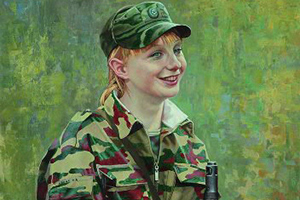
 Yuri Biryukov. Song of girlish. 2013
After the war, Ivan Shevtsov, the author of the pamphlet on the abstractionists “Aphids, becomes a regionalist of the Greek. Antisionist novel. " Written in 1949, he was so monstrously anti-Semitic that they published it only in 1964, when, after the scandalous defeat of Khrushchev, the criticism of Modern Artists became relevant again. In the late 1940s, in the midst of the campaign to combat the cosmopolitans, Shevtsov, along with the director of the studio of Greek, Christopher Ushenin and its leader Nikolai Zhukov, publishes the article “Against Critics-Antipatriots in Batal Painting”. As Shevtsov himself wrote about her in the text, glorifying Evgeny Vuchetich, this “article was directed against those who tried to bury battle art as a dilapidated, no one needed, since the war, they say, is over and now we must glorify the world .” As a result, if other countries have temporarily dismissed their “art armies”, then in the USSR the studio continued its work.
Over the next years, thousands of images of the main stories of the past war and portraits of its commanders were created. New style trends - “severity”, hyperrealism, etc. -With a delay, they also penetrated the walls of the studio, for which in the 1960s the architect of the Ministry of Defense Yuri Krivushchenko built an ultra-modern modernist building on the street of the Soviet Army. There were masters of the “lyrical theme” telling about the everyday life of a Soviet soldier in between battles, specialists in space stories or singers of border romance. 30 artists of different generations - such a team could be a regional creative union, and the works, it would seem, were not much different from the bulk of the official Soviet painting of those years.
“Now we don’t go with an outstretched hand to do our own business,” the army understands that propaganda is necessary and it needs to be paid.
The main specialization of the studio was the production of battal panoramas and dioram. This technically complex genre appeared in the 19th century and has since been popular as a spectacular method of propaganda, convincing the viewer of his objectivity by the “realistic” show of all the details of historical events and the seizure of real space through voluminous requisite in the foreground. The Grekovites created panoramas and dioramas of the events of the Second World War and patriotic historical plots throughout the USSR. In the new building of the studio, a space for such large-scale work was provided, and especially a lot of diorams began to appear precisely in the 1970s: “The assault on the Izmail fortress”, “Plepensky epic” in Bulgaria, “The campaign of Svyatoslav against the Pechenegs” (Zaporozhye) or, for example, “establishing Soviet power” in Vyatka.
In addition, the ministry, apparently, was convenient to have “its own” painters - paintings can be endowed with generals or veterans, decorating cabinets. With an eye on the Greek in 1969, Vereshchagin's own studio was created under the Ministry of Internal Affairs. This studio is also valid. However, the Ministry of Defense could use painting as Soft Power for solving current foreign policy problems. So, in the collection of the Grekov Studio, you can find a number of paintings with the episodes of “helping the fraternal peoples” - but probably even more such works were settled in the storage of the countries of the former Eastern Bloc and other geopolitical partners of the USSR.
 © The Aviation Group in Syria in the Ministry of Defense of the Russian Federation Exhibition of works from the Syrian business trip of artists of the Grekov studio at army international games, Alabino training ground. Summer 2016
The artists of the studio also made reports from the places of new military conflicts with Soviet participation - for example, from Vietnam and Afghanistan. True, neither one nor the other war gave a new canon. The graphic cycle of the “wounds of Afghanistan” Dmitry Belyukin, which he created in the Moscow hospital after returning from the war, frankly and without embellishment shows victims of foreign policy ambitions. Today, the master of patriotic academism does not include this cycle in the catalogs of his work.
The factory of images of the war of the past and the present, like all the production of the Soviet military-industrial complex, turned out to be the most resilient after the collapse of the entire USSR system. In the 1990s, in addition to the orders of the Ministry of Defense, which never stopped acting, the gallery of the studio works was replenished with portraits of patriots and church leaders, paintings on a private order like “Black Theater in Russia”, not to mention the landscapes always popular among buyers. To his anniversary in 2005, Moscow State University ordered studios of the portrait gallery of rector.
Nevertheless, the experience of creating large historical and mythological paintings was also useful to new, post-Soviet, power. Although the Museum of the Second World War on Poklonnaya Gora was laid back in the 1980s, the Diram complex was made by the Greek already under Yeltsin-in 1995. Then the studio brigade won the competition for the painting of the reconstructed Cathedral of Christ the Savior and has since regularly accepted orders for church painting, an example of which is the temple of paratroopers in the city of Carbers in Bosnia, the painting of the Nikolsky temples in Sevastopol and Naro-Fominsk and numerous iconostases.
If only meticulous lovers of military equipment on special Internet forums were fanned about the painting created after business trips to Chechnya or South Ossetia, then the presence of studio artists in Syria was illuminated by central television.
With the defense minister Anatoly Serdyukov, who carried out reforms to modernize the army, the existence of the Grekov studio was once again put into question. The reduction of military institutions of culture and healthcare then caused a lot of protests, and the corruption scandal accompanying Serdyukov - gloating. After the appointment of Sergei Shoigu in 2012, military structures again went through a number of reforms, and the budget of departments began to grow. So, a special department of culture of the Ministry of Defense was created, which began to obey the studio along with other institutions. It is no longer a question of its liquidation. “Now we do not go with an outstretched hand to do our own business,” the army understands that propaganda is necessary and needs to be paid, ” said Sergey School, one of the most successful Greek, in 2014 .
At the same time, the commercial activity of the studio was “optimized”: on the site you can order any picture or its reproduction, a baguette and restoration workshops work, even English courses were announced. Own design bureau managed to become famous for the development of a new logo of the Russian army-a tricolor star, which was accused of plagiarism from the brand of American Mall.
On the patriotic wave of recent years, the Greek Studio began to be used by military managers. First of all, this applies to foreign policy, where the studio is again responsible for Soft Power . In the post -Soviet time, the Grekova Studio brand was recognized in the world market as a guarantor of supplying quality painting in the context of the global decline of its production technology. In the digital era (pseudo), historical paintings, dioramas and panoramas become the subject of specific fetishism of authoritarian and nationalist regimes supporting the “real” art. In recent years alone, the studio has fulfilled large -scale orders for Turkey (the picturesque design of the Ataturka Mausoleum in Ankara and the Main Military Museum in Istanbul, 2009), Macedonia (the Macedonia Museum and the Archaeological Museum in Skopye, 2010-2012). The Grekovites compete only with battal craftsmen from both Kores and China. For example, the panorama of the battles of the Arab-Israeli “War of the Judgment Day” (1973) in Cairo was ordered in the late 1980s Hosni Mubarak Chinese brigade.
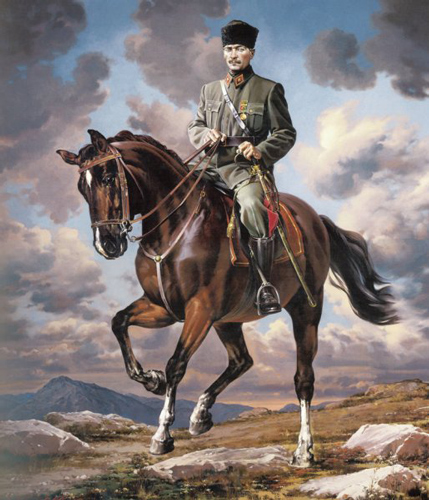 Sergey Skaykin. Kemal Ataturk on a horse. OK. 2009
The listed international orders were certainly commercial and were not advertised by military departments. In Minsk, where in 2013 the studio finished work on dioramas in the new building of the Museum of the Second World War, everything was already different-Alexander Lukashenko and Vladimir Putin solemnly opened the new museum. The Greek map in China, which is a new strategic partner, is tactically played out. In 2015, the holiday of Victory Day over Japan was introduced in this country. Among other propaganda Russian-Chinese events, an exhibition of 146 paintings by the studio at the Academy of Arts of the People's Liberation Army was held.
The attitude to paintings based on military operations in hot spots has also changed. If only meticulous lovers of military equipment on special Internet forums were fanned about the painting created after business trips to Chechnya or South Ossetia, then the presence of studio artists in Syria was illuminated by central television. At first, the cultural department sent an exhibition of paintings “Conversation of Peace” to the cultural and leisure center of the Khmeimim air base, and then three Grekovtsy went to Palmyra for the openier after the city clearance operation .
These plots, like the performance of Gergiev and the Mariinka orchestra in the amphitheater, where terrorists arranged demonstrative executions, should have been broadcast by the domestic and Western audience the humanitarian and cultural mission of Russia.
The merger of the Rosiso with the GCCA opens up career prospects for the Greek people more interesting than to hand over the portraits of Zhukov every six months to decorate the general rooms.
A more active participation of the studio in peaceful cultural life is also outlined. So, if in 2009 the anniversary exhibition of the studio in the arena lasted only four days, then in 2015 it was already a monthly exposition of thousands of work. The annexed Crimea, of course, was the central topic - the exposition was opened by Diorama “The Baptism of the Army of Prince Vladimir in Chersonesus” (Pavel Ryzhenko, 2009). The Minister Shoigu then expressed a wish to make the Grekovtsy exhibitions mobile - and in an abbreviated form, the style exhibition was shown in several cities, for example, in Orel and Yamal. In 2008, in the Catherine Foundation, Joseph Bakstein and Zelfir Tregulov, the exhibition was supervised for the anniversary of the Red Army. Then the works of Sergey Shutov and Sergey Bratkov were responsible for the modern part, and the Greek people participated in exhibitions such as “Airborne Forces - a strong character” in the halls of the ICC. And the new military department of culture included the studio in the program "Night of the Museums - 2014".
So far, the works of members of the collective are regularly exhibited only in the tsarist tower of the Kazan station, where since 2010 the “art space” of the gallery of the people's artist Dmitry Belyukin has been located. ” The gallery appeared thanks to the personal patronage of Vladimir Yakunin, who suggested Belukin to choose any room of Russian Railways. At first glance, it seems that the tower is quite marginal, but in fact the public breaks there and lead students of military schools on excursions. In the book of reviews - the requirements to give a building for a constant exposition of paintings by Pavel Ryzhenko and other Greek, and they collect signatures against the film by Alexei Matilda about the personal life of Nicholas II.
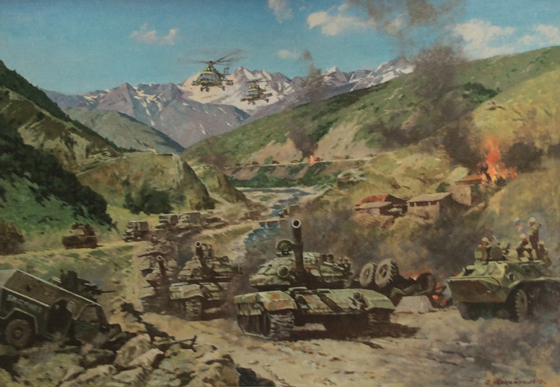 Oleg Avakimyan. Throw on Tskhinval. 2010
For a long time, only civilians have been working in the studio, some of them are given titles and shoulder straps for special merits. Today, among 30 artists of the studio there are many young people, including four girls; These are mainly graduates of the Surikov Institute and the Academy of Glazunov. The work is considered very prestigious: rarely where the artist or sculptor today can count on regular orders, salaries and a full package of social guarantees. The merger of the Rosiso with the GCCA opens up career prospects for the Greek people more interesting than to hand over the portraits of Zhukov every six months to decorate the general rooms. The director of the new structure Sergey Perov is a graduate of the Higher Military School and is unlikely to be indifferent to the work of employees of the legendary institution. So you can wait at exhibitions of "always modern" art of canvases with scenes of the military exploits of the past. Or opus from the life of rocket troops.
Download the entire issue of the magazine "Disagreements" (No. 11) "Neither War, Nor Peace": PDF , MOBI , EPUB