
Translated material
Russia without Putin - Syria without Assad?
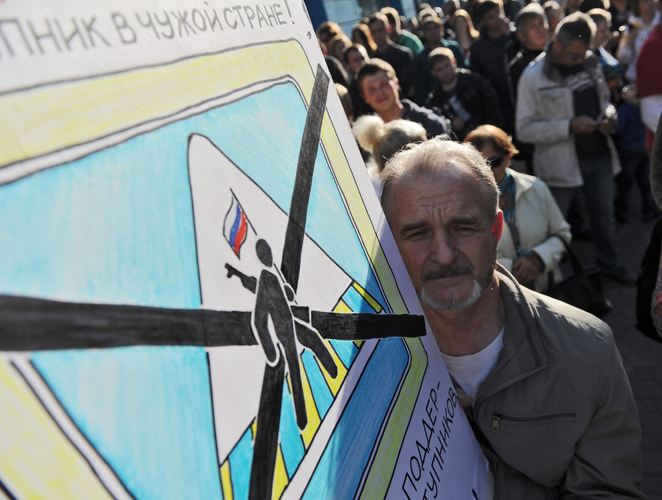
Russian military interference in Syria openly serves the support of Assad’s regime - the initially proclaimed task of combating the terror of fundamentalists receded into the background. But neither opposition, nor, moreover, pro -government media does not focus on this fact of attention.
A month ago in Moscow, a rally was supposed to take a rally against the war in Syria, organized by the Solidarity movement. However, the capital’s authorities did not allow the opposition to hold an event, which was announced by the press by one of its organizers Sergei Davidis. This ban could be surprising, given that Middle Eastern events are usually not considered the problem of the first significance for Russian society. “Disagreements” discussed the attitude to the Syrian conflict and the problems of anti -war movement in Russia with three researchers and activists: Oleg Zhuravlev , Ilya Matveev and Vlad Tupikin .
The conversation was built around the following questions:
In general, one gets the impression that Russian society is quite indifferent to events in Syria, although in Europe this is the number one theme (along with the elections in the USA). Why so? It's only about the media presentation?
The authorities use the military theme (both in Syria and earlier in the Donbass) as a point for uniting supporters. Why does the war in Syria not become the point of mobilization of opposition forces? If it becomes, is it used effectively enough?
In early November, the Moscow authorities banned civil activists and opposition to an anti -war rally dedicated to Aleppo bombing. The reasons remained unknown. What, in your opinion, can explain such a sensitivity of the authorities to the question?
The XX century was marked by powerful anti -war movements in countries that conducted military operations far from its borders (USA and Vietnam, France and Algeria). What conflicts are indicative besides these? What has changed since then?
Is mass anti -war movement possible in modern Russia? Why?
Oleg Zhuravlev
Laboratory of Public Sociology (Russia), Phd Candidate, European University Institute (Italy)
The ban on an anti -war rally is a continuation of a repressive course, within which any protests are suppressed, not only anti -war ones. In addition, as the experience of Russian participation in Ukrainian events showed, Russia performs certain actions of a military character, while often it is often easy to find out about these actions. Oppositionists use this, announcing uncomfortable evidence. And, I think, the authorities are afraid of this.
The current situation is fundamentally different from the end of the 1960s in that in those years there were two global camps. Numerous national liberation uprisings were supported by a communist movement. What is happening now in Syria is a civil war against a dictator, and not an international resonance national liberation movement, on the side of which, for example, left-wing states. Although it is clear, of course, that the war in Syria is internationalized, but the character is completely different.
What is happening now in Syria is a civil war against a dictator, and not an international resonance national liberation movement.
The attention of public opinion in Europe and America to the Syrian conflict is a consequence of the political culture in the West, in which public intellectuals and social movements feel their responsibility and the ability to influence global processes. In Russia, there is no such political culture, although it was in a peculiar form in the Soviet Union. We had a Chechen war, but it not only took place within the Russian Federation, but also led to terrorist attacks in Moscow and other central cities. In addition, Russian draftees were sent to Chechnya. Therefore, it caused a wide resonance, quite a few people were configured against the actions of the Russian political leadership in Chechnya.
European and American intellectuals are very West -centric, they consider protest against the actions of the United States and, wider, NATO with their own civic duty. When the war in Ukraine began, I lived in Europe and saw that many of my left -wing looks took a clear prose -dentist position, because for them the “West”, America is one hundred percent imperialist. In a sense, many Western leftists are similar to Russian liberals, which naively include in all world troubles to blame Putin. Recall the slogan "The main enemy sits in the Kremlin." The "main enemy" of many American and Western European left sits in the Pentagon.
A bill was recently adopted, which allows us to use Russian soldiers in the “fight against international terrorism”.
I am a sharp opponent of Kyiv’s actions in the Donbass, at the same time a fundamental position of, say, Italian anarchists who spoke in support of New Russia, surprised me. I see in it a certain narcissism: these activists are so focused on the fight against the leadership of Germany and the USA that if the last “against collective farms”, then the first are for. There is a certain paradox in this position: this position is rhetorical-anti-colonial, but at the level of motivation in it there is something from a colonial attitude to the countries of the periphery and semi-peripherals: we will not understand the details of what is happening there, but we-at the same time who resist the hegemony of the United States. One famous American professor of Russian descent said such a phrase: “I would really like to go to the Donbass and sign up for the militia, but since I teach here in New York, I am closer to the center of world evil, so I will fight here.”
Another important factor in the lack of anti -war movement in Russia is that, judging by the surveys, most Russian citizens support the actions of Russia in the Donbass and Syria - it does not matter if they believe that Russia is fighting ISIS (the organization is prohibited in the Russian Federation. - Ed. ) Or “saves” Assad. The only dynamics from 2015 to 2016 is a decrease in the share of those who are interested in the war in Syria. Only a rethinking of Russia's actions in the Donbass and Syria can change this attitude in terms of budget expenditures against the background of a crisis or sending our conscripts to Syria. A bill was recently adopted, which allows us to use Russian soldiers in the “fight against international terrorism” - let's see what these steps will lead to.
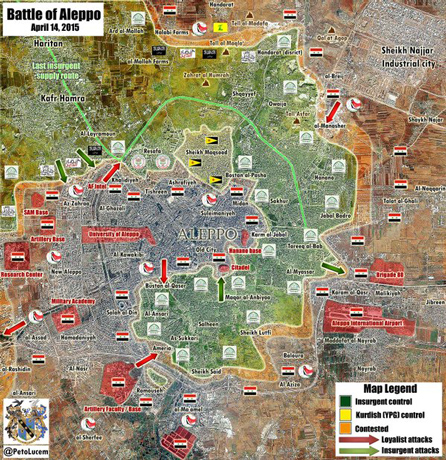 One of the cards for the battle for Aleppo
Ilya Matveev
Candidate of Political Sciences, European University in St. Petersburg
The thesis that our society is indifferent to Syria is rather an illusion. If you look at the data of polls, for example, the Levada Center, then back in October, the Aleppo bombing became one of the most remembered events. 25% of respondents said that over the past four weeks, they remembered military operations and the fight against terrorists in Syria. At the same time, interestingly, the elections of State Duma deputies gained only 18%. Then the question was asked: “Do you follow what is happening now in Syria? If so, how careful it is? " “I am closely monitoring” - 18%. The next item - “I know a little about the latest events in Syria, but I do not follow them intently” - 64%. “I do not know anything about the latest events in Syria” - only 17%said this. This number decreased sharply when a new round of a military campaign began.
The thesis that our society is indifferent to Syria is rather an illusion.
It also follows from polls that the attitude of people to the Syrian conflict is ambiguous - unlike Donbass and Crimea, there is no unity on this subject. Question of the Levada Center: "How do you feel about the application of air at Syria by the Russian Air Force?" “Entirely positively” - 16%, “rather positively” - 36%, “rather negatively” - 20%, “sharply negative” - 6%. In other words, there are 26% of people who are negative. It was difficult to answer another 23%. It turns out that those who are positive, about half. Moreover, even in Western countries, when military campaigns (say, a campaign in Iraq), approval initially at the level of 70%. The surge in the approval of Russian actions in Crimea is not unique in this regard. In America, at first, too, everyone supported the Iraqi war, and then this indicator quickly fell. In Syria, we see that a year has passed - and people do not have much enthusiasm. “Entirely positively” - only 16%.
The lack of enthusiasm is also manifested in the fact that, according to surveys, supporters of intervention are less than half of the total number. In Syria - unlike Donbass and Crimea - not their own; Here it is impossible to mobilize Russian nationalism. Naturally, ISIS is “no worse”, but people suspect that there is no question about ISIS. Putin himself called two reasons for the entry of troops: the first to prevent terrorism in his homeland so that ISIS does not reach our country, and the second is the help of legal power, Bashar Assad. And this already creates ambiguity: why are we doing this? People do not have a clear understanding that was in the Crimea.
In addition, there is one more thing. Polls show that people are afraid of the Third World War. “Are you afraid that the current aggravation of Russia's relations with the West can develop into the Third World War?” “There are some fears” - 38%. Another 10% has “big fears”. That is, for example, if America wants to introduce a useless zone, and Russia flies there with its planes, what does this mean? America will shoot down our planes? Given the nuclear weapons in Russia, the situation is generally unpredictable - people understand this. If 48% in the survey of the Levada Center fears the third world, this means that in the propaganda sense, the Syrian theme is far from as unambiguous as it might seem. Because in the Donbass no one was afraid of the third world, and in Syria they were afraid.
The Syrian conflict has become so complicated that it is simply impossible to single out the moral right side in it.
Since the attitude of people to the topic is ambiguous, the authorities could well be afraid that the rally would be popular. In the case of Ukraine and Crimea, the authorities understood that the position that most of the liberal opposition took did not like the position. Most are not ready to solidarize with the continuation of the ATO, attacks on the Donbass, etc. And in the case of Syria, it is still unknown.
At the same time, the Syrian conflict has become so complicated that it is simply impossible to single out the moral right side in it. That is why there is no anti -war movement around Syria on a large scale - not only in Russia, but also in the West. This is the radical difference from the situation with the movement against the war in Iraq, which gathered more participants than even protests against the war in Vietnam at one time. Demonstrations against the invasion of Iraq were the largest demonstrations in history in general: in America, millions came out on this day, a million people only at a demonstration in New York. Then the question was quite clear: there is a Bushevskaya neoconservative administration, it does not save anyone, but satisfies its monstrous ambitions.
In Syria, everything is more complicated. Many of those who were against intervention in Iraq are not denied intervention: the longer there is no intervention, the longer the bloody meat grinder lasts. And primarily from the Assad regime. That is, it is one thing when the massacre does not occur, but potentially could occur - as in the case of Saddam. And another thing, when since 2011, the Assad regime managed to kill, according to some reports, 500 thousand people. And in this situation, opposing intervention means difficult moral responsibility: it turns out that you are, in principle, against the resolution of this conflict, if it is not allowed for four years.
For all the complexity of the situation, Russia plays a reactionary role - supports the force, on the conscience of which most deaths in this conflict, and thereby prolongs it.
The ambiguity interferes with the creation of a stable anti -war coalition. If we read Davidis's statement about the prohibited rally, what is the saying there? “We demand that military intervention in Syria be directed exclusively at the fight against international terrorism and was carried out jointly with the international community, under the auspices of the UN.” It turns out that an anti -war rally is not against war? Probably, Davidis had in mind that Russia should stop supporting Assad and support ... whom to support under the auspices of the UN? Americans, for example, support Islamist groups. What, Russia also needs to do this? What Davidis had in mind here is incomprehensible. At the same time, he did not rule out the participation itself. From here, too, an ambiguity arises, which prevents the crystallizes of anti -war movement. When we had a powerful anti -war rally in Donbass, there was no special ambiguity, we have come out, by the way, tens of thousands of people. And here ... Suppose, Russia stops maintaining Assad, and what does it do then, what should be the position of Syria? No at all? Russia is an important element of this game.
At the same time, the anti -war statement on Syria is absolutely necessary. Because Russia, for all the complexity of the situation, plays a reactionary role - supports the force, on the conscience of which most deaths in this conflict, and thereby prolongs it.
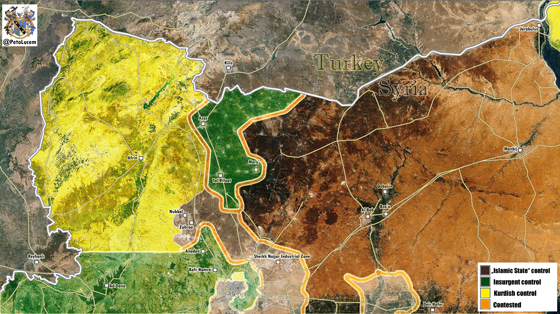 One of the cards for the battle for Aleppo
Vlad Tupikin
Member of the Public Movement, journalist
If we talk about why Syria is the number one theme in Europe, and in Russia it is met relatively indifferent, then the matter is mainly in the media. Russian society is still largely “Soviet” regarding the media: the vast majority of the population draws information about the world from the mainstream media. Rather, it was even worse-Soviet society was much more politicized, and simply more curious, so the information from abroad was watched as a whole more closely than now.
And what is "opposition forces"? There are no single "opposition forces." Some of the scattered “detachments” of the opposition support the patriotic and even imperial vector of the Kremlin policies, so they try to mobilize their supporters on other topics. Some are simply afraid to cross the line, beyond which the authorities will easily move from a long -hard opponent to direct suppression. There are many such topics, Syria is not the most important of them. But Syria, of course, is also in the pool of a specially protected monopoly on a statement. Smart people in the opposition see this and try not to stick out from sin away from sin. How to call them after that - you did not ask me.
For modern Russia, no examples of anti -war campaigns are indicative. And the meaning of movements against the war in Vietnam or Algeria should not be exaggerated.
The Syrian question for the Kremlin is a matter of prestige, primarily in the international arena. That is why it is so important to show that within the country there are no serious protests regarding the Russian politics in Syria. There is one more reason, although not primary: the authorities do not want to attract the attention of the population to uncomfortable issues, even if this is the attention of the vanishing small stratum. Of course, the protest on the Syrian theme will still not be shown on television, but the authorities do not need any hype around Syria, even positive. It is more convenient to soak the scale of the problem: God protects the banned.
For modern Russia, no examples of anti -war campaigns are indicative. And the meaning of movements against wars in Vietnam or Algeria should not be exaggerated. The war in Algeria was stopped not by the French protest movement, but by the new president, de Gaulle, who came to power through the coup. In America, the protest was really wide. But it took him several years to become at least some mass, and a few more years to start influencing the country's policy (war in Syria, if you count from the beginning of the Russian involvement, is still incomparably less than time). In addition, we must not forget the relatively great freedom of speech and press in the USA period of the Vietnamese War compared to the current period in the Russian Federation. The press, which every day shows the war in prime time with all its cruelty and crimes, is not at all the same as the press that the war, its character, its scale and the real responsibility of the warring parties are trying to hide every day.
Yes, our heroic pilots fly, but this is a limited contingent of military specialists, this is not participation in the war - this is what the majority thinks.
In modern Russia, mass anti -war movement is impossible. If only because people for the masses do not believe that there is a war. What is the war? Where? Do we have to do with it? Yes, our heroic pilots fly, but this is a limited contingent of military specialists, this is not participation in the war - this is what the majority thinks. It is not very profitable for the opposition to raise this topic: to someone-because of the solidarization with the Imperial policy of the Kremlin, to someone-because of the fear of repressions. The press deliberately does not pose so sharp questions. While in the case of Vietnam or Algeria, she covered in detail the anti -war movement - no less intently than the course of hostilities.
But the most important obstacle is that modern Russian people for the most part are not aware of the connection between the budget deficit and the foreign policy adventures of the authorities, and at all, are not sure of the direct connection of the policy of any governments “from the TV” with the degree of their prosperity. Власть для современных российских людей — не сменяемая посредством выборов группа чиновников, а некое отдельное явление вроде погоды или климата — все это надо пережить. И переживают. Какая уж тут Сирия? Анти-какое движение?
Скачать весь номер журнала «Разногласия» (№11) «Ни войны, ни мира»: Pdf , Mobi , Epub