Translated material
How to stop cars from killing pedestrians on sidewalks
When a car flies onto the sidewalk after an accident and kills a person, this is a reason to think about how to prevent this. In Russia they came up with the idea of installing road barriers. Like, if we stick iron bars between a person and a one and a half ton car, they will protect the pedestrian from death. But it doesn't work .
Road safety is primarily the responsibility of the designer, then the builder, the balance holder and the police, and only then the driver - this is one of the principles of the successful Swedish program to reduce deaths and accidents on the road, Vision Zero. Therefore, it is easier, even at the design stage, to ensure that the driver has a minimal chance of causing a fatal accident, namely, to prevent him from accelerating to breakneck speed.
The speed of cars is reduced in different ways:
- reducing the speed limit in the city to 50 km/h
- reducing the number and width of stripes
- artificial curvature of the roadway using:
- traffic islands
- sidewalk protrusions in front of a pedestrian crossing and “sharp” turns
- artificial curvatures of the roadway - chicane
- arrangement of roundabouts
- equipment for speed bumps and elevated walkways
- “inconvenient” for cars or contrasting coating at crossings.
Why do you need to slow down?
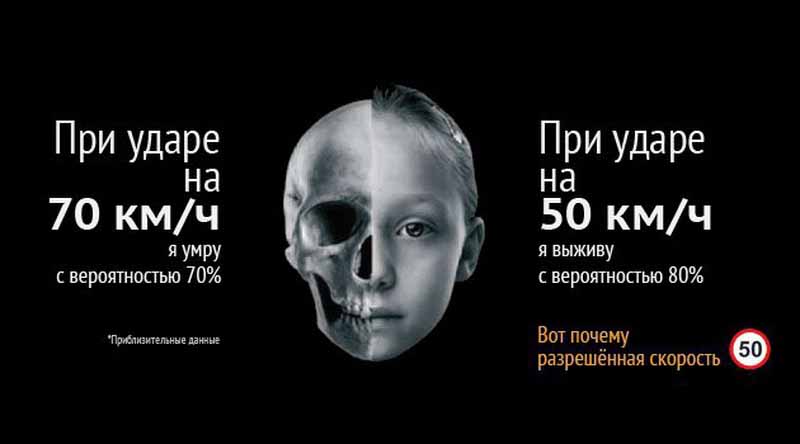
This translated New York poster explains why the city has a 30 mph speed limit. At a speed of 40 mph (64 km/h), the probability of death is 70%. At a speed of 30 mph (48 km/h), the chances of survival are 80%.
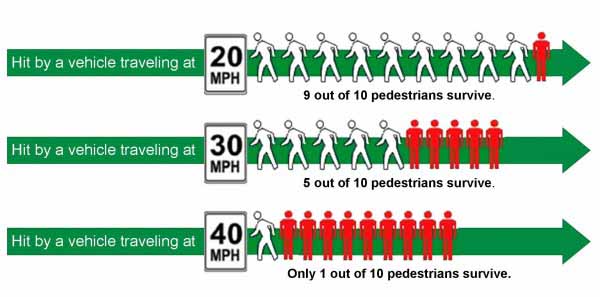
Another example illustrates what a pedestrian's chances of surviving a collision with a car traveling at 32 km/h, 48 km/h and 64 km/h respectively are:
The following illustration also takes into account the braking distance and the driver's viewing angle - parameters that directly depend on the speed of the vehicle. And these parameters already determine how quickly the driver will react to an emerging pedestrian and whether he will be able to stop in time.
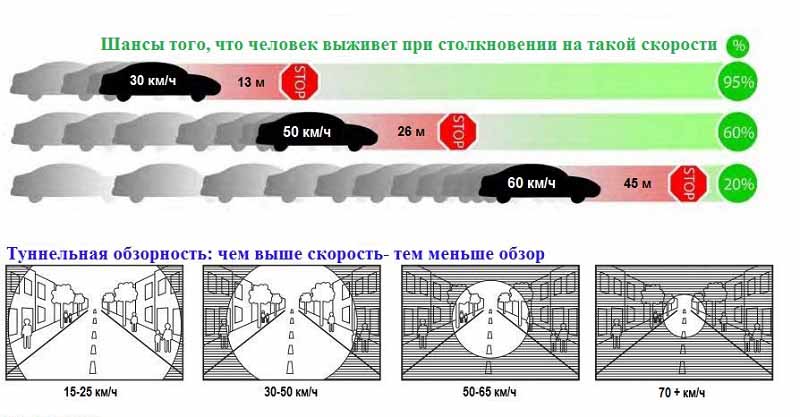
That is why it is worth limiting the speed of cars in the city center to 50 km/h, and making it even lower on busy streets. However, it is not enough to simply install a sign, as the driver may ignore it. It would be more effective to not even give him the opportunity to accelerate to a dangerous speed.
Therefore, the second measure is a general reduction in road width . Roads in the city should not turn into tracks for racers. In general, a city should not have roads, but streets suitable for walking.
In addition to narrowing roads in general , measures are being taken to bend the roadway . This is mainly done with the help of traffic islands: this is a designed space in the middle of the road that makes it easier to cross - for example, older people can stop here and not be afraid of being hit. Another function of traffic islands is to narrow the roadway and, therefore, reduce the speed of cars.
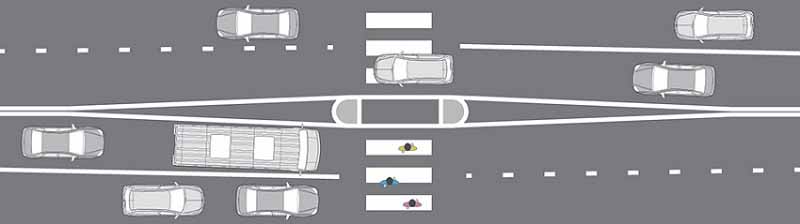
In addition, they reduce the turning radius of vehicles, thereby reducing their speed and making intersections safer.
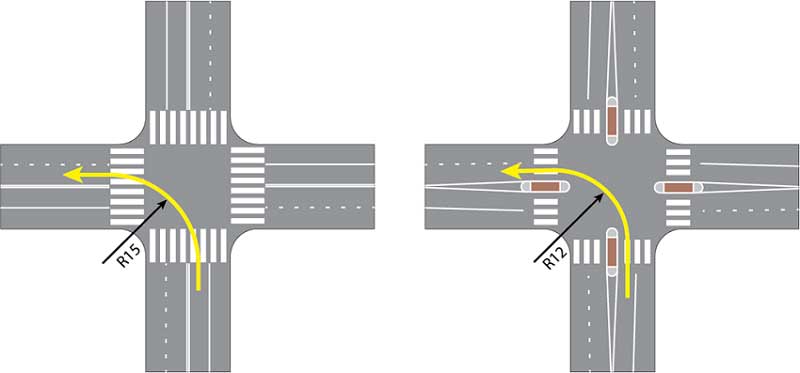
You can read more about traffic islands here .
Another way is to narrow the road in front of the pedestrian crossing. Bonus: Now cars can't park here, making it easier for drivers to spot a pedestrian getting ready to cross the street. Important: the narrowing is designed at the expense of parking so that a bottleneck does not form and the overall capacity of the street does not decrease.

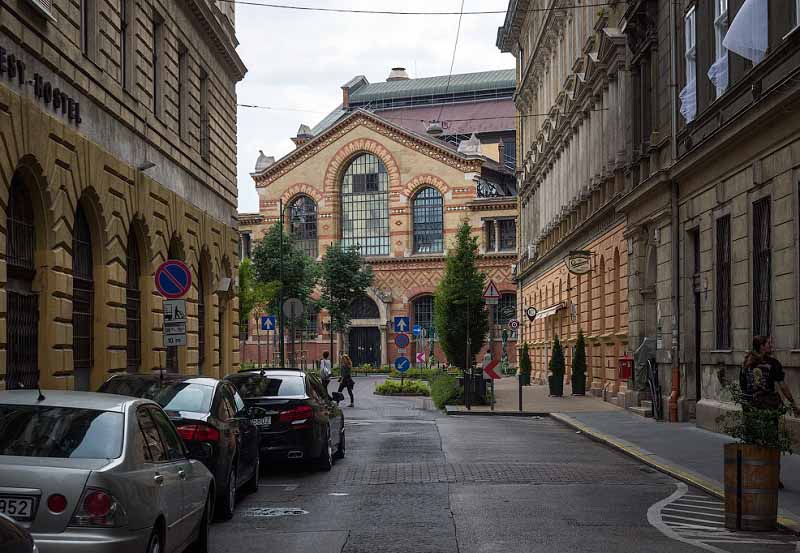
The third method you have seen in racing: chicanes - special artificial curvatures of roads. They can be equipped with markings, parking, flower beds or other small architectural forms.
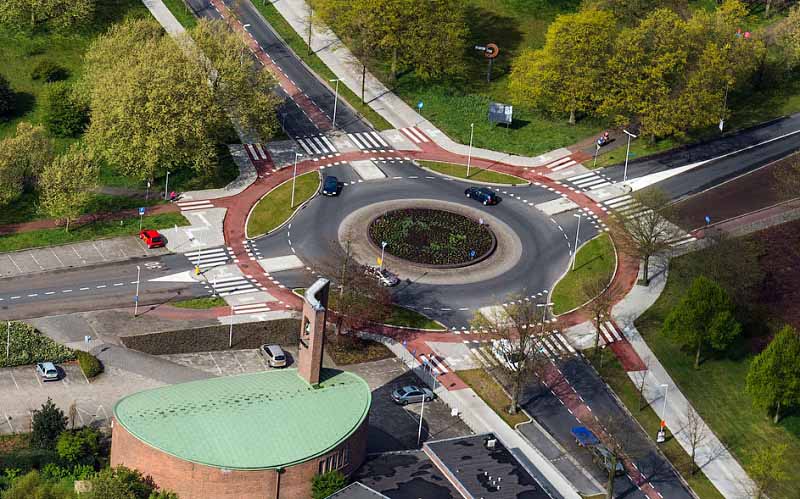
The next measure is roundabouts at intersections . The driver is trying to negotiate a turn and is therefore forced to slow down.
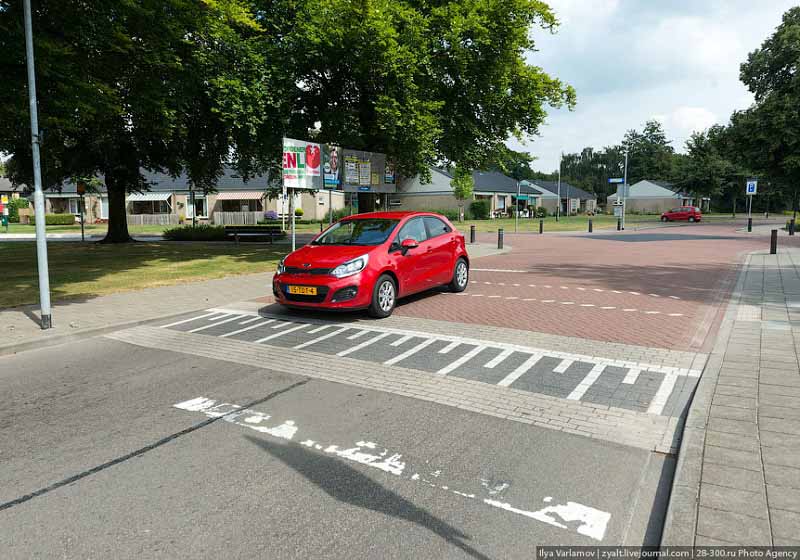
Measure No. 5: the speed bump, common in Russia, and its “relative” - the raised crossing . These methods are used on secondary streets. In the illustration below, the raised passage is also combined with an “inconvenient” surface for cars—paving stones—and is also highlighted in color.
Let's sum it up
The lower the speed of the car, the higher the chance of survival in a collision with a car. Therefore, it is necessary to reduce the speed of cars in the city.
It is possible at the legislative level to limit the speed to 40-50 km/h.
It is possible to prevent the driver from accelerating by using planning solutions to narrow and curve the roadway.
Demand this from the authorities of your city, and then you can be a little calmer for your loved ones.
Sources:
https://varlamov.ru/2519120.html
https://proboknet.livejournal.com/287865.html
https://gre4ark.livejournal.com/476835.html
http://vezudetal.ru/news/Bump
http://autoass.ru/dorozhnaya-razmetka/razmetka-1-16.html