Date
Author
Source

Preserved copy
Translated material
Special services: Results 2016
Last year, it began under the sign of strengthening the Internet censorship, continued with repression against bloggers, and ended with American sanctions against the leadership of the GRU for hacker attacks on the servers of the Democratic Party during the presidential election campaign.
At first glance, all this does not sound too happy, but several reasons for optimism in the future remain.
For the Russian intelligence services, the end of the New Nobility project and the emergence of a new model of the Kremlin work with the FSB and other security forces meant the year. Although the creation of the National Guard at the site of the internal troops of the Ministry of Internal Affairs reflects the fear of the Kremlin before possible protest excise taxes against the backdrop of the economic crisis, in general the “new nobles” have ceased to be the personnel reserve of the Putin’s political elite.
From the very beginning, the Kremlin concept of Internet control was more based on intimidation than on technology. The Kremlin relied on administrative pressure on companies such as Google, Facebook, Twitter and Yandex.
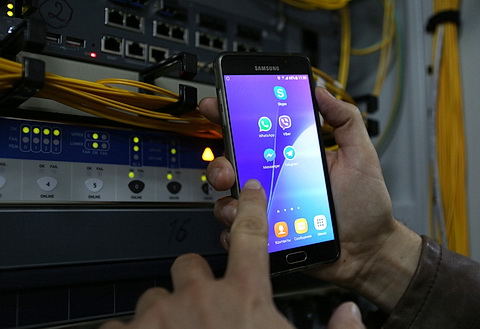
Recently, a huge number of repressive laws have appeared: on sites of sites, about the transfer of servers to Russia, about the mandatory installation of an improved SORM interception system at the expense of companies. In the summer, the most loud and absurd “Yarovaya Law” was accepted, which requires telecommunication companies to store everything that we write, speak and post on the Internet for six months. The purpose of this rapid lawmaking was to force social networks to block content and issue personal data of users at the first request of the Russian authorities, as well as a guaranteed opportunity for the FSB to intercept all the information that users transmit in instant messengers and social networks.
This strategy has failed - no one except Chinese companies and rapidly losing popularity of Livejournal.com, servers to Russia, Facebook and other global companies are practically not issued to the Russian authorities, unlike VKontakte, which after the departure from the company Pavel Durov became densely cooperation with the state.
Realizing that it was not possible to build a wall on the path of information on the network, the Kremlin turned towards China. During the year, Kremlin officials regularly met with Chinese colleagues, trying to understand how to build the same effective Internet filtration system as the Great Chinese Firewall. The head of the cyber administration of China Lu Vey and the creator of the great Chinese Fayerwal Fan Bincin came to Moscow, and Russian officials went regularly to China.
In the summer, Putin signed a joint statement on information security with China, which reflects how similar the views of Moscow and Beijing became in relation to the “threats” emanating from the Internet.
In the fall of 2015, the Kremlin began to make sharp, often chaotic movements, apparently designed to mobilize the state apparatus and regional elites before the elections. Different methods were used - from targeted repressions to the resignation of old friends of the president from among the KGB veterans.
The FSB spoke that a new wave of appointments of Lubyanka employees was coming to the posts in the state apparatus. This did not happen. New people - technocrats and officers from special services, but not from the FSB, but the FSO - the Presidential Protection Service really began to appoint.
The Federal Security Service itself suddenly received several new deputies and heads of key units from the outside. In the spring of 2015, two Varangians came to the deputy - Dmitry Shalkov, a native of the Investigative Committee, became the state secretary, and the counterintelligence head was headed by Vladislav Menshchikov, the former chief of the Presidential Special Directorate of Special Programs. In December, Igor Sirotkin, who had previously oversaw economic security in St. Petersburg, became deputy director.
As a result, in 2016, the special service intensified the fight against spies and quickly blocked the level of spy -farm of the early 2000s, and at the same time was thrown to conduct targeted repression under the flag of corruption - the FSB officers participated in all major investigations of 2016, from the detention of Minister Ulyukaev to the arrests of police officials.
In October 2016, the FSB received another new deputy, and again the external man - Evgeny Zinichev became the deputy director, who made his career among the Putin guards - in the FSO and SBP.
Lubyanka not only stopped supplying personnel for the state apparatus, but the old friend of the President Viktor Ivanov lost all meaning. It was he who was responsible for the first mass wave of appointments of special services officers in the early 2000s,
Being then the deputy head of the presidential administration, who oversee the personnel policy. Vladimir Yakunin lost their posts - a native of the KGB, who claimed the role of the developer of the national idea, and Sergey Ivanov is the most successful KGB officer from Putin's friends, who retained authority on Lubyanka.
So the new model of Putin’s interaction with the security forces has finally took shape: he abandoned the scheme that he tried to implement since the early 2000s, when he began to sculpt from the FSB “New Nobility” - at the same time, the supplier of personnel and the brain trust to develop the new ideology of the country.
The “new nobility” was the postmodern invention of Putin and his friends from the KGB who poorly understood how the Soviet state worked, but believed in the mythology of the “best people of the country”, which was created using films and books under the control of Yuri Andropov in the late 70s and early 80s.
Putin needed 16 years to be disappointed in his invention. In 2016, he decided to return to Soviet experience when the country's main special service was primarily the “advanced detachment of the party” - that is, an effective, but absolutely controlled tool to control society in the hands of the country's political leadership. In Soviet times, this control was carried out through spying - to intimidate the population, and targeted repressions - to keep the elites in the UES. It is unlikely that it was by accident that these two directions were abandoned by the main forces of the FSB in 2016.
However, outside the country, the Russian special services did not become famous for this.
Perhaps 2016 and the election campaign in the United States will go down in history as the first example of using cyber weapons to achieve political goals.
It remains a big question of what role the actions of Russian hackers played in the victory of Donald Trump, but something is clear today. Hackers have changed the rules of the game, and now the military, diplomats and politicians around the world will have to completely revise the response strategies for the cyber surplus of other countries into political processes.
In 2016, the Russian special services exactly fell into history.
Photo: Russia. Belgorod. October 4, 2016. The WhatsApp, Viber, Facebook Messenger, Telegram and Skype app. Russian companies began to search for a method of access to the correspondence of citizens in Messenagers WhatsApp, Viber, Facebook Messenger, Telegram and Skype. This is necessary for the implementation of the "package of Yarovo", in the framework of which, to combat terrorism, the authorities intend to intercept and complete decryption of traffic. Anton Vergun/TASS