
Translated material
The results of the year. Year of sensations and risk
Around Russia
 The results of the year. Year of sensations and risk
January 5, 2017 Alexey Makarkin
2016 became sensational for the modern world. At first, Braxit, then the election of Donald Trump by the president of the United States, and throughout almost the whole year - the leadership of Marin Le Pen in French presidential ratings. Only in December she was bypassed by the new favorite of the legal entities of Francois Fillon. We add to this three -Tour elections in Austria (it turns out that this happens not only in Ukraine, but also in “old democracies”), which the system candidate won with great difficulty. And the defeat of the government in a referendum in Italy, which caused the resignation of Prime Minister Matteo Renzi.
All this once again made a long -standing topic about the end of the West and the end of Europe, which will be crushed by a powerful populist trend. However, over the past hundred years, Europe and in general the Western world has been buried more than once. Serious economists defended the advantages of a planned economy, serious journalists talked about the higher competitiveness of the USSR compared to the West. In the 70s, the footage of the Americans and their supporters from Saigon became a symbol of US powerlessness in the 70s, and a few years later, Jimmy Carter was powerless in front of the Iranians who captured the hostages at the US Embassy in Tehran. Against this background, solemn parades on Red Square seemed symbols not only by relics, but also of centuries -old stability. Several years passed and it turned out that the Western world is more flexible and adaptable to modern challenges.
What is happening now? After the end of the Cold War, a number of principles seemed unshakable to the Western world. This is a rational choice of voters who vote based on democratic values and their own interests. This is the unconditional need for strong political institutions for the development of democracy. And this idea of progress, close to positivism, which existed before the First World War, when people were sure that education helps to promote progressive values and this process is linear or almost linear.
And suddenly the whole usual design began to crumble. However, upon closer examination, it turns out that everything is much more complicated.
Indeed, was not the idea of the strength of the institutions of institutions contributed to the fact that many people vote behind Trump or are going to support Le Pen? Of course, this is not the main explanation, but it seems psychologically very important. It is scary to vote for a populist with authoritarian potential. But if you know that the country has a strong independent court and influential opposition, then fear becomes less and there may be a desire to take a chance. Try a “sharp” dish, realizing that if it turns out to be inedible, it can be replaced in the next election- as it was in the context of friendly competition between left- and right-centers. Many people are sure that new leaders will not become dictators (institutions will not allow them to do this), but they will better represent the interests of citizens who are on the sidelines of progress.
And here you can raise the question of rationality. It is often believed that voting for populists is associated with an emotional factor, a reaction to loud and insufficiently calculated (or not calculated at all) promises. But it should be noted that emotion is an integral part of politics. If the candidate is unable to cause emotion, then incentives to vote for him are reduced. And is there a problem that the Western world puts forward fewer “systemic” politicians who can appeal to people's feelings? Politics becomes an opportunity to make a smooth career - the same as in large corporations. But if so, then citizens are looking for less boring alternatives - and find them.
But it would be a simplification to say that voting for populists do this only for emotional reasons, seeing living and sincere people in them (regardless of the real degree of their sincerity). The main thing is that the transition from industrial to the service economy has become a drama for millions and millions of people. Moreover, this drama is multifaceted. Many lost not only the usual work, but also the status - for example, an industrial worker, a member of the trade union, the support of society. Such a person may not even lose in income, moving to the service sector, but he still has a deep feeling that he does not live his life, does not what he needs to society. Psychology is always behind the economy. It is not surprising that Hillary Clinton suffered a fatal defeat for herself in the three industrial states (Pennsylvania, Wisconsin and Michigan), which were previously considered stably democratic. She could not offer workers who had no rational incentives to vote for her.
Moreover, many really lost in money - especially after the financial crisis of 2008, which inflicted not only an economic, but also a strong psychological blow to Western society. From a technocratic point of view, it is clear why the governments rushed to save the banks - but this cannot be explained to the person who was left to their fate at the same time. The place of progressive economic growth is occupied by more complex processes in which growth alternates with stagnation and crises. Many were wealthy from this.
Now about democratic changes. Here the question arises of whether the elites were able to offer society a summons, which really interests him. A number of topics - for example, migration - turned out to be taboo during public discussions. This contributes to the fact that they are raised-in a bright and strict form-populist politicians who offer simple answers to complex questions. But society does not receive alternative intelligible answers from elites. Moreover, it is already impossible to limit the formulas that have become banal from a long use to the place and not to the place (such as “all people - brothers” and “we must understand the other and respect other cultures”), it is no longer possible.
Often the question arises of the balance of interests of the majority and minorities. A vivid example is a loud Italian history with the initial decision of the European Court of Human Rights on the need to remove crucifixes from schools as religious symbols - on the grounds that this is unacceptable for parents raising their children in the spirit of atheism. The second instance, however, canceled this decision, citing the historical traditions of Italy as a Christian country. The tension between Italy and the court on a specific issue was removed, but the topic itself remained. People who are accustomed to consider themselves a majority and the basis of society are increasingly feeling that the values for them are under a blow. When, for example, it is proposed to celebrate from political correctness not Christmas, but a certain “winter holiday”, cleared of any hint of its Christian character. It is clear that this is not a mainstream now, but there are no guarantees that there will be no mainstream in a couple of decades.
The attitude of the press to Pope Francis is characteristic. When he talks about mercy and openness in the Church, about sympathy for migrants, he, as they say, has a “good press” - even with a shade of cloying. But as soon as Dad politely makes it clear that he does not intend to dismantle the thousand -year traditions of Catholicism and that there is continuity between him and his more conservative predecessor - the tone of comments immediately changes. At the same time, Catholics are also part of society - and they believe that their opinion is not taken into account. Hence the powerful Catholic mobilization on legal -centric primaries in France in support of Fiion - contrary to the ideas that existing in Russia, most French Catholics are not enthusiastic about Madame Le Pen, for them it is too radical.
Thus, voting for populists forces traditional elites to reaction, which can be multifaceted, and not related to the rejection of democratic principles. We are talking about changing leaders, promoting people who can speak with people in their language. And about the interception of the initiative - in a civilized form, the form of populists in socially significant issues (the new government of Austria tightened the position in relation to migration - and the extreme right candidate in the third round received less support than in the second). The understanding that radical avant -garde in the promotion of non -Consulting values can damage not only specific politicians, but also democratic development, is intensified, causing a response opposition. And there are serious reasons to believe that far from the first (and, probably, not the last) “end of the West” will actually become his next transformation, the answer to real challenges that politicians cannot but take into account.
Author-First Vice President of the Center for Political Technology
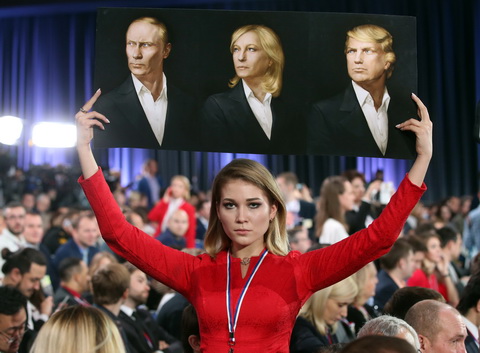
Photo: Russia. Moscow. December 23, 2016. The journalist before the start of the large annual press conference of Russian President Vladimir Putin at the Center for International Trade on Krasnaya Presnya. Artem Korotaev/TASS