
Translated material
Year of exposure of sensations
The main discoveries and achievements of archaeologists in 2016
In 2016, there were many not only archaeological news about interesting finds, but also stories exposing the sensational discoveries of previous years. It turned out that many sensations of 2015 turned out to be a soap bubble. At the request of Medusa, journalist Julia Stutina talks about the main archaeological news of 2016 - about the new discoveries and the exposure of the previous ones.
Three "s"
The authors who write about archeology admit that the general public invariably attract three “h”: mysterious, gold and famous. Unfortunately, three “h” are rare together. To tell the truth, and one “z” in archeology is a rarity, but still convinces the reader to click on the headline. As a result, the most popular news is not so much important events for science as intriguing. Of course, those messages that talk about the possibility of a breakthrough and discovery are gaining maximum popularity. They, as a rule, (but there are exceptions!), And turn out to be soap bubbles.
In 2016, “z”-a single-sensations related to celebrities, gold and riddles in any of their combinations-there were many. For example, the most exciting plot of 2015- the search for Nefertiti’s secret room in the Tutankhamun tomb-was completely blown away by May 2016: the wall scanning data are not available for independent experts, the Minister of Culture of Egypt, who was at the head of this PR company, was removed, and Nicholas Reeves, the author of a bold hypothesis, refuses to talk with journalists. This story was at once two “s”: the mysterious and famous beauty-man, and if the hypothesis turned out to be true, then there was probably more than enough gold (as happened in 1922 with Tutankhamun’s actual tomb: the main and inaccessible three- “zica” of all time).
In 2016, the story about the Canadian schoolboy , who found the lost city of Maya, found in a satellite picture, began and silently ended. There was only one “z” factor: mystery, but it was enough for a huge media fireworks. As a result, truthful news from places sounded comically: one of the mysterious objects found by a teenager is a marijuana field, and the second is a drained swamp.
In the summer of 2015, the news was discussed about allegedly found in a secret tunnel near the Nazi train with the Gold of the Reich (two “z” - zoloto and a riddle). The media with pleasure quoted Deputy Minister of Culture of Poland, who was "99 percent confident in the existence of the composition." A year later, at the end of August 2016, it turned out that excavations worth 140 thousand zlotys (more than 2 million rubles) did not lead to anything: they didn’t find a train, but even the tunnel turned out to be a fiction.
The news about the discovery of Aristotle’s grave (at least one “z” is a celebrity, but you can pull up a riddle). Attentive readers probably did not miss a quote from the sensation of the sensation of the archaeologist Kostas Sismanidis: "I have no good evidence, but I am almost sure of this for some signs." It resembles the above replica of the Polish official, isn't it? Adrián Maldonado, an archaeologist from the University of Glasgow, calculated that in the popular British tabloid The Daily Mail informing about the sensation, 6,000 people shared the news of the tomb, and that the hype turned out to be a millet - only 53.
In 2016, they again started talking about the last chapter in the life of the legendary American pilot Amelia Erhart, who went missing the Pacific Ocean in 1937, making a round -the -world flight. This is a classic unsolved secret associated with a celebrity (i.e. two “s”), around this story there is an even rumble from the very day of the disappearance of Erhart. There are two main versions of what happened. First: the plane did not reach the island of Hauland and sank somewhere near him; The second: Erhart reached the car to the atoll Nikumaroro (belongs to the state of Kiribati) and lived on this uninhabited rif for several more weeks, if not months .
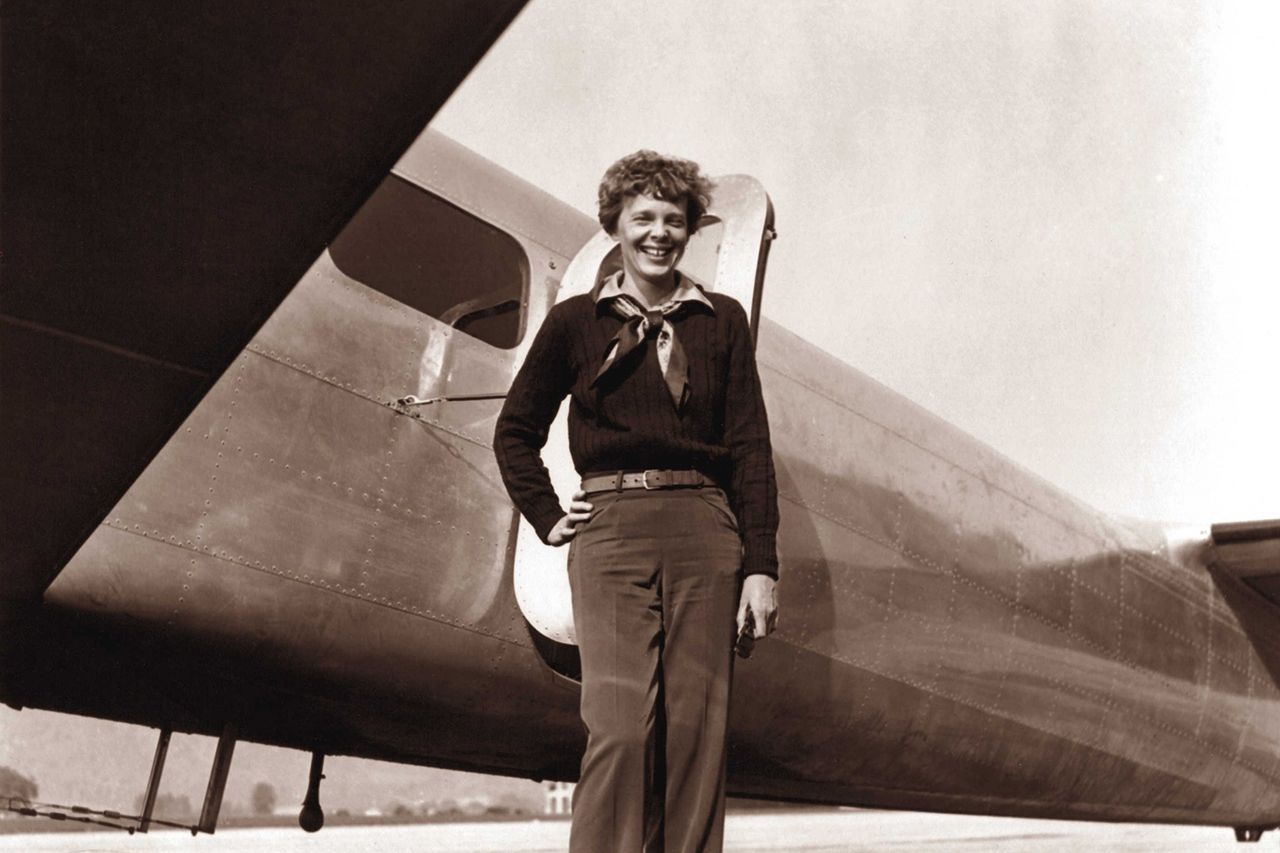
Rick Gillespi, the author of the second version, took excavations three times on Nikumaroro, but failed to convince the scientific community with his finds: neither traces of fires, nor female shoes, nor a jar of cream from freckles - the same as Erhart used. This time, Gillespi called for the help of anthropologists who critically rethought a report on the skeleton found in 1940 on the Atoll. Then the doctors came to the conclusion that the remains belonged to the man, but the Gillespi colleagues now believe that the bones could be female: Erhart was tall, with unusually long forearms. The opponents of Gillespi again criticized his theory - and is not unreasonable. But in the minds of the inhabitants of Amelia, Erhart has long been not just a pioneer of aviation, but a legend - and the legend cannot have an ordinary final.
You can joke for a long and evil over the “z”-numbers, but it is worth taking into account that not only love for sensations drives readers (and journalists). Archaeological news also loves that they may tell a good, interesting story, answer long -posed questions and even close the gestalt.
Discoveries
In 2016, there were many other interesting discoveries-however, rather compact and almost without “z” factors.
The work in the Moscow Kremlin, which had begun in 2015, ended. These are the first full -fledged archaeological excavations at the top of the Kremlin hill. Traces of urban development of the XII-XIII centuries and the remains of the walls of the Miracle Monastery demolished in the 1930s were revealed. The most entertaining find is a casting mold with letters scratched on it, of which only four are read: Riyan. In general, the inscription is recognized as unreadable, but the most ancient in the territory of the capital (end of the XII - beginning of the XIII century).
On the coast of Bulgaria , more than 40 sunken ships were found - Byzantine and Ottoman. Participants in the Black Sea Maritime Archaeology Project managed to make very beautiful photos of ships lying in the hydrogen sulfide zone. The absence of oxygen at depths below 150 meters provided excellent safety of ships, and researchers were able to see several types of ships first previously known only by descriptions for the first time.
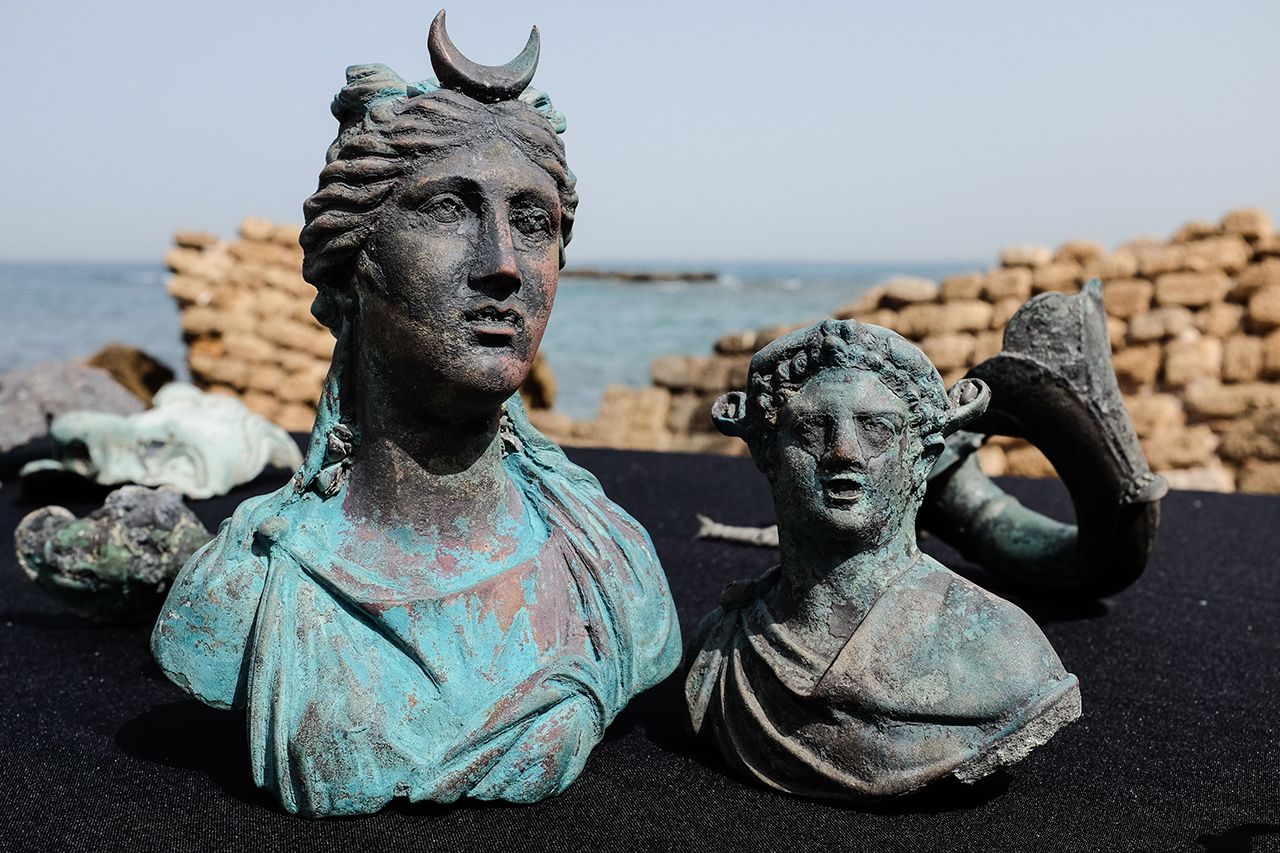
The Israeli divers found a Roman ship on the seabed near Caesarea, sunken in the 4th century AD. The ship is driving bronze sculptures and a load of coins. The safety of objects is excellent. Surprisingly, a sunken ship was found almost there a year earlier - with a load of gold coins.
In Greece on Mount Lycaon, in the ancient area of Arkady, archaeologists, perhaps, found a relic of the dark centuries of ancient Greek history: traces of human sacrifice . The Greeks of the classical era with horror and disgust wrote about these remnants, but the memory of them was preserved and inherited by the Romans as a terrible fairy tale. Are modern researchers right in their interpretation is still incomprehensible, but the find is actually intriguing.
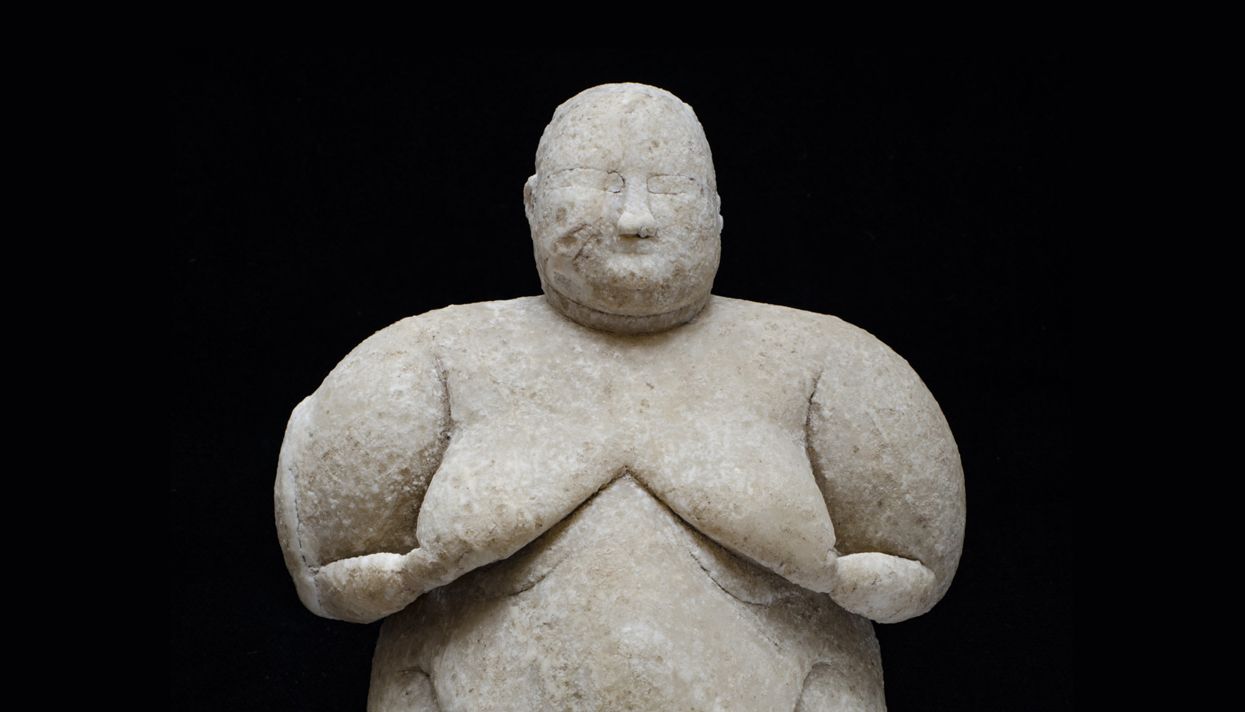
In Turkey, a very thick woman was found. Her age is 8000 years. If such a figure was found in any other place, then it would certainly be called the goddess of fertility, Neolithic Venus, and so on. But the figurine was dug up in Chatal-Hyuke, a unique ancient settlement; His excavations are led by the Englishman Ian Hodder - one of the largest theorists of archeology and a person who has been forcing the most basic ideas about ancient people for thirty years. So Khudder believes that this is not a goddess, but a woman revered by a community, the owner of a high social status.
The history of smallpox, if they do not rewrite, will expand and complement after the study of the mummy of a child who died from this terrible disease in the 17th century and was buried in the Church of the Holy Spirit in Vilnius. Researchers identified the DNA of the virus, recreated it with the genome and compared it to the genomes of other varieties of smallpox. It turned out that smallpox is not at all such an ancient disease as it was thought before. Apparently, a single ancestor of all its varieties (more than 40) appeared only at the end of the XVI - beginning of the XVII century, and not several thousand years ago.
The most curious find of the year was made in the state of New York, where the builders discovered the true tombstone of the Roman tax collector who died in 54 of our era. It turns out that at the end of the 19th century the widow of the oil tycoon Joosaia Maysi bought a beautiful marble plate at the end of the 19th century. The tombstone was stored in the Macy mansion, burned in the 1970s. The workers who disassemble the ruins did not attach the value of the stove and buried it along with other construction garbage.
"Closing"
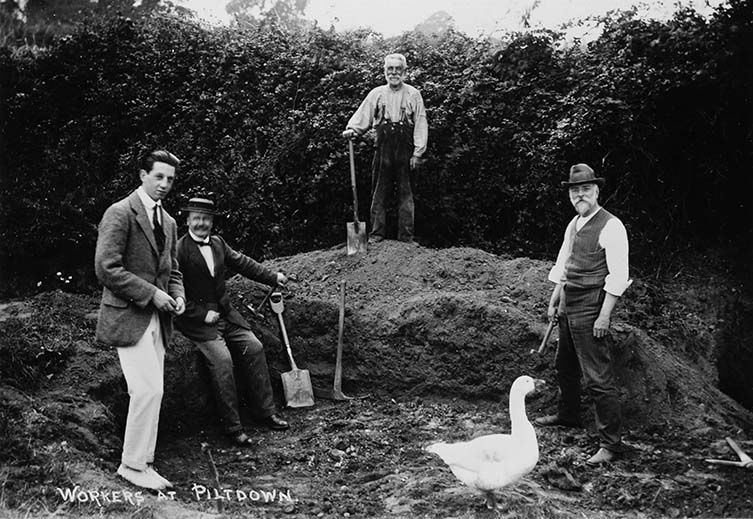
One of the most famous, truly textbook fakes in the history of archeology is the Piltdaun man. In 1912-1915, a group of enthusiasts, led by an amateur geologist named Charles Dawson, discovered fragments of an extremely ancient person in the south of England-the missing link between the monkeys and Homo sapiens predicted by Charles Darwin. Everything was opaque in the history of this discovery, but the public and most scientists happily accepted the idea of the British islands as the homeland of the ancient European Eanthropus Dawsoni . Indeed, in this way, England wiped the nose of Germany, since 1907, who was championing in this intricate competition thanks to H. Heidelbergensis found here.
The Piltdaun man was in all textbooks of archeology and anthropology, where he showed up until 1953, when the fake was exposed. It turned out that part of the bones belonged to the young female Orangutan, and some were borrowed from an unremarkable European who lived in the Middle Ages. And then the most interesting thing began: scientists began to argue who stood behind the fake. They tried to accuse the celebrities of falsification: the writer Arthur Conan Doyle and Theologian Pierre Tayar de Sharden. But Charles Dawson, who died in 1916, remained the main suspect. And only at the end of 2016, his authorship in the creation of a Piltdaun man managed to finally prove . It is noteworthy that the researchers had to use the extensive arsenal of the latest technologies, including spectroscopy and DNA analysis, not so much to convincingly expose a rather rough fake, but to identify a single authorship of falsification. So, finally, a very famous chapter in the history of science ended.
Another important and atypical archeology event occurred in 2016 in the United States: there, after a long dispute, scientists agreed to withdraw the remains of a Kennevik man who lived on the territory of the modern state of Washington 9000 years ago. The skeleton of this ancient hunter was discovered in 1996, and almost immediately it became the subject of disputes between the Indians and archaeologists. The former asked them to give them the remains for burial, the latter wanted to fully explore it as much as possible. After the DNA analysis pointed to the Indian origin of man, scientists agreed to convey the bones to the Indians. The upcoming in 2017, the burial of a Kennevik person is a little rehabilitated by researchers who have forgotten about a good attitude towards people.
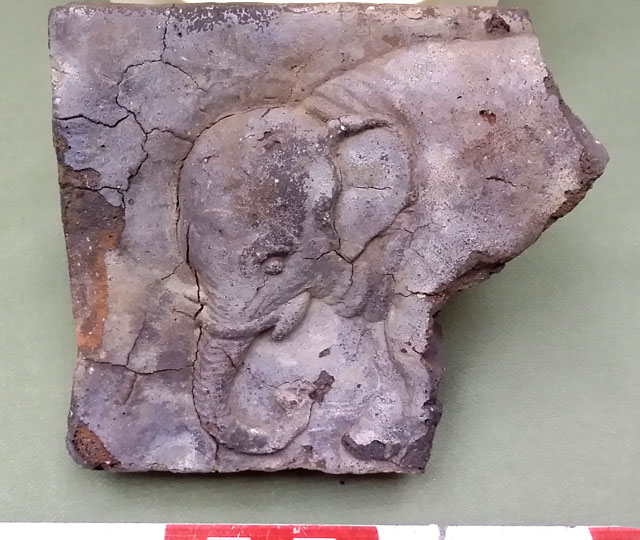
In conclusion, I would like to recall the brightest archaeological photographs of 2016. Firstly, this is the pretty elephant on the tile of the XVII century, found in New Jerusalem. This worthy beast decorated the already excellent and, in gratifying, replenished with bestiary . Secondly, in Israel they found a “thinker” -an image of an extremely thoughtful man in a hat. The figure organically grows from the neck of the clay vessel. The find has no analogues, but the expression on the “thinker” face is recognizable and this is even more valuable. And notice - no gold, no celebrities, except a little mysterious: who he is and what all this means.
Julia Stratotina