
Translated material
Ups, discoveries and falls
Seven main space stories of 2016
Last year, it turned out to be very difficult , but the astronautics turned out to be one of the few areas where you could catch our breath: we were waiting for mostly joyful and certainly interesting news. "Medusa" talks about the seven main space stories that occurred in 2016.
1. Spacex
Ilona Mask was noted by three loud events: good, bad and encouraging.
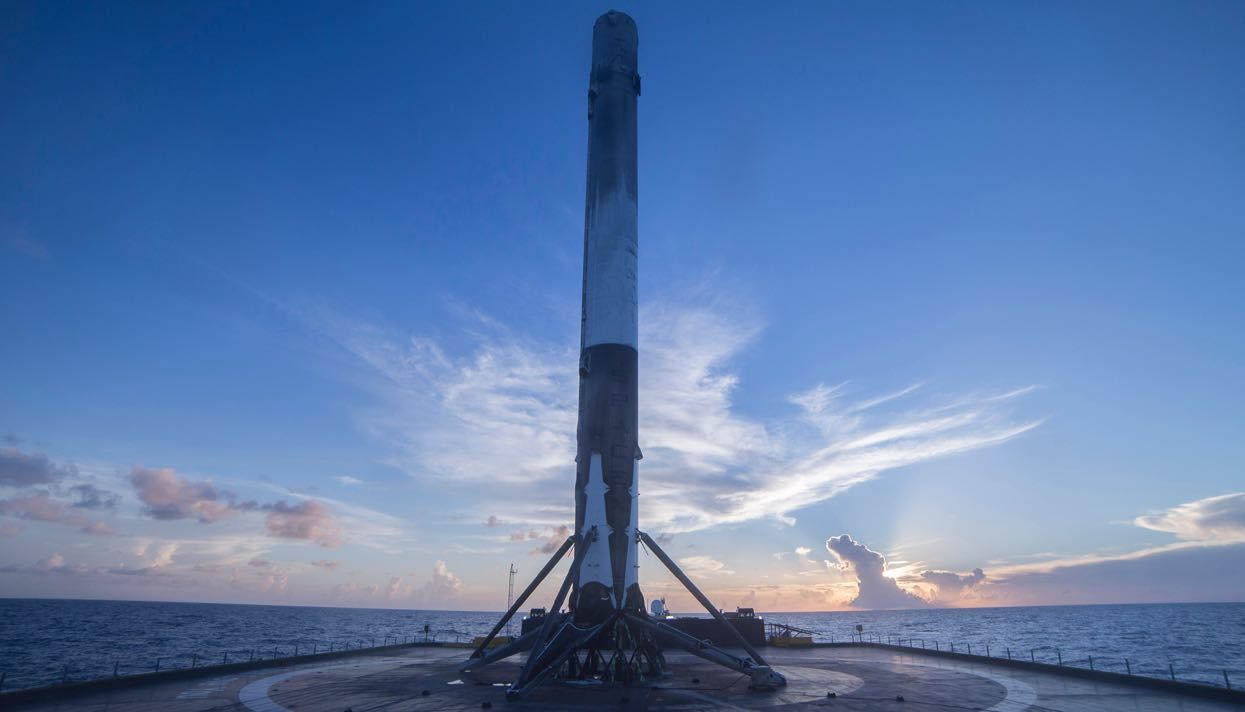
Good: SpaceX learned to steadily plant the first step of the Falcon 9 rocket on a floating platform. In 2016, four successful landings in a row took place at once. Read about why it is generally necessary, read here (if briefly: using the first step repeatedly, you can significantly reduce the reduction of launches).
Bad: on September 1, a Falcon 9 missile exploded at the launching venue of Cape Kanveral. This happened during preparation for launch; No one was injured, but the satellite, which the rocket was supposed to be brought into orbit, was destroyed (in particular, they intended to use Facebook).
The preliminary investigation showed that the explosion occurred due to the crack in the helium supply system into the reservoir with liquid oxygen in the second stage of the rocket. Since September, there have been no new launches of Falcon 9; The next is scheduled for January 2017.
A reversing: Elon Musk promised to send people to Mars. In September, he said that he plans to build a system by 2024, which allows to deliver more than 100 people to a neighboring planet in 80 days at a time. There is one problem: all this works well only in theory - SpaceX has neither a suitable rocket nor a spaceship.
2. "Juno" reached Jupiter
In 2011, the Juno satellite started from Cape Canaveral. Five years later, he reached Jupiter, the largest planet of the solar system. On the way, Juno set a record, becoming the fastest object created by a person. But his main task is different: to explore the atmosphere of Jupiter and try to understand what is hidden under his clouds.
And “Juno” sends us excellent photos of the planet.
3. Europe reached Mars
Last year, the first stage of the exomars mission of the European Space Agency (ECA) was relatively successfully held. In March 2016, two devices went to Mars - Skiaparelli and Trace Gas Orbiter. The first was to gently sit on the surface, and the second - to reach the orbit of the planet.
In October, during a landing at Schiaparelli, an error occurred (he decided that he was below the surface level), and the landing module crashed. But the Trace Gas Orbiter was regularly entered into orbit, and this is the main thing - the device will provide a connection with the marss, which will sit on the planet in 2021. In the meantime, he is looking for methane in the atmosphere of Mars. In Eka, they say that the first stage of the mission was 96 percent.
4. "Rosetta" fell on the comet Churumova-Gerasimenko
At the end of September, the Rosett mission ended: the spacecraft, which flew for nine years to the Cometa Churumov-Gerasimenko, and then studied it for two years, crashed on its surface.
But this is not sad news: the fall was planned. The fact is that the comet began to move away from the Sun (and Rosette with it), the energy for devices of the spacecraft was not enough, and its further work would be complicated.
During the crash, Rosetta transmitted additional data about the comet, and farewell to a series of photos from a few meters from the surface. After the collision, the antenna of the apparatus stopped pointing to the ground, and we do not know whether Rosette remained on the surface or bounced off and flew into space.
Two weeks after the completion of the mission, astronomer Klim Churumov died, who, together with his colleague Svetlana Gerasimenko, opened this comet in the 1960s.
5. Gravity waves are recorded
In February 2016, scientists announced that they managed to fix gravitational waves. Albert Einstein predicted their existence, but it was possible to experimentally prove their existence only last year.
Gravitational waves are the outrage of space-time that occur during the movement of massive objects. For example, in this case, we are talking about the merger of two black holes: one of them was a mass of 36 suns, and the other as 29 suns.
True, these waves reached the ground in such a weak form that it was necessary to build incredibly accurate detectors protected from other vibrations.
Gravitational waves sound like this:
6. The nearest earth type planet was found
The European organization of astronomical studies in the southern hemisphere found that a planet of the earthly type of proxim b is rotating around the proxim of the Centaurus.
The discovered planet is located in the inhabited zone of the star, which means that on its surface there may be water in liquid form. Is there an atmosphere on the planet and even more so the conditions for life is still unknown.
The proxim of the centaur is located in the star system of Alpha Centaurus - closest to the Sun. The star is only 4.25 light year.
Yuri Milner, Stephen Hawking and Mark Zuckerberg plan to send mini-satellites weighing a few grams to the alpha Centaurus, which will accelerate the laser beam from the Earth (so far there is no such technology). It is expected that the satellites will get to the neighboring star system for 24 years.
7. With a strangely flickering star nothing is clear
In 2015, the observatory Kepler discovered that the KIC 8462852 star in 1480 light years flickers very strangely from the ground. From time to time, the brightness of the star (she began to call Tabby) sharply falls, and this cannot be explained, for example, by passing the planet next to her.
Then a fantastic theory appeared: perhaps the aliens built a giant structure that rotates around the star and collects its energy (such structures are called the Dyson sphere; they exist only in theory and science fiction).
In 2016, the situation with Tabby became only more confusing. Firstly, scientists have found another plausible explanation for what is happening-passing a large number of comets before the star.
Secondly, it turned out that Tabby is abnormally fading greatly over time (in addition to a sharp drop in brightness from time to time). Over 3.5 years of observation, the brightness decreased by three percent - this is a lot. Over the past 100 years, the star luminosity has decreased by 20 percent.
Thirdly, in September 2016, astrophysicists found another strange star Epic 204278916; Its brightness periodically decreases more than half. Explain the behavior of this celestial body is a little easier - the star is young, around it there can be seals from gas and dust that close it from the observer. Nevertheless, what actually happens to the EPIC 204278916 and KIC 8462852 is still unclear.
PS “We live while we work, fly. On the sofa lay down ... and Kirdyk "
In 2016, a video made inside the Soyuz TMA-16M ship appeared on the network during the flight to the ISS in March 2015. Cosmonauts Gennady Padalka and Mikhail Kornienko, as well as the NASA NASA astronaut Scott Kelly, flew in it.
Padalka and Kornienko in flight began a frank conversation : about the time that they have to spend in orbit (Kornienko and Kelly stayed on the ISS for a year), about the attitude to flights and the meaning of life: “We live while we work, fly. On the sofa lay down ... and Kirdyk. "
The videos containing this fragment are actively deleted with YouTube, and very vainly: this conversation alone is better than all official photos and videos combined shows that cosmos is not only an euphoria from zero -gravity and a delightful view of the Earth in the porthole, but also hard work. That astronauts are normal people with their problems and experiences.
Caution: on the video there is obscene vocabulary.