
Translated material
Mirror
Alexander Genis: The first Ach of the New Year will open the first release of our quarterly column “Mirror: West about Russia” with Solomon Volkov.
Solomon is natural that we will begin our conversation today by worrying all Americans without exception - from the information war that Russia declared to America in connection with the elections. Now this is no longer a secret, all newspapers are talking about this, the President of America is talking about this, everyone is talking about this. The question is not whether there was information terror, but this is the fact of information terror, but the question is how to relate to it. Many newspapers compare this event with the tragedy on September 11 and the like. But other, less gambling analysts believe that these are new everyday life of the information war. Here I propose about this and talk now.
Solomon Volkov: On this subject, an article belonging to Per Mark Galeotti appeared in the new York Times newspaper.
Alexander Genis: Yes, this is about the famous analyst who performed in our “American hour”, so our regular listeners know him.
Solomon Volkov: What would you like to say about this?
Alexander Genis: It seemed to me that Galeotti very sensibly writes that he did not help the struggle against Putin's information terror. He says that in response to this, America could expose the corruption schemes of the Russian government, including Putin. But he immediately writes that this will not have much resonance, because in Russia everyone already knows that the government steals, Putin steals, and this does not cause any indignation in society. Galeotti recalls that when they opened the Panamanian scam, almost no one was indignant.
I have a waybirth on this occasion. I arrived for the last time in Moscow, it was in 2013, even before all Crimean events. I’m going from the airport to the city center by train and I see a large-large fence in the window, and on the fence it is written in black huge letters “Putin-Thief”. Imagine what would happen if in our time “Brezhnev - Thief” was written. But now no one pays attention to this inscription.
Actually, therefore, Galeotti writes that exposure is a bad answer to the Russian challenge, corruption in Russia is so familiar that it is not noticed. What does he offer in return? He says that the main thing for Putin is vanity. He suggests not to repeat without the end of the word about which Putin is powerful, how the terrible enemy of America he is, how he is able to destroy democracy. Instead, we must speak loudly about Putin's failures - and laugh at him. Relatively speaking, he offers sarcasm, irony, an anecdote in the form of weapons in the information war.
It seems to me that this is a rather witty point of view. Because in all articles, the press has recently emphasized one aspect of the problem. In the CIA, it is beautifully versed in what is happening. What the CIA is poorly versed in is in the motives of his rivals. Recently, literally before the New Year, John Nixon’s book was one of the CIA employees, who was the first to interrogate Saddam Hussein. Debriefing the President: The Interrogation of Saddam Hussein , By John Nixon
In it, the author says that the CIA could never understand what Saddam Hussein actually wants. When the matter concerned his motives, America failed to but understood Saddam Hussein. The psychology of the tyrant for America remains closed. That is why there was an Iraqi war, that no one Hussein.
Solomon Volkov: They did not know that the opponents of Hussein wanted, too.
Alexander Genis: It is important what the expert says. A man who interrogated Hussein, who knows him better than others. Nixon long before the war wrote a dissertation about Hussein. Having met with him during interrogation, Nixon found out that the biggest dream of his life was to finish the novel that he wrote, and the whole political life of Iraq was entrusted to his assistants, he himself was not interested in this. Most of all he was upset that he was not given written supplies in prison.
It seems to me that the same problem is worth it today, when the CIA analysts understand everything except one thing: they do not understand Putin's motives. They believe that Putin has some kind of pragmatic plans. At the same time, one simple thought is excluded that instead of plans, he has vanity, which is satisfied with the fact that they are considered and afraid of him.
We generally underestimate in the history of such simple things. This is not only Putin, Frederick the Great once began the seven-year war, capturing Austrian Silesia. When he was asked, why did he do this, he almost destroyed his own country, only a miracle saved Prussia, the king said: to stay in history. So he stayed.
Solomon Volkov: You started talking about history. It seems to me that any event of current policy should always try to consider in a historical context. As a historian of culture, this position is especially close to me. In such cases, I always recall it can be a playful, or maybe a serious statement by Zhou Enlai, when he was asked how he was evaluating the lessons of the French Revolution, Zhou Enlai replied that too little time had passed to draw a final conclusion.
Alexander Genis: This is a wonderful story, which, as it has already been found out, is not related to reality. He was incorrectly translated the question. Nevertheless, as a result of the mistake of the translation, a magnificent historical joke was obtained.
Solomon Volkov: magnificent aphorism, really fair. Of course, I am not Zhou Enlai, but as a cultural historian I prefer to give evaluations to the events of at least 15 or 20 years ago. And here I would like to remind you of how the luminaries of the Russian culture of its times were involved in the information wars historically removed from us.
One of the participants in what we would call the information war today was none other than Alexander Sergeyevich Pushkin, who wrote two frankly in 1831, now we would have described them so much, propaganda poems. One was called the "slanderers of Russia", and the other - "Borodino anniversary." Both poems, I remind our listeners, were responses to capture the Russian rebellious Warsaws, from the European, for the most part liberal, but also the conservative public, all of France, all of England were against these military operations of Russia.
Alexander Genis: In the “Borodino anniversary” there are only lines that are relevant today:
Our Kyiv is decrepit, golden -headed,
This ancestor of Russian cities,
Whether it will be akin to the violent Warsaw
The shrine of all your coffins?
Solomon Volkov: Nicholas the first appreciated these verses so high that they were printed in a special military printing house with a brochure, now it would be equivalent to spread through the most popular sovereign media, but even then it was a sign that the state supported these actions of Pushkin. Thus, he also took part in the time in the information war.
The second character in historical chronicles of the same kind is none other than Fedor Ivanovich Tyutchev. For me, he was always the second after Pushkin in genius by the Russian poet, not Lermontov, on Nekrasov, but the second by his insights Tyutchev. He, as we know, was a person who participated extremely actively in current politics. So much so that some of his poems to the same way to Nicholas the first seemed even too aggressive, excessively patriotic. Nikolai imposed his personal verdict: this Tyutchev poem cannot be printed now or this cannot be expressed. Nevertheless, when the need came up, then Tyutchev in 1853, on the eve of the known events, namely, the war with Turkey, in which France and England eventually took part on the side of Turkey, we know how it ended - the fall of Sevastopol and the defeat of Russia in the Crimean war - so on the eve of this war, Tyutchev was sent with unofficial, but nevertheless, the existing instructions, but nevertheless, the existing instructions. From the Ministry of Foreign Affairs, authorized by Nikolai, to Paris in order to simply buy the French press if possible so that it stops her attacks on Russia. Buy services of those French journalists who would agree to support Russia's position for money. And the most curious here, we are talking from some unknown to us French journalists, but one figure to which Tyutchev rolled up on this trip was none other than Henry Heine, who lived then in Paris, was very influential, as we would say now, by a political columnist.
Alexander Genis: Yes, he was not only a poet, but also a famous journalist of that time.
Solomon Volkov: Tyutchev and Heine connected friendly relations before that, so Tyutchev was chosen by chance. Tyutchev did not succeed in Heine, although Heine pro -Russian sentiments were also known. By the way, they distinguished Heine against the background of other journalists who were then printed in Paris and in Europe in general. So Fedor Ivanovich also took part in the information war of his period.
Alexander Genis: These, of course, are curious historical details.
Solomon Volkov: Jobs, as they would say now.
Alexander Genis: More precisely, as they would say then. But you know what distinguishes from our time - this is that two, as you just said, participated in that information war, the most ingenious poet of Russia. And in the current information war, people are involved, whose profession is a secret war. But what is it secret if these services come across all the time? It is most amazed to me in this that since the secret police became the main authority in Russia, it is constantly falling out. It seems to me that it is about this that American newspapers rarely write. They get that Putin put everything on Trump so wonderful, so Trump became president. But the fact that Putin came across and now it is already known, like hackers, influenced Trump's victory, makes Trump's presidency less legitimate. That is, they shoot them in advance in advance, they weaken in advance the president, who was supposed to be a Putin partner. That is why Nicholas Christophe is a very influential New York Times, a column about Trump, which he called it very simply: “Putel Putin”, wrote before the New Year. I must say that in English -speaking political jargon this is the biggest insult, which can only be. It seems to have come from England. When Tony Blair was the Prime Minister of England, I myself saw a wonderful scene on TV: in parliament the opposition praises the unfortunate prime minister with questions. And one of the parliamentarians asks his prime minister: “Is it true that you are a poodle Bush?” Tony Blair absolutely calmly says: “No, not true.”
Solomon Volkov: In fact, he largely played this role then.
Alexander Genis: Maybe. Now, as Christophe writes, this position is a poodle, and not the American president, but the Russian president, Trump. Isn't this the failure of the Russian secret service?
Solomon Volkov: You know, here let me agree with you at the same time and disagree. It seems to me that the statements of this kind, I also read this article about which you are talking about now, their result, their effect, if you like, is opposite to the effect that American politicians should strive for at the moment. It seems to me that after the pre -election passions in this campaign, which was unprecedented in the intensity of passions, by rage, volume, often the absurdity of mutual accusations, I will not see anything like this in America, I hope I will never see, but when the passions on this subject subsided, and contrary to the expectations of many, no one has stopped and he became legally chosen, there were no legally chosen ones. There can be no doubt about this, the President of the United States should, as it seems to me, at that moment to stop attacks on the President of the United States, which are aimed at delegitimizing his rule.
Alexander Genis: I have to disappoint you, the American president is always attacked - any president, and not just Trump. And this is the function of the press - to keep under the shelling of his president, and this is freedom of speech. In this case, we are not talking about Trump, but about Putin, who, with his actions, caused just the reverse reaction.
Solomon Volkov: But they are not called a poodle of Trump Putin, but Trump Podeli Putin.
Alexander Genis: This, in my opinion, is wrong, because in this way Putin receives psychological satisfaction. And I believe that the whole confrontation with the West is started by psychological motives.
Solomon Volkov: Yes, I completely agree with you that such statements, it seems to me that you are trying to sit on two chairs in this case, you support this article and at the same time agree with me that it is counterproductive, in its orientation, in the effect that it intends to cause.
Alexander Genis: I agree with our analyst Galeotti, who said that it was much more useful to laugh at Putin for democracy and for the world community than to be afraid of him. And in my opinion, this is the right point of view.
(Music)
Alexander Genis: Our second plot is dedicated to history. We already talked about the novel by Julian Barnes dedicated to Shostakovich when this novel just appeared.
Solomon Volkov: called "The noise of time", borrowed from Mandelstam.
Alexander Genis: We talked about this book when it first published, but now it is translated into Russian, it is constantly on the list of bestsellers, I specially looked. Julian Barnes came to Russia, where he spoke with great success to Russian readers. Thus, this book began to lead its Russian life. And I would like to talk to you about this.
Solomon Volkov: Julian Barnes visited Moscow. In fact, he does not often indulge his audience with such trips, he does not often give an interview, generally prefers to sit at home and write, he is not a political figure. Despite the fact that his work is often painted in vivid political tones, in particular, one of his successful novels described the process over Todor Zhi Zhivkov, Bulgarian communist dictator.
Alexander Genis: Barsna is vividly interested in communist history.
Solomon Volkov: And he is interested in Russian culture. In particular, that I am especially pleased, he is a colossal fan of Shostakovich's work. Barnes met a young man with his music, his brother gave him the records of Shostakovich. I was pleased to hear that when Shostakovich’s memoirs, I was prepared for publication in New York, in the west, he read this book, and she largely painted his perception of Shostakovich. Since then, the psychological image of Shostakovich, not only music and creativity, but the whole appearance of him as a person who lived in society, lived in a system that created for such a creative figure as Shostakovich, huge obstacles, difficulties, this is what the Americans call the pressure, and the pressure from all sides. Barnes worries the problem - how the creative individuality in such a crazy situation still survives, and does not just survive, but survives as a creative figure, creating brilliant works.
Alexander Genis: In the American press, there was an ambiguous attitude to this image of Shostakovich in the book of Barnes. A huge article was printed that Barnes embellished Shostakovich, Shostakovich was by no means a hero or a victim of the regime, but forced by his ally of this regime, in vain, they say, Barnes makes him a dissident.
How do you feel about this point of view, because it directly contradicts the image of Shostakovich that is drawn in your memoirs?
Solomon Volkov: Every time I emphasize that these are not my memoirs, but Shostakovich's memoirs.
Alexander Genis: Yes, of course, sorry, I put it wrong.
Solomon Volkov: Yes, Barnes took this position. He has a sufficient number of opponents who, as we know, exist in the book of this memoir Shostakovich. Nevertheless, we must try to stand in the position of a person who lived in the unprecedented terrible time when friends disappeared one after another, relatives, as happened with Shostakovich, who was forced to at night, and we know this reliably, hold a suitcase with linen next to his bed, be prepared for the fact that they will come to you, to go with some necessary things. It is not known where, perhaps, on the way to complete disappearance.
Alexander Genis: Neither Barnes, nor his criticism, of course, in such a situation, thank God, lived. Do you think this was reflected in their assessment?
Solomon Volkov: Of course, I have no doubt about this, since I personally know some of these critics. These people simply do not understand what it was to live in those conditions. And they do not understand much more. In particular, I am depressed by another detail that may introduce myself to the detail, but for me it is important - this is the question of the authorship of the article with which the Cross, if you like, Shostakovich began.
Alexander Genis: Shostakovich himself said that the appearance of this article was the most important and most tragic event in his whole life.
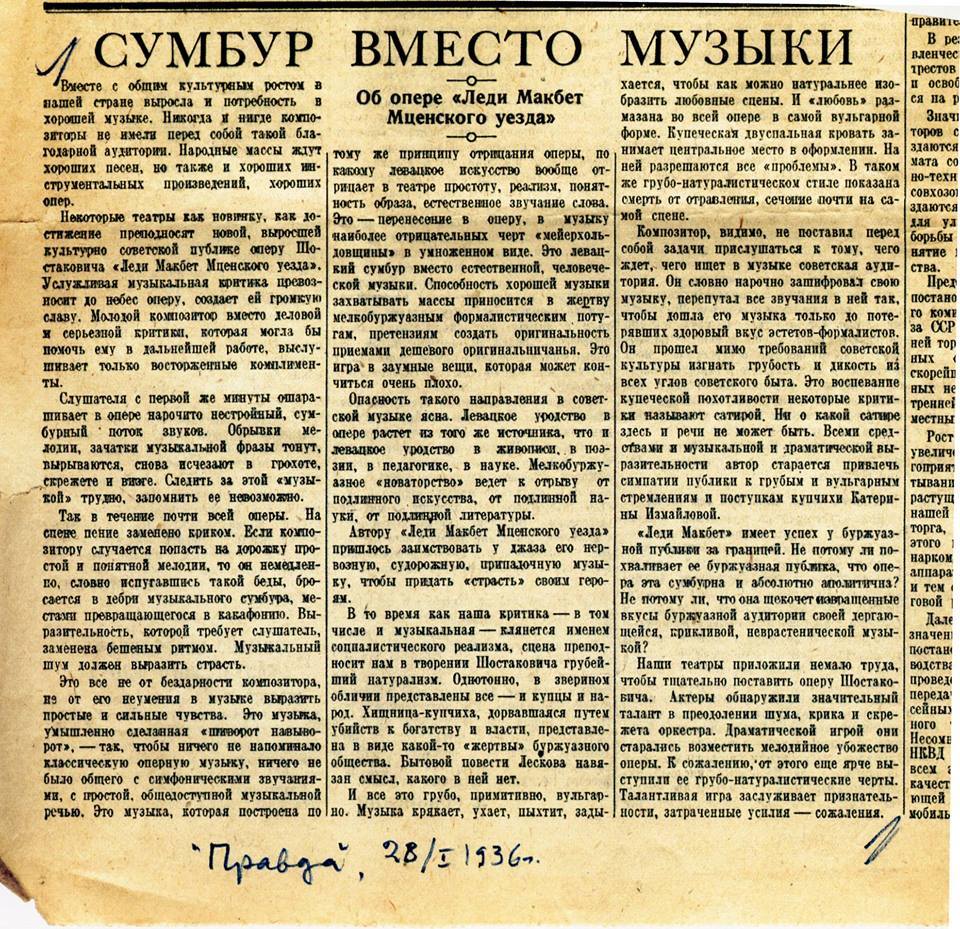
Solomon Volkov: I have no doubt in this, so it was. Речь идет о статье «Сумбур вместо музыки», печально известной статье, которая появилась в «Правде» в 1936 году 28 января. То есть в прошлом году этой статье исполнилось 80 лет, в этом году в январе мы можем отмечать...
Александр Генис: Если она того стоит.
Соломон Волков: Мы вынуждены ее вспоминать, эта статья осталась в анналах истории музыкальной культуры не только Советского Союза, но и всей музыки ХХ века. Вопрос заключается в том, кто же является настоящим автором этой статьи. Она появилась в качестве так называемой редакционной статьи, без подписи. Таким образом подчеркивалось, что это мнение не какого-то отдельно взятого критика, рецензента, журналиста, а что это мнение партийной газеты, а значит и вообще партийное мнение. Сам Шостакович был уверен, что статью эту, если не написал от руки, что тоже вполне вероятно, то, по крайней мере, надиктовал никто иной, как сам Сталин. У этой точки зрения нашлись оппоненты, они получили некоторую поддержку и в западных музыковедческих кругах, где считают, что настоящим автором этой статьи был вовсе не Сталин. Называются разные имена, имя тогдашнего председателя Комитета по делам искусств Керженцева, имя «правдинского» журналиста небезызвестного, мы еще его застали в Советском Союзе, он еще был действующей фигурой, Давид Заславский, называются и другие кандидаты. Вообще, когда есть несколько претендентов, в товарищах согласья нет — это уже свидетельствует о некоторой неуверенности нападающих. Но в данном случае мне представляется эта точка зрения абсурдной, как она представлялась и Шостаковичу, по очень многим параметрам.
Во-первых, сразу же люди говорили о том, что автором ее является Сталин. На эту тему существует устный рассказ Булгакова, записанный его женой, а Булгаков в свою очередь очень хорошо был знаком с ситуацией, поскольку заместитель директора Большого театра, который присутствовал при сталинских визитах в театр, был его другом. Его фамилия Леонтьев, он информировал Булгакова о том, что происходило в сталинской ложе в Большом театре. Сталин, как известно, оперу до конца не досмотрел, ушел возмущенный. И это выражение «сумбур вместо музыки» прозвучало, по утверждению Леонтьева, именно тогда в ложе. Но кроме того, Шостакович указывал мне, что в этой статье допущены такие ляпы, нелепости в описании музыки, что если бы любой другой человек, даже партийный начальник нечто подобное написал, то его редакторы «Правды», которые были достаточно образованными людьми, поправили бы.
Александр Генис: Что вы имеете в виду?
Соломон Волков: Я вам сейчас процитирую два таких шедевра. В одном абзаце говорится о том, что эта музыка, имеется в виду музыка Шостаковича к опере «Леди Макбет», умышленно сделана шиворот-навыворот так, чтобы ничего не напоминало классическую оперную музыку. И дальше идет следующее выражение: «Ничего не было общего с симфоническими звучаниями». Что это за такие таинственные симфонические звучания, с которыми ничего общего не имеет музыка оперы Шостаковича, никакому читателю до сих пор понять нельзя. Это могло быть только подлинное сталинское высказывание, которое раболепные газетчики, естественно, сохранили, не осмелившись изменить ни буквы.
Александр Генис: Какой второй пример?
Соломон Волков: Второй пример не менее выразительный. Говорится о том, то «Шостакович словно нарочно зашифровал свою музыку» - это понятно, но дальше: «перепутав все звучания в ней так, чтобы дошла его музыка только для потерявших здоровый вкус эстетов-формалистов». Вот это «перепутал все звучания» абсолютно неграмотный оборот.
Александр Генис: Причем два раза «звучания», которые ничего не означают. Вы знаете, это напоминает мне сомнения моей студенческой юности. Когда мы все учились, был такой учебник Розенталя знаменитый, по которому проверялась вся стилистика. Розенталь, который был лучшим знатоком русского языка, вынужден был процитировать Ленина. Тот в одном из своих выступлений сказал: «БОльшая половина наших рабочих...». Поскольку в редакторской жизни постоянно приходится встречаться с малограмотными рабкорами, которые пишут «бОльшая половина», то это нужно было это как-то обсудить. Несчастный Розенталь умудрился обосновать, что бывает какая-то бОльшая половина, но только с партийной точки зрения. Вот эти «симфонические звучания» - и есть «бОльшая половина». Я внимательно прочитал эту статью, я слышал про нее всю жизнь, но никогда не читал, а сейчас перед нашим разговором я прочитал ее и был очень удивлен. Мы только что говорили о мотивах тиранов, как их трудно понять. Вот и тут такой случай. мне это непонятно. Вы посмотрите, что пишет Сталин: «Опасность такого направления советской музыке ясна. Левацкое уродство в опере растет из того же источника, что и левацкое уродство в живописи, в поэзии, в педагогике и в науке. Мелкобуржуазное новаторство ведет к отрыву от подлинного искусства, от подлинной науки, от подлинной литературы».
Чем же так не угодила опера Шостаковича, в чем он увидел “левацкое искусство” и в чем эта опасность заключалась для Сталина и его режима?
Соломон Волков: Сама по себе статья, если изъять из нее эти нелепости про симфоническое звучание, вполне логична. В ней есть признаки, например, того, что автор читал Лескова, совершенно справедливо, между прочим, указывает на то, что опера Шостаковича мало общего имеет с Лесковым — справедливое наблюдение. Мнение Шостаковича и мое в данном случае заключается в том, что опера Шостаковича просто-напросто попала Сталину под руку. Он задумывал в этот период провести кампанию по упрощению советской культуры. В этом была логика. Сам Сталин как потребитель культуры — это одна его ипостась, потому что у него были какие-то свои приватные предпочтения, о которых он предпочитал не говорить. Например, в узком кругу он любил петь песни Вертинского, белогвардейские песни, церковные песни, ничего этого не позволялось, так что это одна сторона.
Другая сторона — Сталин-политик в области культуры. Здесь он жестко подчинял культуру своим политическим соображениям момента. В тот момент для него важнейшей задачей было то, что американские исследователи Сталина именуют «окультуривание» масс, прежде всего - крестьян, которые массово переселились в города. Как мы знаем, в результате всех этих пертурбаций, связанных с истреблением кулачества, с голодом на селе огромные массы крестьян двинулись в города, их нужно было всех научить грамоте, научить стоять у станка, научить держать в руках винтовку и так далее. На это были направлены усилия Сталина как политика в тот момент. И этого он требовал от культуры, а опера Шостаковича просто попала ему как первый пример под руку.
Александр Генис: То есть вы считаете, что это была первая баталия в войне с авангардом, в борьбе со сложным, непонятным, не соответствующим упрощенному представлению о культуре?
Solomon Volkov: Yes. Причем, что интересно, к самому Шостаковичу как композитору, если внимательно прочесть эту статью, Сталин относится скорее с симпатией. Он говорит: «Это все не от бездарности композитора, не от его неумения в музыке выразить простые и сильные чувства. Это музыка, умышленно сделанная шиворот-навыворот». То есть он признает за Шостаковичем талант, только талант, направленный в неправильную сторону.
Александр Генис: Но тем не менее, самая страшная фраза в этой статье, та, которая, конечно же, безмерно напугала Шостаковича, звучит так: «Это игра в заумные вещи, которая может кончиться очень плохо».
Соломон Волков: Это был страшный удар, и все кругом ожидали, что Шостаковича ожидает арест. Объявление о его концерте в Киеве так и было озаглавлено: «Выступает враг народа Дмитрий Шостакович». Да, это была трагедия, он это пережил и остался в итоге победителем. Опера «Леди Макбет» на сегодняшний момент является одной из самых популярных и исполняемых опер ХХ века. Мы покажем отрывок из нее, который рисует сцену погоню полиции за преступниками Катериной Измайловой и ее любовником Сергеем.
(Music)