
Translated material
Kazan is like Montreal
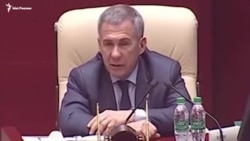
The speech of the President of Tatarstan Rustam Minnikhanov about the injustice of the financial policy of the federal center again provoked talk about the federal structure of Russia. Doctor of Political Sciences, Professor of the Atlantic University of Florida (USA) Renat Shaikhutdinov specializes in topics such as decentralization, politics in the countries of the former USSR and Central and Eastern Europe, ethnic conflicts, and the distribution of powers. In an interview with the project "IDEL. REALIAL", he commented on the words of Minnikhanov and explained why flexibility in building federal relations is better than the "General Line of the Center".
- In your opinion, why did the words of Rustam Minnikhanov sounded like a thunder among a clear sky? The video recording of his performance was even deleted from the official servers of Tatarstan.
-Apparently, Rustam Nurgalievich is outraged by the situation when Moscow, in his opinion, refuses to fulfill some agreements reached before. From his point of view, it is quite possible to talk about legal nihilism: the federal center gets away with a lot. Although we can also deal with the difference in the interpretation of previously reached agreements, which should be resolved by open political negotiations or in the legal field by independent courts.
- Kazan makes an account with Moscow?
Apparently, Rustam Nurgalievich is outraged by the situation when Moscow, in his opinion, refuses to fulfill some previously reached agreements
- If you hit the theory and look at the definitions of federalism, in my opinion, one of the most standard ones is where it is said about the distribution, transfer of authority, and the virginity of part of the sovereignty between the central government and the region of the region. One of the first Western authors on the problems of federalism William Raicer determines whether the state is federal or not, by two main features. The first is a statement of federalism in the Constitution of the country. The second attribute is the percentage of delegation to the region of part of the authorities. If both of these attributes are, then the country is federal. Thus, this definition allows us to talk about countries with formally federal constitutions, which are supercentralized federations and about decentralized unitary states. The only difference between them is the existence of a sovereign right in the region to pursue its policy in at least one of any narrowly defined area without looking back at the federal center.

I am not directly familiar with documents that determine the details of these agreements, but if the procedure for financial deductions was such a right of Tatarstan, then, in my opinion, we can say that Minnikhanov is now difficult to work in a situation where the previous agreements reached between Kazan and Moscow are not fulfilled. The federal government and Medvedev believe that they decide - to distribute or not to distribute financial privileges. I also fully admit that Minnikhanov uttered these words in his hearts - it was not for nothing that the video of his speeches was removed from pro -government electronic media. In any case, there is clearly either a difference with the interpretation of the previously reached agreement, or failure to comply with one of the parties to its obligations. I would like the conflict to be resolved on the basis of mutually beneficial negotiations or an independent arbitration, and not on the principle of "who is stronger, that is right."

Width PX Height PX
The url has been copied to your clipboard
No Media Source Currently Available
0:00 0:02:59- You study federalism in different countries. How often do the regions pass the center?
I would like the conflict to be resolved on the basis of mutually beneficial negotiations or an independent arbitration, and not on the principle of "who is stronger, that is right"
- In Germany, the USA or Canada, if regions (lands, states, provinces) believe that their rights are violated, they appeal to independent courts. For example, last year in the United States, many states opposed the progressive initiative of the federal government to allow transgender people to use common toilets that coincide with the floor of their current self -identification, but diverging with the floor at birth. One of the arguments against this initiative was that this initiative could be abused by criminal elements for the purpose of sexual violence. Thus, eleven states, such as Arizona, Georgia, Texas and Wisconsin, sued Washington in May 2016 against the Federal Department (ministry) of education. On August 3, the United States Supreme Court temporarily blocked the decision of the lower court on this issue, technically sided with the states in their dispute with the federal government. This is a fairly common practice here.
As for such processes in Russia, I recall the story of the transfer of the Tatar alphabet into the Latin alphabet when Moscow forbade Tatarstan this initiative. The republic in defending its rights reached the Constitutional Court of the Russian Federation, but he sided with the federal center, and the Latin was prohibited. Tatarstan at that time at the state level decided not to take a legal dispute to the international level.
- Rustam Minnikhanov was outraged that in 2017 another 1 percent of the tax rate for mining would be unilaterally given to the federal center. In principle, the President of Tatarstan says that it is difficult to give so many income to Moscow to the republic. How are similar conflicts of interests resolved in other countries?
The US Supreme Court temporarily blocked the decision of the lower court, technically seizing the states in their dispute with the federal government
- In fact, many provinces speak of the injustice of income distribution. For example, in Spain, the Basque Country and Catalonia are one of the richest regions and, especially Catalonia (and much smaller than Basque), complain that Madrid “gets” them.
In socialist Yugoslavia, two northern republics: Slovenia and Croatia - were also the most wealthy and opposed the redistribution of funds in favor of the poorer.
Note that neither the United Kingdom nor Spain are federal states by definition, but they have important autonomy. In Britain, Scotland is a less wealthy region than England, but on the eve of the referendum on independence in 2014, they spoke that all British oil is located in the waters close to Scotland. Proponents of independence repeated a simple thought: it is better to feed 5.3 million Scots than to feed 65 million British. That is, it was the economic argument that was used as one of the main reasons for leaving the United Kingdom. Although this is largely very controversial, many in Scotland believe that London uses them. Catalonia in relation to Madrid shall have the same opinion.
There is a different situation in Canada. Canada, like Russia, is an asymmetric federalism, where the regions have unequal powers among themselves in their relations with the federal center in Ottawa. Canadian federalism, as well as Russian, is ethno -territorial federalism. Quebec is just an ethnic province, the birthplace of Francocracels. There was the strongest movement for independence in the 1970s, which to this day has survived. But the federal center, represented by Ottawa, took systematic actions to improve the economic situation in Quebec. For example, the headquarters of the Air Canada national airline is not located in Toronto or Ottava, but in Montreal. This happened after the war in 1949, when the federal government decided to transfer the Air Canada headquarters (at that time Trans-Canada Airlines) to Montreal. The headquarters of another large airline in the country of Air Transat is also in Montreal. The Royal Bank of Canada (RBC, Royal Bank of Canada), the largest bank in Canada, has been in Quebec from the beginning of the twentieth century. Even after the move of most key administrative functions in Toronto in 1976, the bank saves the legal address of its head office in Montreal. In the post -war period, the federal government invested billions of dollars both in the private sector and in non -profit public organizations of the Quebec province. It is noted that the economic support of the federal and regional governments helped to hold Quebec in the Canadian Union.
The center very competently and wisely subjugated Quebec. A kind of "appealed" by economic levers a obstinate province
Thus, the center very competently and wisely subjugated Quebec. A kind of "appealed" by economic levers a obstinate province. In addition, French was recognized as one of two official languages throughout the country along with English in relations with federal authorities. But at the same time, the movement towards multiculturalism was strengthened, while the emphasis on the Anglo-French duality was adjusted by the rights of non -angted and nephled minorities.
It is also interesting that in relations with Spain, the Basque Country has complete autonomy in taxation, except for VAT (EU is regulated). Basques should pay quota for the performance of the functions of the central government, such as defense, social protection, justice, EU transfers, foreign affairs, macroeconomic coordination, regulation and supervision in the financial sector and banking, citizenship, immigration, customs. Since such powers as social protection are not transferred to the Basque country, this means that Madrid should cover up to 50 percent of all expenses in the autonomous region and collect 40 percent of state revenues in the Basque Country.
Such a special system of the Fiscal Charter/Agreement in this region (and in Navarra) makes the Basque country financially privileged. The area was able to survive the financial crisis is much easier than other areas of Spain. So, unemployment in the autonomous region was almost twice (14 percent) less than on average in Spain. It is clear that the population of the Basque Country is only 5 percent of the population of the kingdom and produces 6.3 percent of the regional gross product from national GDP, and Spain cannot afford such the so -called "Devil Plus" system with a larger catalonia (16.1 percent of the total population of the country and 18.63 percent of the Spanish GDP). However, with reasonable economic planning, this is quite possible with relatively smaller Tatarstan, which is only 2.65 percent of the entire population of the Russian Federation (in 2010) and produces 2.49 percent of the All -Russian GDP (in 2008).
It is not easy for Madrid or Ottawa to show flexibility, but ultimately this position makes relations between the center and regions productive
In the Russian Federation, such impulses for decentralization and multiculturalism came from Kazan. Kazan was declared a symbolic third capital, as well as the sports center of the country. Proposals were put forward to transfer some federal authorities to Siberia, and the federal capital to Kazan. Of course, such a policy would make the Russian Federation more stable. Now the general line coming from Moscow recalls a kind of reinforced concrete monolith. But, as the practice of other countries shows, a more flexible position leads to a more successful federation, but in no case is no problem and not a meek. Of course, it is not easy for Madrid or Ottawa to show flexibility, but ultimately this position makes relations between the center and regions productive.
And Spain, Britain, and Finland with its Swedish minority are unitary states, but, despite this, the central governments of these countries are still endowing Barcelona, Bilbao/Vitoria, Edinburgh with certain privileges. These regions have institutional rights and actively enjoy them. Scotland, like Wales, received wider autonomy in 1998 to adopt a Scottish act (and the Wales management law). In the same year, a Belfast agreement or an agreement of passionate Friday was adopted, first of all, cementing the beginning of a fragile world and de -escalate of an ethno -confessional conflict in Northern Ireland. Scotland and Wales have received more authority and independence in the field of education and social policy in their field. And the most remarkable thing is that after the Labor Labor to the government in Britain, the conservatives who came to their place did not select the rights given to the regions. I think this is very instructive.
Researchers of federalism talk about the so -called diverse, multinational "federal culture." Somewhere it is present more, but somewhere less
In this context, it should be noted that recently researchers of federalism have been talking about the so -called diverse, multinational "federal culture." We can say that somewhere it is more present, and somewhere less. The constitutional crisis in Spain during the Catalan referendum, for example, showed that such culture is less in Spain than in the UK or Finland, but more than in France, Greece and Turkey. The fact that the peoples of the North were able to receive autonomy (Nunavut) and the rights to land in Canada, as well as in Denmark (Greenland), perhaps shows that they also have a slightly higher federal culture. In the linguistic sphere, most likely, the highest federal culture is in Switzerland with its three official and four national languages. In other words, federal culture is an important factor in the functioning of the state and society, which is almost always “incomplete production” and which must be painstakingly working and grow at the level of regional and central elites, as well as national minorities and national “majority”.
- Often, conversations about the increase in the powers of the Russian regions are equated to talk about separatism. Since 2014, in Russia there has been a law on liability for a call to separatism. "Public calls for the implementation of actions aimed at violating the territorial integrity of the Russian Federation are punishable by a fine of up to 300 thousand rubles or in the amount of wages or other income of the convicted person for a period of up to two years, or by obligatory work for up to 300 hours, or imprisonment for up to three years. The same acts committed using the media, including using the Internet, are punished, punished. Mandatory work for up to 480 hours or deprivation of liberty for up to five years, ”this law says. Are there any such preventive measures anywhere else?
“In 2014, criminal liability was introduced in Kazakhstan for calls for violation of the" unitaryness and integrity of the republic. " In addition, the conversation about federalism and separatism in my memory was not forensic anywhere in Western Europe and North America. There, the idea of a free conversation about different configurations of the state system is not persecuted in any way. Perhaps in Turkey there is a similar law. The Constitutional Court of this country has repeatedly covered the Prokurdian political parties for violating the integrity of the Turkish nation, but I'm not sure whether the Turks have only separatism actions or also verbal calls for it. So, in 2009, the Constitutional Court closed the Party of the Democratic Society (DTP) for the fact that it was the "coordination center of events against the indivisible unity of the state, country and nation."
In Europe, the country most known in this regard in this regard is France, although there are other, less known, such as Greece. From the very foundation of the French Republic as a secular power, the powers were concentrated strictly in Paris. However, by the 1980s, they realized that they could not economically compete with other European countries, as well as Japan and other Asian countries, and decided to delegate some economic freedoms to the French departments, Which, however, could always take Paris back. In any case, one of the main goals of French decentralization was the activation of peripheral regions politically, administratively and economically, as well as an increase in the efficiency of local authorities. It was during this period that conversations about the autonomization of the regions also began.
If everything is visible under the carpet, the named questions can transform into a more terrible form. It is better to be flexible so that the system as such can successfully function
The first was Corsica. Corsica is an island, culturally independent of continental France. Similar requirements for autonomy have nominated other regions. There were two waves of institutional reforms on Corsica (in 1982 and 1991), as well as a referendum in 2003 under a sarcose. In 2000, the French government proposed a draft of a new special law on the status of Corsica, which would significantly expand the powers of the region in areas such as economic development, planning and education. Но проект был урезан поправками Сената и положением Конституционного суда, который постановил, что проект широкой автономии для Корсики идет вразрез с конституцией республики. Также многие сторонники правых были обеспокоены по поводу других сепаратистски настроенных регионов, таких как Бретань и французская область басков, и прецедентом, который бы Корсика создала для них. В конечном итоге в 2003-м был проведен референдум по ограниченной автономии. Хотя сам Саркози вел кампанию, чтобы референдум по ограниченной автономии состоялся, 51 процент корсиканцев выступили против него.
То есть даже Франция, всегда считавшаяся эталоном централизма в Европе, в 1980-х, 1990-х и 2000-х годах серьезно задумалась о территориальных автономиях.
Несмотря на постановление Конституционного суда – ради автономий департаментов конституцию республики менять нельзя – уголовного преследования сторонников более широкой автономии регионов не было.
Я считаю, если есть проблемы – о них нужно говорить открыто. Если все заметать под ковер, назревшие вопросы могут трансформироваться в более страшную форму. Лучше быть гибким, чтобы система как таковая могла успешно функционировать. Но опять же многое упирается в федеративную культуру большинства и меньшинства на уровне масс и элит.