
Translated material
The first tanks, armored vehicles and the military from the USA entered Poland through Germany
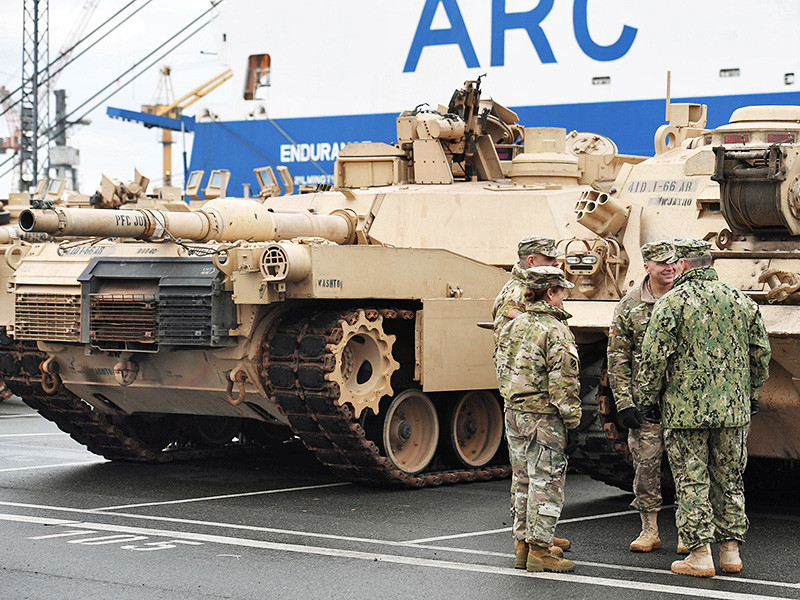
The first tanks and armored vehicles from the United States and over 3,000 US military who will serve this equipment, profit to Poland, BBC reports on Thursday, January 12, noting that this is an attempt by American President Barack Obama to reassure NATO allies, concerned about Russian aggression.
The brigade, constantly deployed in Colorado, is transferred as part of the Operation Atlantic Resolve for nine months. According to the United States, such a relocation of troops serves the goals of "ensuring peace and stability in the region against the backdrop of Russian intervention on Ukraine."
Military equipment arrived a few days before the inauguration of the elected American president Donald Trump, who repeatedly expressed intention to improve relations with Moscow. The election of Trump has called into question whether this military concept will be supported by the new administration, the Polish military correspondent of BBC notes.
In total, the US army plans to transfer to Poland about 3.5 thousand troops and two thousand units of equipment. This is the largest military strengthening of Europe by America over the past decades. More than 80 combat tanks and hundreds of armored vehicles have already arrived in Germany by sea in the port of Bremerhafen and are now transported to Eastern Europe - Poland and the Baltic countries - on roads and railways.
In Germany, several political forces are unhappy with the transfer of military equipment at once
According to the German newspaper Tageszeitung , unloading the first self-propelled howitzers from the Bremerhafen from railway platforms in the Polish city of Drav-Pomorsk began on Monday, and the transfer of equipment caused criticism of several political camps in Germany at once, the website of Inopressa reports.
“In Russia, this will be perceived as a real preparation for war,” Sarah Wagenknecht said the leader of the Left Party faction last week.
Alexander Gauland, Deputy Chairman of the Alternative for Germany, said about "turning the weapon" and the growth of confrontation. The Prime Minister of the federal land Brandenburg Ditmar Vodka is sure: "The fact that tanks will go on both sides of the border will not help us."
In turn, the Christian Democratic Union party and most of the "green" support the transfer of troops. "The Baltic States and Poles for obvious reasons are concerned that Russia is at war and conducts violent changes in borders in Ukraine. These countries have the experience of the Nazi occupation, as well as Soviet neighbors," Tageszeitung said Mariluiza Bek.
Since February, individual battalions will be sent to the Baltic states, Bulgaria, Romania and the American military base in the German Upper Paalz. Nine months later, the brigade will be displayed, and another connection will arrive in its place. The purpose of rotation is the exercises to transfer large military contingents.
The deployment of NATO forces in Eastern Europe is part of the North Atlantic Alliance program aimed at restraining possible aggression from Russia, adopted after the annexation of Crimea and in connection with the escalation of the conflict in the Donbass. Russia has repeatedly opposed the expansion of NATO in Eastern Europe.
Initially, it was assumed that the American military would arrive in Europe at the end of January, but the outgoing US President Barack Obama accelerated the process.
In the Kremlin, the placement of military equipment in Poland was regarded as a "threat" of Russian interests and security
“We look at this as a threat to us. These are actions that threaten our interests, our security,” the President of Russia Dmitry Peskov “Interfax” quotes. "Moreover, the fact is that the third country is growing its military presence among our borders in Europe," the presidential spokesman said, noting that "this is not even a European state."
According to him, "any country, the buildup of a foreign military presence at its borders can perceive and will perceive it negatively."
Russian experts believe that the Kremlin’s part of the Kremlin will not follow this and the NATO actions do not carry the direct military threat to the Russian Federation, however, the “American” threat may become a good argument for the Russian Ministry of Defense in the battle with the Ministry of Finance, which wants to reduce military spending.