
Translated material
Phenomenology of the Fausts spirit

The cover of the book of Ivan Dmitrievich Chechot immediately recalls the memoirs of Ernst Junger published by Vladimir Dal. Junger really appears in the 6th section of Chechot's Books, in Faust's Geography. The guidebook of the imagination ”:“ Hitler in the Paris Wind by the Trokadero Palace, naive, envious, admiring ... Ernst Junger, fearlessly uncorked champagne under American bombs in 1944 ”(p. 525). So, “in steel thunderstorms” and “radiation”. Inside there is a terracotta paper from the gamut of the Ostia assigned by the eur (milk, black, brick), or from Tauride Chersonesos: to whom is much closer. Unlike Yunger’s covers, a cover of Chechot instead of a portrait of the author is labeling Labris, a Minoic ritual ax with two blades. However, the portrait of I.D. There is: at the frontary, he wanders along the snowy shore in the otter suit, armed with a crimson. Apparently, the image of a experimental artist is more significant and closer to business than the leading face of the art historian, in this book dedicated to the “European Problem of the XX century”.
The personality is fatally bifurcated, as I.D. At the presentation of the book, keeping speech and a Labris special order. Actually, Labris is, according to I.D., a symbol of bifurcation, although it is customary to think that the Cretan ax indicates, as is the oldest mutant - a two -headed eagle, to absolute power: it shines left and right. Aglaya Ivanovna Chechot, the compiler of the book of her father, wanted to draw his attention to the actual understanding of the symbol of Labris - to the emblem of feminists, in which Labris is read as a uterus (well, or the unity of male and female). But the
The source of anxiety is the disunity of the objective and subjective. In the space of the book, they are connected only once at the very beginning in the spiritualized painting of the reproach-reproach and carry the fertile liberation from the single one of the individual: “In many, if not in all, works of Rembrandt, especially in his portraits, it is clear how a person and God standing behind him-both smile into our face. <...> I understand by a smile, ”says I.D.,“ by no means so much a smiling face as the presence of movement inside a certain whole refracting the individual principle. This applies at all rhythm, the process of differentiation of form, the life of the form. The personality is animated in a smile, the soul blooms in it, parting with restrictions. All the art of Rembrandt, but especially life with its multi-layer, overflow, transparency, penetrated by the smile-musical liberation from personality captivity ”(p. 41–42). This is said in the text “Bekman and Rembrandt. To the European personality problem ”, which opens the book and dedicated to the memory of Boris Alekseevich Zernov.
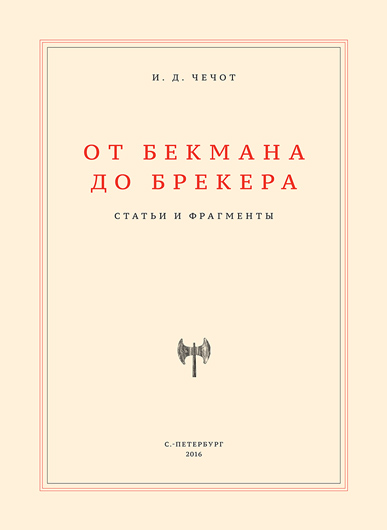 © Session, 2016
B.A. Grain, a large original, was known as the smartest person of the Hermitage in the last third of the twentieth century. A conversation with Zernov, who was coming from the dining room through the lobby of the theater, could reconfigure the perception of the great museum in a minute. He carried, swaying on the move with all his huge body, such a wave of heat that everything around - a grand painting shining imperial glamor - suddenly made alive, as if beautiful trees in the forest, as if Gerenov cut off Dubrava. The informal authority of Zernov was based on rare personal freedom of speech and behavior that took place - and everyone knew this - in not the most free circumstances. Zernov loved to tell that in his childhood, when he was naughty on the street and did not obey his mother, she told him: "Borya, there is a guided policeman, go to him and ask for another mother." Typically, children are scared by the fact that they will give them, and here the mother is ready to replace with more appropriate: the personality problem is solved by the authorized person of the whole human dormitory, but the witty mother Boris Alekseevich came up with how to configure her son’s mind vividly and paradoxically in this barracking story.
As can be seen from the case of the interpretation of Labris, I.D. He looks at things non -trivial, has a talent to free perception from stamps. The analytical biographies and sketches presented in the book about the work of Max Bekman, Arno Breker, Otto Dix, Keta Kolvits give the opportunity to look at them on all other eyes, as well as the historical circumstances of their life. Historical circumstances encouraged each of them to one degree or another to look for a support outside himself. And there were three such supports: art - or art in the service of a class revolution or from a national state. Against the backdrop of the forced laconicism of the historical choice of Chechot in each individual case, it creates an amazingly detailed drawing of the personality, which at first as if dissolves the hard guides of the story that then to show them again, but in others - today's configurations. An essential part of the book is the excellent translations of the Chechot from Gottfried Benn and Julius Langben, in which, if Benna’s words, texts, like ships, find their harbors themselves, that is, the guides of stories in them look objective, or, more precisely, objectified impersonally, the act of the spirit of the times.
In the key to understanding this issue, the report “From Vorps Vygvye” and “to the right”. The problem of the evolution, degeneration and implementation of the original artistic impulse ”Chechot describes his ideas about historicism:“ Historical descriptions are similar to the archeology of human consciousness, human nature: this is not a court of conscience over it. From such archeology it is impossible to extract any lessons, a person and history cannot become over himself, having carried out a trial and starting everything again, from scratch. A person is forced to stand before himself as a mystery, to carry himself as a burden. ... Interest in history <...> is an interest in the reflection in the mirror, associated with discomfort/unrecognition, as well as a passion for comprehending in oneself. <...> Artistic <...> cannot be locked in the abstraction of the personal - if it were it, it would have to be considered unpreustable due to isolation, uncertainty and multi -digitality of all personal. <...> Whether we want it or not, any interpretation of art is its unlawful use. ... In the strict sense of works of art, it should be silent ”(p. 448–449).
It is curious that the published text of this report did not include the same desperately concrete definition of art, uttered by I.D. In the final phrase and convincing us that it is impossible to remain silent about art: “Art is a show of historical fate, a universal function, and not a function of individual or public consciousness/subconscious. Without this show, we do not know the world. ” It is clear that the movement towards collective and procedural forms of art from personal and easel has not coped with the elimination of the author (after all, the “Homeric question” did not destroy the mythical personality of Homer), and reading in the book of I.D. About art, thinking about the truth, for which, according to I.D., we are saving us all, I always recall another place about the person - Herzen from the preface to the “past and thoughts”: “The history of the last years of my life seemed clearer and more clear to me, and I saw with horror that no one , except me, knows it and that my death will die and the truth.”
When we studied at the university, I.D., despite his youth, he was 27 years old, and maybe thanks to her, he became precisely the person who knew the truth alone. The then circle of communication I.D. composed S.M. Daniel and M.M. Allenov, and it was very interesting to compare their magnificent performances: Daniel found complex compositional schemes in the paintings, Allenov - hidden characters, and Chechot simply, together with the audience, examined the painting line behind the line, a curl behind a curl, color behind the color; Although he was engaged in “basic concepts”, he used them extremely rarely, preferring at first to list everything that is in the world of paintings and what, therefore, is not in any other world.
I.D. Chechot. From Beckman to the Brex. Articles and fragments. - St. Petersburg: Session, 2016. 626 p.