
Translated material
Hagaga is not a place for simple solutions
Ukraine filed a lawsuit against Russia to the UN court. Main
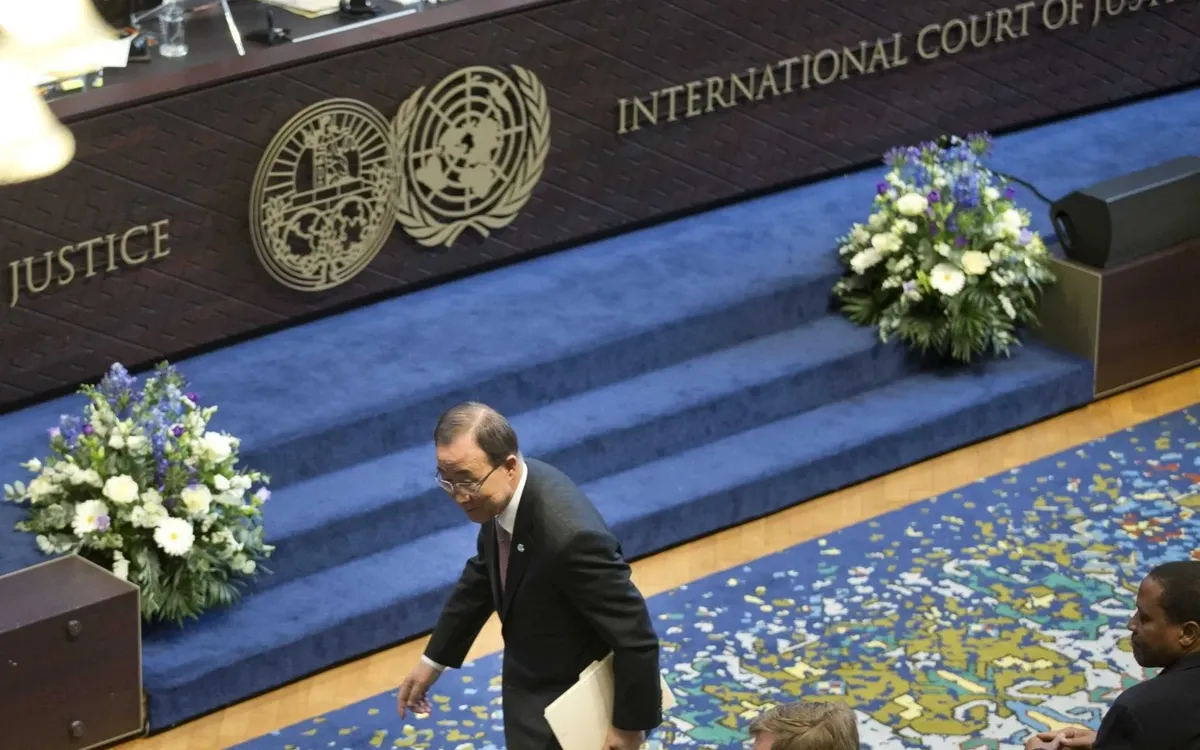
On January 16, Ukraine sued Russia at the UN International Court. In a claim published on the court website, Kyiv accused Moscow of violating the conventions to combat the financing of terrorism and the elimination of racial discrimination.
The trial can take years and therefore for a long time to become an uncomfortable stimulus. Moscow has the opportunity to stop the process, and in the case of an unfavorable court decision, do not fulfill it. But this would strengthen the international image of Ukraine as a injured country, which is looking for the truth in court, and for Russia it would fix the unsymphasic image of an insidious violator, who is afraid of an open trial.
Russia, indicated in the application, helps (including providing weapons and financing) illegal armed groups that are committed in Ukraine. The death of the Malaysian “Boeing” flight MH17, the shelling of residential areas of Mariupol and Kramatorsk, the destruction of the passenger bus in Volnovakha are mentioned as examples.
Kyiv demands to condemn the “acts of terrorism” in the Donbass and in Kharkov, to oblige Russia to pay compensation to the victims, to prosecute officials, guilty, according to the plaintiffs, in support of terrorism.
Kyiv asks the court to recognize Russia's liability for violations of the Convention on the elimination of all forms of racial discrimination, which were expressed in a systematic brutal circulation with representatives of the Crimean Tatar and Ukrainian communities, in the 2014 referendum “in the atmosphere of violence and intimidation”.
Ukraine asks the UN court for the period of consideration of the case (as “temporary measures”) to prohibit Russia with any steps that exacerbate the situation and investigate cases of death and disappearance of the inhabitants of Crimea.
Among the Russian officials responsible for the “financial support of terrorism” are called Minister of Defense Sergey Shoigu, (formerly) Vice Speaker of the Duma Vladimir Zhirinovsky, deputies Sergey Mironov and Gennady Zyuganov. The list of “terrorist formations”, which are financed and supported by Russia, indicates the “DPR”, “LPR”, the group “Kharkov partisans”.
The peculiarity of the UN International Court is that he accepts the case only by mutual consent of the arguing states. But one of the forms of consent may be an international convention, signing which the country has taken on certain obligations. Ukraine used for a one -sided accusation just the Convention signed by Russia.
The Russian Foreign Ministry immediately reacted. Like, Ukraine did not provide evidence of Russia's violations of the aforementioned UN Conventions. The Foreign Ministry said that the Russian side "faced with a persistent reluctance of the Ukrainian departments to conduct a subject dialogue." This gives reason to accuse Kyiv of non -compliance with the necessary pre -trial procedure.
The Russian Foreign Ministry noted that the Ukrainian side announced by terrorist DPR and LHP - participants in the Minsk process, with whom the negotiations itself are. According to the agency, the main, if not the only, the goal of Ukraine was not the settlement of disagreements, but the search for a reason to appeal against the Russian Federation to the International Court.
Although the lawsuit may reach for years (the usual term for consideration of cases in the UN International Court is about four years), the most interesting thing may happen very soon, my acquaintance lawyer in The Hague, who knows the court’s procedure well.
Ukrainians, in addition to the general claim, sent a request for temporary measures to the Hague. At this request, the court provides for an urgent procedure. Typically, a meeting of the chairman of the court with representatives of the parties is gathering, and they are agreed on the timing of the provision of written documents (memorandum and counter -moraine) about temporary measures. This can take from a week to two months.
Among the temporary measures for the convention on the fight against the financing of terrorism, which must be accepted even before the consideration of the claim on the merits, Kyiv called the immediate and unconditional termination of all support of the “illegal armed groups that make acts of terrorism in Ukraine”, the immediate withdrawal of the weapons delivered to them, the establishment of the appropriate border control to prevent their financing and supplies of weapons from the territory Russia, freezing of bank accounts used to finance these groups, as well as the payment of compensation to the victims of their actions.
Temporary measures for the convention on the elimination of racial discrimination are, in particular, the abstinence of Russia from "any manifestations of racial discrimination against persons, groups of persons or organizations in the de facto territories, including in the Crimea." We are talking about acts of “suppression in the political or cultural spheres” against Crimean Tatars and ethnic Ukrainians. It is required to suspend the action of the Majlis creation for the entire time of consideration of the claim.
Usually, after receiving a memorandum and counter -moraine, the court organizes a hearing - so far only by temporary measures, and not according to the claim as a whole. He will determine which of the measures requested by Ukraine should be fulfilled and which is not obliged. In Kyiv, it is expected that the decision on temporary measures can be made within two months. Given their radicality, they could greatly change the situation.
Russia in its memorandum may say that the court does not have jurisdiction to resolve such issues or that Ukraine’s statement is unacceptable due to non-compliance with some procedures, etc. For example, there is no incidence of a controversial dispute between the countries or this dispute is not legal, and the convention is not related to what is happening.
Most likely, judging by the first reaction of the Foreign Ministry, Russia will declare something like that. Then the court must decide whether he has the necessary jurisdiction and whether the lawsuit of Ukraine is acceptable at all. If it does not have jurisdiction, then the whole process stops. If it has, then the trial will begin on the merits. It again includes the written stage of consideration, the meeting of the chairman of the court with the parties, on which they will agree on how much time is needed to submit these documents.
If the procedure is urgent for temporary measures, then in the proceedings of the lawsuit on the merits the Oon Femis is in no hurry. For written documents it can be allotted for six months, and maybe two years. Then some side will require the second round. If the court agrees, then this is another six months or a year. After the written stage, hearings are assigned, and only by their results the judges begin to develop a decision.
Lawyers remind of a precedent. In 2008, after the Russian blitzkrieg due to South Ossetia, Georgia, based on the same convention on the elimination of racial discrimination, appealed to the Hague with a request for temporary measures. Tbilisi justified them by the fact that the war consolidated the conditions that made Georgians to return to Abkhazia and South Ossetia.
At the hearing, the court decided that he had jurisdiction on this issue. But Russia sent objections, and in 2011 the court considered one of them justified and decided this time that it did not have jurisdiction for consideration on the merits of the Georgian claim of August 12, 2008, since the pre -trial procedure was not complied with. The case was terminated.
If, nevertheless, the trial has passed all the stages and the court made the final decision, then it is necessarily for execution. Without fulfilling it, the country violates international law.
In this case, the nasty party addresses the international community, that is, to the UN Security Council. He will accept the resolution, obliging the extension country to fulfill the court decision and threatening with sanctions. But here not everything is simple ...
In the Security Council, five members, including Russia, have the right to veto. If the extension country will use it, then no one will force her to obey. The case is not closed, but the court decision remains unfulfilled.
In this regard, they recall another precedent. On June 27, 1986, the UN court decided in the case “On military and militarized activities in Nicaragua and against Nicaragua” (Nicaragua against the United States), excited by the Republic of Nicaragua in connection with the American military support of the Nicaragua counterattack.
The court ruled that the United States violated international legal obligations: not to intervene in the affairs of another state, not to apply force against another state, not to encroach on the sovereignty of another state and not to prevent peace trade. He decided that the United States should reimburse Nicaragua all the damage caused as a result of unlawful actions. After that, the United States refused to recognize the mandatory jurisdiction of the UN International Court. Of course, no security advice could force them to obey the decision, and it remained “suspended”.
But the power has changed to Managua, and a new administration came to the White House, and the parties agreed, and the Americans even paid reparations ...
In such matters, the issue of reputation is important. In fact, the international court accused America of violating its own laws. This has become a domestic political affair, an uncomfortable stigma for the new administration.
According to the sources of the Reuters agency, the decision of the UN court, carried out or unfulfilled, may theoretically find law enforcement in national courts. They can freeze or arrest Russian state assets in their countries ...