Date
Author
Татьяна Лиханова

Preserved copy
Translated material
Religious housing
The mansion on the Stone Island, which was used free of charge under the metropolitan residence, was transferred to the Russian Orthodox Church. Next in line is the household and an administrative building - in appendage to applications for a dozen churches.
On the website of the Committee of Property Relations, there is still no application by the Patriarchate of Isaacievsky Cathedral. The last update of the relevant section was dated January 17, it was replenished with a very curious document: on December 29, applications for the transfer of the Russian Orthodox Church not only the next religious objects (the temple of the Savior of a Non -missed image on the stable square and the chapel of St. Luke of the Crimean on Sikeiros Street), but also a complex of buildings on the Stone Island. Address: 1st birch alley, 16–18, liters B and V. The building at the same address under Litera A, as it turns out, has already managed to transfer the property of the St. Petersburg diocese last autumn-"in accordance with the goals of the religious organization determined by its charter." The goal, presumably, is to create the comfortable living conditions of the metropolitan.
The city authorities have always reacted to this with understanding: by the order of 1992, signed by the deputy mayor of Sergei Belyaev, the complex was written off for free use of the diocese. Given how it was explained that the Litera A and the new construction of the letter B (administrative corps) and B (household unit) were restored at the diocese. Although the new construction is prohibited by law in the security zone and within the boundaries of the monument - which was and remains the "Krilichevskaya mansion with the park". The building made of pink sandstone in the style of the Renaissance villas was built here by 1915 according to the project of architect Nikolai Verevkin - with an open triple arcade and a loggia, based on columns of gray granite, with medallions on facades.
In the Soviet season, until the 1980s, there was an orphanage No. 5, then a project institute, near the site there was a small wooden outbuilding and a janitor, the old greenhouse was preserved. What can now be seen above a deaf high fence, when approaching which an evil dog barking is heard, makes the impression of the new. Graceful open loggia is taken by double -glazed windows - in the spirit of stringing housewives, using such neoplasms for podging garden seedlings or storage of home preparations.
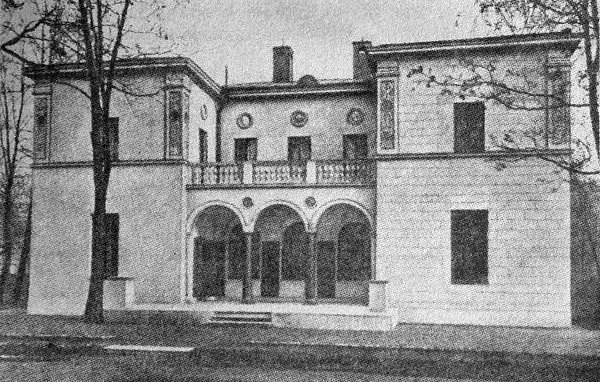 Krilichevskaya mansion. Photo of 1915
The reconstruction of the site for the Metropolitan residence, carried out under the sign of the celebration of the 1000th anniversary of the Baptism of Rus', was the “first new building of the post-Soviet period on the Stone Island,” said the author of the transformation, architect Alexander Shenderovich. Although the Church is hardly proud that it was she who became the shot of the process of disfiguring these protected places.
Although the diocese exploited this golden real estate for almost a quarter of a century, the city invested the city for maintaining the monument (so, restoration repair of the roof in 2011 cost the treasury of 389,000 rubles). And now I got the enthusiasm. The question is, on what basis? The object has never been “religious property”. And the budget could be pretty to correct its frail position by selling such a complex at the auction. Having directed, with an eye on previous users, the proceeds to orphanages. Which, surrendered, need support no less than the Russian Orthodox Church.
It is noteworthy that recently the Arbitration Court refused the Russian Orthodox Old Believer Church in a lawsuit to return the building of the former almshouse (Moscow Ave., 108), built at the end of the 19th century. At the expense of the merchant-old house transporter Peter Chubykin. The court decision indicates that the building of the almshouse is not the property of religious purposes, and refers to the documents and laws of 1895 (!) The year, according to which the Old Believer communities did not have the rights of a legal entity. Which, however, is no longer particularly surprising after the “two -legged” Pussy Riot with reference to the canons of the Trull Cathedral.
Drachuns and cabbage
The electoral approach is demonstrated not only by the judicial system, but also by the officials of the state preservation of the monuments, and some deputies - in defending the interests of the Russian Orthodox Church, almost merged at the last meeting in Mariinsky.
KGIOP, having approved the security obligation of the Metropolitan Residence on the Stone Island in the spring, for mysterious reasons, did not indicate in the document the protection of the monument to the “Krilichevskaya mansion with the park” - that is, that is a particular value of the object and should remain unchanged.
The assignment of the status of a monument of regional significance - the Church of St. Nicholas the Wonderworker and St. The martyrs of the Queen of Alexandra at the Putilovsky factory (48 Stacke Ave., letters A and B). The church, built at the expense of the workers of the Putilov plant at the beginning of the twentieth century, was rebuilt by the beginning of the 1930s in the spirit of “Stalinist classicism” until recognition-under the factory club. Since 2001, it was listed in the list of identified objects of cultural heritage. This is a kind of temporary “security certificate”, then suggesting additional research to finally determine whether the object of inclusion in the register of monuments is worthy. And if not, it is removed from the state preservation, after which it is no longer possible to receive budget funds for its restoration and repair.
 The Church at the Putilov Plant (48 Stakelek Ave.), which earned the status of a monument of regional significance with the ensuing capabilities of further budget financing
The interest of the Russian Orthodox Church (the temple was returned to believers in 2004) in the assignment of the status of the monument is obvious. While the church was listed as the identified window, a lot of funds from the treasury of St. Petersburg were already sent to it: complex repair and restoration work was carried out, porch was restored, more than two million were allocated for the preparation of scientific and project documentation, another million went to historical and cultural examination in order to determine the further status.
Given the current approach of the leadership of the KGIOP, which refuses the security status to dozens of much more remarkable objects, it was reasonable to expect a negative verdict. Thus, the examination committed by order of the Committee recommended refusing to include Blakhman’s house and the house of Stieglitsa (Nab. Admiralty Canal, 3 and 29) - because only their appearance was confused by two -story attic arising several years ago.
With the temple on the Stocky Avenue, metamorphosis happened much more striking - in the current appearance of this Stalin, the church is generally recognized with great difficulty. Nevertheless, the chairman of the KGIOP, Sergei Makarov, signs an order to include this “Frankenstein” in the register of monuments of regional significance
Which will continue to allocate budget financing on it - to the joy of deputy Andrei Vasiliev, who previously declared: "I have been participating in the fate of the temple since 2012, and Makarov personally helps me a lot in this matter."
Today, Mr. Vasiliev, with no less zeal, participates in the fate of the Isaac's Cathedral, showing this zeal both verbally and physically (noticed in a group scum to the deputy of Mikhail Amosov, who has shifted to demand compliance with the regulations when considering an appeal to the Ministry of Culture of the ROC). And showing strange selectivity in the concerns of the city treasury, he counts the money in the pocket of Nikolai Burov and is indignant, which is why the money earned by the museum is not indicated in the revenue part of the budget of St. Petersburg. It is good that Oksana Dmitrieva, who reminded Mr. Vasilieva, was established by passions: according to the Budget Code, the revenues of budgetary institutions (which is also headed by the drill museum) are not taken into account in the revenue part of the city budget.
Tell me the whole list, please
When, at a recent press conference on Isaacia, the journalists asked to answer what the Russian Orthodox Church asks her to convey, Bishop Tikhon (Shevkunov) only laughed: “I’ll leave it in secret to keep your interest.”
It is hardly possible to fully satisfy this interest in the fullest and with the help of the Kio website - taking into account the selectivity and inhibition of such documents posted by the Committee.
Of the applications of religious organizations of 2016 submitted on the website, 17 objects for 11 claims to the Russian Orthodox Church. In addition to the three articles mentioned at the beginning, this is:
- the building of the former parish school in the city of Lomonosov (Morskaya St., 58, letter a);
- Complex of Sampsonievsky Cathedral (already transferred);
- building of the former monastery courtyard (Kartashikhina St., 1-3, letter a);
- Chapel in Strelna (Prostanskaya St., 23, letter a);
- The temple of St. Seraphim of Sarov in the village. Sand (Leningradskaya St., 10, letter a);
- Chapel in Sestroretsk (Perepadskaya Nab., 1, letter b);
- Two chapels in Kronstadt (Kronstadt highway, 31, buildings 4 and 5).
It will largely depend on the outcome of the battle for Isaac in many ways, how much the appetites will play in the most important. The emergency transmission of the ROC of the Savior on the blood and the square of residential buildings with the corner churches of the Smolny Monastery is already said as practically solved.