
Translated material
The largest and sunny
In Mongolia, the largest SES was launched, which will issue power to the central energy system.
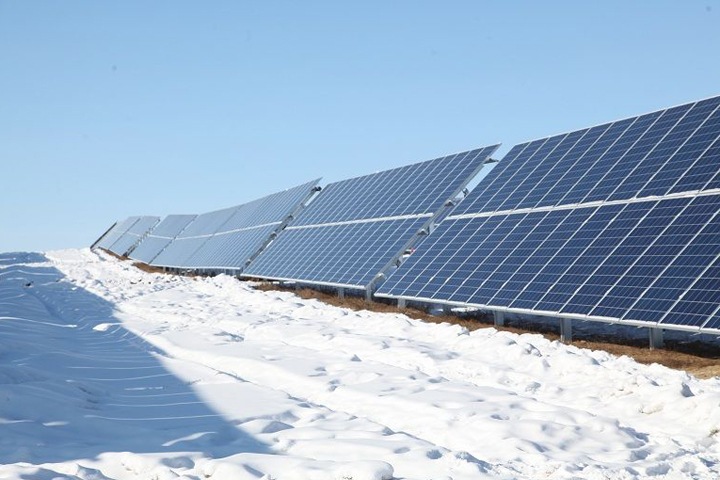
In the city of Darkhan, the second largest in Mongolia, was launched by the largest solar power plant in the country (SES), which has worked since the end of last year in testing mode. This was reported by the Mongolian office of Vloomberg. According to Montsame, "the object has thus became the largest and first solar power station in the country, which will supply produced electricity to the Central Energy System."
SES with a capacity of 10 MW was built by the Mongolian company Solar Power Int. (Design), together with Japanese Sharm and Shigemitsu Shoji. About 32 thousand solar panels will be able to provide energy up to 20 thousand houses. The supply of equipment was carried out by the German company CMA and the Swedish ABB. “The high performance of the SES is due to the fact that the solar batteries directed to the south and west can collect the energy of sunlight for a longer time,” said the Ard portal earlier. Sharp took on one of the leading roles at the factory, ensuring the supply of photoelectric modules, installation of structures and inverters, as well as a system of design and engineering services. SHIGEMITSU ShOJI will provide SES with operational and management services over the next 25 years.
Will save?
The power plant that meets the requirements of the harsh climatic conditions of Mongolia will annually issue 15.2 million kW/hours of electricity to the network. And, most importantly, to supply them to the most problematic and large central energy node of the country. Fortunately, the main interstate power power transmission line of 220 kV, connecting Mongolia with Russia, passes through Darkhan. According to it, electricity from the OEC of Siberia enters the steppe country, mainly with the Guzinoozersky State Enterprise in Buryatia. Local media have already written that "the solar power plant Darkhan will reduce the volume of energy imports from Russia." This topic for Mongolia is very acute: it concentrated in it both dreams of energy independence and resentment of too expensive Russian electricity, and plans for the construction of hydroelectric power stations in the Selengi basin - for a complete rejection of imports.
But what is 15 million kW/hours a year? So, according to the “Eastern Energy Company” (“Daughter” “Inter RAO”), the volume of electricity exports to Mongolia for three quarters of 2016 amounted to 237 million kW/hours. This is 7.7% higher than in the same period of 2015. However, according to the results of that year, deliveries to Mongolia collapsed by 27% - from 390 to 284.5 million kW/hours. And they decreased several years before. But even against the background of the import of imports, Darkhana 15 million kW/hour is a drop in the sea.
It should be noted that Mongolia imports energy from Russia to cover the peak loads of the central energy of the node. And such an energy a priori is an order of magnitude more expensive. True, in the VEC, a decrease in supplies according to the results of 2015 was explained by a decline in industrial production in Mongolia, as well as the launch of a new power unit at the Ulan-Batorsky TPP-4. Be that as it may, but one, even the largest SES, is not able to significantly affect the volume of energy port from Russia. Whether the matter is an increase in capacities in coal energy traditional for Mongolia!
In addition, the Mongol media does not have information about the cost of the Darkhan sun. What tariffs will this energy go to the network? Will they be subsidized by the state or act at cost? There are no answers in open sources for this and many other questions.
Will help reduce emissions?
SES in Darkhan, the Mongol media write, will contribute to the development of the WIE industry and the formation of "pure energy" in Mongolia. Everything is so, but there are nuances. The construction of this facility was partially funded by the Japanese government - according to the JCM scheme aimed at the distribution of low -carbon technologies in developing countries. Therefore, the reports of the Mongolian media specifically indicate that the station will prevent the release of greenhouse gases into the atmosphere up to 15 million tons per year.
Mongolia, as you know, signed and ratified the Paris Climate Agreement. And in its climatic obligations, she stated the desire to increase the share of renewable renewable in the energy sector from 7.62% in 2014 to 20% by 2020 and up to 30% by 2030. As a result of the implementation of the Climate Change Program, Mongolia predicts a decrease in greenhouse gas emissions by 7.3 million tons of CO2-Equillus (or 14%) by 2030 (of which a decrease in the electrical and heating system will be 4.9 million tons of CO2). It turns out that one SES in Darkhan is able to double this global goal? Moreover, now the volumes of PG emissions in Mongolia are approximately 20 million tons of CO2.
At the same time, by the way, last year in Marrakesh, during the UN climate session, Mongolia also entered the list of 47 countries that took on the obligations by 2050 to switch to 100%VIE generation. The gesture was beautiful, but do not forget that about 95% of the energy of this country is coal thermal power plants built during the years of the USSR, with the participation of Soviet specialists and Soviet technologies. Overnight, correct this structure, inherited by Mongolia from the “big brother”, will not work.
Nevertheless, the launch of SES and other objects working on renewable sources is one of the steps in a low -carbon future. And it is very important that they begin to supply their capacities to the common network, allowing the Mongols to develop the experience of operating VIE generators in the system (providing solar panels of the nomads yurt is still a different kind). True, it is worth making a reservation that Mongolia plans to make the main bet in the low carbon development of Mongolia, which ecologists constantly trumpet it, resting on the fantastic potential of the wind and sun (within the framework of the Gobitek project, for example, up to 100 GWT production would be possible). And on the hydropower - in particular, on the same hydroelectric power stations on the tributaries of the selenes.
Alexander Popov