
Translated material
Drama with a hammer
In the theater.doc, the premiere of "New Antigon" was held - a documentary performance about the mothers of Beslan
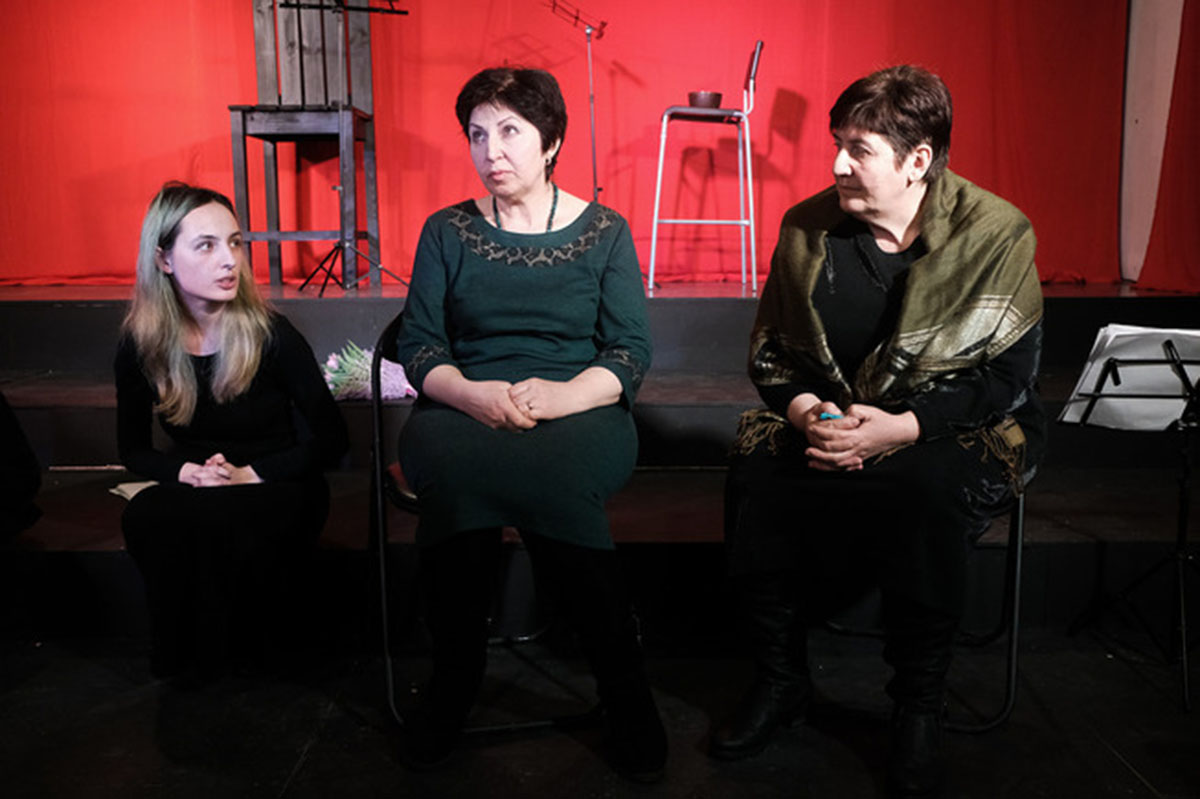
On the first of September 2016, the mothers of children who died during the terrorist attack in Beslan 12 years ago, after a memorable memorial service, staged a picket, demanding justice: the statute of limitations for bringing the perpetrators in the Beslan tragedy to criminal liability has long expired, and there are no results of the investigation. Women were roughly detained and sentenced to administrative punishment. Five months later, the permanent director of the theater.doc Elena Gremina staged a documentary performance “New Antigon” based on their case.
The site of the experiment
The co -author of the text of the performance is the correspondent of Novaya Gazeta Elena Kostyuchenko, one of the two representatives of the media who illuminated the action of the Beslan Mother Association in Beslan on the spot (the second was Diana Khachatryan, an employee of the publication "such things"). Then the police detained journalists along with the participants in the action, and two days later they were attacked, forcing them to leave the city. In the performance of theater.doc, Kostyuchenko participates as an actress. In general, in this work, director Gremina, the professional experience of performers is not so important. Actor Roman Evdokimov plays at once all the witnesses of the court, subtly conveying the embarrassment with which his heroes quote the slogan of the Putin - executioner Beslan, and many replicas of the defendants are read out by the audience, whom the actors invite to this.
Political performances of theater.doc are a kind of living monuments: acting like Chekhov’s “man with a hammer”, they do not allow to forget about the victims of state violence after the topic leaves news headlines
Theater.doc is literally an experimental platform that exists to offer different answers to the questions one after another: what is the theater today, what tasks can it solve? For example, he can give the audience unique experiences that have no place in everyday experience: the perfect example is “silence on a given topic”, a 60-minute session of silence, scarce in the conditions of a metropolis. Vsevolod Lisovsky, one of the most radical heroes of the new Russian directing, which nevertheless requires not to use the word “director”, is responsible for this and similar projects in the theater.doc. The works of Lisovsky, although they take place according to the category of theatrical productions, often exist according to the laws of contemporary art: say, they are organized in such a way that the reaction of the audience becomes their organic continuation, and dramatic art is included in the ordinary human habitat. So, a few days ago, in St. Petersburg, the staging “implicit impacts”-the city “boil”, that is, the performance, whose action unfolds in public spaces, and the audience follow the actors along an unexpected route, took place. Then the producer Lisovsky and actress Lyudmila Kornienko detained the police, accepting the emotional reading of poems from the balcony for trying to suicide - law enforcement officers involuntarily participated in the creation of the “portrait” of the Russian city, where any atypical behavior seems deviant.
in a natural environment
Another interpretation of the theater supported by the “dock” is an alternative channel of information: less massive than television, newspapers and magazines, but more independent (of course, it is fully possible only if it comes to a private rather than a state site). The political performances of the theater.doc - such as the recent “War of Close”, dedicated to conflicts in the Donbass and Syria, or the same “New Antigon” - not only comment on the agenda. These are a kind of living monuments: acting like Chekhov’s “man with a hammer”, they do not allow to forget about the victims of state violence after the topic leaves news headlines. When the problem is exhausted, and the setting ceases to be relevant, the theater without hesitation removes it from the repertoire: “Swamp business”, based on an interview with the relatives of the convicts, instantly disappeared from the posters as soon as the last of the heroes of the play was released.
By the way, another of the potential roles of this ancient art in the 21st century is the Center for Social Adaptation, which gives people who were supplanted on the sidelines of society, a new, creative life. The beginning of such a work is laid in the “dock”: among the actors engaged in his repertoire - former prisoner Marina Kleshcheva and the veteran of the Uzbek ballet, and now the labor migrant Aman Karamatdinov (solo performances of these artists, in which they talk about themselves, are called “Lir. Mite” and “Spatula”, respectively).
Process
Elena Gremina, who personally developed the space of her new performance, launched the auditorium 180 degrees. The stands, on which the seats are usually located for the public, became a stage: the audience looks at the high chair of the judge from the bottom up. The walls are covered with dazzling red matter: the non -accidental “imperial” color looks very unexpectedly in the strict interior of the tiny basement theater (however, the visual decision would just have won if Elena Kostyuchenko’s rebellious green hair remained the only bright spot on the stage).
Actor Roman Evdokimov plays at once all the witnesses of the court, subtly conveying the embarrassment with which his heroes quote the slogan of the Putin - executioner Beslan, and many replicas of the defendants are read out by the audience, whom the actors invite to this to this
The connection with the “Antigon” of Sophocles stated in the title reveals itself in a pair of laconic interludes, where the Greek princess is dive for his despotistical uncle, Tsar Creon (the director gives his replicas to actor Sergey Bukreev, for the rest of the time playing the role of the judge). A stumbling block in the tragedy of Sophocles is the body of Polinik, the brother of Antigone, whom the king as a traitor to the motherland prohibits burying. The similarity of two plots is evident: a woman is opposed to power, which does not honor the memory of the dead. Antigon was walled up in an underground crypt according to the ritual, leaving her a little food - "so as not to tarnish the city." Six mothers of Beslan - “public order violators” The right -bank district court of North Ossetia sentenced to fines and public work.
Excerpts of the trial protocols are mounted with the stories of Elena Kostyuchenko about each of the participants in the action: who was and who lost whom on September 1, 2004. The contrast between the monstrousness of the facts and the indifference of the judge (Bukreev in this role is ruthlessly accurate), to which the accused are so indifferent that, reading the case file, he does not pause at the end of the sentence, but at the end of the line - as if the text is obviously deprived of any sense. The theater is not in solidarizes with the slogan of the mothers “Putin - the executioner of Beslan”, in any case openly, and this is not about that at all. The message of the "New Antigone" in another: even a person who suffered from terrorism is not protected from state arbitrariness.