
Translated material
Return to the unknown
Russia in Davos did not discover the world market and the political reality with which it broke away a few years ago
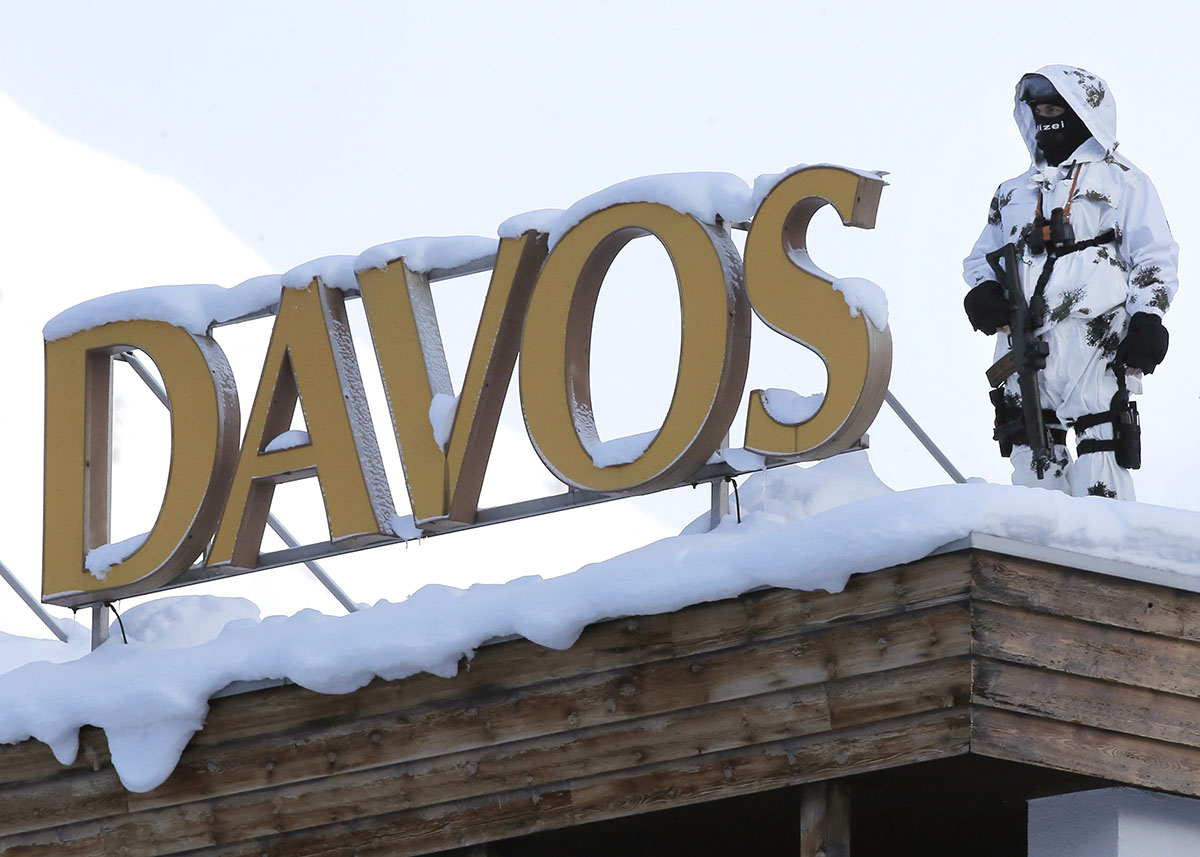
A large delegation of Russians in Davos 2017 was a surprise rather. Including for themselves. No, of course, there were those who Davos with his semi -holiday/half -edition do not miss: Chubais, Gref, Kostin - these are all familiar faces here.
However, since 2011, when quite promising Russian-American informal trade consultations fell on the fields of the World Economic Forum (WeF) (then, in particular, investments from the USA were discussed in railway projects in the amount of up to $ 5 billion), and especially after the administration of sanctions, Davos began to relate to some inevitable burden-Russian panels and sections were compressed to The degree of indistinguishability, and Russian officialdom began to choose other slopes for ski pleasures. However, with the election in the fall of 2016, US President Donald Trump, or rather, with the advent of the thesis walking in the world press, that Vladimir Putin helped Trump to choose with the help of hackers, "Russia received a chance for minutes of attention in Davos.
Russian Davos
The session in Russia at the forum took place for the first time after a two -year break. And it was right away. There were no distinct, loud topic in Davos this year for understandable reasons. Trump was not going to Davos, the performance of the now former US Vice President Joe Biden was not too interested in at least due to the fact that he was former. The chairman of the PRC Xi Jinping, who came to Davos for the first time, did not bring any news important for business - well, perhaps he promised to open China stock exchanges for foreign companies. India, active in past years, is engaged in internal problems, and therefore basically advertised in Switzerland the “dawn” state of Andra Pradesh as an object for large investments-many Davos participants knew about its existence than the presence of the Ulyanovsk region in Russia. Finally, the European Union was represented in Davos this time very poorly.
Talking about the inevitable abolition of sanctions against Russia over three days Davos have become such a common place that the head of Sberbank German Gref even had to exhort enthusiasts - well, it is unlikely that this will happen in 2017
Against this background, Russia looked more or less interesting - besides, I tried my best. On the eve of Davos (the official Russian delegation was headed by the First Deputy Prime Minister Igor Shuvalov), the government made a very important decision not to spend additional oil and gas revenues for analysts and reduce the budget deficit. In addition, the only official representative of Trump in Davos, his future economic adviser, and earlier the head of the hedge fund Anthony Scaramucci at the start of the forum said that sanctions on Russia are still not operating-and therefore, it is necessary to look for the possibilities of a “larger transaction” with it. Naturally, I did not bring any transactions of Scaramucci to Davos, but in a closed mode I got acquainted with the Russians - you have to know who to talk to later.
Sanctions, sanctions
Talking about the inevitable abolition of sanctions against Russia over three days Davos became so common that on January 19, the chapter of Sberbank German Gref even had to exhort enthusiasts - well, it is unlikely that this will happen in 2017. However, in addition to the sanctions, there are other important topics that the entire Russian officialdom - from the Minister of Economy Maxim Oreshkin to the head of VTB Andrei Kostin, quite neatly voiced in Davos. At the current oil prices and with a declared budget policy, it is likely to increase the sovereign rating of Russia - now it is on the “garbage” or, more harmonious, non -investment level, any increase in the S&P, Moody's and Fitch rating would be extremely important.
In this sense, Igor Shuvalov was unlikely to be cunning in Davos, saying that the movement of foreign capital to Russia could happen in the very near future. Strictly speaking, it has already occurred since the fall of 2016 in the form of Carry Trade, operations with borrowed funds in rubles, on the strengthening course of the national currency. In addition, the propaganda slogan, hung on new propaganda banners after November 2016, namely, “Barack Obama is to blame for everything, and not the United States that we really love,” is obvious and there is some semblance of an extended hand: we, if that, are ready to become Europeans again.
Europe is on the threshold. What?
Paradoxically, the most interesting conversations in Davos spun not so much around Donald Trump, about whose future policy it is unlikely that anyone can say something sensible now. The same Anthony Scaramucci diligently made a frivolous appearance, showing that in Davos he was a private person for several days (the forum took place from January 17 to 20 and ended on the day of Trump's inaigration) and generally glad to see everyone in this wonderful Swiss town with marvelous mountains and snow. The hero of Davosa 2017 was the European Union, and the heroine-British Prime Minister Teresa May. Brexit and its consequences occupy everyone: a referendum on the withdrawal of the United Kingdom from the European Union is traditionally seen as the victory of anti -globalization, xenophobic and protectionist forces. Nothing of the kind, said Teresa May. The UK leaves the European Union exactly because he no longer wants to put up with the insufficient globalization of his economy. Outside the EU, the country can globalize its economy more efficiently, having secured a more profitable place on the global shopping card, as well as in the industrial market, and will not be constrained by the internal problems of this rather conservative union. And in general - the British economy would not want to look for a new formula for access to the Unified EU market. Instead, she would prefer to negotiate with each European economy separately to mutual benefit. In 27 trading agreements, more freedom than one, the Prime Minister of Great Britain said.
Mai wanted this or did not want to, but got to the point. Regardless of what the British government will do in negotiations on Brexit, its partner will be a political and economic union of a completely different property than the one in which the United Kingdom entered in 1973. At that time, the slogan of the “common market” was the slogan of freedom of trade within Europe, in which universal protectionism reigned. Now the EU is rather a kingdom of protectionism on external borders against the background of the general trend to destroy trade barriers (Trump has been forgotten about the protectionism of Trump). Of course, there are no these barriers inside the EU market. But they are on the EU border - and Great Britain can really consider itself as a victim of these barriers.
At several sessions of the forum, behind closed doors, experts and business discussed a completely new topic - possible alternatives of the EU political structure
But the matter is not only in the UK - at several sessions of the forum behind closed doors, experts and business discussed a completely new topic - possible alternatives to the EU political structure, the future consolidation of jurisdictions in Europe. For example, the prospects of the Industry 4.0 program in Germany and in general the European vision of the Fourth Industrial Revolution, the main topic of the agenda for the corporate sector, were very meticulously. The head of the Russian office of the EY audit company, Alexander Ivlev, recalled that the 2015 report stated: from 1995 to 2011, the withdrawal of production from the USA, Great Britain, Germany and France led to the loss of 3 million jobs moved mainly to China, India, Vietnam and Singapore (the UK brought 18% industrial production, Germany and France - about 10%). Scientific and not requiring cheap human production resources during the “fourth industrial revolution” can move back to the “old” economies, although so far we are talking about the return of traditional industry - chemistry, transport equipment, optics, electrical engineering, and shoes. At the same time, the Fourth Industrial Revolution promises to be a new round of the globalization of the economy - in a world in which there are big problems with politics.
This marvelous new world
Representatives of Russia in Davos after several years of self-isolation do not really understand what strange context their Western interlocutors (Western, we note, have already been attributed to Jack Ma from Alibaba and Winnie Bianim from the Oxfam international charitable group with headquarters in the UK, and the head of the EBRR Suma Chakrabarti, and Shiva, and Shiva The KHEMMA from the Indian-Russian Sun Group) is entered a quite possible “investment boom” in Russia, if it happens. Paradoxically, Russia will have to return to a slightly different economy and to a completely different policy than those that it was proud (and not quite of its own free will) left five years ago. According to Pavel Teplukhin from Matrix Capital, one of the most important topics on the forum was the topic of future leadership - both political and economic: who will be able to present a program that inspires the world is not yet clear.
Actually, this is the main “geopolitical” sensation from Davos-2017: while Russia is looking for a favorable reason to begin to restore relations with the powers that be, the very concept of “powered out of this world”-what it was five years ago-has changed a lot if it did not disappear at all. It is not clear who and how to agree with, when the Brexit theme is most constructive in Davos is not discussed by representatives of the European Commission, but by top managers of the Government of the Netherlands. It is not clear who will take into account the interests of Russia when the discussion of the resumption of Japanese-European trade relations is led by the President of the Japanese Toshiba, and in 2017 it does not seem surprising. It is not clear how to talk with the head of the IMF Christine Lagard, if her most vivid event in Davos was an unexpected and very sober and economically convincing discussion on the topics of gender inequality and the rise of feminism in the world,-Deputy Prime Minister Olga Golodets was in Davos, but participation in this kind of discussion on the agenda of the Russian White House is somehow entered. Finally, it is not clear why Donald Trump generally refuses the role of the “main world leader” (by the way, Xi Jinping in Davos did not at all resemble the Chinese emperor at all-was rather perceived as the chairman of the Supervisory Board of the Chinese Corporation in trillion dollars) and conveys a wish about some “transactions”. If there is no “Washington regional committee”, the “Brussels regional committee” disappears, then before whom is Russia proud of Russia and to whom to defend national sovereignty? Is this really the same multipolar world that Russia has been talking about for the past 15 years from any device that can make articulate sounds?
If there is no “Washington regional committee”, the “Brussels regional committee” disappears, then before whom is Russia proud of Russia and to whom to defend national sovereignty? Is this really the same multipolar world that Russia has been talking about for the past 15 years from any device that can make articulate sounds?
It looks like it is he. Rather, this is not quite a “multipolar world” in the understanding of theorists of the 1970s from the international department of the CPSU Central Committee, where two military poles were accepted for “multipolarity”. It is rather a world with many points of attraction in which the status of “superpower” is a unique trade proposal to the rest of the world. The world in which large armies correspond to the size of GDP gradually go into the past. So, at one of their closed meetings in Davos, one of the members of the Government of the Russian Federation sincerely corrected the head of a major international company, who spoke about the future strategy of Russia in the world economy similar to Asian countries - Russia is not Asia, it is not necessary to look for analogies in South Korea, it is rather central Europe. Meanwhile, he was offered a much more interesting alternative in the eyes of a person’s business - well, what is central Europe? Where is it more promising - in Croatia or in Malaysia?
Russia, not so far from Khrushchev’s rivalry with the United States for the production of steel, milk and medium -range missiles, will be extremely difficult to accept this kind of reality, no matter what its officials say in Davos. No, while they are still talking with colleagues in close language-well, at least thanks to the hobby of IT technologies in public administration. But gaps are already visible in understanding the general reality-if everything remains as it is (and the tactics of power for 2017-this is precisely the preparation of structural reforms without any reforms at least until 2018 or later), in a year in Davos Russians will listen to much less attention. The world without Russia is large enough. And the spoon is good for dinner.