Date
Author
Александр Генис; Соломон Волков
Source

Preserved copy
Translated material
Dialogue on Broadway
Alexander Genis: In the second part of the ACh - “Dialogue on Broadway”, which we lead with the historian of culture and musicologist Solomon Volkov in the Broadway studio Radio Liberty.
Solomon, what is they talking about Broadway?
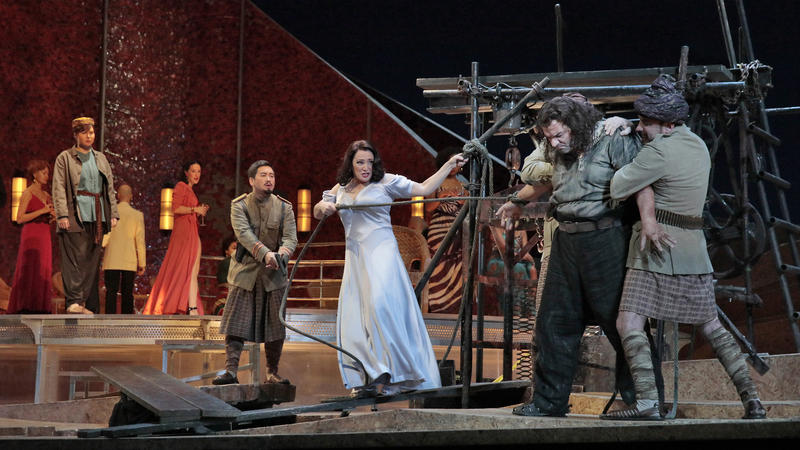
Solomon Volkov: Broadway speaks about the sensational production of the opera Salome Richard Strauss. Do you seem to go to her?
Alexander Genis: Yes, I just returned from her and barely waited for this performance. Because the whole city is talking about this production. She was transferred just recently on public radio. Every Saturday, opera lovers in the United States are clinging to the radio, because they broadcast performances from our Metro Theater. I was just at the performance that was broadcast on the radio, so that millions of Americans listened to this opera with me, and many foreigners also listen to these broadcasts now, when there is the Internet.
I was extremely liked by the production, it was avant -garde, but not too much - this is an avant -garde, as we love to speak with you, with a human face, and in this case, also in the body, because, as we know, the Salome is an extremely erotic opera.
It was the production of Jurgen Flimm, a very famous German director. He began as a dramatic director, put only Chekhov in Germany, all Shakespeare and so on, until he reached the opera, now he is the famous opera director. His production is not new, but it was resumed this year and with great success. I really liked the scenography, it is great invented. On the one hand, he transferred the opera, relatively speaking, to the twentieth century. A certain colonial hotel somewhere in Turkey or in Africa is not very clear, but somewhere in the east. People are dressed in tailcoats, women in evening toilets. The scene itself is divided into two parts: the first part is this luxurious hotel with a staircase, with palm trees, with crystal, everything looks very impressive, from James Bond Entouches. And the second half of the scene is a desert, where John the Baptist languishes in the dungeon, which is the reason for this opera. The plot of the opera is unusually strange. When Oscar Wilde composed this play, he wrote it in French, in England it was forbidden to put it, because it was considered obscene on the one hand, and on the other side of the blasphemous. This is exactly what she is. And the division of the scene into two parts works well on the plot of the opera. On the one hand - King Herod, Herodiada and daughter of the Herodias of Salome. All of them are villains, villains, hedonists, all of them enjoy life while ordinary people suffer.
And on the other hand, we see a desert, guards dressed in strange skirts-so once Arab or Turkish soldiers looked. We see John the Baptist, who looks like a bull - hairy, huge, in chains. He is mighty and he sings from under the scene - he does not get out of the dungeon half of the opera. I think how to be able to sing in order to fill the gigantic hall of the metro at a time when the singer is under the stage, nevertheless, he does it.
The combination of an eternal biblical plot with a momentary and very vain life, represented by villains, Herod and his family, of course, acts great: we take the side of John the Baptist. Although, of course, the play itself, and the plot, and the music, everything is ambiguous, because there are many complaints to John to John. Why is he sitting in a dungeon? Because he accuses the Herodiad of being confused with the Egyptian once, even before Herod. Her crime lies in the fact that she is a cosmopolitan and does not care about the purity of blood. By our standards, on the opera, rather John the Baptist is a fanatic, Taliban. And Strauss, and Oscar Wilde, and the dates of the metro leave this consideration aside.
The opera is expressionist, so there are cries and dissonances. The metro orchestra is an amazing tool, of course, he makes all this opera terribly gambling. She goes without a break a little less than two hours, and you are sitting all the time on the edge of the chair, especially, of course, when the central episode of the opera begins in any production - the dance of the seven bedspreads.
Solomon Volkov: I do not agree with you in one, nevertheless for me, the central character of the opera is a person who is taken to the title, that is, Salome. Still, her character, her aspirations and her actions dominate, everything else, in my opinion, for Wilde and Strauss, was rather sideways. By the way, the thought also suggests me on this topic, we once discussed with the deceased George Balanchin the whole story with Salome, referring to Wilde's homosexuality, he just said that for Wilde it was more likely an erotic hue: in the final scene, as we know, Salome kisses the lips of John. Balanchin expressed such an idea: Wilde realizes in this action his desire to kiss a man on the lips. It is curious that this passage from our conversation with Balanchin, it is published in the book of my dialogues with Balanchin, inspired Maurice Bezhara to the Salome ballet, where a man plays with the head of the alleged John the Baptist.
Alexander Genis: This plot with kisses simply does not end. A few years ago I was in Paris in the Pere Lashez cemetery, where, as we know, Kommunars were buried, victims of the Paris Commune. But besides this, many other famous people are buried there, for example, Chopin. And Oscar Wilde was buried there. The grave of Oscar Wilde is the object of pilgrimage for homosexuals of all countries, and all of them leave traces of kisses on the monument to Oscar Wilde. So this topic has a continuation.
The content of this production is such that it provokes all kinds of erotic reasoning. With one time, they said that in this opera blasphemy with fetishism fights, erotomania and a drop of incest were added there. This is what Sorokin's stories look like.
Solomon Volkov: Yes, this is a rather explosive tcockel.
Alexander Genis: But this is done very curious. Jurgen Flim, it seems to me, was influenced by Bob Foss, this whole family is a terrible Heroda ...
Solomon Volkov: How are characters from Fossa musicals?
Alexander Genis: Yes, in the style of the German cabaret, which Bob Foss depicted in the film "Cabaret". This also applies to the dance of seven covered Salome. In old productions, she always danced something like a dance of the abdomen, but there is nothing like this here. She dances in a men's suit, dressed in a tuxedo, which she gradually, with great difficulty, takes off, because it is inconvenient to take off her trousers on stage. Everyone, holding their breath, is waiting for how it ends. When there was the premiere of this production of Salome in the metro, Karita Matilla, the famous Finnish soprano, played the title role. She was already 43 years old, but this did not stop her from being exposed on stage.
Solomon Volkov: There was, in my opinion, 15 seconds of nakedness.
Alexander Genis: I think there is much less, because this time the singer was revealed literally for a second, but nevertheless, everyone managed to notice it. This, of course, was a spectacular sight. Because after all, the metro is visited by an old-fashioned and stiff audience. So this made the right impression, but everything was made with great taste. The main thing is the music of Richard Strauss. Solomon, Richard Strauss, as I understand it, was such an “Anfan Terryble” of that time.
Solomon Volkov: Yes, but he, like many others, and this is one of my favorite topics, evolved from an expressionist style, the top of which is, of course, a “Salome”, towards a neoclassical, if you like, a neoensky style, the top of which is, of course, a “cavalier of roses”. These are the two most popular operas of Richard Strauss.
He wrote a lot of operas and, in general, are more or less placed, but “Salome” and “Cavalier of Roses” remain the most repertoires until today. Of these, of course, incomparably more shocking and extravagant, balancing, as we found out in our conversation, on the verge of permitted, is Salome. Everything, of course, depends in this opera primarily on who and how sings Salome.
In this sense, I was lucky, I knew, it seems to me, the greatest Salome of the New Age, Greek in birth, Teresa Stratas, who performed on the stage of the metro for very many years, in my opinion, for 36 years she sang to the metro and suddenly left the stage in 1996. I met her on Broad in the wild - like a bum. She took up charitable activities, left for Calcutta and there in a shelter with her mother Teresa worked with patients, then went to the Romanian hospital and was engaged in similar activities there. She left the scene. With her, there was some kind of psychological turning point,
Alexander Genis: As with the Saloma, by the way. This opera can be interpreted in this way: Salome was a capricious girl who fell in love with her enemy, she could not do anything with her feeling, she survived a spiritual fracture, the one to which John the Baptist called for those whom he baptized. It just occurred to me that such an interpretation of this tragedy is also possible.
Solomon Volkov: This is an absolutely legitimate interpretation. As for Stratas, she is now 79 years old, she lives in Florida very solitary, does not communicate with the press at all. This is one of such tragic destinies that developed in unison with the tragic fate of her heroines. She was a wonderful singer, one of my favorite records - these are two disks with the performance of Kurt Stratas songs, which were extremely popular at one time.
And we will now show this most erotic dance, how it sounds in the opera of Strauss, the dance of seven covered, the Salome dancing.
(Music)
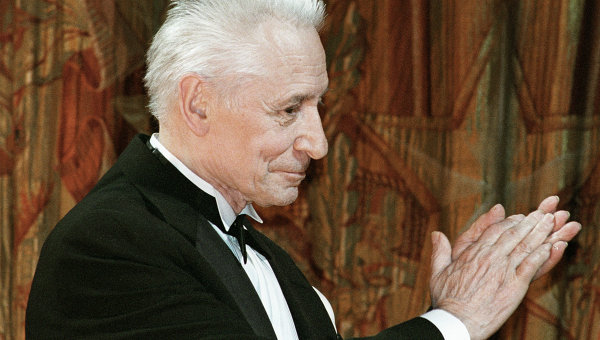
Solomon Volkov: Filled in January 90 years of the titanium of domestic choreography Yuri Nikolaevich Grigorovich. This is a person who headed the ballet of the Bolshoi Theater unprecedented 30 years, a person with whom a huge piece of history of the Bolshoi Theater is associated in this way.
Alexander Genis: Solomon, all last year you introduced us to the history of the Bolshoi Theater. From this story, I made that one of the most difficult works in the world is to lead the Big Theater. How did Grigorovich dealt with this huge enterprise?
Solomon Volkov: This is the mystery and greatness of Grigorovich. Because the time of his reign is unprecedented in his duration, in his influence and in the passions that this rule caused. It can be called the king of the Bolshoi Ballet of the Bolshoi throughout this period, he led from 1964 to 1995.
Alexander Genis: But these are at least three or four stages: 60s, stagnation, perestroika and new Russia.
Solomon Volkov: Four, yes. Each of these stages was turbulent. But he was held every time on the crest. In 1995, he left, and with a big scandal. And since 2001, he has been cooperating again with the Great Theater, since 2008 he is his full -time choreographer, not the main, but regular. And now, at the age of 90, Grigorovich continues to work at the Bolshoi Theater. This is an absolutely unprecedented phenomenon.
Alexander Genis: What is the aesthetics of Grigorovich?
Solomon Volkov: Aesthetics Grigorovich also changed. It changed in a sense even before my eyes, as a spectator. I always repeat that I am in no way with a ballet, I am primarily attracted to music in the ballet. What is blasphemous, of course, in the eyes of the balletomans of the real. For example, when Balanchin arrived for the first time in the Soviet Union, I did not go to the performances of the company led by him not to see Balanchin’s ballet, but in order to hear the Stravinsky’s ballet “Agon”, which Balanchin brought then. For me, "Agon" was much more interesting. I was very carried away by the Balanchin choreography, I made this hobby before my life in New York, and, as you know, I eventually made a book of conversations with the Balanchin, but the initial impulse has always been music for me. And I love Balanchina primarily for the fact that he always deeply, originally interpreted music. Seeing a kind of musical work in the interpretation of Balanchin, since then I can hear this work, only imagining choreographic images of Balanchin.
Alexander Genis: And Grigorovich?
Solomon Volkov: Grigorovich is the same. I went the first time, then I lived in Leningrad, on the ballet “Stone Flower”, and it was 1958, the ballet appeared in 1957, it was a comparative novelty, primarily in order to hear Prokofiev’s music. Because in 1957, Prokofiev was not at all considered such an indisputable classic, the great composer, which the whole world now recognizes him. And even people who may not like modern music at all, know that Prokofiev is one of the titans of composers of the twentieth century. And then it was all with the heat, with the heat. Prokofiev died in 1953, the debate around his work did not fall silent, books still appeared in the Soviet Union, in which Prokofiev was criticized very unpleasant for the formalistic slope. Grigorovich put this ballet as a classic, and it was a very strong impression.
Then Grigorovich succeeded - I already understood this retroactively when he began to better understand the history of the ballet, to fuse two currents that seemed incompatible before that time, he fused the so -called “dramatat” - this is a specific genre invention of the Soviet ballet era, when the main attention was paid to the development of the plot so that the ballet was logical dramatic. It usually took some significant social topic, it could be a revolutionary plot, it could be some kind of production story, it could be the interpretation of the classics, but it was all more likely a theatrical than a ballet performance, that is, the ballet as such in the dramatates receded into the background.
Alexander Genis: That is, at first there was a drama, and then the ballet?
Solomon Volkov: That's right. Grigorovich, taking the best elements of the drama, and these elements were there. At one time, a dramat was scolded by fashion, when the times of the Stalin and post -Talinsky passed, the dramat was subjected to terrible reproach and, by the way, from domestic progressive ballet critics, and even more so in the West, they frankly laughed at him. Although they made exceptions. “Romeo and Juliet” is classic, also to the music of Prokofiev - this is largely a dramat.
Alexander Genis: The best interpretation of this tragedy of Shakespeare, which I know.
Solomon Volkov: I relatively recently saw the Flame of Paris, who brought the Ballet of the Mikhailovsky Theater to New York, which also began to laugh at at one time. And in vain, this is an interesting, exciting, fascinating sight in all respects. And even the music of Asafiev, who was generally refused any virtues, I liked extremely.
There is nothing to talk about the “stone flower”-this is a masterpiece, in my opinion, unconditional, and this is a wonderful work, a wonderful interpretation of Grigorovich. Because he also added interpreted elements of classical dance to the best elements of the drama. He fused these two elements that, so far, I think, are of great artistic interest.
Alexander Genis: What is the best Ballet Grigorovich, in your opinion?
Solomon Volkov: Of course, the best Ballet Grigorovich is the one that is his hallmark and the hallmark of the Bolshoi Theater to this day - Spartak to the music of Aram Khachaturian, which was staged at the Bolshoi Theater in 1968. Imagine how many years this performance has been a truly visiting card.
Alexander Genis: I saw this performance in Riga when I was still a schoolboy, Maris Liepa danced Crassus. It made a huge impression on me, I really liked it. I was not a big connoisseur of music, but I terribly liked antiquity. This performance represented Rome and the Roman story in a way as it was customary in the first half of the 19th century in a romantic school of painting. That is, it was solemn, heroically, beautifully and exciting. What else do we want from ballet?
Solomon Volkov: This ballet received the Lenin Prize, made Grigorovich a favorite of power. At the same time, in it, as in any significant work, there is very significant ambivalence. We have two heroes - the revolutionary of Spartak and the Roman military leader Crassus, who, in the end, after humiliating defeats from Spartak, nevertheless wins him with cunning, cruelty, all sorts of deceitful maneuvers, and so on. What is, as it seems to me, the colossal achievement of Grigorovich as a choreographer, I now do not go into an analysis of purely choreographic techniques, but Psychologically and meaningfully, Grigorovich’s achievement is that these are equivalent characters in interest, in expressiveness. That is, it is not so that the ballet is called Spartak and there is one interesting positive Spartak in it. Or vice versa, it often happens that a negative hero is much more interesting than positive. No, here these are two equivalent figures.
Alexander Genis: And this is very distinguished by Grigorovich’s “Spartak” “Spartak”, which I saw around the same years with Kirk Douglas, which I categorically did not like it precisely because there was no ambivalence, Spartak in the cinema was miserable and oppressed. And here they were both heroes, one was a prison hero, the other was a hero hero, but it was clear that these were strong men who stubbornly fight for their job. Конечно, как бы плох ни был Красс, он вызывал уважение. Не зря Марис Лиепа танцевал именно его.
Соломон Волков: История взаимоотношений Лиепы с Григоровичем до сих пор бурно обсуждается в балетоманских кругах, она была очень драматичной, но в воспоминаниях Лиепы и в воспоминаниях других участников премьеры «Спартака» говорится о том, что этот балет рождался коллективными усилиями труппы, коллективными усилиями Григоровича и его исполнителей главных ролей. Лиепа говорит, что Григорович охотно принимал какие-то советы, пожелания, в итоге вылепился такой сложный многоплановый образ Красса, который символизирует власть, не только политическую, но также и власть сексуальную, что тоже очень важно в этом балете.
Я смотрел этот балет - его привез в Нью-Йорк в 2014 году во время своих последних гастролей Большой театр. “Спартак” производит колоссальное впечатление на публику комбинацией идей -столкновения государственности с идеей бунта и проходящей через весь балет темой столкновения двух альфа-самцов, как теперь принято говорить, Спартака и Красса. То есть Григорович сделал действительно из этого всего захватывающее зрелище, как вы справедливо указали.
Александр Генис: Как Хачатурян отнесся к постановке?
Соломон Волков: Хачатурян плакался все время. Потому что его балет ставил не только Григорович, существует версия в постановке Игоря Моисеева и Леонида Якобсона, с которым мы разговаривали о «Спартаке» (об истории якобсоновского балета, который был показан в Ленинграде — это особая увлекательная история). Хачатурян каждый раз плакал буквально как ребенок, потому что балет кромсали, ни в одной постановке музыку так, как ее написал Хачатурян, не исполняли. Кромсали по-разному, довольно безжалостно, оставляли, по словам Хачатуряна, куски хорошей музыки за бортом. Поэтому он каждый раз бывал несчастен по этому поводу, как и полагается замечательному композитору.
Музыка ведь и правда потрясающая — это одна из главных удач Хачатуряна. Западные, в частности, американские балетные критики, когда им хочется не любить «Спартак», массу претензий предъявляют хореографии, но и они не могут игнорировать реакции аудитории, которая всякий раз на моих глазах здесь в Нью-Йорке вскакивала со своих кресел и аплодировала бешено, потому что этот балет производит огромное впечатление - как смерч, как шторм, который не оставляет возможности сопротивляться этому зрелищу. И даже снобистски настроенные критики вынуждены признать в данном случае победу и Григоровича, и Хачатуряна, и исполнителей главных ролей, если они соответствуют тем задачам, которые перед ними авторы поставили.
Поздравляя Юрия Николаевича Григоровича с 90-летием, мы завершим нашу передачу музыкой Хачатуряна, это - замечательный фрагмент: торжество Красса.
(Music)