
Translated material
Skinheads against the aliens
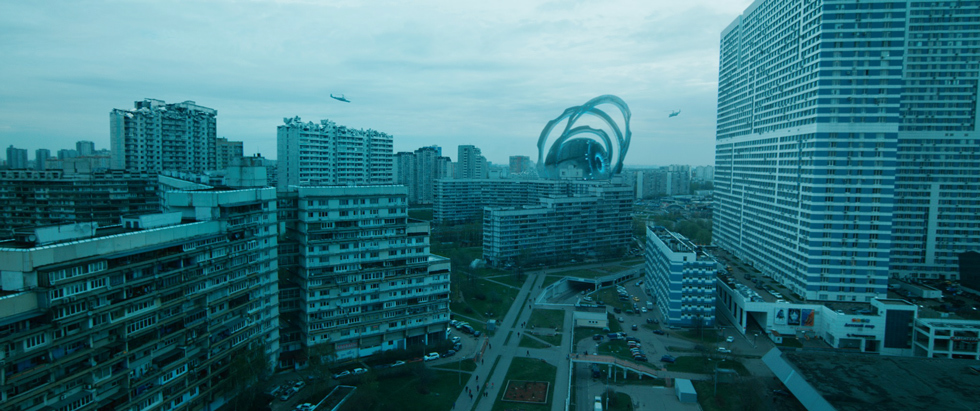
The main characters of “Attraction” are young Muscovites Julia (Irina Starshenbaum) and Artem (Alexander Petrov). The scene is Chertanovo, the southern outskirts of Moscow. Julia lives in a high-rise building with a military father (Oleg Menshikov) and studies in the last grade of the school. Artem is the first guy in the area, with whom Julia's father clearly does not approve. Therefore, in order to meet, young people have to apply ingenuity. Under the pretext of the fact that a unique starfall is expected over the south of the capital, they are secluded in the apartment of Yulina's classmate, who, like many Muscovites, decides to observe a rare cosmic phenomenon from the roof. The first sex of the main characters coincides with the first contact of earthlings with alien civilization, but, as often happens with a sensual manifestation of proximity, the first meeting is not too smooth - the alien ship suffers a disaster, destroying half of Chertanov. Human victims are calculated by hundreds. Julia's friend dies, and the main characters miraculously manage to escape. The area of the decline in the spacecraft is numb by the military, the commandant hour is introduced in Chertanov, and Julia's father becomes the main person in the city and personally is responsible for contacts with extraterrestrial civilization.
The first part of the film confidently develops the ideas of “district No. 9”, the main “reference” “attraction”: aliens, like any stranger, will not be happy on Earth. After the death of hundreds of people, the lights of the city outskirts are quite expected to light up with anger and hatred of the aliens. And among the main characters, this hatred is strengthened by personal motive. And when it becomes clear that the authorities are not going to take revenge for the dead, the guys from Chertanov decide to take the situation into their own hands.
 © Sony Pictures
The main emphasis in the advertising of “attraction” is on the fact that this is the first Russian film about the invasion of aliens. The regulars of multiplexes and SCI-Fi lovers will surely compare it with the best samples of the genre, and the film is ready for this. His dramaturgy is subtly built on the deceit of the audience expectations, and if desired, “attraction” can be developed on “spare parts” to find out with which famous film the creators “talk” in a particular episode. This is not surprising: the new film by Fedor Bondarchuk was shot in the cinematic tradition, unfamiliar to Russian cinema, and the tribute of this tradition is given in it in full.
But it is much more important that “attraction” is also the first Russian fantastic blockbuster, the action of which takes place in modern Russia from the time of the “patrols” of Timur Bekmambetov. Apparently, Russian filmmakers every ten years have a kind of need to supervise a watch with the surrounding reality.
Comparisons with “patrols” cannot be avoided already in the “attraction” trailer: one of the most memorable episodes of Bekmambetov’s dilogy was jumping around Moscow and destroying everything in its path of a damn wheel. In the “attraction” of the aliens, similar to the human eye in a three -dimensional projection, no less effectively falls on Chertanovo. And just like the “patrols” became the main statement of the zero in commercial cinema, “Attraction” has every chance of becoming the main box office of the 2010s. To think about him, you do not need to look out what the authors said in addition to their will about their time.
 © Sony Pictures
Bondarchuk removes the world that is afraid of the future and is extremely hostile to it. The world in which rebels for no reason, young romantics in a few minutes turn into an aggressive crowd with bits in their hands, chanting: "This is our earth." Moreover, this is the world not at all cardboard characters. The development of the character of the protagonist, his metamorphosis is one of the most interesting achievements of “attraction”, perhaps even more interesting than a painless transplant of the film genre about an alien invasion of Russian soil. The charming and impudent hooligan in just an hour of screen time turns into a leader of the neopharyngeal movement (and this cannot but remind how many supporters of the “strong hand” before our eyes turned into right -wing populists in just a few years). But at the same time, the director is in no hurry to put him an unequivocal moral assessment (partly on a similar logic, the drama of Stalingrad is built, where the German captain, burning people on the alive, was shown by a person with history, tragedy and fate). The director explains the choice of the protagonist, but at the same time convincingly shows that this choice is incorrect. In the recently born commercial Russian cinema “Attraction”, probably performs the most important social task to date - this is the first genre anti -fascist film.
 © Sony Pictures
Films about the arrival of aliens have always been a convenient way to say about the problems of attitude to another in modern society. In the Star Troops, Verkhoven brilliantly showed the fascist inside out of American ideology, the “Independence Day”, on the contrary, justified the US dubious contribution to the fight against world evil by interfering with other states, and in “area No. 9” Nil Blomkamp diagnosed the values of the already global world. “Attraction”, among other things, indicates a choice between civilization, which is personified by the director and man Fedor Bondarchuk, and barbarism. But paradoxically, at the ideological level in the “attraction”, “district No. 9” is found with “Independence Day”. According to Bondarchuk, the possibility of peace on Earth seems to be still provided by the state and its military machine, the functions of which just include the construction of a protective fence that separates some from others. But it is enough to even mentally change the places of the hero Oleg Menshikov, a reasonable military man who is able to make a wise decision in an extreme situation, and the hero of Alexander Petrov, blinded by hatred for someone else's and thirst for revenge, to understand such a fence and such a society does not have such a fence.