
Translated material
Through the light
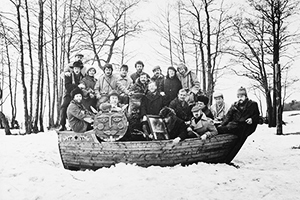
The situation in which in the great World Warehouse of images of the “Golden Age of Search” [1] there is no mention of the author’s works and about himself is unique. That is how things were with the Leningrad Amateur Photo Collut of the Mirror, whose activities were in the late 1970s-early 1990s and which was forgotten by the time of the widespread spread of the Internet. At the time of work on my research “Mirror”, the information that could be found about this photo club on the network was limited to the materials of the grant application submitted by Igor Lebedev, curator and researcher of photography, in 2013; For a long time he met with the authors, collected prints and restored life stories. Some of them managed to save from oblivion, but for various reasons we will never see much.
The point is not only the invisibility of individual authors - the names of many of them are well known to us - but also in the peripheral situation of amateur practices, the significance of which is often underestimated. Meanwhile, behind a brief line in a biography, talking about membership in a photo club, there are years of life: personal experience, ideas and mood moods, a wide historical context. The Soviet amateur photograph was and remains something like a counter-rhlers, which historically went to parallel with world amateur communities, but remaining much less well-known. And although in the history of the “Mirror” photo club there are notable names in St. Petersburg and beyond, the Leningrad photographs in general turned out to be walled up in its era, not receiving development and proper theoretical understanding.
The activities of photographs could not be defined as a radical art project that belonged to the conditional sphere of non -conformist creativity - and at the same time it did not come down to photojournalism. Entering amateur photographs in the discourse of contemporary art is quite problematic, since the methodology of the Western knowledge system developed in a different social configuration, and their equalization only to documents of the era would mean denying the artistic value and autonomy of these images. Now interest in such a complex phenomenon of late -Soviet culture as amateur photography, and in the development of a language for its description, has just begun to manifest itself.
The flowering of photography in the Soviet Union came for a while after the Second World War, when mass production of inexpensive low -format mirror cameras is launched in the country.
The “mirror” as a phenomenon of the second half of the “short” twentieth century, conditionally limited to 1989 (the year of the appearance of the Internet), was noted by a number of features inherent in many other Soviet amateur associations. Historically, the Soviet club movement is a closed system associated with a special political and economic situation, limited in the acquisition of materials and limited communication with world photography. Due to the difference in the conditions of the role of photography as a language in domestic and western contexts, it was strikingly different. In 1932, after the resolution of the Politburo of the Central Committee of the All-Union Communist Party of Bolsheviks (b) “On the Perestroika of Literary and Artistic Organizations”, all creative associations were dissolved, and for two decades, before the start of the thaw, photographs were “wintering” at film correspondent points at factories and enterprises. The heyday of photography in the Soviet Union came for a while after the Second World War, when, on the basis of imported technologies and equipment in the country, mass production of inexpensive low -format mirror chambers is launched; In addition, many foreign cameras were brought by private individuals, which contributed to the spread of individual photography [2] .
In the period from the end of the 1950s to the end of the 1960s, the club movement made an impressive leap from gatherings interested in photography to a certain situation of elite, growing a galaxy of professional photographers of a high level of skill [3] . One of the few places in Leningrad, where it was possible to get a professional photographic education, was the faculty of photo correspondents of the People's University of Public Professions of the Palace of Culture named after CM. Kirov. It was visited by most participants in the “mirror” of the first period (1977-1980). Such an education made it possible to get basic technical skills and join the photojournalism genre - the only officially approved way of using a photographic medium that was understood in the USSR not so much as art as a means of spreading information [4] . They studied the rest of the magazines themselves, with family members, from colleagues, near the city. Despite the fact that the City of the Mirror practically did not shoot (except as a scene on which the documented social life was played out), Leningrad was a kind of aesthetic resource for them, a daily simulator of visual literacy. It was the “museum” of this city that largely determined and formed their aesthetics.
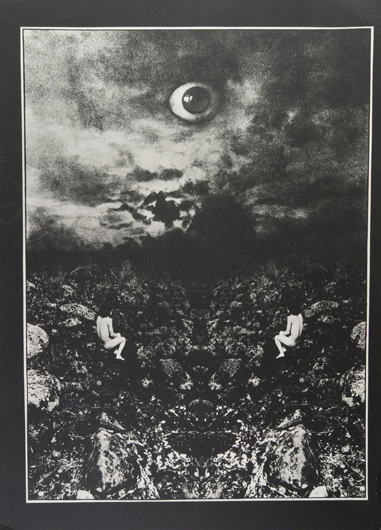 © from the collection of Rosfoto Gennady Tkalich. Strange plateau. From the cycle "Tales of the Blue Beard." 1979
Among the members of the “Mirror” were those who were engaged in photo report - in particular, Boris Bulgakov, Alexander Nikolaev, Leonid Zlachevsky, Evgeny Raskopov - and it is important that professional reporters brought to the club what they could not show at work. There were those who shot artistic documentary: Pyotr Lebedev, Pavel Ivanov, Sergey Podgarkov, Boris Mikhalevkin, Lyudmila Ivanova, Lyudmila Tabolina, Evgeny Mokhorev, Alexander Kitaev, Andrey Usov. And those who were more occupied by experiments with form, and later - conceptual photography: Yuri Matveev, Sergey Arsentiev, Alexei Titarenko, Gennady Tkalich, Andrei Chezhin, Valentin Kapustin, Dmitry Schneerson, Yuri Zhuravsky.
It is easy to notice that the composition of the photo club was mainly masculine. Among the more than 60 participants in the Mirror club at one time or another for a decade, female photographs can be counted on the fingers of one hand: Lyudmila Ivanova, Lyudmila Tabolina, Tamara Ishenina, Lyudmila Fedorenko and Yulia Larionova. In addition, women were not inscribed in extra -circuit initiatives. Lyudmila Tabolina performed the function of the secretary and kept all the records of the club, and out of thirty personal exhibitions held in the Photokinovarian stores from 1977 to 1989, the personal exhibition of the club participants was held only once (Lyudmila Fedorenko’s exhibition in 1986). This situation was generally characteristic of a professionalized amateur photo movement.
The implementation of overtime work and visiting public events made it possible to receive roaning “Barter” and, folding the days, travel around the union with mobile “mirror” exhibitions.
The specifics of the functioning of the social life of the late Soviet period can be interpreted through the category of “extra -consumability” introduced by Anthropologist Alexei Yurchak. This category is important for understanding the futility of the search for gradations of political among Soviet photography. INSUENCELY - This is “the simultaneous presence inside the rhetorical field of authoritative discourse and outside this field, which differs both from the support of this discourse and from the opposition to it” [5] . Investigation, according to Yurchak, became possible thanks to the contradictory policy of the Soviet state, which made a lot of efforts to educate a comprehensive developed individual. There were countless (or purely symbolically paid) leisure capabilities, the creative environment inside which made it possible to form unexpected meanings and interpretations not provided for by the system [6] .
INDIVITY combined people who often come from very different social groups, but with a similar attitude to the static authoritative discourse, which imposed strict compliance with the norms and the execution of formal rituals of the regime (visiting the Party, participation in subbotniks, etc.), at the same time allowing a flexible interpretation of the rules and caressing between them, subject to external observance of the priest. So, the chairman of the “Mirror” Yevgeny Yuryevich Raskopov, like many other participants in the club, was repeatedly officially employed as an engineer, while performing the duties of a photographer (often the official position of the photographer at the enterprise simply did not exist). The implementation of overtime work and attending public events made it possible to receive roaning “Barter” and, folding days, traveling around the union with mobile “mirror” exhibitions, competitive work, lectures, popularizing the club inside the country.
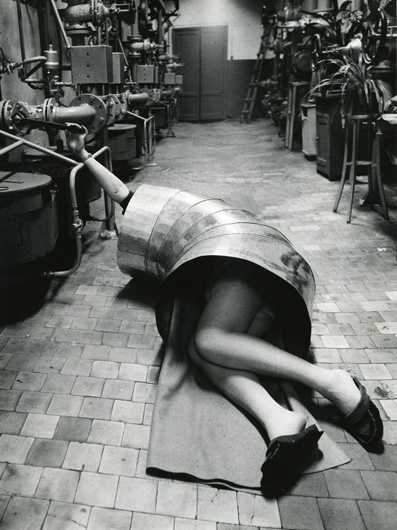 © from the collection of Rosfoto Yuri Zhuravsky. From the cycle "Profession - Kochegar". 1982
All photographers (correspondents) of the USSR were either members of the Union of Journalists, or were content with amateur status (the only society in the USSR was organized in Lithuania in 1969). However, the status of a people's correspondent was supported by photographs and gave certain privileges. In the certificate, which was issued a member of a folk photo club, a phrase was placed next to a spiritual quote from Lenin: “The Council of the photo club and the Directorate of the Palace of Culture is asked by state and public organizations, as well as to individuals to assist the photojournalist in the production of photographs.” Such a document was for members of the first composition of the Club "Mirror", which was originally in the framework of the photo club of the recreation center named after CM. Kirov and possessed the status of folk. As an independent association, the “Mirror” received the status of a folk photo club in 1987, when most of the described restrictions ceased to exist.
It was such artifacts as a crust of a member of a folk photo club that clearly demonstrate the internal inconsistency of Soviet policy: membership in the folk photo club gave the rights to access to objects and events compared to those that professional photojournalists possessed, providing the opportunity to remove reality not from the point of view of authoritative discourse, but by setting up their own photo sound. Thus, the activities of the photo club were primarily a private character: the photographs of the participants were not politically contrasted by Soviet culture and were not read to it as dissidentity. For almost the entire history, the club balanced between the “official” and “unofficial”, repeatedly faced with censorship (three of the eleven exhibitions “Mirrors” simply did not open due to the appropriate indication from Smolny), the ban on printing or exhibiting work-and at the same time successfully participating in the largest all-Union exhibitions. Reviews of photographs of the club were published three times in the “Soviet photo” - in 1979 (No. 12), 1987 (No. 5) and 1991 (No. 7).
The worker and crane operator in the port Alexei Cicas, the phagotist, soloist of the Symphony Orchestra of the Kirov Theater Valentin Kapustin, the chief geologist of the Golden Hall on Chukotka Nikolai Bobrov.
One of the most important results of the work of the photo club “Mirror” was the reduction of the photographic category of truth - the truth not as an unquenchable distortion of factual, attributed to the photography, but as a collection of subjectivity that are not represented and not read from the outside, in an authoritative discourse. Through the constant critical understanding and discussion that all creative projects of the participants passed, the “Mirror” managed to develop a multiple truth, the truth of the subject and its symbolic, with distinguishing creative approaches inside the common optics. Photos fought a quiet struggle for their own view of the surrounding reality and for the ambiguity of its perception.
Despite the desire for the pluralism of opinions and approaches, the device of the Soviet photo club, as a rule, was hierarchical. The Mirror is no exception here: the club was led by the sole and permanent chairman, who determined the sequence of personal exhibitions and the program of inter -club events. The selection of photographs for reporting exhibitions in the recreation center and all kinds of allied competitions were engaged in art council of five people (owners of documents on the presence of their education in the field of art), the taste and presentation of which were the basis for assessments, comments and ultimately decisions. Club badges and letters were produced, duplicating the state structure of positive social sanctions.
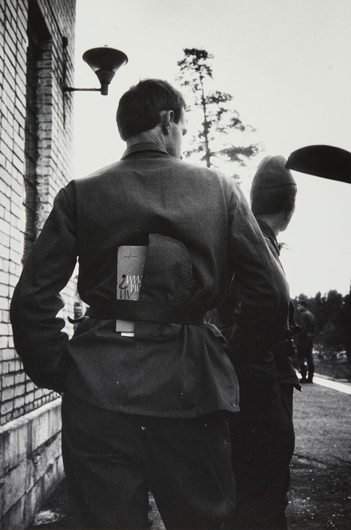 © from the collection of Rosfoto Vladimir Stolyarov. From the series "Military Duties". 1992
This situation by the beginning of the perestroika period caused internal discontent: in the club journal - a kind of annals of the photo club - participants note that they began to “equally see and find the same figurative decisions” (Alexander Kitaev); There were proposals on the “destruction of the stereotype of large exhibitions”, the creation of new exposition formats, in particular, an increase in the number of personal and thematic exhibitions. All this occurs against the background of a change in the historical landscape, political and social attitudes, the beginning of a publicity policy, a revision of the boundaries of private and public spaces. In the second half of the 1980s there is an intuitive need to deconstruct a recent, but rapidly removing Soviet myth.
Each of the club directions is transformed: photojournalism begins to touch previously taboo topics, the formalistic current gradually turns into a conceptual, artistic documentary rethinks the sudden freedom. Photographic methods are enriched with new theories, genre boundaries are blurred. The established system of argumentation and perception is loosened, and the photo club format ceases to correspond to the expectations of a significant part of its participants. In the “Mirror” there is a split, which is logical first of all as a symptom of changes in the country's scale, following Valentin Kapustin’s record in the club journal: “The Club crisis is due to the interest of time.”
A collision with canons is a test for an amateur who takes time in his free time. The category of free time - and symbolic free time (“time free from interaction with the rituals and statements of the authoritative discourse of the system” [7] ) - is very important for understanding the work of “mirrors” and motivation moving them. Therefore, the biographies of the club participants, for the first time compiled in the process of research, the result of which will be presented in the “album book preparing for the release, are not a text is a texture, but part of the sign system of images, a productive variety of destinies and biographies. It is they who are the help for the analysis and understanding of the artistic diversity that the activities of the “mirror” gave us. Among the others, the worker and the crane operator in the port Alexey Cicas, the facultist, the soloist of the Symphony Orchestra of the Kirovsky (Mariinsky) theater Valentin Kapustin, the chief geologist of the Golden Promis on Chukotka Nikolai Bobrov, who abandoned his main lesson for the photograph for the photograph, participated in the work of the club.
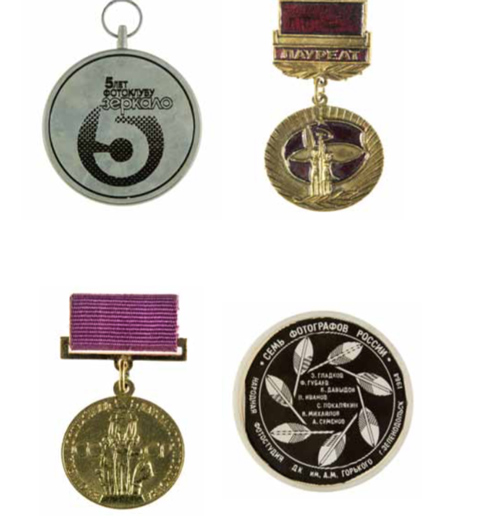 © From the Rosfoto Collection from left to right, clockwise: 1. Silver medal “Five years of the photo club“ Mirror ””. 1982. Designer - V. Bertels; 2. The medal of the laureate of the All -Union Sight of Amateur Artistic Creativity. 1983–1985; 3. Seven photographers of Russia. The icon of the folk photo studio of the recreation center named after Gorky, G. Zelenodolsk. 1984; 4. Medal of VDNH USSR
The Mirror lasted eighteen years. The composition of the participants changed several times. They came to the club in search of like-minded people, for criticism and collegial friendship, not aimed at financial success and career growth as a professional photographer. The weekly meetings “On Mondays of Seven and BC”, straightforward and tough discussions, steadily increasing technicalness and quality - all this led the “mirror” to obtain the status of the best photo club in 1987 according to the results of the exhibition of VDNH of the USSR. However, the rise was followed by a sharp decline: the club magazine records the minor mood of the “Mirror”, the feeling that they went into a “dead end state”, that the photo block as “the last step of amateur photography before professionalism” has no prospect.
The work of the “Mirror” photo club has yet to be rejection from the position of the time of time to existence, in the terminology of Jacques Ranciere, in aesthetic mode in which “artistic objects are identified by their belonging to the specific regime of sensual”, justifying “independence of art and the identity of its forms in which life itself is formed” [8] . Through the transformation of photographic practice into a means of communication (a series of Sergei Podgarkov about “drinking practices” in Leningrad in the late 1970s-mid-1980s), through hybridization, crossing several techniques and genres (“graphic” photomonts of Gennady Tkalich, which connect reality and surreality), marginality (“temples” of Lyudmila Ivanova), creation собственной знаковой системы образов (серия Юрия Журавского «Профессия — кочегар») они вышли за пределы де-факто принятого функционала фотографии, социального репортажа, клуба друзей, болеющих фотографией. «Фотография — единственный способ выплеснуть для нас свою боль», — сказал Дмитрий Кощеев на обсуждении знаковой отчетной выставки в 1987 году. Это способ самовыражения, это попытка самоописания в веренице невидимых существ и сообществ, и раскол, «разбитое» «Зеркало» — это не конец, а позитивная трансформация, обусловленная «интересом времени», новой ситуацией смены поколений и форматов фотографического общения, поиска независимости и свободы.
Время переменилось, и сегодня традиция мастерства (как жизни, положенной на определенное занятие) потеряла свою значимость. Генерируемость идей не зависит от рода деятельности, и в этом смысле уже нет необходимости быть декадентствующим эстетом или специалистом, привлеченным любителем. Формирование насмотренности, образа восприятия сместилось от визуальности к метаидеям и ярлыкам-зацепкам. Обещание, заложенное любительскими движениями, вышло за свои берега: мы больше не принадлежим к определенным аудиториям, не обладаем фиксированной идентичностью и характеристиками, не можем отследить влияние образов на нас и нас на образы, осознавать свой выбор; мы не способны на создание сообществ. Но современность по-прежнему способна на поиск пространства для создания разрыва, способна дружить, рефлексировать, возражать — и в этом главное наше наследство.
[1] Levi Strauss D. Words Not Spent Today Buy Smaller Images Tomorrow: Essays on the Present and Future of Photography. — New York: Aperture , 2014. P. 9.
[2] Багдасаров О., Золкин А. История отечественного фотоаппарата // Фото-89. Almanac. — М.: Планета, 1989.
[3] Подробнее см.: Стигнеев В. Век фотографии. 1894—1994: Очерки истории отечественной фотографии. — М.: Книжный дом «Либроком», 2011.
[4] Degot E. The Copy Is the Crime. Unofficial Art and the Appropriation of the Official Photography // В eyond Memory: Soviet Nonconformist Photography and Photo-Related Works of Art. — Rutgers University Press , 2004. P. 107.
[5] Юрчак А. Это было навсегда, пока не кончилось. The last Soviet generation. — М.: Новое литературное обозрение, 2011. С. 564.
[6] Там же. С. 581.
[7] Ibid. С. 462.
[8] Рансьер Ж. Разделяя чувственное. — СПб., 2007. С. 26.
Download the entire issue of the magazine "Disagreements" (No. 12) "What a party?": PDF , mobi , epube