
Translated material
Vasily Kondratyev. The latest texts
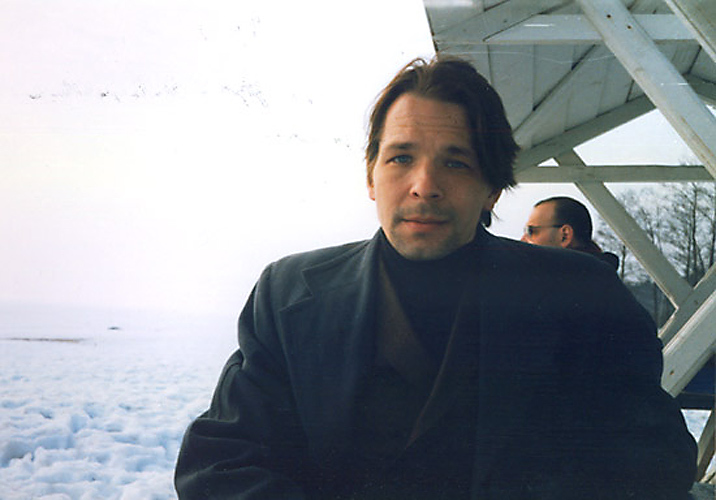
Green book
[Trips to Oranienbaum]
The life of Andrei Nikolev
Green book
Katya Andreeva
- Mais le Vert Paradis des Amows Enfantines,
L'Nnocent Paradis, Plein de Plaisirs Fourtifs,
Est -il Déjà Plus Loin Que l'nde et que la chine?
Baudelaire, Moesta et Errabunda
This book for a dark green binding recorded in 1995. Consequently, all the places, faces, events related to her. I can say this for sure, because next year I burned her. There, in fact, there were no notes, but this empty book has perhaps such a meaning that it stayed with me everywhere all the time I want to talk about here. Say, it was a kind of passport of my kind of occupation, exactly the same habit as having documents with you and not have money. Who am I? I am a storyteller, and this is my place in life, so that the green book had in mind a certain prestige of my existence, which I was fenced off so as not to be distracted from my cigarettes and from the card deck, that is, from the only things that I need.
Well, what did I want to say that? I think that since my story will take place mainly in the so -called resort places on the shore north of St. Petersburg, and so - I will always return to the state of that very characteristic for these places of gloomy, like dense comfort, in which I had pleasure to grow and spent the most substantial months of the time of interest to me here - it means that we will begin from the episode from my childhood. It was a suitcase of diaries, letters and other papers of the old housewife, who was her homemade (family of mother's friends) were supposed to be burned on the lawn behind the alley of silver Christmas trees that went to the house.
I will not say for sure, but most likely it was autumn, because the smoke from the fire, with which small black flakes of ash diverged in the air, carried a characteristic smell. From this smell in the garden, when I watched the home rite there, there was a completely romantic atmosphere, a darling that we, children were called amazing Ambre [1] - and if in summer this condition was usually associated with the morning evaporates in the bouquet of field flowers collected for breakfast, or with the aroma of rosehip and lilac in the evening at the seashore, then it was in the fall (and the colder, the colder, the more cold More persistent) The smells of summer bonfires and the night fireflies of windows behind the fence and thickets spoke about him ... However, since the conversation about the scene that once happened in the garden acquired a key role from me here, at first I have to describe the house.
The type of cottage, which is discussed, is quite typical for the resort coast, causes a sensation in the style of Liberty . Such a look of housing means pine and spruce, creating the excitement of gloomy greenery outside the window of the room, where there is a snakers, like a drawing on shawls, the cramped bureau, a screen, boots and all kinds of gizmos, shelves and pictures. No less cramped, which has an equally complex drawing, is a ladder, a couple more rooms and even a kind of hall around the table under a lamp, a greenish lighthouse of which at night is clearly visible through the forest. And there is a strangeness. It seems that these rooms are a reflection in the mirror and as if the space where they lead is also the imagination that the mirror frame creates (a large mirror of a wardrobe in the corridor-output house really remembers, inspired me with the difference between the mistress and life of the family, as if on two sides of this glass). In fact, this oddity has nothing to do with the mirrors [2] . However, there is an impression that there is a life that cannot be here, and now, in fact, why the situation creates a feeling of Liberty style .
[1997?]
[Trips to Oranienbaum]
Dear Katya, I do not know how much you can judge by this passage of the second chapter of my composition, which I wanted to devote to Martyshkin. As you could notice by the passage from the first chapter, which Philip [Fedchin] and Gleb [Ershov] managed to print, in my essay there are no special descriptions of the area with monuments; For my part, this is ridiculous and unnecessary, because there are reference books for tourists, and recently, as someone from the Writers' Union tells me, a whole big book of the author, who was born or lives, I don’t remember, in these places and, in any case, has an advantage to perpetuate their reality. And my prose is, if you like, a kind of psychoanalysis of my suburban trips, which (if we talk about the drafts dedicated to Martyshkin) contains discussions about my beloved Somov; About the magical, from my point of view, the charm of the figure of Peter III, in which I see the hero from the novel of Hoffmann and, thanks to this, in Rambov with Martyshkino - Hoffmann places; On the romantic fashion of the Incroyables of the Great French Revolution in Russia, which almost did not take place in Russia , in which both eroticism and the occultism of the 18th century were completely expressed, and which was William Bekford or our later hero Fedor Tolstoy , and today is so remarkably expressed by the fashion of John Galliano; About such, from the point of view of today's taste, art classes, like the secluded literary work of Novikov, who in old age rewrote as samizdat and illustrated the Masonic books; And finally, about those binding all these and other motifs of erotic marginalia, from which, if I am not mistaken, in Roberte CE Soir Pierre Klossovsky first made independent creativity (between us, Julinka, with which I discovered Oranienbaum and Martyshkino, has a striking resemblance to the main character of these drawings). My always random visits in Martyshkino and related jokes and impressions allow these discussions about my favorite things a light and pleasant, in my opinion, “insinuting” nature of a walk in the area, which is more likely in a dream, although this is a completely plausible dream. But the beginning that you asked me to show:
2. I began to go to Oranienbaum from the age of sixteen, and for the first time I came here with Julia, like young art lovers, that is, a couple in love, who wanted to create a wonderful life with modest means. We read how to arrange such a life in the memoirs of Benois and in Somov’s diaries (then the books of Dobuzhinsky and Golovin added to them). Probably, I still see in the habits and household arguments of these myriskuns more interesting, from the point of view of living in St. Petersburg than in their works. But if Benois, rather, repelled me with his too obvious philistinism, then it was from Somov that I learned to understand the solitude and specific humor, which peels out in cruel or scouring things, by a beautiful life. Over time, I forgot Somov a bit, because my interest in Les Douces Habitudes de la vie , that is, - to the sweet habits of the past, was too focused on his friend Kuzmin; However, he remained for me a hero of such a wonderful and boring degree of imaginary biography in the spirit of the new Plutarch , who wanted to write a cousin about him: a closed life in which love for the 18th century became a genius and has no vulgarity. And then, when Julia and I loved each other and wanted to be happy, the development that my tastes received thanks to Somov made me choose Oranienbaum immediately among other palace suburbs that were accepted for retrospective dreams and a joint beautiful life (as Kuzmin rightly remarked, it is like a “Russian soul” or flea, and it is difficult to catch it). And Yulinka then was (and let it remain) a very beautiful high young woman with bronze in her hair, who had the appearance of the dream of the artist of the era of modern and, in my opinion, this was well aware of this. Somov, by the way, lived in the country in Martyshkino.
My very first feeling for Oranienbaum, where he had not yet been, was connected with his drawing - with the profile of the little girl Olya, the daughter of the watchman of the cemetery in this country village near the palace city. For the first time I went there with the desire to find this old cemetery, where once long ago Somov and Benoit came to the burial of the Holsteans-a soldier of the funeral guard of Emperor Peter Fedorovich. Of course, in a country area with a dusty road and with the barracks covering the large segment of the shore of the bay, there was no way than other such summer places throughout the Leningrad Region. However, in the names of two neighboring stations of the Martyshkino and Oranienbaum railway there is such malicious tenderness, as if it were a trauma forgotten in childhood, and it always seemed to me to disassemble it very necessary mental activity. Since I like to lay out solitaires, I will allow myself a comparison that the main one in this lesson is not a Tableau , which is required to add the rules of the game, but rather, anxious imagination trembling in the change of cards; The random stop of the kaleidoscope on the table and gives a picture that most often represents the unsuccessful outcome of the game and, nevertheless, causes a puzzle and even fortune telling (an evening spent in the analysis of such paintings leaves a pleasant flicker in my head, as after a big walk, and a kind of superstitious enthusiasm). My comparison is, perhaps, with impressions of one ancient deck of cards painted very in the taste of the gallant era, two of the stripes of which are, by the way, monkey and orange .
[1998]
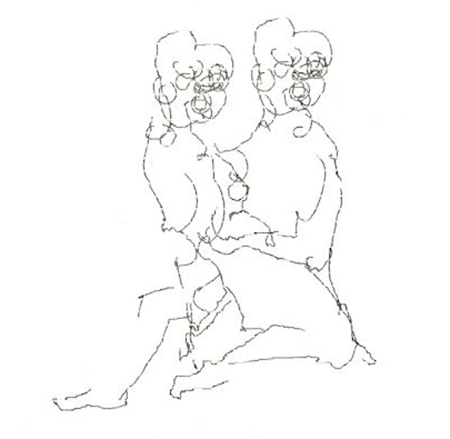
The life of Andrei Nikolev
Katya Andreeva
I.
Tested constancy
In the thirties and sorcerers in the West there was a joke about a refugee from fascist Germany, who kept Hitler's large portrait of Hitler at home, so as not to forget what the homeland was. Probably, such a person was actually, and maybe there were many such people, but I do not know that. But I know from V. Erl that in Leningrad in the thirties the same story was told about the writer and philologist Andrei Nikolayevich Egunov, only he had, of course, portraits of Soviet leaders on the wall ... During the war, by the way, the Egunov, who served the exile in Novgorod , was deported by the Germans to work in Neushtadt , and then he fled from the camp for 1946 for the camp for 1946 Russian repatriates in occupied Germany, he was already arrested by the Americans and he again went to the Gulag. Andrei Nikolaevich, they say, jokingly compared his life with the wanderings of Odyssey. For twenty -three years that he was not in Leningrad, he sat, lived under supervision, but one day, as we managed to notice, he spent three days in his life in the wild to celebrate his birthday (he turned fifty -one years old).
I met Egunov’s poems just when I served in one of the military construction detachments that processed and harvesting the forest, and was able to get a certain living idea of the system of repression in Russia, which I read about Shalamov and Dombrovsky, because since then the morals and working conditions have not changed too much, frankly, it changed. I am used to repeating these poems to myself, coping with different very unpleasant things, and did not see anything strange in the fact that the real background of many poems from the collection of the Champs Elysees really were really string of people crawling like ants under the observation towers, and the immense sky, crossed out with barbed wire:
I loved early getting up:
slightly discovered things
Preventive outline.
This spell of the fields -
The most tender intersubject glue,
Almost through, almost milky.
I will also spread, of course,
softening and vague haze,
Before I become invisible.
Egunov wrote poetry and prose under the pseudonym Andrei Nikolev: he borrowed this surname from the Russian poet of the 18th century, the author of comedies, a proud poet and experienced constancy . Of the modern writers, his only friends were Mikhail Kuzmin and Konstantin Vaginov. From his novels, stories, poems and poems, very few were preserved, and in 1993, Gleb Morev published a book of these works in Vienna. During his lifetime, in 1931, in Russia only one novel was released on the other side of Tula - a book, the originality of which can be compared with the novels of Ilyazda and the Finnegan Wake Joyce translated by Henri Volokhonsky. However, Egunov’s philological work, who translated Plato and late Greek prose into Russian, could also interest a wider reader: say, an article about the descriptions of ecstasy borrowed from ancient love novels in the lives of Russian saints ... In the extensive entry to the Russian edition of Heliodor Ethiopic , he created a detailed portrait of the Hague of Elineism, and although he was a detailed portrait This is a strict historical essay, in it, at the same time, it is easy to identify a very accurate image of the Leningrad intellectual, which could serve as a preface to one of the novels of Vaginov.
By the way, in the hero of one of these novels, a collector of dreams, the features of Egunov himself remained. Most likely, one more hobby was connected with dreams. In the twentieth-thirties, he made up surreal collages from magazine pictures and reproductions (inserted, for example, the figure of Laocon was not expected into a popular picture). It should be noted that for that time it was by no means a common and banal lesson, as today.
Returning to Leningrad, after the break, during which I met the verses of Andrei Nikolev, I, like any other young fan of the phenomenon called Petersburg poetry, began to search for the last apartment and grave of my beloved author. When I saw the window of the five -story building - “Khrushcho” - across the road from that very kindergarten in the backyard of the passenger port and trading exhibitions, where I learned to go and where I ran from school, I was very ashamed of the philistinism that I used to connect with poetry, and I was never interested in the living space of the writers. Andrei Nikolaevich Egunov died in 1968, and his grave was lost at the most prosaic and boundless northern cemetery of St. Petersburg, by which I wandered several times, reading Nikolev to myself and recalling Ilyazda, which is by no means large glasses create a large astronomer. From all places and things that could be preserved from the life of Andrei Nikolev, I decided to firmly remember only the old joke about the portrait of the leader. After all, who is, in fact, the poet, if not the hero of the most ancient jokes in the world, that is, banal discussions on the topic of freedom:
I sniffed from Russian roses,
and the smells of others do not distinguish
And I do not want to either coffee or tea.
Always saber shine and barbarism of dads,
whether they bury il God call
Or they give me in the face, frenzied -
I miss the compatriots of the non -nuclear,
But the world of the same Mazan and smelled -
Who lived among the weeping roses for a long time,
The whole world is an answer, not a question.
(May 99)
Publication and afterword of Ekaterina Andreeva
[1] This word contained only a certain insight of children in a romantic relationship, but still did not mean anything condescending, for example, to the smell of a man and a woman.
[2] In the life of the hostess, they, on the contrary, had a meaning. At first glance, at its seemingly age, any brilliant surface caused a persistent rejection (for example, it could use an exceptionally dull mirror of a wardrobe pushed into the darkness). In fact, - as the domestic ones who gained access to her rooms said, shortly after the episode with the burning of papers, everything was explained by the round mirror, which was suspended above the bed in the bedroom.
As a rule, we could watch the mistress on the shore, which she visited about once a week. A domestic worker arranged her umbrella and a deck chair in the thick shadow, at a high dune from the beach. In the grandiose hat and dark glasses that gave her toilet the elegance of an insect, the hostess, like an idol, sat down on a crowd of naked bodies near the water ... However, neither so rare walks, nor even evening sessions on a spacious balcony above the garden had such a significant meaning as that way out, as far as possible, she made every night.
This time, despite the protests of a pet, she locked herself and dressed on her own and prepared for bed. Having opened one more, small folding mirror in front of her, she took on Belila, mascara and lipstick; The hostess was not such a simple woman to draw in front of others, and her former temperament was expressed in public only in the lilac color that her high hairstyle had ... Finally, only her cigarettes appeared on the night table (now these were the thinnest bitter cigarettes north laid down with cotton wool during the evening air bath), a system and a glass of still warm water. The hostess counted drops. Then, having drunk the medicine, she leaned back on large pillows, so her face painted in the twilight was in a round mirror, suspended opposite. Now this could last a long time, at least, judging by the light in the window, which we children, when we could get into the thickets for one of our secret meetings, watched, in the morning. This light in the coniferous more often (the species that for some reason is associated with the book of Japanese fairy tales about the werewolf witch) actually meant that the hostess of the house went on such a walk, which is the most possibly fantastic journey in life.