
Translated material
Poor relative with an invaluable inheritance
In December 2016, the director of the Shchuseva Museum of Architecture, Irina Korobin, published a statement from the post on Facebook due to the conflict with her first deputy Pavel Kuznetsov. Nine days later, the Ministry of Culture announced a competition for the development concept of the museum, the winner of which will take the position of director in January. These events did not cause a significant response in the architectural environment - it is obvious that it is not possible to influence the choice of the Ministry of Culture. At the same time, the identity of the new director will become largely decisive to answer the question about the future of the main architectural museum of the country. But what is this museum?
Behind the massive building of the Lenin library, a quiet courtyard is hidden on the corner of Vozdvizhenka and Starovagankovsky Lane. In the ancient estate there is a museum of architecture, in the collection of which is more than a million exhibits. Among them are all the movements of Russian architecture, including the design schedules of the Soviet architectural avant -garde: the original Melnikov, Ginzburg, Golosov, Vesnin, Vhutemas, Materials of Competitions, projects of Moscow Metro stations and other epoch -making structures. Things from funds are actively used for publications and large exhibition projects in Russia and abroad, while the museum suffers from a lack of space for storage and showing exhibits, and its premises require restoration.
- Not in all capitals there is a museum that keeps the history of architecture in such a volume.
“The Museum of Architecture named after Schuseva is a unique phenomenon on a global scale, ”says Marina Khrusteva, coordinator of the Archnadzor public movement, architecture historian. - It was created several decades earlier than similar museums in other countries of the world. Its existence seems to us for granted, but in fact, far from all capitals there is a museum that preserves the history of architecture in such a volume. Moscow and Russia as a whole were very lucky that there is such a museum. ”
The museum with such a collection by Western standards cannot be in the backyard of the cultural life of the city, but if you recall its history, it is generally not clear how it reached today. The museum was formed on the basis of the Museum of the Academy of Architecture of the USSR established in 1934 in the Don Monastery and the Republican Museum of Russian Architecture, created after the war on the initiative of A.V. Schusev in the Talyzinsky estate on the Vozdvizhenka. In 1991, the Don Monastery was given to the Russian Orthodox Church, and museum exhibits were urgently sent to Vozdvizhenka. By that time, the manor complex has not been repaired for thirty years and fell into decay, in addition to the laying of the Filevskaya metro line deformed the structures of buildings. To place the funds, I had to abandon the constant exposition. The city promised to compensate for the squares and repair the buildings, which never happened. The Museum of Architecture entered the Millennium, pushed by tenants who traded in its rooms with furniture and souvenirs.
The modern history of the museum began in 2000 with the appointment of the director of David Sargsyan. The biologist by education, David Sargsyan made a movie along with Rustam Khamdamov and the architectural environment was unfamiliar, but immediately conquered everyone with his enthusiasm. In the absence of the necessary state financing and any hopes for development, the new director was able to turn the dying post-Soviet institution into a center of stormy cultural life. Under him, the museum was mysteriously called Muar and for the Moscow architectural scene was a cult place.
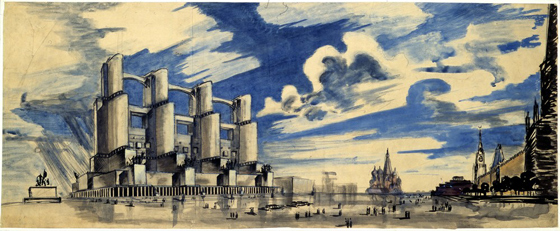 A.A., V.A. Vesnins. Competitive project of the building of the People’s Commissariat of Heavy Industry, 1934
“The museum of architecture is a state institution, and its functioning proceeds in the logic of the state structure, and the director, in fact, is a bureaucratic nomenclature,” explains Elena Gonzalez, head of march Lab. - The phenomenon of David Sargsyan was that he was from another test and completely fell out of this logic. Under him, the museum could exist in some kind of autonomous mode, as in a joke: Saturday around, and we have Friday. And we all felt and were in a hurry to have time to use this David thaw. By this I explain the incredibly gained by the Museum, popularity among a fairly wide circle of not only architects, but also artists, critics, filmmakers. ”
“It is obvious that David was not any museum worker in the classical sense of the word,” says Marina Khrustaleva. - He knew how to tighten life around him, knew how to light people. To the museum, about which few people remembered before, life returned, people stretched. He managed to make the museum of architecture a place of conversation about the city: albeit not scientific and source, but very sharp and living. ”
For a decade, something has been happening in the museum, now already inexplicable: contemporary art and Western architecture got along with historical samples, youth with the masters, innovators - with guardians, and the ruined surroundings of the XVIII century estate added atmosphere to what was happening. The museum found a shelter of the architectural bureaus of Alexander Brodsky and Megan, the Archnadzor movement originated. Sargsyan spent all his personal savings on the reconstruction of the second floor of the main building.
Under him, the museum was mysteriously called Muar and for the Moscow architectural scene was a cult place.
With the departure of David Sargsyan in 2010, the museum was at a crossroads. Around the upcoming changes, the discussion flared up: the architectural public hoping to extend the moment advocated the appointment of Vladimir Papernaya, the author of the famous “Culture-2”, wrote letters into the Ministry of Culture and insisted on turning the David’s cabinet filled with all kinds of artifacts to the museum exhibit. The office later really became an exhibit and in virtual form even exhibited in Venice (curator - Yuri Avvakumov). The head of the museum, the Ministry of Culture appointed Irina Korobin, the head of the center of modern architecture. Corobin, even if she hadn’t had a museum and exhibition experience, was a well-known person-she brought foreigners with lectures, conducted the program “Architectural Gallery” on television. Her candidacy was promoted by the Academy of Architecture and the Union of Architects - very serious organizations. The era of serious management has come: the architects moved out, the special spirit of the cheerful Museum-Ruin evaporated (although the ruins themselves remained), Muad lost his mystery and again became a native to them. Schuseva - the State Museum without any romance.
“After the death of David, the museum returned to its“ natural ”state,” says Elena Gonzalez. - And in general, I stopped being interesting to me. Although individual exhibitions there were very high quality, but as a “special place”, as a magnet it no longer exists for me. I remember our hopes that Vladimir Paperny will become the director and the thaw will last for some time, but, I must admit, we ourselves have already believed in it little. ”
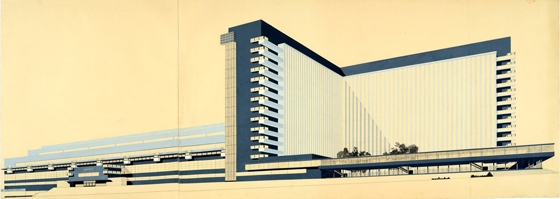 D.S. Markov, D.F. Friedman, V.I. Fidman. Library named after Lenin, competitive project. 1928
The new era was remembered by the impressive advertising campaign “Find out the full story” with the Blessed Vasily, Moscow University and the Great Theater, which were going deep underground. The collages were called upon to illustrate Moscow architecture and its history, represented in the museum, but much better they reflect the ratio of the visible and hidden volume of museum archives. It was not possible to get to the depths - the constant exposition never reached the public (with the exception of fragments of the model of the Big Kremlin Palace). However, exhibition activities resumed, a lecture hall, a book, appeared, and in general the museum continued work.
“In the past six years, certain changes have occurred for the better,” said Anna Bronovitskaya, architectural historian, director of research by the Institute of Modernism, and teacher march. - The lectureur earned, the exhibitions began to be accompanied by well -published catalogs, the Ruin hall was tactfully reconstructed and can now work as a full -fledged year -round exhibition space. The task of the restoration of the main building, putting in order of storage and the most valuable phototext remains. ”
“The museum sounded loudly - there were bright exhibitions, a variety of excursion routes appeared,” agrees Alexander Selivanova, the head of the Center for Vanguard at Shabolovka, senior researcher at NIITIAG and the Moscow Museum. - But it was, rather, the activities of the gallery or the cultural center, and not the museum. Unfortunately, the multimedia installation, which is positioned as a constant exhibition, does not fully correspond to the scale of the collection and the status of the museum: a series of plasma with 3D models of several monuments cannot replace a full museum exposition, which everyone has been waiting for many years. ”
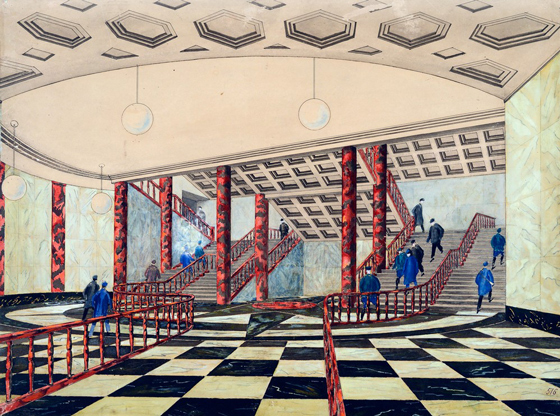 I.A. Fomin. Project of the metro station "Red Gate", 1934
The issue of constant exposition remains open, another problem is the systematization and availability of archives. Alexandra Selivanova is sure: the museum should finally describe his collection, including the schedule of modernism and the last revenues. “It is well known that the state of the funds in terms of their availability for specialists and attributes leaves much to be desired.”
For all the primacy of the task of archival work, museums today can no longer limit themselves only by it and more and more often take on the functions of a cultural and exhibition center. To this end, Korobin promoted the initiative to create a museum cluster, which would associate the museum of architecture with the museums of the Kremlin, the Pushkin Museum and other cultural objects. However, or not, there is a where to develop as part of a cluster or not: it is not so easy to take a worthy place among the leading metropolitan sites.
“The Museum of Architecture is a poor relative of Moscow art museums,” says Bronovitskaya, “and this is unfair. The collection there is completely fantastic, but the museum has neither financial nor intellectual resources in order to adequately represent it. You can compare the Soviet section of the recently held in the Plane. Pushkin’s exhibition of pyranesi, most of which was made up of things from the collection of nibbling them. Shchuseva, and those exhibitions that are held in the museum itself, as a rule, they do not have a clear concept and are weak in the exposition plan. ”
The era of serious management has come: the architects moved out, the special spirit of the cheerful Museum-Ruin evaporated (although the ruins themselves remained), Muad lost his mystery and again became a native to them. Schuseva - the State Museum without any romance.
As for the role of the cultural center - the museum could again become a space that unites all those who are not indifferent to architecture, but for this, the hemching will have to establish relations with the outside world. 2014 was marked by a large scandal around Melnikov’s house : the vanguard masterpiece turned into a battlefield between the museum and the heirs of the architect. The museum insisted on a forced eviction from the house of the granddaughter of Melnikov, Ekaterina Karinskaya, but the desire to allow the pathetic situation to be allowed in one fell swoop led to serious consequences.
“The black page of the life of the museum of the last period is a scandal with Melnikov’s house,” says Alexander Selivanova. “Due to the unethical behavior of employees, the museum suffered significant reputation losses, a significant part of the professional community turned away from it.” This point of view is also shared by Anna Bronovitskaya: “The museum’s heavy blow was seized by Melnikov’s house, when, not finding a solution in a difficult situation, the leadership resorted to unworthy methods. The director’s change, I think, is a good case to apologize to Catherine. ”
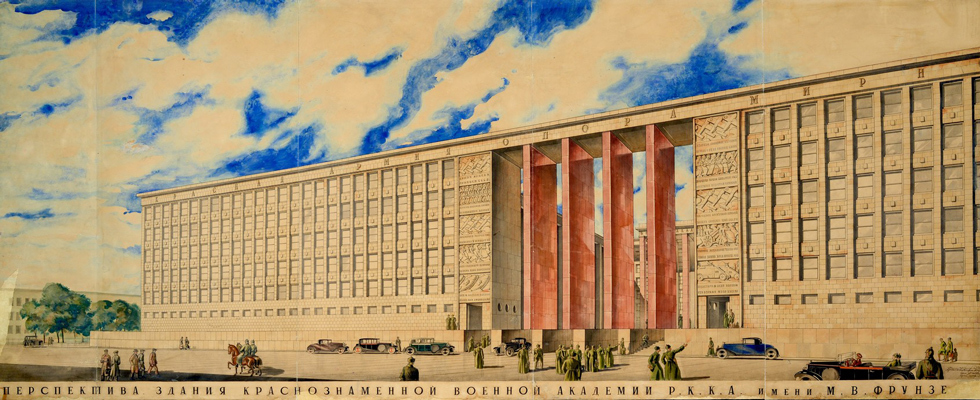
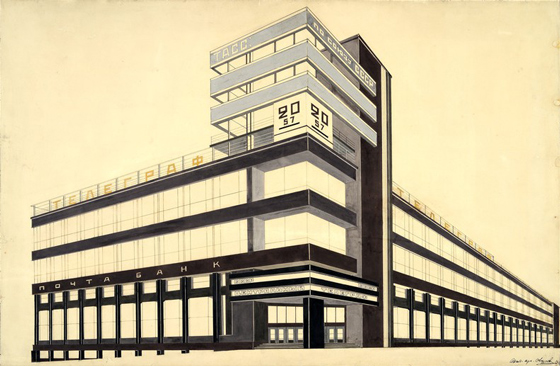 A.V. Shchusev. The project of the building of the central telegraph, 1926
Now, after the departure of Korobyina, the future of the Museum of Architecture is once again decided, but they no longer write letters to the Ministry of Culture, and they do not expect a miracle from the results of the competition. It is impossible to glean any conditions of the competition, including the New Year holidays, including the New Year holidays, including the New Year holidays, the conditions of the contest, the jury, and the requirements for work from the news on the ministry’s website are impossible to draw. They promise to summarize the results in January - and this is with the deadline for submitting projects on January 31. From the comments of Colta.ru, the museum refrained. One thing is clear: whoever becomes the new director, he will get rich, but difficult. And let's hope that a complete story will still open to us.
Elena Gonzalez: “For a constantly changing city, the Museum of Architecture is very important, because it accumulates layers of these changes. This is the place where these layers can collect, study, “glue”, correlate among themselves and relevance. I do not have any harmonious vision of the future museum, but I know two people who can give birth to such a concept. This is Anna Bronovitskaya - a person with a good academic education, a scientific warehouse of mind and a great involvement in an actual architectural context. And it would be very interesting for me to see the director of Yuri Avvakumov, who is unlikely to be needed. I think that if this happened, there would be a chance to see a high -quality breakthrough in the activities of the museum. ”
-At the beginning of the new millennium, two letters fell out of the non-well-willed abbreviation abbreviation-nor (scientific research).
Alexandra Selivanova: “The Museum of Architecture, of course, should become one of the most important museums of the city, this is natural for any capital. Its value is in a magnificent collection of architectural graphics and photographs, thanks to which all metamorphoses that occurred or only thought in Moscow can be traced. The museum’s collection allows you to talk about the architectural life of the city both to schoolchildren and specialists. Unfortunately, the museum does not have such an option now, since there is no full -fledged form of permanent exposure, and the collection is almost inaccessible - for everyone, including professionals. ”
Marina Khrustaleva: “At the beginning of the new millennium, two letters fell out of the not very harmonious abbreviation abbreviation-nor (scientific research). Indeed, the museum has not held serious conferences for a long time and did not issue collections of works, as once. But at a new round of information technology, he could take on a more important role - to become a resource center, an educational hub, accumulating knowledge of Russian architecture. The museum could become incredibly in demand if he had followed the path of modern research centers - the Getti Institute, the Congress library. A large -scale digital and phototectic digic for graphic funds and photographs could not only give a new meaning to the work of the museum, but also give an impetus to a new wave of research and restoration projects. ”
Anna Bronovitskaya: “Under favorable conditions, the museum of architecture can become the most important research center and a bright point on the cultural map of Moscow. Someday, his digitized collections will become available to both specialists and everyone who are interested-without this it is simply impossible to realize the history of Russian architecture. If at a new stage it is possible to attract modern curators to the museum and provide a decent level of exposition equipment and design, much more visitors will reach there: after all, interest in architecture in Moscow is growing. ”