
Translated material
The third campaign to Korsun
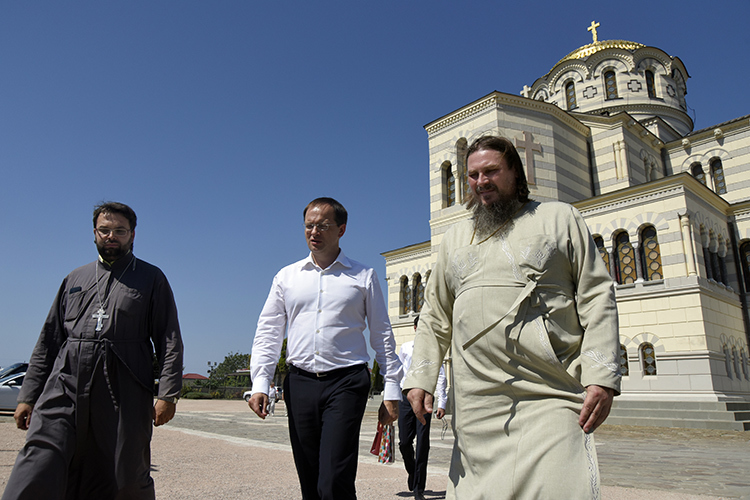
For three days now, with bated breath, we have been watching how the Russian Orthodox Church has been making its second approach to the projectile.
That is, she has just achieved the desired result in the exercise “Swear” - safely pulled out the St. Petersburg Isaac's Cathedral.
Now it is re-suitable for a slightly less spectacular, but technically rather difficult exercise “bench press”-intending to squeeze the territory of the National Reserve “Tauride Chersonesos”, one of the most important and richest archaeological monuments in modern Europe.
Why the approach is considered repeated - it is clear: the previous attempt was made in the summer of 2015, when Archpriest Sergius Khaluta was appointed director of the reserve and without discussion. At that time, the bench press ended with a deafening scandal. The spectacle was memorable and dispersed in several videos widely: the reserve staff publicly rebelled and even dared the then Sevastopol Governor Sergei Shanyilo. Chanyilo himself was uncomplicated: of all the arguments available in the world in favor of his decision, he chose the most obvious and irrefutable, President Putin, “called Chersonesos, the Sacred Place for the people of our country,” and the minister Medinsky ordered to fulfill. What else is needed?
Nevertheless, it was not possible to calm the scandal for a long time, and in the end, the rough and tongue -tied channel, along with the sweet -and -core father, had to retreat.
For the second attempt, the diocese chose the argument thinner. Colleagues from the editorial office of the present time, who had just had direct communication with the official representatives of the Orthodox church authorities of the Crimea, report that the push-ups carefully underlie their claims not some Medinsky pussy there, but a link to the decree of the Holy Synod of the Russian Empire No. 4141 of May 4, 1850. According to this relic of Russian state office work, the cape between the quarantine and sand bays was originally decided to build three monastery cells, as well as a small temple in honor of Princess Olga.
Why this one is not explained from all regulatory documents ever published by the Synod, immediate inflicting, in the current diocesan administration, is not explained. And only significantly silently, hinting with this silence that the very fact of the existence of such a powerful document is a sufficient basis for the final closure of the issue of belonging to Chersonesos and no additional explanations, in fact, are required.
And everything would be fine if there were nothing in the archive documents of that time, except for this decree. And this, of course, is not entirely true.
The fact is that among experts who gave themselves work to ask the history of the monastery in Chersonesos, in recent days, one marvelous document related to the time that directly followed the transfer of this territory to the church is especially popular. However, last year, for example, he was quoted in detail in one great success in the public a report on the Uvarov Tauride Scientific Readings in the Chersonesos itself.
We are talking about a report presented in the winter of 1887 to Emperor Alexander III with the then authoritative specialist, chairman of the Moscow Archaeological Society Countess Praskovya Sergeyevna Uvarova (among other things, the widow of another great archaeologist, one of the founders of the Russian archaeological science of Count Aleksey Sergeyevich Uvarov). Countess Uvarova a few months before Khersones visited on the way from Constantinople. And upon returning to Moscow, she sent a detailed report on what she saw to the august name. Note that between the provision of a valuable archaeological territory to the monastery and the appearance of this report on the Crimea, a destructive and bloody war swept.
So, Uvarova writes to the emperor:
“... the French occupied Chersonesos and arranged their main apartment here, scientists were with the troops who wanted to extract the values of the Chersonesos, whom they met according to the works of Count <...>.
But that fate saved from the foreigners should die at the hands of those who should more than others cherish the first Christian antiquities of the Russian people <...>.
Everyone knows how the archimandrite of the local monastery Eugene plucked Chersonesos and, loading at night full barges, saved his prey to the prudent wines factory in Sevastopol.
Several decades have passed since then, and the position of Chersonesos has been worsening more and more, nothing has left of the antiquities of the time of Count Uvarov, the temples and graves are plundered, the city and burial grounds are not fenced, excavations are produced in semi -literary monks without any control and scientific plan, the ancient walls are hacked and used to the needs of the monastery.
You can foresee the time when one pile of stones of no one, not talking about anything, remains from ancient Korsuni, remains <...>. "
In the fields against this paragraph with the own hand of Emperor Alexander III, a note was left: "Yes !!!"
Meanwhile, Uvarova continues: “This desolation increases every year, even a stranger is striking and cannot but serve reproach to any true Russian person.”
“I agree,” the sovereign writes in the fields.
We read further: “It was possible for your imperial majesty last summer to visit the ancient Chersonesos, and we have no need to apply to the account of the desolation in which Chersonesus appeared before your august eyes.”
"Indeed, I was amazed at this outrage!" - confirms Alexander III right there, opposite this paragraph.
What exactly happened at that the famous imperial visit to the reserve, found out and described in detail in a specially dedicated article by the article by the Saratov historian Vladimir Katz ( this article is completely ):
“... Visit to Emperor Chersonesus ended with a“ bad joke ”, as some newspaper feuilletonists called the incident.
After the completion of the traditional ritual, the solemn service in the Church of St. Vladimir, the emperor, the emperor wished to get acquainted with the monuments newly discovered in the church. He was accompanied by an explanation by Hieromonk, who led excavations in recent years. Alexander III was already heard that the ruins of a small temple with a well -preserved marble mosaic floor were recently discovered. When we approached the temple, it turned out that around its residues, in order to preserve, a wall of dashed stone was built, a wooden door with a hanging large lock was made. However, it was not possible to get into the temple, the accompanying Emperor Chicheron did not have a key. They ran to look for a keychair's father, but they did not find it.
The emperor and the retinue at the closed door twisted and left with nothing. Divine reporters found out that if they even coped with the castle, then it would not be possible to get acquainted with the desired mosaic. The wall was built, but they forgot to build a roof and put a watchman. As a result, one night some attackers climbed over the wall, broke and took off the mosaic ... "
In short, in the final of her report, Countess Uvarova begs the emperor:
“They led, the sovereign, and the ancient Chersonese will become Russian Pompey, will interest all the well -being of Russia, will involve not only Russian scientists, but also travelers from Western Europe <...> to study its antiquities.
This difficult and at first the ungrateful task can be assigned to one of the archaeological societies, requiring the device from it on the site of a separate archaeological station, with his watchman and employees, inspector and conservative <...> ”.
The general resolution left by Alexander III in a letter looked like this:
“This must be done so as not to be known as the barbarians. Talk about this case with whom and imagine a conclusion and as soon as possible to save everything that can be saved. ”
The report of the Countess Uvarova is still stored in the scientific archive of the Institute of the History of Material Culture of the Russian Academy of Sciences (f. James 1/1894, d.250, l. 1-2), and anyone - even Archpriest Sergius Khalyuta or, for example, the head of the diocese is the Metropolitan Simferopol and Crimean Lazarus (in the world, Rostislav Filippovich Shvets), and you look there, you see, you look. Maybe even the so -called himself The Minister of Culture of the Russian Federation - can get acquainted with it.
Based on the highest order, Chairman of the Imperial Archaeological Commission Count A.A. Over the next few years, Bobrinsky has banned any excavations in this territory by monastery employees. And June 24, 1887, the chief prosecutor of the Holy Synod K.P. Pobedonostsev sent a special notice in the name of Bishop of Taurus Martinian, in which he said that “on the basis of the petition of the Moscow Archaeological Society, the emperor ordered to ban the production of excavations to the ministers of the monastery of St. Vladimir, as well as the sale of things found by monks” ( here we can familiarize themselves with the academic publication of this document).
Thus, the current approach of the Russian Orthodox Church to the squeezing of the Khersones reserve should not be considered the second, but already the third. And the failure ended already two: for the first time the coveted shell did not submit exactly 130 years ago.
It would be nice not to forget about this anniversary. And it is even better to be aware that the epic of robberies and vandalism, carried out in this long-suffering territory with a variety of church-economic scammers, has already has a long, well-deserved story. And nothing, completely nothing, even the Father of the Khalut or Admiral Changilo, is not news in this story.