
Translated material
Colta.ru
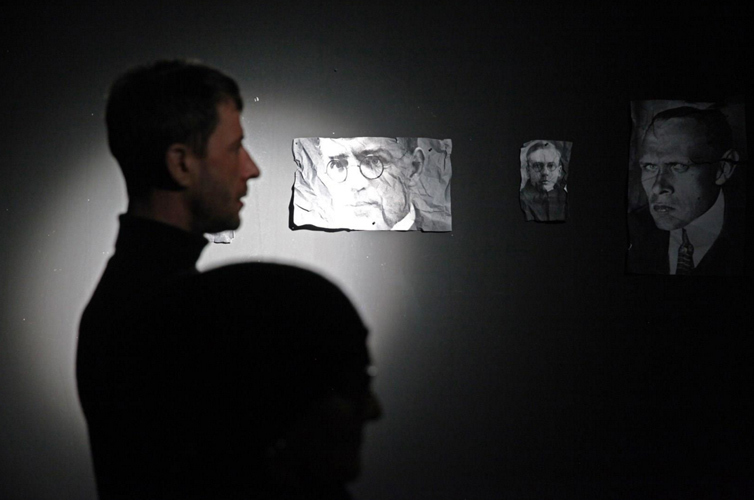
In the coming year, they will actively and very differently recall the year of 1917. In Berlin, the centenary of the revolution began to be celebrated by the festival “Utopian Reality - 100 years of our time with Alexandra Kollontai”, which was held from January 12 to 22 at the Hebbel Am Ufer ( HAU ) theater. All these ten days in the HAU showed the performance of Eternal Russia , composed of Marina Davydova , the artist Vera Martynov and composer Vladimir Rannev, who made his debut in directing.
Alexandra Kollontai appears in only one of the scenes of this fascinating “fermentation” on several floors of HAU-3 , the third site of the theater. There are no “living” actors in the play, there are a lot of videos and audio, objects and images, spectators move from one room to another. Each of these spaces creates the image of a particular stage of Russian history: four versions of “Eternal Russia” and three utopias. “Eternal Russia” is an empire until 1917, the early USSR, the Stalinist empire and modernity; Utopia is the history of the revolutionary movement, the avant -garde and the sexual revolution. Eternal Russia would be a spectacular work of Contemporary ART , a set of difficult installations, but there is a plot with all its components - and there is a hero.
And this hero is a confused Russian intellectual. The same person about whom until recently it was possible to say the "representative of the Russian liberal intelligentsia." But in Eternal Russia , this quest on the history of ideas, liberalism has no place. It is simply not mentioned. Marina Davydova tells the viewer: Russian history teaches us that only the left idea can be an alternative to totalitarianism.
But, of course, Eternal Russia is re --izing the left idea for a modern educated Russian. The new symbol of faith - and, possibly, the energy of resistance - is based, as expected, on three sources, “utopias”. This is a social and political revolution according to the version of the socialists-revolutionaries, aesthetic renewal according to the version of Russian avant-garde players and a moral revolution according to Alexandra Kollontai. This performance is an extremely clearly articulated political statement, political in the cleanest and most important meaning: not about the results of the elections, but about the choice of ideological weapons.
The reason for the disappointment of Eternal Russia is not so much repeating lesions in the fight against invincible Leviathan, taking different guises. His disappointment is not so much historical as modern. Leviathan does not make it possible to calm down. We are doomed to fight. This performance is a logical result of the defeat of protests in 2011-2012 and the onset of a new reaction. Eternal Russia says that the only possible conversation about the 100th anniversary of the Russian Revolution-and history in general-is not the rapture of the details of the departed era, but a consistent policy of turning to the past.
This performance is an extremely clearly articulated political statement, political in the cleanest and most important meaning: not about the results of the elections, but about the choice of ideological weapons.
Russian history in Eternal Russia has a slender concept, but the fact is not how reliable this historical logic is. It is much more important that it is she who demonstrates the nature of an ideological choice. And this choice is addressed not only to modern Russian society. The performance made in Berlin by the authors from Moscow and St. Petersburg is also the conversation of Russian left intellectual with European: they both confront different forms of lack of freedom and obscurantism, but the Russian political program is based not only on common values, but also on the traumatic historical experience. Making a left choice, modern Russian intellectual remembers too well about repression. The February Revolution made Russia the most free country in the world. Lenin is the leader of Okhlos, who turned the "revolution of intellectuals into a revolution of demons." Stalin is a fascist who “was not going to be the builder of the new world, he was going to become the ruler of the old world. And he became them. He resurrected this old world, slightly adjusting it to Asian megalomania. ”
As a result, the ideal and example of political behavior is the unnamed hero Sergei Chonishvili from the first “utopian” scene. This is a populist who evolved in the Socialist -Revolutionary, a man, proud that his party fought for civilian freedoms and was at the same time massly. And this is an important reproach of modern Russian political reality - the hero Chonishvili says: “In October 1905, two million people took part in a universal strike throughout the country. How much did it go to the streets of Moscow during 2012 protests - it seems to be one hundred thousand? ”
Of course, today to say “left” means to call for a wide variety of ideas and phenomena. For the hero of Eternal Russia, the choice of the left idea is primarily not so much political as aesthetic. The best that was in Russian art is the avant-garde of the 20s, politically and physically destroyed during the time of the Stalinist Empire.
In each of the scenes, the audience is offered to leave the space in which they are located: from each version of “Eternal Russia” the path lies into utopia, from each utopia - to “Eternal Russia”. In the final of the play, spectators can leave only through the door, over which the word emergency burned with hellish flame Exit . Behind the door is a completely different life. Theater hall. The foyer of the HEBBEL am UFER experimenting theater. One of the most lively and diverse Berlin regions of Kroyzberg.
This finale does not look edifying, but it leaves no ambiguities. If you do not go into the space of art, critical thought, personal freedom and political freedoms, then the image of “Eternal Russia” from the last scene of the performance will remain an alternative. In it, the icons of Russian classics are adjacent to the icons of Orthodox saints, on the table with expensive porcelain are plastic bottles of water “Holy Source” and on the pseudo -classic sculpture placed with transparent panties, carefully attach the St. George ribbon.