Date
Author
Андрей Бабушкин

Preserved copy
Translated material
At the Third Abramkin Readings

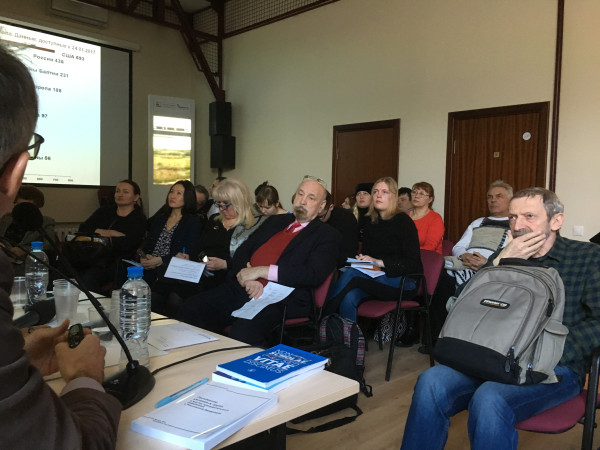
The third Abramkin readings brought together about 50 people - human rights activists, prison system employees, scientists, and former prisoners.
Lev Ponomarev spoke about the fight against torture zones. Those who order the existence of such zones, he concluded, are often not the administration of the penal system, but representatives of law enforcement agencies and intelligence services who use these colonies for pressure. Participants in the hearings agreed that it was necessary to draw up a list of such “Black Zones” and abolish competition between colonies for obtaining confessions from convicts.
My speech was dedicated to a modern reading of the book “How to Survive in a Soviet Prison,” written a quarter of a century ago. Most of the provisions of this book not only have not lost their relevance, but can still help hundreds and hundreds of thousands of people. For example:
If the investigation “wants to put any pressure on you,” then it will look for reasons to take you into custody. “Let’s say the investigator calls you for questioning, but calls you “carelessly,” knowing that you will not receive his summons or will receive it, but will not have time to come. After this, he can draw up a protocol on failure to appear and write a resolution to change the preventive measure. .. Therefore, if you want to remain free while under investigation, you should not give even formal grounds for taking you into custody. For this purpose, fulfill the requirements of the investigator: appear at all his calls, bring references, invite witnesses.”
And here's another quote:
“Everyone has probably experienced hours of anxiety for a loved one who was suddenly separated from you by the unknown. Wait for news, suffer from heavy forebodings until dawn, pray to yourself: Lord, give me at least some sign that nothing terrible has happened. Now multiply these experiences not by a day, not by a week...
Prison is timelessness, prison is unconsciousness, prison is a grave... Dostoevsky has the exact formula: a dead house. Crossing the threshold of the prison, you clarify the formula (not suspecting that this is only the first clarification): here you are buried alive...
No sun, no sky, not a blade of grass, nothing living. Your heart is still beating, you breathe, you feel, you remember... But what’s the point! The walled space is taken beyond the limits of life. The blank wall is not only around you - in you. It fences off the past from the present, cuts off all the shoots that should have unfolded from yesterday into today.
For a pioneer, a pre-trial prison is a failure into emptiness, inactivity. There are no affairs and worries with which you were overwhelmed in freedom. You don’t have any connections with the old world, you can’t help your loved ones, and they can’t help you...
Or there are five of you sitting in one cell, and you can’t get away from each other. In freedom, you could even leave home, even leave your wife. But here, no, here you are doomed to live together.
And all this makes prison seem intolerable, impossible. Death is more natural, more surmountable. There, beyond the threshold of life, no matter how you imagine it, there is either nothing, or there is space... Therefore, a rare newcomer is in a hurry to join prison life; everyone usually gets stuck in the “hallway” for some time. It seems easier, more correct: to hang around here, wait it out, because “everything will pass.” Prison is not forever, so why the hell should you try? It’s not yours anyway, it’s yours to remain free, you will return to it from unlife when your term ends. The temptation is great: not to live, but to survive, to close yourself off, to freeze, not to see or hear anything, to go into memories, not to pay attention to anything. But if you don’t get involved in life, then this turns out to be worse for you - people stuck in the “hallway”, as a rule, begin to degrade.
And sooner or later a person understands: one must be born for a new life, otherwise there is no other way to call it. Learn to walk, see, hear, speak again. In the first days, for example, you don’t see or hear the prison; from the exercise yard you hear otherworldly voices: car horns, the creaking of hinges...”
You probably couldn’t write about it better or more clearly.
I proposed to revise Abramkin’s book, taking into account changes in legislation and prison practice (the last edition of the book was published about 20 years ago) and publish it again. I also proposed filling prison libraries with human rights literature.
The speech of Valery Abramkin’s long-time colleague and ally, criminologist Professor Ya.I. Gilinsky, was striking. he voiced his thesis that prison cannot correct anyone, proposed to abandon the use of imprisonment for minors, and to reduce the prison population by changing the terms. Gilinsky announced the average prison term in European countries - 1 year and 8 months. according to his data, since the 1990s, the rate of recidivism after imprisonment has doubled and amounted to 47%. This figure seems erroneous to me, since in this case, approximately 800 thousand previously convicted recidivists should be held in Russian penal colonies, but in total there are less than half a million of them.
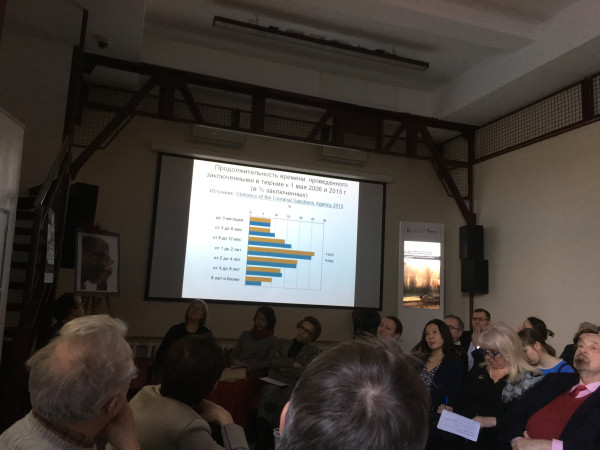
Speakers repeatedly addressed the idea of reducing the country's prison population. They noted that among the large countries of the world, Russia is in 2nd place in terms of the population of prisons per 100 thousand inhabitants, even ahead of Belarus, which ranks 3rd. The report about Finland was very interesting. In the 1940s, it ranked first in Western Europe in terms of the number of prisoners. But thanks to the work of criminological scientists, the country's authorities were able to convince the country of the need to reduce the number of prisoners. In 2006, only 12% of those convicted were sentenced to imprisonment, 57% received a fine, and 24% received suspended imprisonment. After 12 months convicts can be released early. If a person has no violations, then such an exemption applies to him. 26% of convicts spend from 1 to 2 years in prison, 28% - less than 1 year, and only 10% - more than 8 years. There are only 55 people in prisons per 100 thousand inhabitants in Finland, or approximately 8.5% times less than in Russia.
Participants in the Hearings noted that pre-revolutionary Russia was characterized by the proportion of the prison population that exists in Europe. And today's 2/3 million prisoners are a direct legacy of the Gulag.