
Translated material
Yes, we are a sect
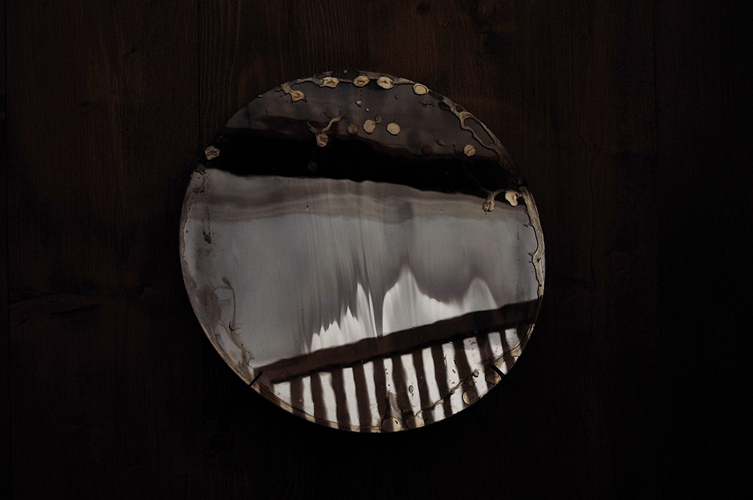
The critic Yegor Sofronov, analyzing the works of Alexandra Sukhareva, wonders the question of “disagreements” raised in the preface to this number: how much is contemporary art to be considered a subculture?
I. Allegory
The onset of obscurantism in politics and art makes itself felt in fashion for hermeticism, in migration of meanings away from the navigated program towards the allegorical. As Walter Benjamin wrote: “In the kingdom of allegory thought, the same is that in the kingdom of things there are ruins” [1] . The ability to clarify the ability to clarify in the kingdom of thinking today. Allegoria sets us an urgent task of interpretation, analytical decryption, but also requires the precaution and respect the web of references that entails the possibility of interpretation. The disclosure of allegory production mechanisms is similar to the desire to debunk the veil of hoaxes that formed under the oppression of censorship, which blocks the pronunciation of causal relationships. The discourse of art will not remain anything else in the face of the increasing opacity of the world and the growing crisis of knowledge, except to establish, bind and enlighten.
The control and closure of the public sphere by the state leads to psychasthenia, to the rehabilitation of mysticism, to various escapes, to the collapse of society into closed micro -communities. Today's reactionary autocratic clamp, suppressing the rationalistic articulation of concern, causes, consequences and conclusions, leads to a crisis of the ability to act to encryption of statements. In society, supervision, surveillance and network quantification give birth to a triumph of suspicion and doubt. In philosophy, animism, objectively oriented vitalism, anthropological pluralism are reanimated. The economy triumphs post-phraindic praincarity, which-due to a taboo on a critical class analysis, is compensated by psychotherapy reconciling with life and new cults. For analysis, not only the departure of the circles and underground, but also the subjectivity, which are generated in them - as if in the bubbles of ideological wandering.
The control and closure of the public sphere by the state leads to the rehabilitation of mysticism, to various escapes, to the collapse of society into closed micro -communities.
The production of allegories as an artistic method can become again relevant in Russia in 2017, during the more and more militarizing right dictatorship. In the 1970-1980s, to attack on the left of the modernist canon, art historians Craig Owans and Benjamin Buklo used the fragmenting principle of allegory as installation and collage-debunking and piercing again. So in interwar Europe, echoing the methods of Dad and surrealism, Walter Benjamin, with the help of the concept of allegory, comprehended historical memory during the collapse of the revolution and the rise of totalitarianisms. And today, artistic and critical practices should be attentive to allegorical seizure and resistance.
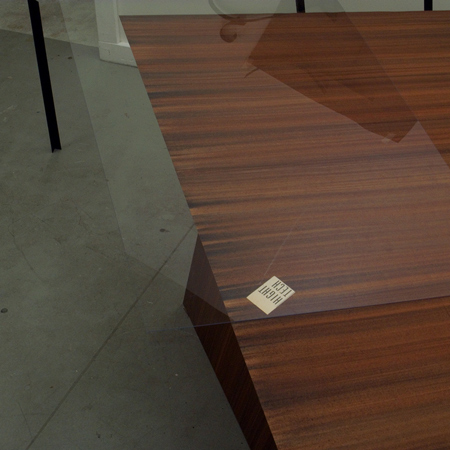 Alexandra Sukharev. Iceberg. 2008, goetborg
It is the removal and debunking of an object that is the method of the most, perhaps, well -known works of the artist Alexandra Sukhareva, for example, “iceberg” (2008) and “obscurantity” or “without name” (2009). This method forms the basis of a series of art games with perception of mass. Created from paper, painted with watercolor under the veneer, the objects of Sukhareva seemed much harder than they were actually. These works not only referred to the vernacular interiors of the late communism and the post -Soviet bureaucracy or to the North American minimalism, but also involved the fragile unreliability of the modern art object: combining drawing with watercolors and sculptural volume gave rise to the fact that the theorist Hal Foster, discussing the modern methodology of object production, called it "Pre -kerity." According to Foster, the praise of the object of art is an aesthetic analogue of the praise of labor, constantly undermining the public contract and generating social exception [2] .
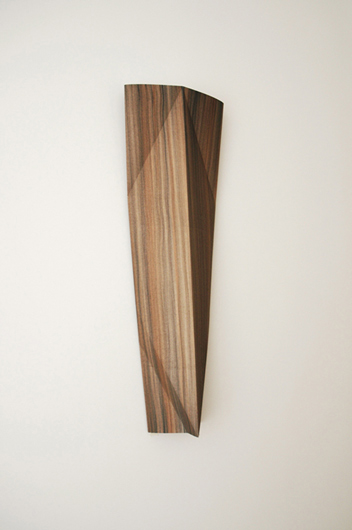 Alexandra Sukharev. Obscurantist. 2009
Now Sukhareva is conducting an annual study of the occult quasi -aliber circles of the blockade Leningrad and, wider, phenomena of esoteric socialism during the period of high Stalinism. In these phenomena, she finds an allegory of today's social condition: then the minority identity - akin to today's subcultural - survived and devoured themselves during a oppressive reaction, state violence and poisoning ideological hegemony. The project, called the “comb in the grass”, continues the motives of the two past works by Sukhareva: firstly, the work “Witness” (2015),-a black and white album of photos and poems about the destroyed estate in which meetings of the Rosicrucians were held before the Soviet government established the chemical plant there; Secondly, the installations “this is, you are not” (2014), built on “Manifesto-10” in the form of an occultist chapel and have a part of the blockade of Leningrad.
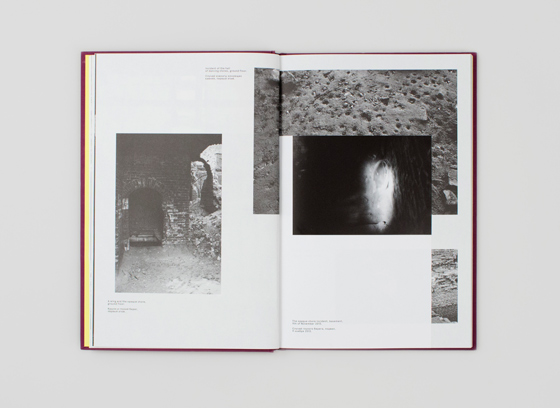 Alexandra Sukharev. U -turn from the album "Witness". 2015
Sukharev finds the preserved information about the arrests, betrayals, missions and eccentric life stories in the literature, in diaries, in campaigns in archives in Moscow, St. Petersburg and Uzbekistan. Among her heroes you can find many examples for identification. For example, a psychiatrist Gustav Reitz, who combined scientific and medical work with an interest in parapsychology. Or archaeologist Mikhail Gerasimov, who exhumed Tamerlana's tomb in the midst of World War II. Or a psychoanalyst woman Sabina Spielrein, who fell into psychoanalysis as a hysterical patient and subsequently pushed Freud to open up to death with her studies. Her scientific career was interrupted by the crowding out of psychoanalysis from Soviet Russia, and life ended with the execution of German occupation forces. Information about the heroes of the project is supplemented by topographic attention to locations that store memory: for example, to the St. Petersburg Psychiatric Clinic, where the Reitz worked, or to the dilapidated chapel pavilion in Tsarskoye Selo, where the last meeting of the Martinist Order passed before the repressive machine ceased its existence.
Microhostoria of such untimely lives and chronotopes weave inconspicuous, useless, failure, obsolete or deeply mistaken creative efforts and intellectual claims, difficult and encrypted and encrypted acts of resistance and desires. Being erased from the recorded memory and inaccessible to historical clarification, they should have been forgotten. This is exactly what motivates Sukharev, using the phrase of Benjamin, "to scratch the story against the wool." But how much the fact and the narrative transmitted through art in the new Sukhareva project will be able to avoid secondary symbolization into mysterious allegorical or non -memorial of things? However, the project is planned to escort the public program - in the name of greater interdisciplinary and focus on the production of knowledge.
Sukhareva conducts a year study of the occult quasi -initeric circles of the blockade Leningrad.
In addition to the new orientation to artistic archival research, changes in its work with objects continue. From the poetics of radi-mades and installations, from almost weightless paper sculpture of the end of the zero in the tenth years, Sukhareva passed to a picturesque abstraction and manually made mirrors and transparent glasses with an emulsion applied to them.
“Miro,” she tells me, pointing to the round glass, laid for photography on a small white canvas. The glass is covered with frozen splashes of black pigment, really reminiscent of the surrealist blots of Juan Miro. The analogy with the canonical, recognized art is impressive when you stand in the artist’s workshop and nod carefully, trying to respectfully find out the details about her work. The surname of the master of surrealism is called upon to give a possible interpretation of one of the works of the new Sukhareva series. In this unet -named series, the artist uses a copper solution, asking the invited accomplice to apply it with his own hands: the work becomes a kind of recording of the meeting session with another. The co -author at the time of applying the solution - according to signatures intended for the etiquette support of each of the glasses - imagined, concentrating, the image of the Virgin Mary. Miro and Virgo Maria - how subtle, if not deceptive in her veil as interpretation for a completely clear form. The explicitly phallic, obscene eaguulating manifestation of presence if it does not reflect a kind of dark desire, then it can cause the thought of it - as if an emulsion of chance and necessity on this transparent medium. “Glanz,” I say, trying to convey my reading. “Remember the language game in one of Freud's texts: about the brilliance on the nose of women and about the look of a fetishist? A game that used the translation and homonym? "
“Miro” in the work of Sukhareva encodes, firstly, the English Mirror , the “mirror”, as a certain rest of narcissism, and secondly, the first name of the artist is Juan-or, to be precise, his consonance with the mother’s designation of the phallus. The sublimation of the unleashed from a work of art, determines it as an inducing reason. Nevertheless, what kind of forms it will take, it depends on Sukhareva not on the calculated program, but on subtle plexuses and layers of chemical compounds, words, thoughts, images, whose drawing generates the effect of freedom from any determination.
II. Ellipsis
The ellipsis lies at the beginning: this is the operation of seizure, reduction, and silence. As Ozhegov’s dictionary explains: “In linguistics: a pass in a speech of some. easily implied word, a sentence member. " Syntactic incompleteness involves the complex construction of the support, which is able to hold the pass, - the symbolist, in the spirit of Mallarm, the origins of modernist poetics, willingly resorted to Ellipse make itself felt here. The ellipsis in a series of copper glasses of Sukhareva, fixing its meetings with co -authors, removes a mimetic semblance or indexal trace from the portrait convention - juggling with the logicians of photographic, picturesque and sculptural. From the idea of the portrait there is only the alleged psychological semblance, approved by the word and based on faith.
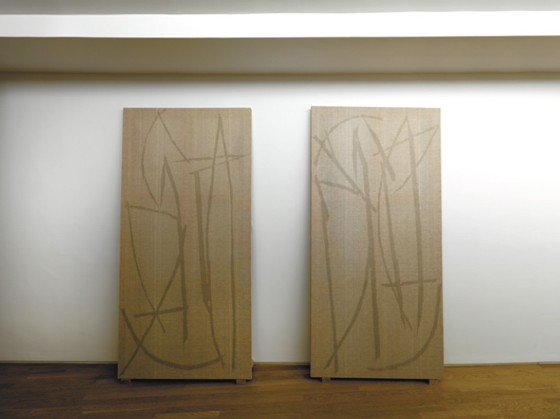 Alexandra Sukharev. Dog, woman, moth (guest). 2013
For her series of copper glasses, the artist turns to techniques similar to abstract photo printing. The emulsion formula was discovered by coole by accident, in the process of searching for a lost proportion of the composition for the mirror on copper amalgam. Having successfully created one, with a pink tint, she tried in vain to repeat it, simultaneously finding that the procedure for filling two consecutive solutions gives chemical reactions of pseudomorphic substitution, the creation of galvanic steam and recovery. Thus, after a single successful creation of a mirror, an optical apparatus of self -contemplation, an elliptical seizure and blocking of visibility occurred. The basis of all works of the series is the same: it is round glass with a pointed narrowing belt around the edge, sometimes mounted on a ghoth -sharp triangular stand. The compositional device of the glass contains a symbolic diagram of numerals: a double logic of mirror reflection occurs on the triangular circuit of the support. From 2011 to 2015, Sukhareva manually poured mirrors on Silver Amalgam, repeating the recipe from the found textbook on applied experimentation of the forties, as well as resorting to the help of a father, an amateur inventor who has been dedicated to the searches of a non-fuel engine for several years. Sukhareva compares her children's training in photography with how many of the former reagents in his youth were banned or are now available in strictly limited quantities.
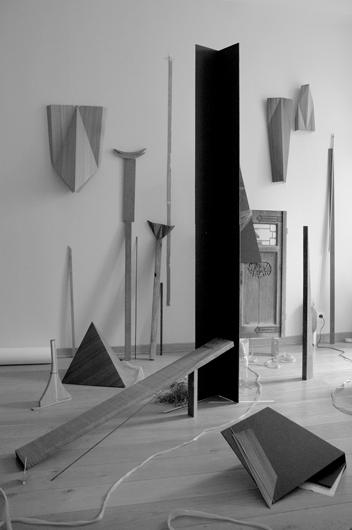 Alexandra Sukharev. View of the workshop, 2008
Explaining the essence of the chemical process and its meaning that interests it, the artist refers immediately to dark materialism and Paracelsus and Mercury Van Helmont. Sukhareva’s workshop with numerous flasks full of dangerous and rare substances of different shades, elegant flasks and vessels and really resembles an alchemical laboratory in which what was replaced by the new time as irrational. Sukhava seems to remind with his glasses that the reflective self -control of the contemplative subject of modernity, which is supposed to be transparent to the mind, is historically determined by the construct, which is built on toxic pollution and on the fetish faith, on aggressive alienation and forcibly moving the masses of people into large cities, rapidly growing capitalist centers of production and consumption, pierced by views, pierced by views, impressive views Evil or lusting. Calling one of the particularly successful silver glasses with a “detrimental object” (2014), and in general a series of “harmful”, Sukhareva refers to the evil eye of the lacan, associated with an accommodation attraction, where cursing envy and narcissism are inseparable.
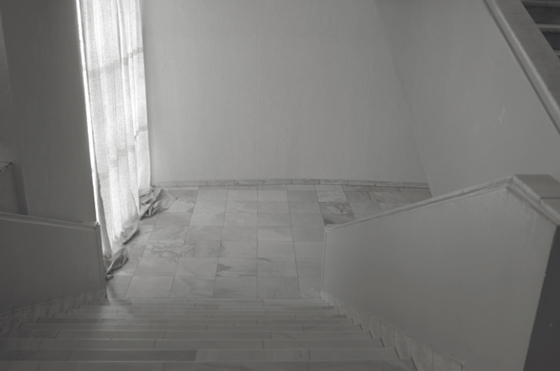 Alexandra Sukharev. Dox, 2012
Repeated attempts to create a mirror on their own gave rise to another parallel series of work: Sukhava wrote large -scale abstract canvases in which the pigment was seized and replaced by chlorine, that is, whitening substance. In some of them, such as the diptych of “dox” (2012), it was possible to read the cubist geometry frame - geometry, obliged by his invention to the appeal of artists to the unusual forms of the image of African tribes and thereby always encountering abstraction and figuration. The removal here works as a positive method of artistic production, where a millennial attitude to applying a coloring substance, understood as a synonymous art, again received a convincing refusal. Sukhareva in work on this series of canvases, without using the soil, moved from brush to the roller, and then to the spray gun, eliminating all living touches. This series could become one of the key items of discussion in the discussions that have since returned the medium of painting since then, but this has not happened, since these works have not been exhibited since the fall of 2011.
“Subtlement,” the interlocutor, which is far from modern, repeats to modern art, to whom I try to tell about the work of Alexandra Sukhareva. Yes, it is hermetic to a hoax than it can cause indignation, especially in the viewer inexperienced. Most copyright descriptions of the work also do not add clarity, but duplicates the allegoricality of artistic practice: is it about interpretation through the latest philosophical innovations [3] , about the coverage of anthropological impulse [4] or how Sukhareva causes various asynchronous temporalities [5] . All these descriptions lack attention to the actual productive tool. This effect is enhanced when in self -description they call themselves in the plural - “yes, we are a sect”, and the way of life is a neurostenic mixture and a cyclic repetition of reclusion and socialization on the principle of parting, decline and hypomania.
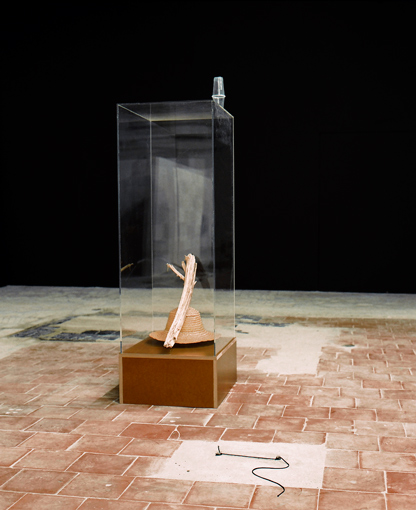 Alexandra Sukharev. The case of a flying head. 2011, MDF
 Learning now as a business card of Sukhareva-an economical sculptural diptych from simple radi-maids, two plastic cups, put vertically one hole to another. This diptych creates the effect of meaningfulness not only of its simple and at the same time syntactically complex (in relation to the languages of sculpture and radi-mide) with a trick of the presented materiality, but also as a rebus. The air, clogged with cups, as if it refers to hermetic, rearranges a banal everyday life as if, despite the formal modernity, the gnostic dimension of archaic brings out. At the same time, Sukhareva turns to sculptural techniques - a negative volume and demonstrations of the gravity forces that she mastered, studying their logic and history. This miniature installation of two cups became one of its first works in 2008 and has since migrated to new works and exhibitions, such as, for example, to Euraurarg (2011) or into the Sidur Museum “Here I dropped my hundred cloaks” (2014-2016)-an installation depicting a support of two of two Transparent, glued mud in mud, placed in a tomb -like sarcophagus with ribbed walls. The contours of the sarcophagus, as well as the false features in “It is, you are not” or a triangular stand in a series of mirrors and glasses, deliberately refer to expressive minimalism of millennary sects. In their ascetic pragmatism, the expectation of the Apocalypse looms.
[1] Benjamin V. The origin of the German baroque drama. Translation from German Sergei Romashko. - M.: Agraf, 2002. P. 185.
[2] Foster h . Bad New Days: Art, Criticism, Emergency. - London: Verso , 2015.
[3] Ogurtsov S. How to measure the rabbit hole during the flight? // Dialogue of the Arts, No. 2, 2014
[4] Adashevskaya L., Bereznitskaya N. Interview with Alexandra Sukhareva // Colta.ru, December 17, 2013
[5] Shuripa S. Space as a state of mind // alexandra sukhareva. Being of Mother Is the Bone. EXH. With AT. - Moscow: VAC Foundation , 2012. P. 7-11.
Download the entire issue of the magazine "Disagreements" (No. 12) "What a party?": PDF , mobi , epube