
Translated material
Decay over low heat
Kama Ginkas put "all over" Edward Albi
... She has on stage - a Siberian hut was broken by the wind, a Siberian hut: a toilet in the yard.
... He has on the stage - a living room on Manhattan: leather, red tree, busts of classics.
She has on stage - a pensioner leads the court of the courtyard, the writer heated by Soviet life hates his doll play “Murlyk”. The pilot Kolya, in the creation of the pollination of the fields, rinses the girl in the sky. They give them pillows at the wedding - blue and pink.
He has a gray -haired doctor from his skepticism. Buried by the shadow of the great father, Sonbak son hates his career. Two similar women lead a duel: how to bury a person who has not been divided? What to choose for him: flame or worms?
She has a dreary voice of a lying sick mother from behind the scene: "Kolya, where are you?"
He has a quiet wheezing of a dying father because of the scene. And he does not call anyone to himself.
Kama Ginkas said “New” in an interview: MTUZ, their common theater with Henrietta Yanovskaya, Theater of two directors, husband and wife, as if the premieres of a long dispute about the oddities of love. Yanovskaya staged in 2016 the play by Evgeny Popov “Balm-Having Amur” about the Krasnoyarsk of the 1960s, about the half-life of the Soviet world. The fact that there is no defense from the fate.
In January 2017, Ginkas answered her with the premiere “It's over” (1971) Edward Albi. About the United States of the 1960s, about the half-life of families where they argue about Meterlinka and confuse the faces of grandchildren. The fact that there is no defense from the fate. Neither in the hut without amenities, nor in the mansion besieged by reporters.
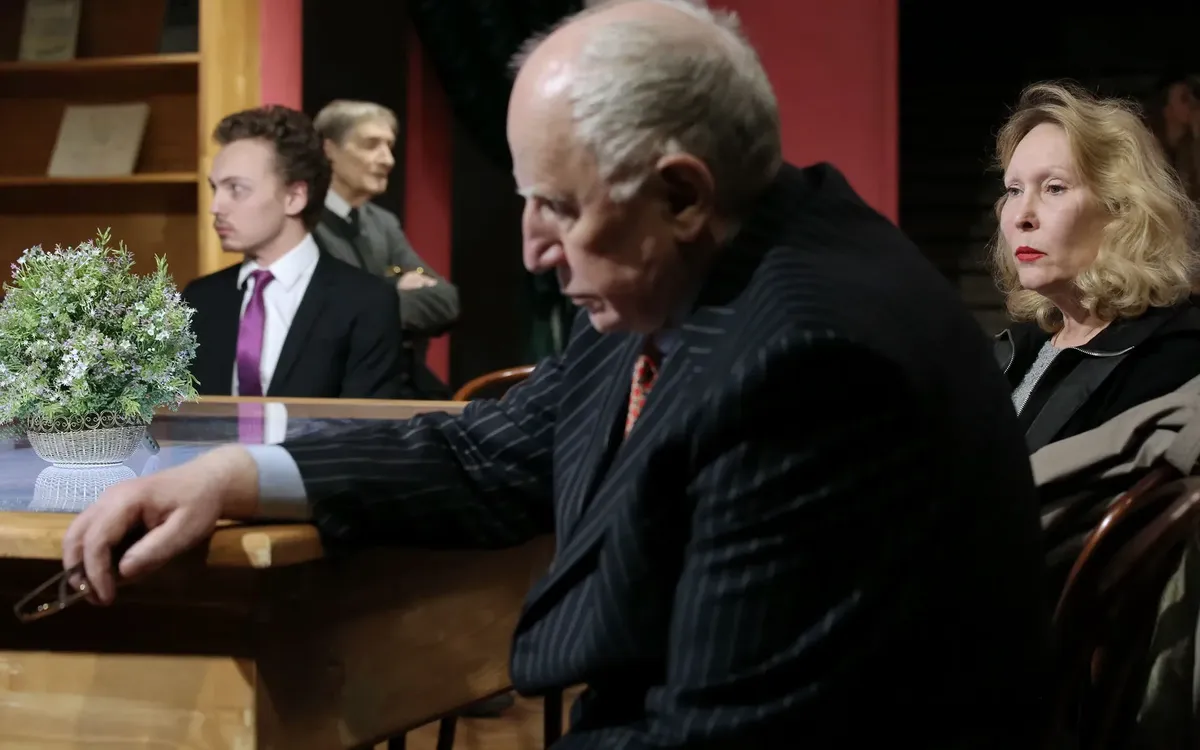
“It's over” Ginkas Kama - three hours with an intermission, in a chamber hall, especially for the performance built in the lobby. Spectators surround the playground from three sides: so students around the professor sat in ancient medical schools, observing the progress of the operation. Here and in this format, Ginkas staged its most stringent performances - experiments on actors, operations on the heart of the stalls: “Noktyurn” by Adam Rapp and “Who is afraid of Virginia Woolf?”.
“It's over” - the continuation of the cycle. All the heroes are prosperous, like flowers in Ikuban, standing in the middle of the table on stage. All - like the same colors - slowly die, because they have long been cut off. All are fixated on their trouble. The gray-haired doctor (Igor Yasulovich) remembers, in fact, that patients are losing confidence in him due to age. All actions are elegant, professionally human - but he comes to life, only defending himself. The lawyer (Valery Barinov) confidently conducts practice - but secretly looks like a confused boy, who was abandoned alone: his wife dived into madness, into a world where mouse tails stick out from her ears ...
The wife of the dying man (Olga Demidova) is in the center of the plot. Having lost the war for her husband for a long time, she still leads her. Roughly, violently, inconsolable. Refusing love to children unworthy to the father.
And it seems: the main crack in the play and in the heart of the world passes here.
The worst thing: they all try to observe rituals. The ritual of Christmas by the fireplace with a conversation and fried chestnuts. An intrigue ritual with a friend in order to revive the love of husband with jealousy. The ritual of the participation of the doctor and the nurse in the night vigil at the door of the dying bedroom. Ritual of mutual support of old friends ...
And all this does not work. Because everyone has long died. And without it, everything is in vain.
The mistress of the dying man (Oksana Lagutina) seems to understand this. And in a whisper, he is trying to explain the cornerstones of the world of the adult daughter of his lover: “ Do not care about anything, even about yourself ... What words you will remain if you will spent all of them to kill? What words will you call for help if the day will ever come ... And you, poor, suddenly understand that you love ... words ... "I love you", "I want to be with you"-they will sound like the growl of a wounded and wounding beast. " In response, the growl of the wounded man as a child and wounding without looking at the beast: "A whore!"
The dying dies. The air on the stage is full of fury, longing, sarcasm, despair. The dumb dialogs are completed. The actors of Mtuza accurately and harshly played the torture of a long interaction of people who lost, who killed any ability to interact.
The audience - when returning home - we should look in the mirror. So simple. From sin ...