
Translated material
In the shadow of the New World
What are the Europeans? Terrorism, migrants, Brexit, free trade and right -wing populism - as the European Union solves old problems in the new transatlantic era
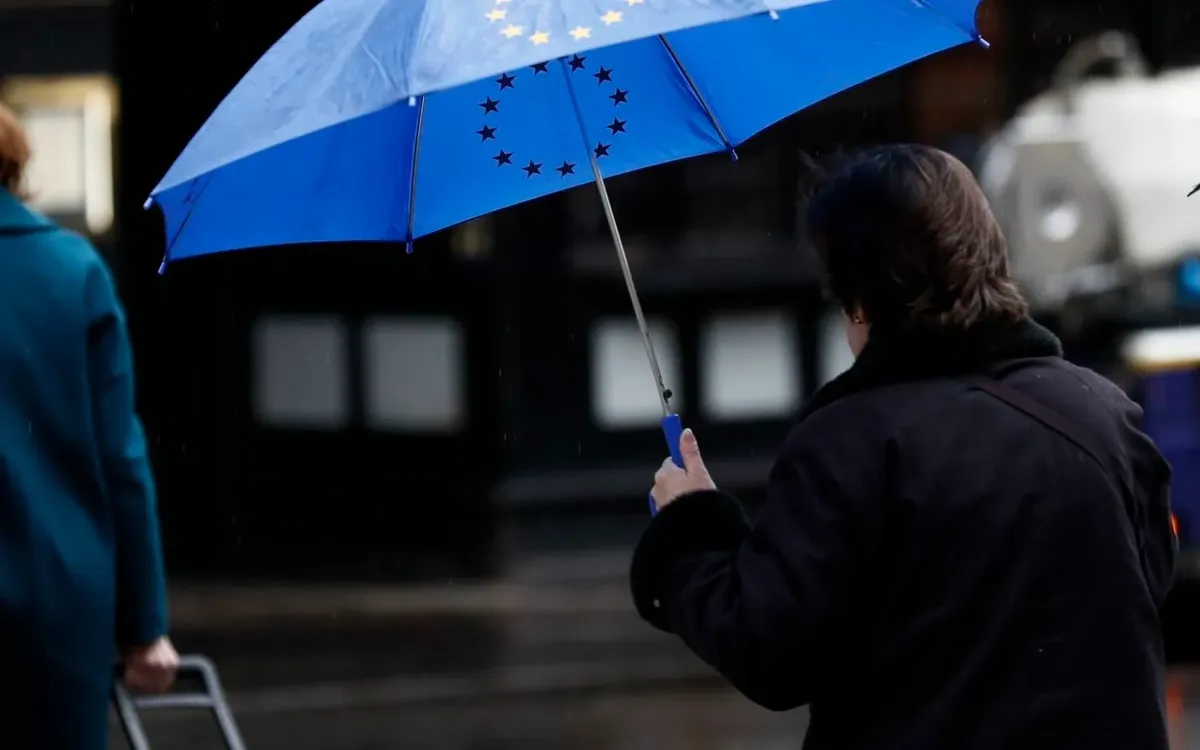
Response to a terrorist threat
Trump passions did not affect the everyday life of Brussels (as, however, Paris, Amsterdam, Berlin and other cities). The Brussels Grand Pages today are plows of tourists from all over the world, an international jazz festival takes place on the flag, and a festival of illumination on the embankment of the Brussels Canal was scheduled on the night of February 2. It will be crowded there, although the administrative border between Brussels itself and the sinister, judging by the programs of Russian federal television channels, commune Molenbek, passes through this channel. There are many women in hijabs on Trading Street. Many children are in a hurry to use the prices that have fallen to the baseboard in the last days of January sales.
Increased security measures after last year’s terrorist attacks are manifested in the presence in some places on the streets of the brave Ardenne shooters in complete combat equipment. There is no guarantee that they will frighten suicide terrorists, but the inhabitants see in them something like police radars designed to reduce mortality on roads, which is much more mortality from terrorist attacks.
Reply to the migration crisis
The ethnic appearance of large cities of Western Europe has been formed in the last 30-40 years, and not in two years of migration crisis. Tens of millions of “color” population of Europe are its natives, and not yesterday’s migrants, as right agitators are trying to imagine. The problem of coexistence is rather socio-cultural than migration.
The crisis is not exhausted, although the severity was removed. Not that hundreds of thousands of migrants who arrived “resolved”, and new flows of aliens were exhausted. The migration problem has become a given. The European governments and the EU are trying to react to it with measures, the scale of which, however, is not impressive.
Camps are equipped in Greece and Italy, but Brussels plan to resettle at least 160 thousand migrants that have accumulated there in the Union is still less than percentage. The refugees of the country of the former social camp are especially strongly resisted.
The European Commission said that the EU border and coast guard service, which was decided to create three years ago, was almost formed. More than one and a half thousand of its employees are ready to accommodate on the external borders of the Union and help local border guards. Bases for quick response groups have been created. That is, the border guards of Germany, Holland, Belgium, Denmark, Sweden and other “internal” EU countries will help the Spanish, Italian and Greek colleagues to guard the sea borders, and the Bulgarian, Romanian, Hungarian and Polish. Negotiations with Serbia and Macedonia, not part of the EU, will begin, so that operational groups of the European border guard operate on their territory.
But while the conditions for a complete return to the Schengen system of open borders have not ripened, and Brussels agreed to resolve five countries (Austria, Germany, Denmark, Sweden and Norway), which introduced passport control at their borders, maintain it for another three months. Of course, temporarily, in an exceptional order.
The head of the EU foreign policy, Federica Mogherini, announced the cooperation of Brussels with Tripoli in the struggle against carriers of migrants through the Mediterranean Sea. 200 million euros were allocated to the Libyan project. Part of the money will be monitored by the southern borders of Libya with a niger and a child. EU instructors are already training Libyan coast guard. And, of course, Mogherini said, Europe does not leave a promising goal to eliminate the indigenous causes of migration, contributing to the development of countries from where people flee to Europe.
How useful these small steps are, time will tell. The Russian factor can intervene. The Government of the chairman of the EU Malta reported that the separates of the separatists of General Caliph Haftar (the very one that the board of the aircraft carrier cruiser Admiral Kuznetsov) are going to take the capital of Tripoli and overthrow the recognized UN Government of Libya, with which the EU cooperates.
The migration problem affects moods and political trends along with the consequences of the economic crisis and the costs of rapid globalization. The salvation of Greece is not completed from bankruptcy; The restoration of the economic growth of the EU and the eurozone is slow, and many leading economists, for example, the President of the European Investment Bank Werner Hoyer, who met with the press in Brussels last week, do not see a way out except in the acceleration of structural reforms, eliminating the narrow places of bureaucratic regulation, inhibiting investment, in further liberalization and economic integration of the EU. In paradoxical contradiction with this, the main theme of today's Europe is Brexit.
How Europe is going to survive Brexit
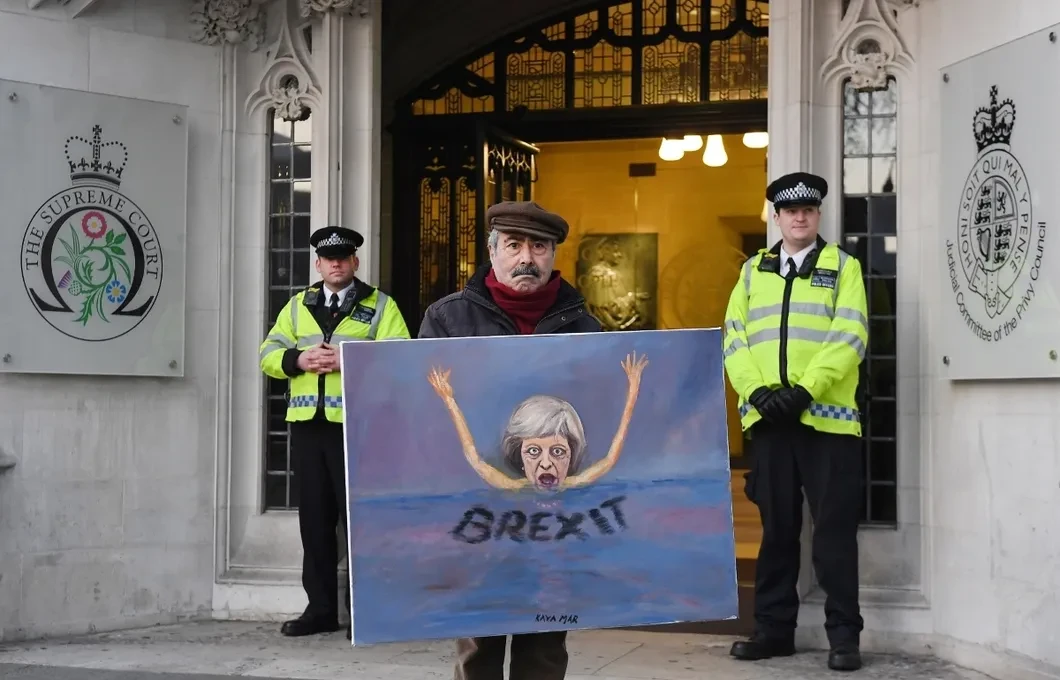
After a long uncertainty on January 18, it cleared up what it would be. Prime Minister Teresa May announced that her government had chosen a “tough” option. Great Britain will leave not only the EU, but also a single European market, which not only voted for the “in” would definitely want, but also many of those who voted victoriously for “out”.
Neither the Swiss nor the Norwegian options will work. The British at the referendum voted primarily against migration from the countries of the Union, from Central and Eastern Europe, against the free movement of labor. And this is one of the sacred “four freedoms” of the EU market, along with the freedom of movement of capital, goods and services.
“To be outside the EU, but a member of a single market would mean obeying the rules and norms that are determined by these freedoms, without a voice in establishing rules and norms,” May said reasonably.
“As widespread access” to the Unified EU market as possible, UK will seek in hard negotiations with the rest of the EU 27 members on a trading agreement.
The exit of Great Britain from the EU is not an act of national self -isolation, protectionism. On the contrary, London wants to restore its role in the world shopping center, weakened by the bonds with the countries of the British Commonwealth, to strengthen relations with the United States. And he intends to remain cramped with the continent, as far as possible with a new status, communication.
May, who was the first after the Washington Inauguration, visited the United States, was cool to praise Donald Trump, who supported Brexit and famously suggested that the EU would leave soon. A day after such a statement by Trump, she assured that Brexit is not against the European Union or its members: “We will remain reliable partners devoted to allies and close friends, and the unique potential of British intelligence will continue to serve the peoples of Europe in the struggle against terrorism.”
True, the head of the European group, the Minister of Finance of the Netherlands Yerun Deisselblum painted a gloomy picture of the consequences of a tough script. After 20 years, he believes, Britain will return to the 70s of the last century: "Eallesting backwardness, mass unemployment, impoverishment."
Nevertheless, Brussels appreciated the decision of London. The head of the European Council Tusk said that it fully corresponds to the inseparability of the four freedoms of a single market. Otherwise, Great Britain would have gained competitive advantages. He noted that May is closer to Churchill than to Trump. But the European Commission chief Junker added that negotiations on the trade agreement will be “very, very difficult”. It is gratifying that the divorce promises to be intelligent.
United Europe challenges Trump
Europe is split into those who sympathize with Trump’s anti -globalism and advocate for the return of the national sovereignty of the model of the beginning of the last century, and those who see the imperative of history in globalization and are looking for only ways to mitigate its costs. The conservative reaction that struck the civilized world is confident in the latter - this is a temporary phenomenon.
There is an emotional inconsistency between Trump and the EU. Trump is the antipode of the Brussels bureaucracy. He is passionar and impulsive, while the European Commission is rational and careful. He speaks the language of the street, and she is on professional jargon.
Last weekend, angry farmers sprayed milk on Schumann Square in Brussels in front of the EU Council building, enveloping the police and themselves with a white fog. They came from different countries, even from distant Latvia to express despair. They have to work almost at a loss to compete with livestock breeders from less “expensive” countries, and then Brussels bureaucrats decided to sell strategic reserves of milk powder. Prices collapsed ...
The problem of the competitiveness of European farmers is really complicated against the background of globalization. And the point is not so much in Russian counter -sanctions as our propagandists are trying to imagine. Export to Russia is important for many manufacturers, but in tenth place in the EU. It’s just that the world is already changing according to its own laws, and we need to look for a solution to objective problems.
Once the European kings fought to collect national markets protected from competitors within a radius of half a hundred kilometers. It was the era of the formation of national states. Now it is funny to talk about such distances in trade.
On the day when Trump led the United States out of the Treaty on Pacific Partnership (TTP), in Brussels the relevant European Parliament Committee approved the EU trading agreement, and it will most likely be ratified.
This is the most advanced EU Treaty of Free Trade with an external partner. He was considered the forerunner of the Treaty on Transatlantic Trade and Investment Partnership between the EU and the USA (TTIP), whose fate against Trump's isolationism became unclear. True, last week both parties confirmed that negotiations that have been going on since 2013 do not stop.
The unification of 40 National Unions of Industrialists and Entrepreneurs of European countries Businesseurope (something like our RSPP) sent a manifest by the leaders of European states on Thursday, urging the EU collapse. Business - for integration and participation in globalization, which played a progressive role, raising the world economy to an unprecedented level and saving hundreds of millions of earthlings from starvation.
The EU, which produces 22% of the global GDP (with a population of 7% of the world), may and should form the process of globalization, the authors of the manifesto are sure. Fear of globalization nourishes populism, extremism and nationalism, and the European project is based on directly opposite ideas.
Protectionism and isolationism is a true road to poverty, business captains are sure. A thorough and open discussion about world trade is needed, and the European social model will have to be modernized taking into account demographic aging and strengthening international competition.
Populism and isolationism became the trend of the “new era”, whose milestones are considered by Brexit and the election of Trump. But Europeans, even notorious Euroskeptics, were not ready to weaken the transatlantic connection, which for seven decades provided them with prosperity and safety. They hope that Trump will not go to the dismantling of NATO and to weaken economic integration with Europe. The Americans associate not only roots, but also values: the rule of law, human rights, gender equality and respect for minority rights.
Will NATO be
“I am sure that if we cooperate on the basis of general rules, values and principles of international economy, international trade, contribute to military alliances, then this will benefit us,” said Angela Merkel in response to the rhetoric of Trump.
And the Secretary General of NATO Stoltenberg said that now is not the time to abandon the North Atlantic Alliance. Act today - "this is not an option for Europe or the United States."
It is unlikely that EuroSceptics in Central Europe will talk about leaving the Union. But in Germany, the Netherlands, Denmark, under the influence of public moods, the positions of the Parties of the mainstream protruded. To win the elections, you have to adapt without acting, however, principles. France turned out to be a weak link. She is the only one where the proliferators-priests and right-wing conservatives have received real chances of power.
Europe after the next election
The favorite in the election campaign is Marin Le Pen, which was recently unthinkable. But in the second round, as happened in 2002, even the socialists and communists will vote for Francois Fillon hated by them. Unless, of course, he overcome corruption scandals.
Fiion, as a probable winner of the election race in France, went to Berlin, to Merkel last week. After all, she is the real leader of the European Union, no matter what a blow in the sense of folk sympathy inflicts her migration policy on the party that was ruling in Germany.
Fiion and Merkel noted disagreements on migration policy and sanctions against Russia. At a press conference, the Frenchman remembered the pro-Russian tone: "Russia made mistakes, this is undoubted, but we, too." Russia is not the main thing in the current agenda of the EU.
Few doubt that Merkel will remain at the helm for another chancellor term. The surprise was the appearance of an opponent (or a future partner). Social Democrat Martin Schulz refused a new term as chairman of the European Parliament and decided to look for good luck in his homeland. The former burgomaster of Little Aachen made a career in Brussels. Today, this Euroborcrat, a convinced champion of European integration, has the same rating in Germany as Merkel himself: 41%. There are chances to become, if not a chancellor, then the vice-chancellor in the coalition government and lead the FRG FRG.
Europe is in confusion, doubt and rain. Due to diversity, it is difficult for her to decide herself. And even more difficult to understand it to others.
Brussels