
Translated material
"Uncle, Read Deleuza"
Hegel, indicator of fish species, futurists and theology: what and how the pancakes read
Gorky continues the cycle of materials about the practices of reading different social groups - in past issues it was possible to find out about the Ural workers , prisoners and authors of the Almanac “Translite” . Gorky asked Maxim Dinkevich to talk with domestic punks and hardkiders about their reader interests and habits, as well as whether there is enough time for reading the driver of a tour bus, why is Martin Eden, whether it is worth reading the “state of postmodern” of Lyotar and whether it is necessary to publish fundamental work about Russian skinheads.
Denis Alekseev, driver of the Gazelle of Death , Hero of comics
I am pretty mixed with the opposition of the “book” and “real” world: as if the book world is illusory and indicates the escapist inclinations of the subject. I don’t know who this dense stupidity occurred to whom. Personally, I perceive the book world much more clearly. In it, I am at least sober. I would like to spend my life, digging in the texts of Russian futurists, sometimes interrupted for sleep and food, but instead I do some kind of garbage. It’s not that it is very upset by it: the people involved in some garbage in this world are simply called “normal”.
My "specialty" in the punk rock is a driver of a tour bus, on which groups go on tour. I am not at home for two months - and I don’t have at home as such. There is a corner where you can throw a sleeping bag, but it is the feeling of a house that is what I have been missing for many years. This leaves an imprint on what and how I read: I have to carry a box with books in my Gazelle, I don’t have a book shelf, after reading the book is given or exchange, and those that no one wants to take is sent to the cash. I will make an audit of the subplastic space.
A year ago, the Foreigne Publishing House moved to a new building and staged an unprecedented sale: four numbers of the Foreign Literature magazine for a hundred rubles or something like that. I was sore then in Moscow, so I went to a big horde and lowered a couple of thousand, buying up everything that was. The format of the journal publication best corresponds to the rhythm of my life: a couple of stories, a small romance or fragment, essays, poems, memories, criticism. The names of the authors can not be memorized. While the group with which I am in the tour will cut on the stage, I have a couple of hours to devote to reading. Focusing in the conditions of the roar and atmosphere of the general holiday is not easy, but theoretically possible.
In the last completely catastrophic round of the Estonian punk group, Hot Kommunist (only three of the planned concerts took place-thanks to the domestic automobile industry and Orthodox activists) I read: “Birth of the killer” Laszlo Krasnachorkai (Hungarian author, who is closely collaborating with the director of the White Tarr), the “triple agent” by Jobi Warrick (documentary A novel-investigation about the CIA struggle with al-Qaeda, very exciting), the stories of Marianne Gruber and Magdalenna Tully about the Second World War from the point of view of the German soldier and daughter of Polish Jews, the Nobel speech of Moscow Yan is Il No. 5 in 2013. It is easy to recall, because no one will take this number - at one of the absorptions it was pissed by the cat pissed it off.
I do not read punk literature. You don’t think that the operators of the dredgers pay special attention to reading the novels in which the main character works as a baggereter? The best punk literature is the biographies of Arthur Rimbao and Mikhail Bakunin (both are in ZhZL). I still can’t decide what impresses me more: the spirit of Bakunin or the cut leg of Rimbae. Everything that you read about the punk group will be a slurred parody. Everything that you read from the punk groups will be even worse. "Please kill me!" - PF, funny ...
Tour is an extreme situation, perceived as the norm, constant fatigue and a series of insoluble problems that have to be solved. Therefore, read in the tours is superimposed on personal sensations, and personal sensations on what has been read, and poetry comes best. I can’t even say exactly what I really lived, and what I have in other people's lines. Strange sensation. It is as if written is a resonance with the surrounding reality - it happens that I am ready to burst into tears from how amazing, accurate, integral, momentary and one -time.
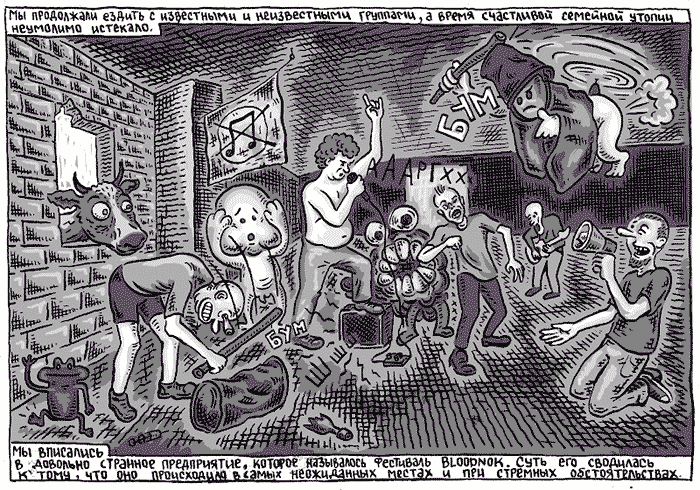
Page from the Comic “Gazelle Death”, 2016
vk.com/gazelleofdeath
The authors closest to me - the righteous of the world Cheslav Milos, Thomas Ventzlova - the sage, according to the exact remark of Ani's "Umki" Gerasimova, "vaccinated from the plague, when we were not yet born," and Alexei Khvostenko is an absolute idol. The first Beitnik of the Soviet Union, a person with a unique sense of internal autonomy and integrity: “Who is from the world to free, so that praise does not sing him” is his line. I would write it aboard my Gazelle as a motto. Such as the tail are no longer done. Last year, the book of A.Kh.V “Universal Collected Works” was published in the UFO, it included texts written together with Henri Volokhonsky. Volokhonsky himself is also very appreciated, the play “The First Mushroom” is the best that I read in 2016. I met Khvostenko twice when he came to Russia shortly before his death. It is important to me.
Victor Sosnora-I don’t know how someone turns to complain that in our time there are no truly great ones while this person walks on the ground. Gennady Aigi is no longer with us, but in my inner table about the great he is in the same pantheon.
In truth, I would like to be distracted from Russian futurists not to sleep and food, but to the texts of Dadaists and Oberiuts. I hate Berlin. The city in which everyone does not give a damn about everyone is like Moscow, only worse. I have already made one oversight that led to the most ridiculous fact of my biography - I was born in Moscow. Now it would be a height of frivolity to accidentally die in Berlin. No, pipe. I will stay away from him. The only thing that slightly rehabilitates the German capital in my eyes is the Berlin club Dada. Hulzenbek, Hausman, Gross, Baader - this is good.
I would prefer to die in Istanbul. I like this city and spring Turkish flowers so much! In April 2016, the St. Petersburg Group Matushka-Gusyn, we took a rather adventurous and suicidal journey around the Black Sea on the Gazelle-in the midst of a batch between Russia and Turkey. When we left the country, we were asked to sign some papers that the Russian Federation is not responsible for transporting our corpses to their homeland. I did not specifically watch the news before leaving and reasoned like this: in Moscow there is a large Turkish poet Nazim Hikmet, close to my heart. Muscovites and Muscovites bring Russian flowers, cornflowers and forget -me -nots to his grave, despite political crises and diplomatic exacerbations. And although it sounds arrogant, it is still pleasant to dream that I would have got a couple of beautiful spring flowers from brothers-Turks and Turkish women, if it happened to stop in Istanbul forever. Why transport my body to cold Moscow? Probably, Havana would also suit the final stop. The translating of the “three sad tigers” of the Cuban Guillermo Cabrera Infante is devoted to the problems of Il. No one will take, because the book is wet in the rain, and in vain - the novel is incredible.
“Revolution of everyday life” by Raul Vaneigem and “On Knives with everything existing” Alfredo Bonanno - two books that turned my brains great. I would like to participate in anarchy much more than in rock and roll. It is only a pity that anarchism in Russia mutated for some strange teaching, "how to make everyone comfortable and not offend anyone." For me, anarchy lies in a completely different, perpendicular comfort of the plane. Freedom is not comfortable for anyone.
But my most favorite book (not the first decade) is a indicator of fish species. I won’t give it to anyone, even with a return.

Alekskandra Semenova, bass player Jars
I started reading early. One of the very first children's memories: I read poems with my mother, I teach letters and syllables. Therefore, the love of reading was instilled in me almost in diaper age. The child was often left at home alone: in order not to lean, I turned on the TV without sound in each room and read. Or watched the pictures. With warm feelings, I now recall the children's atlas “Peace and Man” and “The World around us”. Sometimes I still feel like a girl with that cover with a fat ellipse instead of a head, which inquisitively discovers such an interesting and colorful world.
I spent almost all my childhood at school or at books, bowingly mastering the school curriculum and lists of extracurricular reading. With pleasure I recited poems, learned to write early. Once I was closed for several hours in the room and released only after I read Oblomova. Why released - I do not remember. I admit, literature for me has always been a saving escape practice.
I was 14, I lingered in the department of modern foreign literature, wanting to take something completely unknown to me. There was a narrow bright green book with red cheap pages-the “bridge” by Ian Banks. For teenage consciousness, this turned out to be a strong artistic experience, against the background of a school course in literature - even a shock. At one of the lessons, the teacher reproached me: “Of course, after all, it is not as interesting to read the classics as modern prose about sex with a menstruating woman in an abandoned tower.” It turned out that she received a “bridge” from my mother, when she was puzzled by the question of what the younger generation reads. It is a pity that from my shelves she came across not the “suction” of Houom or Burroughs. Hawoma still loves Stuart - he is very ironic, grotesque and a little miserable. At 15, I read his novels mainly at night and very quickly.
When it became older, something more often appeared in his hands, besides fiction. From the fathers of anarchism read Kropotkin and Bakunin. I wanted something fresh, it seemed that I had to dig deeper or slightly in the other direction. Fromm Froma took away the “flight of freedom” from a dusty underground in the same dusty libraries. I read the Frankfurt school, criticism, re -read Freud, always frowned from Marx. Nietzsche's work is the most expensive and secret. I celebrate October 15 - Nietzsche and Foucault's birthday, this is a real holiday for me. I passionately love French philosophy of the XX century, for which I began to learn language. And also for the sake of genuine pleasure in reading in the original of the French Symbolists, Surrealists and Poetry of Beckett.
If we talk about books as artifacts, I especially value “Maltorore songs” published by the “Club of Promotors”. From the very beginning, as I began to gather my modest library, I really liked how the roots of the PHILOSOPHY series of the AST publishing house look. Of the whole many worthy attention of the books of the series I will highlight “Technognosis. Myth, magic and mysticism in the information era ”by Eric Davis. I have many books of the Giley publishing house, among which, of course, there is John Zerezan and Bob Black.
The last books read were “1913. Summer of the whole century ”Florian Illyesia and the“ autumn toad ”Dmitry Gorchev. The first is the boulevard kaleidoscope of the events of the cultural and political life of Europe. Monthly reports in the style of “let them say”, but the book contagiously exudes the broadest erudition of the author! The second is the ironic miniatures of a modest intellectual, a fluffy misanthrope with an alcohol-paternal soul. A! And, of course, “how to live together” Roland Bart. This work should get acquainted with everyone who is interested in the problem of the human dormitory, a variety of forms of social ties from the standpoint of cultural anthropology and socio-political reflection. I am very close to how Bart writes about power. Power sets the rhythm. And his idihythmic fantasy, in my opinion, is largely consonant with the utopia of anarchist society.
I definitely want to insert the once fashionable Kiev slang expression "uncle, read the case." After all, everyone should really take and read Deleuz, who has not yet had time. I think literature is a means of multiplying worlds, and the text is a pleasure. There are no bad books, you need to learn to read.

German Boldovsky, vocalist of degenerative behavior groups and Obsession
I fell in love with reading thanks to Eduard Uspensky. In childhood, he considered his books the funniest, and since I always had a tendency to humorous literature, he was actively read out by them. The standard “Prostokvashino” and “Cheburashka” was not limited - in my collection there was a collection, which included “the investigation of Koloboks”, “25 professions of Masha Filippenko”, “warranty men”. Analyzing his life, I understand that the Assumption very strongly influenced my worldview. When you recall some books, you begin to understand that many jokes there are oriented to adults, and the Assumption is a man tired of state arbitrariness. There is an episode in his “Kolobki” where Kolobok is trying to catch poachers, promises to call the police to be imprisoned, and one of the poachers puts on a cap and says: “What kind of police? I am a police! ” For a seven-year-old me, brought up in an intelligent family, it was a shock-how is it? And the illustration was such that it immediately became clear: this policeman is an extremely unpleasant person. Most of the works of Uspensky permeates the acute sense of social justice.
Dan Brown turned out to be the next author who strongly influenced me. His description of cryptographic and conspiracy art history puzzles attracted me very much. The detective part only enraged, but the investigations themselves and their connection with the actually existing works of art were fascinated. Of course, I had heard about secret societies before, but I did not attach any importance to them. Interested in the topic, I discovered a huge layer of information in which I need to understand and dig in order to understand at least something. In addition to directly conspiracyology, this has spurred my interest in religious studies, philosophy, the history of arts and history in principle.

In this regard, the most serious and voluminous book was the “Encyclopedic presentation of the Masonic, hermetic, Kabbalistic and Rosencrecer symbolic philosophy” by Manley Hall. Hall is a big erudite and clever, consisting in a pile of secret orders. He wrote the encyclopedia at 27 (if my memory does not change) is one of the most thorough works that allow you to get acquainted with the world of occult without excessive hoax. The hall entered my life so much that the texts of one of my groups are based exclusively on occult topics. Our last record is a musical interpretation of the symbolism of the two torches of Demeter, who was studied by him.
Houses still remained father’s books on architecture and urban planning - I also read them with rapture. Even if heavy books come across, I always use the advice of Henry Rollinz: “When I choose a book, I have to read it to the end. I have to do this, even if it is physically painful in the process of reading. ” This is a very good advice: if you cannot read the book, you are a weakness.
Recently, my father repaired the old PDA and I downloaded Hegel's “History of Philosophy”. The entry to the first one from some Russian philosophers occupied as many as 60 pages out of 311. And it was written in such an uncomfortable language that the brains turned out. It was then that Rollinz’s advice came in handy-although I still did not understand anything. Why is the History of Philosophy? To be honest, recently I noticed that I have capital gaps on many issues - and they all need to be closed. I never supported the stereotype punk as a thumping in the trash of an idiot. I believe that punk is one of the most ideologically savvy subcultures, so that we must somehow observe the renom.

Andrey Ku!, Bassist of the Vini-Pooh Legs group
In my childhood, there was not only the Internet and mobile communications, but even video recorders with game consoles. Reading, as in the 19th century, was still good entertainment. I loved to fall somewhere with a book and immerse myself in the next volume of the “adventure library”, until someone from Rodney pulled me out of the travels in Africa to King Solomon, participation in the Anglo-Boer War with the captain of the Soldian-headed or cocaine thrips with the bored Sherlock Holmes.
If we talk about punk rock and literature, then, as Pit Silaev wrote in the “Exodus”, I am from the last generation that grew on Soviet cartoons, films and books. When you are small, you still do not have your own understanding of life, you perceive what your parents and school teach you. In our childhood, a dynamic era of the collapse of the Union fell. In May, you are proud that you are accepted into pioneers, and in September it turns out that it is a pioneer to be All these, in general, good pioneering moral values begin to combine poorly with reality, which creates the very feeling of No Future. It frustrates a little.
The theme of noble outsiders come in well teenagers. Without any war, I easily felt like a part of the lost generation. You can say thanks to the remark, Hemingai, Salinger-and a little later, Kizi, Dovlatov and Bukovsky-because they finally convinced me to play punk rock on the basements and wander in promotions instead of studying and making a career well. I am sure they pushed me into the abyss. Впрочем, панк-рок стал единственным местом, где мне удалось найти таких же, как я, — сумасшедших и смешных; it ain't lonely at the bottom.
В последнее время я значительно меньше читаю художественную литературу, как-то пропала в ней потребность. В основном дочитываю пропущенное из классических авторов. Недавно добрался до «Чевенгура» — Платонов, конечно, гениальный писатель. Еще пара не самых известных романов моего любимого Воннегута, «Фокус-покус» и «Рецидивист» — очень хороши. Недавно в слегка измененном состоянии сознания начал читать «Мозг Эндрю» очень уважаемого мной Доктороу, который написал «Регтайм», но пришлось отложить до лучших времен, так как мне показалось, что у меня самого начинается шизофрения. Вот она — сила искусства.
Сейчас меня больше привлекают биографии и научпоп — например, биография Маяковского от Дмитрия Быкова. Тема благодатная, написано ловко, авторский взгляд на жизнь Маяковского заслуживает внимания. Единственное замечание: мне кажется, в XXI веке западло писать книги по 700 страниц, если можно уложиться в 350. А сегодня я буду засыпать под «В поисках двойной спирали», историю открытия ДНК в Кембридже. Вот тут автор молодец — 150 страниц карманного формата, язык слабоват, но тема мне интересна.
О панке стоит прочитать «Прошу, убей меня!». Это лакмусовая бумажка: если вам омерзительны все эти гомосеки и торчки, извините, вы не панк. Если вам показалось, что это весело и трагично, — добро пожаловать в подвал. Чтобы погрузиться в закулисье панк-группы, можно почитать недавно вышедшую автобиографию NOFX — там тоже все смешно, грустно и понятно, кто чем живет в панк-роке.
Еще одна важная для меня книга, по которой снят один из моих любимых фильмов «Падшие», — «Все равно тебе водить» Джузеппе Куликкья. Это не совсем о панк-роке, а скорее о потерянном поколении девяностых. Для меня это близкие понятия, такой экзистенциальный панк-рок. Комикс «Газель смерти» от Дениса Алексеева и Пети LastSlovenia очень близок мне по духу, это талантливое художественное произведение о панк-роке. «Исход» Пита мне не очень нравится из-за чрезмерного любования чернухой, но это точно мощно — есть упоение в бою. Если вы не были свидетелями российского околомузыкального насилия нулевых, можете рискнуть в него погрузиться, книжка почти документальная.
«Философия панка: больше, чем шум» Крейга О'Хара — ликбез для тех, кто не в теме. Для контраста и снятия напряжения рекомендую совмещать ее с треш-романом «Отсос» Стюарта Хоума — не так познавательно, но гораздо веселее.

Александр Red Head, редактор и сооснователь вебзина Sadwave , сооснователь пивоварни «Заговор», баров RULE taproom и DOGMA bottle shop
Я очень давно охотился за книгой Ника Кейва «И узре ослица ангела божия», недавно ее заполучил. До этого за пару вечеров прочел его же произведение «Смерть Банни Манро», очень понравилось. Поэтому от более ранней и известной книги лидера The Bad Seeds у меня были особенные ожидания. Может, именно из-за них я немного разочаровался — она не так сильно меня поразила по сравнению с предыдущей. Но она точно заслуживает внимания, просто нужно отнестись к ней непредвзято. Это очень мрачное произведение погружает в грязь и трясину всех человеческих грехов. Грешны все: и главный герой, и общество, и сам Ангел Божий. Страшная и пугающая истина о самой природе человека. Несмотря на то, что в книге описывается вымышленный мир, трудно отделаться от мысли, что автор писал, оглядываясь на свою родную страну, — сытую и светлую Австралию. Мне посчастливилось побывать там, но, видимо, я ходил туристическими тропами, поэтому не ощутил того, что повлияло на Кейва. Я бы провел параллели с рассказами Мамлеева, но знакомые поклонники Мамлеева за это сравнение меня пожурили.
Поскольку моя профессиональная деятельность с недавних пор кардинально изменилась — теперь я сооснователь пивоварни «Заговор» и баров RULE taproom и DOGMA bottle shop, а раньше работал в НИИ редких металлов и полупроводников, — то и профессиональная литература поменялась соответствующим образом. Купил книгу одного из основателей шотландской пивоварни Brew Dog Джеймса Уотта «Бизнес для панков». Brew Dog — одна из самых популярных в мире крафтовых пивоварен, которая добилась оглушительного успеха своим ключевым сортом Punk IPA и кучей других экспериментальных сортов. Парадоксально, но при всей крутости Brew Dog, это совершенно бесполезная книга, которая не будет интересна ни тем, кто просто любит пиво, ни бизнесменам, ни тем более панкам. Я очень не люблю книги-мотиваторы для стартаперов, но эта даже на такую не тянет. 90% сводятся к тому, что вы должны никого не слушать, на все наплевать и делать так, как вам нравится. Есть, правда, несколько ярких историй: создание самого крепкого пива в мире The End of History, бутылки из-под которого засовывали в чучела белок, чьи трупы подобрали на дорогах, и выпуск пива против гомофобии My name is Vladimir c Путиным на этикетке.
«Состояние постмодерна» Лиотара, может быть, и не настольная книга для интересующихся постмодерном, но к прочтению, по-моему, обязательна. Это философская книга, которая далась мне очень нелегко, некоторые моменты перечитывал не раз. Обиднее всего, что ясная картинка все равно не сложилась, — да и, наверное, не сложится. На то это и постмодерн. Лиотар сыплет термины, но не доводит объяснения до вывода, который бы все объяснил. После прочтения «Состояния постмодерна» есть ощущение, что вы приняли участие в языковой игре, оказавшись явно не в выигрыше.
К сожалению, интересных с литературной точки зрения панк-книг существует крайне мало. Большинство носит энциклопедический характер. Например, American Hardcore интересна мне, потому что там собрано колоссальное количество информации о панк и хардкор-группах из США начала 1980-х, моем любимом периоде.
Помимо фактов, музыкальные книги очень приятны тем, что передают дух описываемого периода. Хорошим примером служит работа о нашем андеграунде 1990-х — «Песни в пустоту». Есть исключения в виде дневников — например, чудесные работы Генри Роллинза о его жизни в составе групп, полной рефлексии и переживаний. Еще Аарон Кометбас написал отличную повесть об азиатском туре Green Day 2010 года, где показал группу с новой стороны для большинства ее молодых поклонников.
Булат Ибятов, основатель издательства «Сияние»
В октябре я принялся читать Библию, купленную в Ростове Великом в женском монастыре. Скрывать не буду, чтение шло тяжело, растянулось на три месяца. Но и объем нешуточный — более 1100 страниц. После этого за две поездки в метро прочел «Манифест коммунистической партии» Карла Маркса, прекрасно изданный дружественным коллективом Common Place. Затем — сборник рассказов «Мужчины без женщин» Мураками. Недавно купил «Котлован» Платонова, но в тот же день, будучи в гостях у Димы Зеленого из группы «Витамин Роста» и Rockstar Bar, нашел биографию НАИВ, написанную Максом Кочетковым. Выпросил почитать, ею сейчас и занят. Добью сегодня-завтра и приступлю к Платонову.
Как и у всех читающих людей, у меня есть список must have. Покупаю книги, опираясь на него, и стараюсь делать это не реже раза в месяц. Также стараюсь покупать все, что встречается о музыке и музыкальной индустрии. Всем без исключения, вне зависимости от субкультурной принадлежности, рекомендую плотное изучение русской классики: Толстой, Достоевский, Булгаков, Гончаров, Гоголь, Чехов, Куприн. Из более современного — Ильф и Петров, Довлатов, Пелевин, Сорокин, Веллер * Признан властями РФ иноагентом. , Лимонов, Ерофеев. Очень сильно понравился «Исход» Петра Силаева. Вот навскидку то, что люблю из русской прозы. Мои вкусы не отличаются оригинальностью. То же самое можно сказать и о поэзии: Есенин, Маяковский, Мандельштам, Бродский, Блок. К сожалению, иностранную литературу читаю значительно меньше. Огромное впечатление на меня произвели Маркес, Кинг, Паланик, Лондон. Терпеть не могу «Над пропастью во ржи» — искренне не понимаю интерес к этой и подобной ей книгам.
Уже много лет я увлечен теологией и историей религий, в моей домашней библиотеке можно найти немало книг о христианстве, исламе, буддизме, зороастризме и языческих верованиях древности. А где увлечение теологией, там и до эзотерики два шага, поэтому у меня есть и пресловутые Кастанеда с Зеландом, и Рерих, и Блаватская.
Что касается панка, сделать первые шаги в его изучении мне помогла книга Ольги Аксютиной «Панк-вирус в России». Сейчас она наверняка не имеет никакой ценности. Позже у Аксютиной вышла еще одна книга «DIY хардкор/панк сцена в России» — в ней достаточно сухой язык и подача, но все равно довольно интересно. Лучший источник изучения панка — это фэнзины: Old Skool Kids, Взорванное Небо, Insomnia, Ярость Юности, GAS, Имхопанг. Из иностранных мне интересен Maximumrocknroll.
Тем, кто увлекается стрэйтэджем и хардкором, рекомендую All ages и Burning nineties, изданные Revelation Records. «Библия скинхедов» Джорджа Маршалла — отличная книга, оторваться невозможно. Нам не хватает русского аналога. Было бы круто, если кто-нибудь из ветеранов напишет нечто фундаментальное о своей сцене. Ничего подобного нет ни о панке, ни о хардкоре. Исключениями можно назвать «Формейшн» Феликса Сандалова и «Песни в пустоту» Ильи Зинина и Александра Горбачева, которые я настоятельно рекомендую. Вот бы кто-то написал то же самое о панке, хардкоре, скинхедах и так далее...

Картошка фри по-деревенски с сырным соусом (респондент попросил указать себя под псевдонимом — прим. ред.), админ паблика Interesting Punk
Не сказал бы, что панки читают что-то особенное. Мои книжные вкусы достаточно типичны для любого приличного гражданина России, разве что есть небольшие вкрапления рок-литературы. Вот авторы, благодаря которым я полюбил читать:
Джек Лондон . В школе я совсем не читал и не питал к этому занятию никакого интереса, настойчивые попытки родителей приучить меня к «хорошему», имели, как обычно, обратный результат. Самой ненавистной книгой детства была «Почемучка» — мама заставляла прочитывать по статьи из нее и пересказывать в свободной форме. Когда поступил в институт и переехал в столицу, поселился у тети, жившей в полутора часах езды от университета. Волей-неволей приходилось убивать время в дороге. По счастливому стечению обстоятельств, ничего, кроме полного собрания сочинений Джека Лондона, у тети не было. Спасибо небесам за то, что именно он стал дверью в прекрасный мир литературы. На тот момент я уже плотно слушал панк-рок, но четкого понимания идеологии жанра у меня не было. Это прозвучит не очень скромно, но все-таки считаю, что с самого детства у меня обостренное чувство справедливости — левый уклон в моей политической ориентации не мог не проявиться. Лондон — социалист, а его лучшие книги «Мартин Иден» и «Железная пята» как раз про это все. Как по мне, Мартин Иден — панк. Вероятно, поэтому я перечитал эту книгу раз пять.
Альбер Камю . Экзистенциализм занимает не самое большое место в моей жизни, но «Посторонний» Камю определенно произвел впечатление. Я соотношу себя с Мерсо, мне очень понятен этот герой. Первая строчка повести гениальна: «Сегодня умерла мама. А может быть, вчера — не знаю». Помню, когда умерла любимая прабабушка, у меня это не вызвало почти никаких эмоций. Умом я понимал, что так не должно быть… Но так было.
Курт Воннегут . Этот автор покорил меня сразу — достаточно прочитать о нем статью в «Википедии», чтобы влюбиться. Как по мне, это один из главных панков литературы. Его юмор и сюжеты — мощнейшая критика современного общества. Из всех его бестселлеров я выбираю «Галапагосы»: там появился мой любимый «Мандаракс» (фигурирующий в романе суперкомпьютер — прим. ред.) и потому что необитаемый остров — это круто!
Томас Манн . Одна из самых важных книг последних лет — «Волшебная гора». Манн — великий писатель, мне кажется, что для немцев он значит столько же, сколько для нас Толстой или Достоевский. Нужно ли говорить, что мне захотелось заболеть туберкулезом и отправиться на лечение в Швейцарию, чтобы испытать все описанное на себе? На какое-то время лечебница и ее посетители полностью завладели моим умом и фантазией — даже приснился поход главного героя на лыжах. Окончательно меня добила прекрасная экранизация — один из немногих случаев, когда кино не хуже книги. Главный герой до сих пор со мной рядом — моя учетная запись в компьютере называется «Ганс Касторп».
Vladimir Dudintsev . После «Волшебной горы» могли идти только «Белые одежды». Главный герой романа, Федор Дежкин, принят в штат моих альтер-эго и на данный момент начальствует над всеми, служит мне моральным ориентиром в жизни. В книге описываются события из жизни биологической тусовки СССР времен так называемой «лысенковщины». Во-первых, это очень познавательно, во-вторых, автор проделал огромный труд, книга прекрасна: и слог, и сюжет, и мысль. Советую всем панкам!
Лев Троцкий . «Мою жизнь» я купил случайно на выставке. Многого не ждал, хотя личность Льва Давидовича меня всегда интересовала. Биография Троцкого открыла его для меня как писателя — очень легкий и доступный слог. Узнал много интересного об Октябрьской революции и дальнейшем развитии событий. К слову, у Бунина в «Жизни Арсеньева» описывается то же время. Но где Бунин, а где Троцкий? The question is rhetorical.
Чингиз Айтматов . Знакомство началось спонтанно — просто нашел дома его книгу с двумя произведениями. Первая вещица, «Тавро Кассандры», показалась жалкой. Слава богу, следом шел «Пегий пес» — совершенно гениальная повесть, которая никого не оставит равнодушным. Чуть позднее я прочитал почти всю классику Айтматова и остался в полном восторге.
Eduard Limonov . «Это я — Эдичка» полностью перевернул мое отношение к Лимонову. До прочтения он был для меня еще одним сумасшедшим политиком, каких в России всегда хватало. Хотя, чего таить, НБП как «абсолютно „правая” и бесконечно „левая” партия одновременно» всегда вызывала у меня восторг — какой прекрасный оксюморон. Но за всем этим не удавалось разглядеть Лимонова-писателя. Наверное, потому что все, что его сейчас окружает, выражаясь его же словами, — это «мутность, мутность и мутность». Я влюбился в роман с первых строк: «Там, на последнем, 16-ом этаже, на среднем, одном из трех балконов гостиницы сижу полуголый я. Обычно я ем щи…». Лично я обожаю щи — мне вполне понятны эмоции автора. Очень сильно импонирует его отношение к приспособленцам и подобной мрази.
Непосредственно рок-литературы читаю не так уж и много — за последние два года всего четыре книги:
Феликс Сандалов . Группы, чья история описывается в «Формейшне», весьма специфичны, их слушаешь с трудом (кроме «Банды четырех»). К тому же там поэзия и все такое... Их творчество больше напоминает современное искусство; явно не то, что я люблю. Доставил абсолютно безумный образ жизни главных героев (особенно самого главного) — если сделать экранизацию, получится вторая часть документального фильма «Панки 90-х», возможно, даже более трэшовая, чем первая. Автор проделал огромный труд — однозначно респект. Некоторые места очень интересные, около половины — мимо. Не понимаю, зачем было делать такой кирпич, — можно смело урезать в два раза. В любом случае не жалею, что прочитал эту книгу — с исторический точки зрения очень полезный труд.
Dmitry Spirin. Читал «Тупой панк-рок для интеллектуалов» в первом издании 12 лет назад. На этот раз у меня было переиздание в нормальной обложке и с дополнениями. Многое переосмыслил, на многих людей взглянул по-другому; 12 лет — большой срок.
Александр Балунов . Я не поклонник КиШ — в моем детстве были другие группы. Конечно, глупо отрицать влияние этого коллектива на отечественный панк-рок. «Король и Шут. От Купчино до Ржевки» все-таки купил, хотя АСТ — ******** (гомосексуалы — прим. ред.). Сначала смутил сам формат преподнесения информации — вроде заметок из ЖЖ. Но по прочтении понял, что автор написал настолько добрую историю, что у меня нет никакого желания что-то критиковать. Балу теперь представляется сказочным волшебником из детства.
Александр Горбачев, Илья Зинин . «Песни в пустоту» произвели странное впечатление. Прочитав, задумался, что это вообще было. Смог вспомнить только два момента — про Епифанцева и ПТВП. Остальное в тумане. В общем, не мое это, но, уверен, поклонники у книги найдутся.