
Translated material
Mr. Europe against Mom Merkel
German Social Democrats decided on their candidate for chancellors
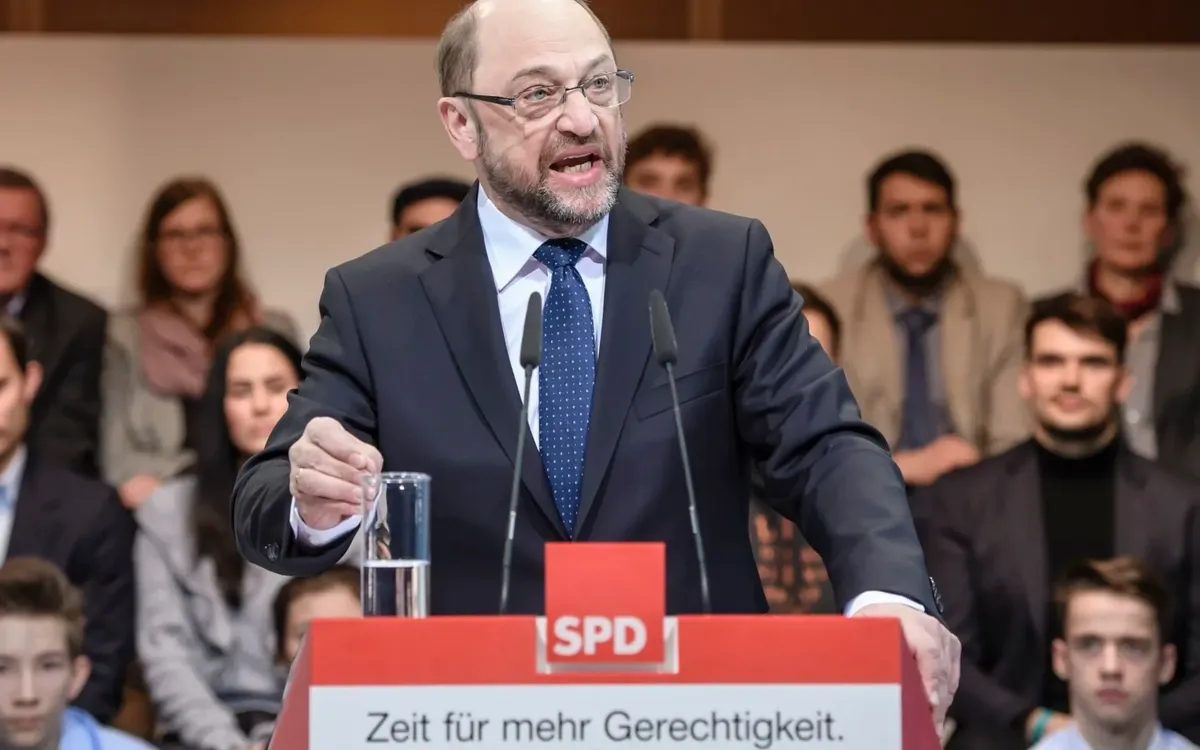
The main political parties of Germany began to prepare in advance for the upcoming Bundestag elections in September: they held congresses, clarified the program provisions, and most importantly, they decided the question of which of the leading functionaries should become the party of the party in the election campaign. Only the Social Democrats kept an intriguing pause, promising to inform the name of their candidate at the end of January.
The surprise was a success. Last week, Vice Chancellor Sigmar Gabriel announced that he was leaving the post of head of the SDPG, yielding to him, as well as the right to run from the party to the Chancellors, the ex-chairman of the European Parliament Martin Schultsu. He himself decided to change the Ministry of Economics to the Foreign Ministry instead of the President of the Federal Republic of Germany Frank-Walter Steinmeier.
The castling in the leadership of the Social Democrats only at first glance seems sensational. The oldest political party in Germany, leading its history since 1869, has long been experiencing a deep systemic crisis. Recently, the SDPG rating has dropped below 20%, since the beginning of the zero years it has lost almost half of its voters, and the party membership is steadily reduced.
An alternative threat
The role of the younger partner in the black-red coalition with the CDU/CSS further strengthened the negative trend in the SDPG position. The party, which once considered the people and more than once successfully disputed the palm of the championship among Christian democrats, is now inferior to its position not only “green” and left -handed, but also to the right -winging populists from the “alternative to Germany” (AFD).
This was most clearly manifested in the series of recent elections to land parliaments. In some places, the losses of the Social Democrats, exceeding the 10 percent line, pushed them to the third or fourth lines in political popularity. Even the victories in the elections in Mecklenburg - the passing of Pomerania and Berlin cannot be called the reason for the celebration, since the SDPG did not read from 5 to 7% of its basic voters who replenished the ranks of AFD supporters.
The nature of the current election campaign in Germany is largely determined by the migration crisis and its consequences. The millionth influx of refugees led to the split of German society, causing an increase in nationalist sentiments in its certain part.
The ruling political forces did not immediately recognize the scale of the threat. But even when the criticism of the migration policy Angel Merkel intensified in the ranks of the HDS/CSS, the leader of the SDPG Sigmar Gabriel continued to unconditionally support the Chancellor. Moreover, he in a television interview, showing excessive emotionality, negatively responded about those compatriots who protested against migrants, blocked buses with refugees and attacked shelters.
Gabriel’s belated attempt to distance himself from the migration policy of the Chancellor was regarded as the tactical maneuver of the SDPG in anticipation of the electoral year. In addition, in time she coincided with the desire of the Minister of Economics to achieve the allocation of an additional 5 billion euros from the state budget for integration projects in relation to refugees.
In this regard, one of the German political scientists, noting the absence of the leadership of the Social Democrats of his own strategic line on the migration problem, figuratively compared the vice-chancellor with an empty coat suspended on the street, which is swinging in the wind.
Turned away from the ground?
The SDPG has matured that Gabriel needs urgent replacement. And she was found.
From the moment when the chairman of the European Parliament Martin Schulz in November 2016 announced his return to German politics, it was clear that it was unlikely that Mr. Europe (with such a nickname Schulz awarded the press) would be able to be content with a secondary role.
The bright speaker and acute polemicist Schulz over two decades of career in the field of European parliamentarism have gone from a deputy to the chairman. However, he never hid the unsightly facts of his biography.
Schulz could not finish the gymnasium due to poor behavior. In his youth, he was addicted to alcohol, in the immoderate consumption of which, in his own expression, "was like a pork stomach." However, he found the strength to stop in time and at the age of 31 became the youngest burgomaster in the hometown of Wurzelen (Earth North Rhine-Westphalia).
Since 1994, Schulz is a deputy of the European Parliament, and in 2012 he was first elected his chairman. In this post, he made maximum efforts to turn a motley deputy meeting into an effective EU legislative body. He advocated the transfer of part of the functions of national governments to maintain the European Commission. A convinced supporter of European integration Schulz has repeatedly sharply criticized East European EU members for refusing to participate in a quota to distribute migrants and the construction of border fences.
However, these qualities of a European scale, according to German analysts, are easily turned into minuses at the national level of a candidate for federal chancellors. They also believe that Schulz is not well familiar with all the nuances of the German domestic political cuisine, and one enthusiasm is not enough to achieve success in the elections.
Add pepper
In the ranks of the CDU, the news from coalition partners was appreciated with restraint. The leading Christian democrats doubt that in the time that remains before the election the new leader of the SDP, it will be possible to radically turn around the situation and really claim a decisive victory. Of course, the emotionally restrained Merkel is inferior to the charismatic shults in communicating with the public, but the stability of the political course and many years of managerial experience play on its side.
In addition, Schulz will be seriously limited to the ability to lead on an equal footing with his main rival. Even officially becoming the head of the SDPG, he will not be entered into the Bundestag, whose tribune is usually actively used in the election struggle. He will not have direct access to government meetings in order to quickly receive information necessary for selective tactics. Although the latter can be considered an advantage, since Schulz, not bound by government subordination, receives the right to freely criticize the Chancellor's policy.
In general, the permutations in the SDPG were positively perceived by public opinion. According to the first polls, the party immediately added 3% to its ranking, and its candidate for chancellors in the sympathies of voters was equal to Merkel. Social democrats, German observers believe, managed to add pepper to their election campaign-with the participation of Martin Schulz, she promises to be not boring.