
Translated material
Hollywood and stars
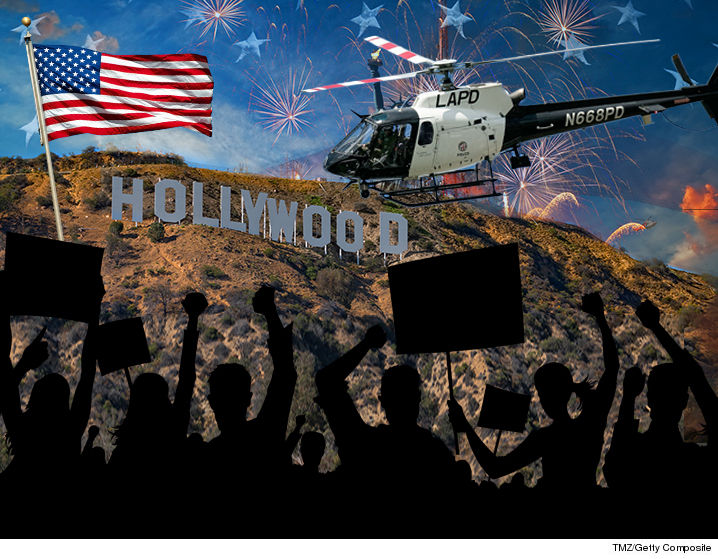
Alexander Genis: The comedian of New Yorker magazine Andy Borovits, who accompanied the whole campaign with his malicious comments, wrote on the eve of the inauguration that not only Hollywood stars, but also the Karaoke system refused to participate in a festive concert ...
The historical report of Vladimir Abarinov tells about the relationship between Hollywood and the authorities.
Vladimir Abarinov: Many in Russia were surprised by the civic activism of Hollywood stars. The Russian public-probably by analogy with the domestic sofas of show business-is used to considering them glamorous creatures and political conformists. There are such, but they do not make up the color and pride of Hollywood.
I must say that back in the 1940s, American film actors were forbidden to participate in political campaigns-this was one of the conditions for their contract with the studio. To evaluate all the drama of this situation, it is worth recalling the 1940 Oscars. The prize for the best female role was then, for the first time in the history of American cinema, African American Hatti McDaniel, who played the role of Nannish-Rabin in the film by Victor Fleming, “Safeed by the Wind”. She went out of the far corner of the hall to receive the award. She sat separately from the rest of the film crew, and it was still a gracious concession, because the Los Angeles Hotel “Ambassador”, where the ceremony was held, did not allow African Americanists to his walls. Laureate is represented by actress Fei Bainter. The second -plan actors were then awarded as a prize not a figurine, but a bronze gilded plate.
Fei Bainter: I am especially happy that I was chosen to present this particular plate. It seems to me something more than just a piece of gold. She opens the door to this hall, pushes the walls and gives us the opportunity to hug the whole of America - America, which we love it, America, which almost the only one in the world recognizes the merits today and pays tribute to those who give it the best that has, regardless of its faith, race or skin color. Aware of this, the whole nation will stand up and the presentation of this plate will be welcomed, this award of the American Academy for the Lawing Women's Room in 1939, Hatti Daniel.
Hatty Daniel: Academy of Cinematographic Arts and Sciences, my colleagues in the film industry and dear guests! This is one of the happiest moments of my life, and I want to thank each of you, those who chose me to reward this award for your kindness. I accept it with great humility. She will always be my guiding star in everything that is destined for me to do in the future. I sincerely hope that I will always be useful to my race and film industry. My heart is crowded, I just can’t express everything that I feel, I can just say thank you, and may the Lord bless you.
Vladimir Abarinov: During the Second World War, Charlie Chaplin did not hide his sympathy for the Soviet Union, talked with Soviet diplomats and attended techniques in the Soviet General Consulate in Los Angeles. After the war, he was remembered. Especially the American right -winged, Chaplin's film “Monsieur Verdu” - about a serial killer who pushes capitalism pushes for crimes. The cinemas stood pickets, the film was required to be banned, and its author is expelled from America. Chaplin received a summons from the Congress committee to investigate anti -American activities. The interrogation was postponed several times - usually this meant that no evidence of subversive activity was found. In the end, in April 1947, Chaplin convened a press conference in New York.
Charlie Chaplin: Thank you, ladies and gentlemen, journalists. I will not lose your time. Start your reprisal.
- You can directly answer the question: you are a communist ...?
Charlie Chaplin: I am not a communist.
- Communist sympathizant, I wanted to ask.
Charlie Chaplin: Communist sympathizant? These words need definition. I do not know what you mean by the expression "communist sympathizant." During the war, I sympathized with Russia because I was sure that it holds the front. I remember this and grateful to her for that.
Vladimir Abarinov: Chaplin never waited for interrogation. In 1952, he went to the UK for the premiere of his film “Ramfa Lights” and was deprived of the right to enter the United States as an unreliable foreigner. He returned to America only after 20 years, to give him an Oscar for an outstanding contribution to cinema.
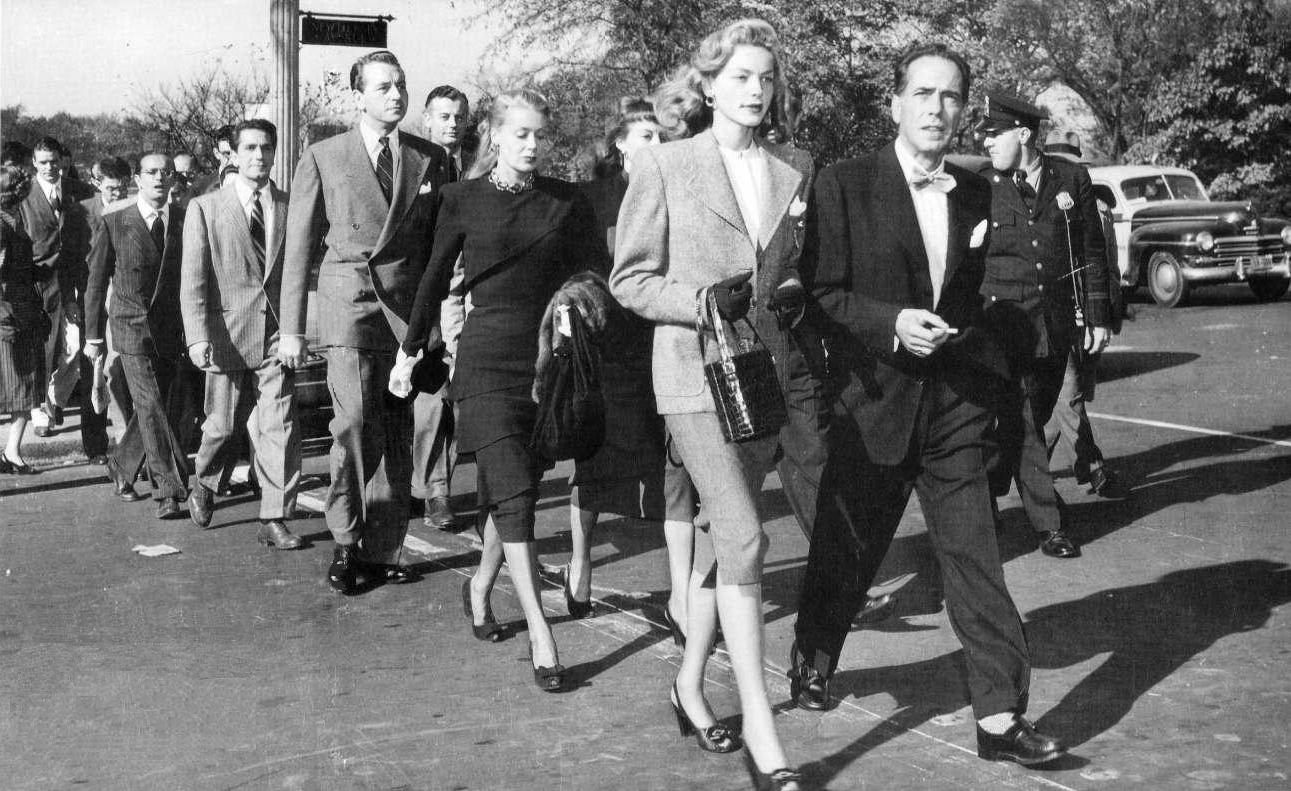
In the 1960s, the legal status of actors changed thanks to the general atmosphere in society, antitrust laws and the successes of trade unions. Many of them began to take part in political actions and election campaigns. So, for example, Harry Belafonte raised funds to the organization of the organization of Martin Luther King, participated in election campaigns. Here is his video in support of John Kennedy.
Harry Belafonte: Hello. My name is Harry Belafonte. I am an artist, I'm not a politician. But as most Americans, I am very interested in the political and economic fate of my country. Senator John Kennedy sits next to me. I have a lot of questions for him, as I am sure, and each of you - about civil rights, about foreign policy, about the economy and what will happen to the country.
John Kennedy: And I want to declare with certainty, Harry, that in all issues regarding civil rights, minimal salary, housing construction, improved working conditions, I stand for equal opportunities for all Americans. For them stood the Democratic Party of Franklin Roosevelt.
Harry Belafonte: I vote for the senator. And you?
Announcer: Vote for a leader the same as Roosevelt. Choose President John Kennedy.
Vladimir Abarinov: In 1973, the Academy Award for the best male role was awarded to Marlon Brando for the “godfather”. But instead of him, a girl in an Indian suit rose to the podium. It was the young actress Maria-Luis Cruz, an Indian’s father, who took the Indian name Sashin Pershko. Shortly before the ceremony, the armed clash of the Lakot tribe with troops in the village of Wunded-ni in South Dakota ended. Sashin refused to accept the figurine extended to her by Michael Murom, and said the following.
Sashin Person: Hello. My name is Sashin Person. I am from the Apachi tribe and I am the president of the National Committee for a positive image of indigenous Americans. Today I represent Malon Brando here. He asked me to read a very long speech, but I can’t do it because of a lack of time. However, I will be glad to give the press its text, the meaning of which is that he, unfortunately, cannot accept this generous reward. The reasons are how American Indians are portrayed in the cinema and on television, which shows these films, as well as in recent events in Wunded-no. I dare to hope that I have not spoiled the evening to you and that in the future our hearts and our mutual understanding will allow us to show mutual love and generosity. Thanks on behalf of Marlon Brando.
Vladimir Abarinov: In 1972, President Richard Nixon was re -elected for a second term. Even during his first presidential campaign, he promised to end the war in Vietnam. But the war continued. On January 19, 1973, on the eve of the inauguration, the entire Washington Bomond, led by the president and the first lady, was present at the inaugural concert at the John Kennedy performing art center. The Philadelphia Symphony Orchestra, led by Eugene Ormandi and, with the participation of Van Klibern, performed Nixon's favorite work - Tchaikovsky’s overture “1812”.
At the same time, another concert was held in the Washington National Cathedral. He was conceived and organized by the rector of the Cathedral Francis Seyr and the great American composer and conductor Leonard Bernstine - both active opponents of the Vietnamese War. For this concert, Bernstein chose the work of Haydn "Messa of the War". It was written and first filled in 1796, when Napoleon’s troops invaded Austria.
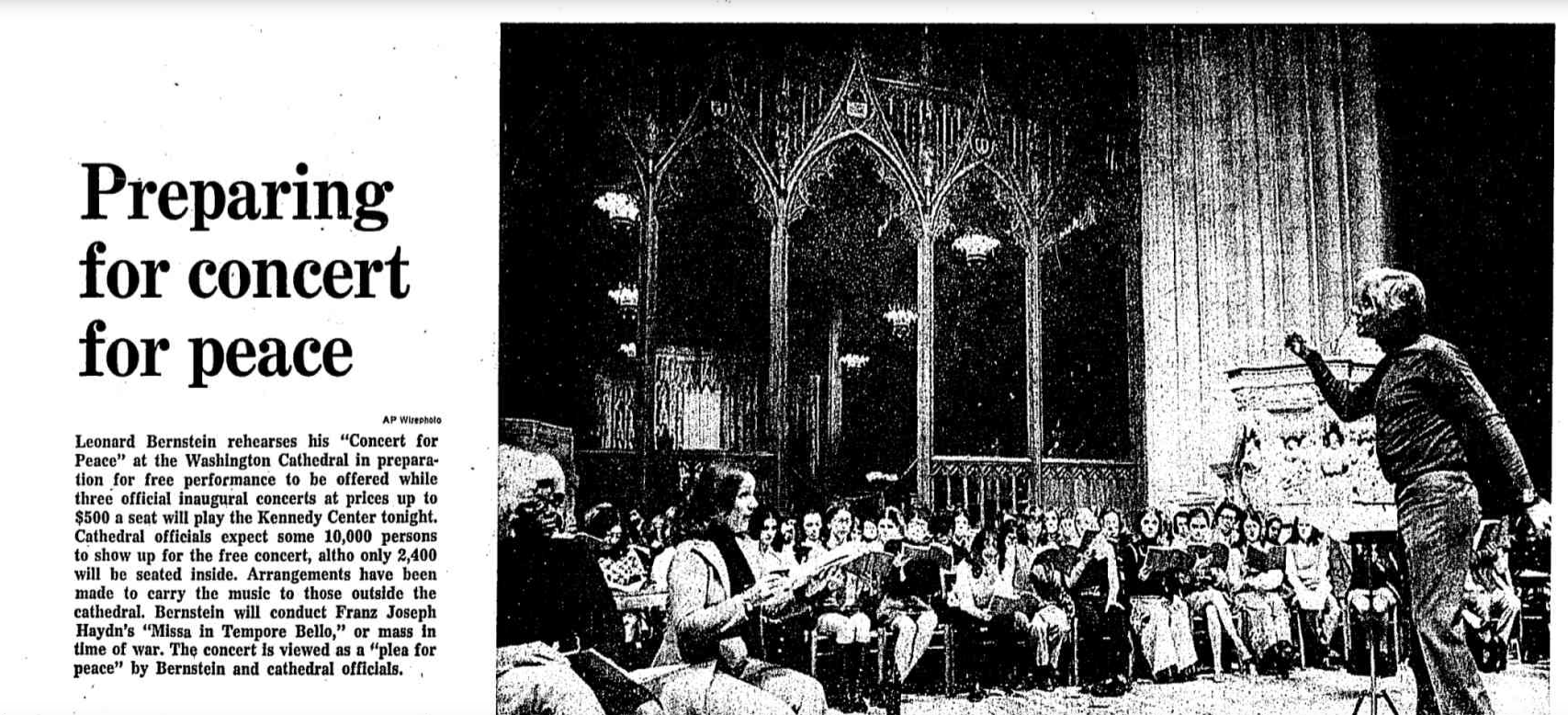
The orchestra and the choir at Bernstine were prefabricated. The performers did not receive any fee for their work. The entrance to the cathedral was free, but there were only 3,000 seats in the hall. Another 12 thousand people listened to a concert on the street, under the pouring rain. Here is an excerpt from the third part of this mass - “Credo”. Conductor Leonard Burnstein, move and orchestra of Bavarian radio.
Vladimir Abarinov: I think it is unlikely that anyone will argue with the fact that the concert on the occasion of the inauguration of Donald Trump was a miserable sight. His only participant, known to all of America, was actor John Voit. Once in his youth, Voit adhered to liberal views, was an activist of anti -war movement, starred in my two favorite films - “Midnight Cowboy” and “Returning Home” - films without which America would be different today. Well, then Voit repented of the mistakes of his youth, stated that he had become a victim of Marxist propaganda and now he went to the microphone at the concert in honor of the victory of Donald Trump. During his speech, he pointed with his hand to the statue of the seated Abraham Lincoln, at the foot of which the stage was built.
John Voit: We were all witnesses to one and a half very exhausting for the chosen president of the years. We witnessed propaganda, from which it took a spirit, and we wondered if the Lord would hinder this stream of negative lies, directed against Mr. Trump, whose only desire to make America great again. Of course, he did not need employment. And the Lord heard our prayers, because it happened, and we will all go into history. And President Lincoln, who is sitting with us now, I am sure, smiles, knowing that America will be saved by an honest and good person who will work for the sake of the whole people, regardless of his faith and skin color.
Vladimir Abarinov: John Voit was lonely on this stage. But not alone were his colleagues, the color and beauty of Hollywood-actresses who went on January 21 on the march of women in Washington and Los Angeles. The best, for my taste, was Ashley Jadd. She read the poem of a 19-year-old student from Nashville, Tennessee, Nina Donovan. The poem is called the "vile woman." So Donald Trump called Hillary Clinton during the television. The poem is long. I translated two passages from it to the best of my weak forces.
Ashley Jadd: I am a vile woman. I am as vile as a man who looks like a panel was panicked, a man who confuses America. The language of enmity poisoned the national anthem (...) I am not as vile as the swastika, which will be repaired by the rainbow of gays. I don’t know if the devil will rise, but I feel Hitler on these streets. Instead of a mustache, he now has a kok (...) I am not as vile as racism, deception, conflict of interests, homophobia, sexual violence, male chauvinism, ignorance ... Yes, I am a vile woman - a noisy, vulgar, proud woman!
Vladimir Abarinov: It is possible that the president will call Ashley Jadd a strongly overvalued actress, as he called Maryl Streep. But this will be his personal opinion.