
Translated material
Drunk countdown
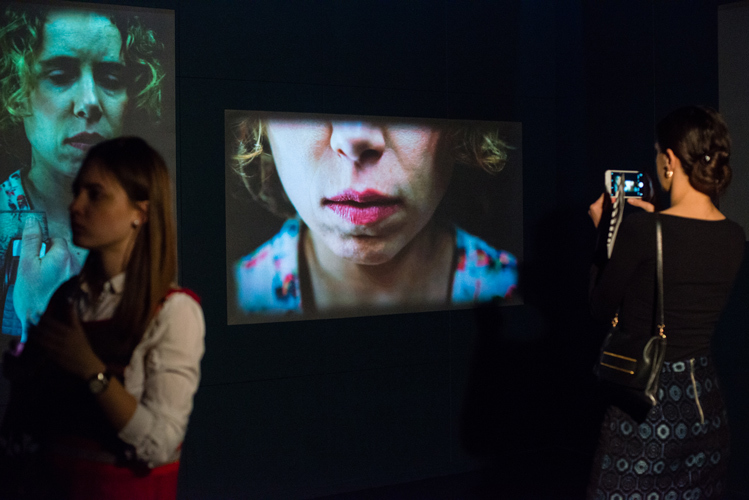
The second anniversary of the opening of the Stanislavsky Electric Theater celebrated the vernissage of the exhibition of the outstanding British director Katie Mitchell Five Truths . The installation created in 2011 for the British Museum of Victoria and Albert and already represented in London, Paris, Vienna, Washington and Amsterdam, Lilia Shitenburg.
On ten screens, the video shows a scene of the insanity of Shakespeare's Ophelia: “Ah, he died, mistress, he is cold ashes, // Green turf in his head, a pebble in his legs ...” Ophelia experiences the death of his father, Ophelia sings his song, Ophelia is drowning. Five times. In five different versions created by Katie Mitchell in the manners of the great directors-reformers: Konstantin Stanislavsky, Antonen Arto, Bertolt Brecht, Peter Brook and Hedgehog Grotovsky.
What does this really mean: to embody the style and method of a recognized genius of directing on the screen? The question immediately arises: Stanislavsky, Brook, Grotovsky - which? What period, caught at what moment of their endless searches? What to do with those who rarely stood still, ruthlessly denying their own ideas, striving for always elusive truth? "Five Truths"? For each of these five such truths - found and polemically rejected - there are much more. Katie Mitchell had four shooting days: someone really expects that actress Michelle Terry (very good, Laureate of the 2011 Lawrence Prize for the role of the second plan) will fully comprehend and master five different methods of acting, becoming in a couple of minutes by Moskvin, then Scofild, then Ryshard Cheslyak? "Lord, we know who we are, but we do not know who we can become!" - said Shakespeare's Ophelia translated by Lozinsky.
Katie Mitchell is an experienced, serious and conscientious director. This means that she has accumulated questions. It is precisely these questions - her own - she asks the great shadows and the now resilient Brook.
And the next question: how to avoid an involuntary parody, do not succumb to the temptation to illustrate the most general, common and superficial ideas about the Great Heritage, not to turn the experiment into a theatrical joke, even entertaining and filled with respect? To calm the eternal cricket behind the scenes in imitation of Stanislavsky, to rid the art from the overly simple-minded loud happy happy details, to hear in Brecht something except the march and the fragmentary recitation, to find something in addition to esoteric meaningfulness in Grotovsky ... In general, all this is decisively impossible, there is nothing to try.
Katie Mitchell makes the only possible move. She does not pretend that in ten minutes (about the same way, each of the Ophelia dies) will give the quintessence of the legendary directorial method. He does not seek to argue with inevitable parody details (in the end, there are very real reasons that hated by the snobs of “common performances”). Katie Mitchell is an experienced, serious and conscientious director. This means that she has accumulated questions. It is precisely these questions - her own - she asks the great shadows and the now resilient Brook. And what we see on the screens are the answers received in this professional dialogue. If all this is partly and a parody, then Parodia Sacra , a sacred parody, in which, as Grotovsky wrote, "the viewer re-finds his personal truth in the truth of the myth." In an interview with almost twenty years ago, Katie Mitchell said that she did not understand why there was a play “Hamlet”, but there is no play “Ophelia” . The fact that the classics answer Mitchell specifically to questions about Ophelia - this is where the "personal truth in the truth of the myth" begins.
 © Electrotheater Stanislavsky
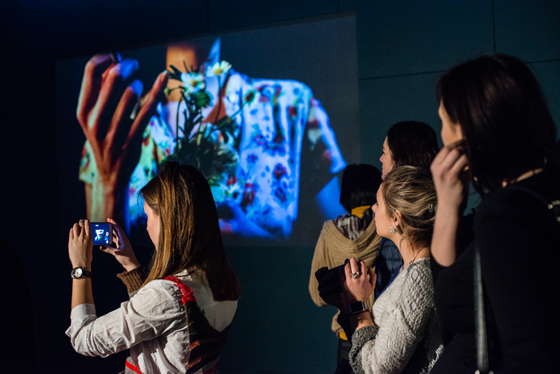
Suppose you began to watch from Stanislavsky. Ophelia “according to Stanislavsky”, strictly obeying the memory of physical actions, one by one sorting out objects extracted from a plastic package - that which remains of the late father. Daddy's wallet. Watch. Glasses. Keys. Some kind of trifle. Ophelia smokes slowly, her inner silent monologue does not interfere with the twitter of birds in the distance (the cricket is silent). Finally, she takes out a crumpled scarf with a spot of blood from the bag. Puts aside. The gesture from the subject to the flower, standing right on the table, will live and survive to the end. (Of course, in every passage, Mitchell plays with angles and largerness. In the Stanislavsky, we see all the plots of violets and margaritians in detail.) The Ophelia song ( “He is Dead and Gone, Lady, // He is Dead and Gone ...” is born as a result of a condensed internal solution: Death: Death: Death: Death: Death Inhuman, cold, disgustingly stingy - let the one who left will have a few flowers. We must do everything right, you have to sing. The subtext is exceptionally intelligible, in each microscopic turn of action up to immersion in the water, the main thing is the front portrait on the close -up, the harmony of natural balance.
In Bruck (as in other scenes), a set of objects will remain unchanged. The loud ticking of the watch in silence will replace birds - but not only this will not allow you to confuse the truth of the new Ophelia with the "simplicity and naturalness" of the heroine in Stanislavsky. Each word of this heroine is a word arising from silence, against the background of a distinct time, and each plan with a battle plays a piece of illuminated flesh at complete darkness. This is Brooke of the times of Shakespeare-in-Bockete. But not only. In the Mitchell version, this is also a directing of large metaphors, symbolic gestures and cultural quotes: Ophelia collects a bouquet, solemnly pulls it off the father’s watches and plunges into the water, freezing in the classical perspective of “Ophelia” by John Mille.
 © Electrotheater Stanislavsky
The audience of the exhibition will undoubtedly be flattered by the ease with which they will learn Brecht. Ophelia fixes a hard demanding look from the screen, supplies her with an apartment “She said” and, having painted her cheeks and lips of the brighter, turns his constant “He is Dead and Gone” into a jerky, desperate zong. It begins the fact that it begins to master objects “according to the Brecht” with a businesslike recess of money in her father’s wallet (shifting the inheritance into her own wallet) seems to be a witty “Marxist” joke. But in this scene there is also a “Magnit more fashionable”: Michelle Terry, in addition to the mean replicas of Ophelia, is also pronounced by a monologue of Gertrude (“There is a willow above the stream ...”), embodying the idea of finding through the already existing Shakespearean story in the third person.
The cricket is silent.
Finding the key to Grotovsky, not devoting all his life to this, seems to be a perfect utopia. Let us recall one of his ways to the truth: “Violation of the intimacy of a living organism, its disclosure, which has gone so far in physiological specifics and in internal impulses that it already overcomes the threshold of the excess, returns the situation of the myth of its universal human specificity, and becomes a comprehension of truth.” In ten minutes. But these are the conditions of the game. Mitchell begins this episode from the “heart of chaos”: the soil shooks, the table trembles, the formidable slurred rumble is heard, which is blocked only by the howl of Ophelia, which hut under the table and shuddering with the whole body. The high note taken and held by the actress is important here - reminding, as far as possible, the exceptional value of the vocal and plastic trainings in the practice of Grotovsky (as well as an attempt to find the desired pose so that the acting body is “entirely” is occupied by the creation of the image). But even more important - and more precisely - the chosen size of the plan: the actress’s face is close as possible, the pores on the skin are visible, so that the entire screen can occupy the eyelids and trembling lips that are swollen from tears. “The action should be literal, not symbolic”: his own favorite technique Katie Mitchell (using the video) here simultaneously sets the limit to perform the task (removing the viewer from the actor) and helps it solve it (due to the visual reliability of the image).
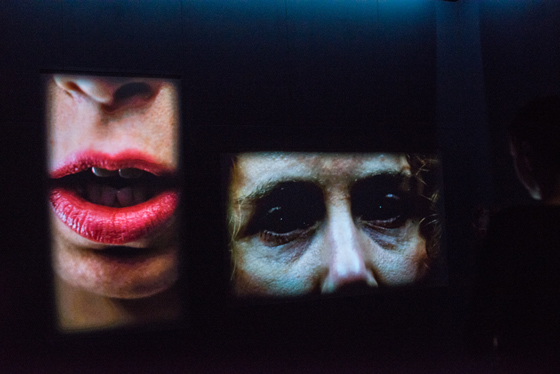
In the death of Ophelia “according to Arto”, perhaps, most valuable is that which is not there (in attempts to create a modern “theater of cruelty”, almost every step is fraught with profanity). His “He is Dead and Gone ...” Ophelia, gloomy and “indomitably decisive”, at first shouts silently, crumbling grimaces, tearing his mouth and frightening gold fish in the aquarium. The image floats, the heroine's face is distorted, as in a crooked mirror, the song stucks on a meaningless and fierce repetition of syllables - to the real total “plague” here, perhaps, far, but, of course, this theater is amazed at madness. You can take this episode of “five truths” simply as a strange one (Prince Hamlet advised in a similar situation), but you can recall, for example, that a mask with dead eyes and a shocked mouth is a favorite “starting position” in the facial performances of Karmelo Bene, whose deep connection with Arto cannot be denied.
 © Electrotheater Stanislavsky
Where “five truths” are announced, there is a sixth. The truth of Katie Mitchell herself, who entered into dialogue with the classics, is the directorial truth of her video interpretations. How would the heroes inspired her with the experience of new theatrical technologies relate to her? Brooke, who composed something like “medieval newsreels” back in 1945 at King John? Grotovsky, who found the introduction to the theater spectacle of movie screens and other mechanical tricks simply false? Brecht, always asking the question "Who says this?" - Cathei Mitchell in the practice of Katie Mitchell in the classic question “Who sees this?”? The potential infinity of the directorial dialogue is the main achievement of the installation in which all the “truths” exist synchronously. After all, not only Katie Mitchell asks questions and receives answers - but what is the tension of Brook’s conversation with Arto! Or Grotovsky with Stanislavsky! Bruka with Stanislavsky! What energies actually pierce the space between the screens glowing in the dark, on which Ophelia is drowning and drowning?!
The spectator who falls into the epicenter of this semantic field, freezing at one screen, wandering around, trying to cover the panorama, of course, “mounts” what is happening according to his own taste, intelligence and concentration. The dialogue of geniuses over the body of Ophelia is changing with every new witness. “Here is the appointment of a real witness,” wrote Jerzy Grotovsky. “Do not interfere with petty goals, with an obsessive demonstration of your“ I am too, ”but be a witness, that is, remember, remember at all costs and do not forget.”