
Translated material
Fear and hatred in Muscovy
Two weeks of the life of Ivan the Terrible from the author of the "Damn wheel"
Mikhail Gigolashvili. Secret year. M., AST, editorial office of Elena Shubina, 2017.Since Mikhail Gigolashvili in 2009, the romance of the Damn Wheel, telling about the cycle of drug trafficking in Georgia of the 90s and has become one of the main artistic texts of the decade, have definitely expected the topic from the emigrant writer. However, in 2012, the “capture of Muscovy” was released in 2012 - a linguoculturological experiment met with bewilderment, developing a canonical plot “Foreigner in Russia” (which, by the way, has a philologist Gigolashvili devoted a lot of literary articles): the young German Fredya, inspired and deceived by Russian literature, comes to the homeland of Dostoevsky and faces an unexpected reality; First of all, the language ... Now, after the release of the new novel, the work on which Gigolashvili devoted the next four years, it became clear that the “capture of Muscovy” marked the transition period and the search for form. Fredya, who in Russia had to encounter the others with Colonel Maisuradze from the Damn Wheel, was a descendant of Henry von Staden, a mercenary who lived 12 years in Rus', who served as an oprichnik with Ivan the Terrible and went down in history thanks to the memories known as the “Notes of Muscovy”. Part of the text of the “capture of Muscovy” reproduces these notes, encouraging the reader to compare Russia at the turn of the XX-XXI centuries with Russia of the 16th century. In the novel “Secret Year”, Staden himself rumbles with armor and recruits mercenaries from the German settlement. And in the center of events - John Vasilievich himself.
The action of the “secret year” covers two weeks of autumn of 1575, when the Moscow king left the throne on the baptized Tatar Simeon Bekbulatovich and retired with his family and archers to his estate Aleksandrovka, however, continuing to engage in the most important state affairs. What caused such a decision of Grozny, historians are not known for certain, although it is assumed that he was going to demonstrate to the boyars and clergy: there may be worse options on the throne. In the novel of Gigolashvili, politics is present on a par with a spiritual, mystical plot: in Aleksandrovka, the king gives the vow not to shed more blood and prays a lot: “Teach how to live! You see - I am lonely, as a fish in the depths! There is no one except you, to enlighten and reassure! Only you can indicate the road! My vile life is overshadowed by your silence, Lord! ”
Each chapter of the novel describes a day from the life of the Grand Duke of All Rus'. It begins with a dream (as a rule, prophetic), continues to take visitors and opium, solving urgent issues or planning the future, and ends in a print, where the servants of Proshka and Oniska make a painting of the people of the sovereign (guardsmen who need to be caught) and the synodik of the disgraced tsar (victims for which the monasteries should serve prayers, which hopes to save the soul). If it occurred to you that the “secret year” recalls the “Oprichnik Day” by Vladimir Sorokin - Hurray or alas, this is not so. Rather, the “laurel” of Evgeny Vodolazkin, and even then just a little.
Among the actors of the novel are historical and fictional characters. Real events are mixed with bikes and legends. In the letters dictated by the king, well -known quotes from the true correspondence of Ivan the Terrible are guessed. For example, the threatening messages to the Crimean khan Davllet-Girey or a wonderful letter to the English Queen Elizabeth I, in which the Russian king expresses a suspicion that Elizabeth is not the sovereign, ruling his country, but the “simple girl”, which is influenced by trading men (so formidizes the need for the queen to consult with parliament). Other historical documents pop up: notes of the Roman ambassador Daniel, who is also present in the novel, or a German engraving depicting formidable in the bestial form in the midst of numerous executions and torture (today this engraving is popular on “patriotic” sites with signatures like “Information War against Russia” from the 16th century ”). However, of course, the “secret year” is a historical, but not documentary novel. Between the memories of childhood, the dashing years of Oprishn and thoughts about pressing political problems, a detective-mystical plot glistens. The king every now and then is the "satanic signs", frightening him and clearly prompting to leave the power. However, it is worth warning the reader that this component is not felt right away, so you should not wait for a full historical detective either.
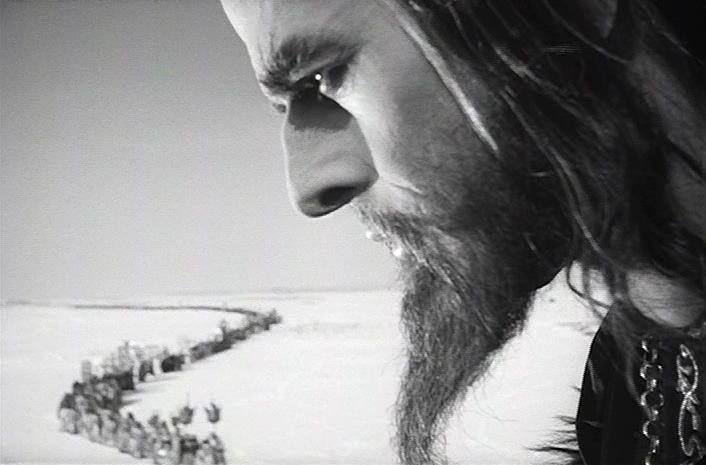
Frame from the film "Ivan the Terrible." Director Sergei Eisenstein, 1944
Grozny himself in the version of Gigolashvili-a man-hand. It will be appropriate to recall the words that Soviet officials criticized the second series of the film “Ivan the Terrible” by Sergei Eisenstein, which was not released to the death of Stalin: “... and Ivan the Terrible, a man with a strong will and character [the director presented]-weak-lecharacter and limp, something like Hamlet.” In the “Secret Year”, Grozny also appears to be a kind of Hamlet, constantly trying to decide-to be or rather, more precisely, to be an enlightened monarch, opening schools and workshops, or king-rover, “saving fear” their unreasonable people; stay on the throne or escape for the seas; Take care of the power or the soul, which is already clearly prepared for the place in hell. The king in the novel is a frightened and lonely old man, which flows into childhood or mortal horror. In one of the episodes, he is most similar to his image in the famous picture of Repin: “So the old thin man was sitting in beds - the beard is clocked, his eyes are inflamed, the skull shines into sweat - and looked at the candle at the candle, and the candle suddenly began to twitch and went out, as if exhausted under his stopy gaze.”
Roman Gigolashvili can be read as an apocryphal portrait of one of the most mysterious Russian monarchs, or it is possible - as an annoyingly accurate portrait of the damn wheel of Russian history, written with such passionate painstaking (let the specialists catch historical inaccuracies), which causes respect and even gratitude. At the same time, it must be admitted that 729 pages, to put it mildly, do not fly quietly: endless scenes of dressing the king, his meal, laying on the bed and looking at the sores the farther, the more they seem excessive. The detective plot does not hold all the events of the novel on a stretched leash. The clear structure, which is packed in a rich set of historical jokes and hoaxes - legends about bloody oprichniki, the nuances of the royal genealogy and reports of the achievements of science and technology in Europe (maybe slightly exaggerated due to the natural Westernity of the author living in Germany), suggests a long reading, familiar to the reader of the same 16th century than today's.
The fact that Russia has not changed dramatically over the past 500 years, Gigolashvili spoke in an interview after the release of the “capture of Muscovy”, and here he convincingly proves his pessimistic point of view at the Stayer distance. Attempts by Ivan the Terrible to suppress bribery, fornication and foliage constantly stumble upon a misunderstanding of others and royal personal impatience. Long conversations with ambassadors, foreign mercenaries, the confessor, the confessor Misail Sukin and the squire of Roda about how it would be good, following the example of the Fryags, open universities, banks, glass -shower and time workshops, end with another theft or stupidity, which removes the king and returning to the idea that the “little people” he got nothing good, and therefore even this bog did not Blood has to be observed with Jesuit resourcefulness. The treasury is empty, the Tatars demand a tribute, the Roman dad urges the prince of all Rus' to accept the Latin faith, Elizabeth I does not agree to become an Ivanova wife, the priests eat from gold and silver, the merchants of Stroganov with the Cossacks either replenish the treasury, mastering the newly found oil in Siberia, or the enemies and the epochs are more and more rich in all sides - and the epoch Enlightenments are postponed every day for an indefinite time.
Although, as we know, Ivan the Terrible really opened schools and even managed to create something like a conservatory, but all these undertakings stalled with his death. But the consequences of wars and oprichnins have been preserved for a long time. The question of whether all this was worth an increase in the territory of Rus' to unprecedented sizes seems so familiar that it was even awkward to speak out loud. Yes, by the way, about whether Tavrida needs to conquer, Grozny also regularly thinks. As a result, it has to be recognized that inside the unknown trend on historical novels, with the help of which Russian -speaking writers continue to dig mainly the XX century, the age of XVI looks relevant to horror. And to howl here out of habit “how much can you?!”, But in response you will hear only the creak of the same damn wheel - as they ordered.