
Translated material
Holly Golitley - not Russian
To the history of Trumen Capote Visits in the USSR
Last week, an article was published in the Afisha about the journey of the American writer Truman Capote to the USSR - in it, in particular, it was argued that the Soviet girl could become the prototype of Holly Golitley. The editorial office of Gorky was addressed by the American philologist and translator Dmitry Kharitonov, who in the return article proving that such a development of events was absolutely impossible. Gorky is happy to provide a polemic site.I
The reason for this publication was the appearance of Denis Zakharov’s text on the website of the “posters” of the text of the Holly Golitli-Russian?: With whom Truman Capote met in the USSR ”dedicated to the light of documentary prose“ Ghosts in the Sunny Sveta ”(“ Azbuka ”, ABC-Atticus, 2017). The text is devoted to a curious episode from the writer’s biography, contains a number of inaccuracies and one consideration, which should be said a few words, since it is as sensational as, alas, doubtful.
Doubt causes the very beginning of this text: “Sixty years ago, Truman Capote visited Moscow. Few of the Americans know about this. Even fewer people in Russia are generally understood who is about. ” We do not undertake to calculate how many Americans know about this, but suppose that there are still not very few, given that the hood is a classic of American literature and literary journalism. In Russia, people who understand who such a hood should also be decent: his prose has been published and reprinted with us since 1963, almost everything that he wrote, and the appearance of “ghosts ...” is not an impressive surprise, but evidence of non -reprising interest. Another thing is that the reader's interest in this case surpasses the research, and from the point of view of Russian philology, the Capote's work seems to be surrounded by a boorish void in which each sound spreads far and surrendered echoing. That is why some probability that Denis Zakharov’s assumption will seduce another gullible reader still exists, and the temptation to follow the humane proverb “Don’t be any - do not listen, but don’t bother”. ”We will have to overcome.
We already had the opportunity to speculate on the visits of the hood in the USSR in the 1950s and the mysterious unwritten manuscript (the theme of Denis Zakharov’s text) in the transfer “on top of the barriers” (“American hour”) on Radio “Freedom” a few months ago ( part 1 , part 2 ), so we limit ourselves to a brief notation of this story.
At the end of 1955, Kapota ended up in the USSR along with the troupe that performed the opera Porgie and Bess. Denis Zakharov mysteriously defines this visit as "the first cultural exchange between the United States and the Soviet Union, which paid the USSR Ministry of Culture." Probably, these words should be understood literally (“the first exchange paid by the ministry”, and not “the first, moreover paid by the ministry”), but just in case, we recall that the members of the troupe were by no means the first Americans who visited the Soviet Union, and besides the Ministry of Culture, there were such institutions as the Commission on External Relations of the All -Union Central Council of Trade Unions, the Comintern Agitation and Propaganda Commission, the Intourist and the Foreign Commission and the Foreign Commission Union of Writers of the USSR. “Porgi and Bess” is characterized by Denis Zakharov as “Opera about the oppressed people crushed by capitalism”, which “answered the aspirations of the Central Committee, proclaiming the progressiveness of the Soviet system”. Above this characteristic, it is worthwhile to lower the veil of mercy with the words: "This is not entirely true."
Kapota wrote about the trip the essay “Muse is heard”, printed in 1956 in the New Yorker magazine, and then published by a separate publication (in Russian this essay was published in 2007 in 2007 in the journal “Banner” (No. 5–6), and not “only now” in the aforementioned collection, as Denis Zakharov believes). Then Kapota entered the closed circle of golden youth, in the center of it was a certain Anna Kogan (pseudonym), called by Denis Zakharov the daughter of a “specialist in aeronautics”. The participants in this circle shocked the writer with the discretion with Soviet citizens, about whom he managed to draw up a certain idea (which will be discussed in the second part of our publication). As a result, another outline for the New Yorker was supposed to be a different essay under the title “The Daughter of the Russian Revolution”. Kapota went to the Soviet Union twice, wrote several pages and abandoned this venture.
The pages of the “daughter ...” are few, but very interesting (for the decoding of the sophisticated handwriting of the hood, I am grateful to my wife, Maria Mitlin), in particular, thanks to the image of Anna Kogan, in which Denis Zakharov guesses the possible prototype of the heroine of “Breakfast at Tiffany”: “Capota] met a group of children of the Soviet elite. <...> He meets with the metropolitan bohemia, hangs with her in the Grand Hotel restaurant, who was located at the Moscow Hotel, walks along Gorky Street, goes home and directly at the National Hotel makes the first sketches of the future essay ... It is likely that some features of the main character Holly Golitli were inspired by meetings with the Soviet girl. Bohemian mug ... "
Let's start with a bohemian circle, which cannot be called bohemian, because children, relatively speaking, marshals and ministers (and the core of this circle seems to have a public just such a fraud: “The offspring of the most high -ranking Soviet elite,” writes Kapota) - this is not a bohemian, no matter what lifestyle they tremble. The words “hanging out with the metropolitan bohemia in the“ Grand-Hotel ”are suggested about the brilliant crowded fuss, while the hood says that the company (the same, not bohemian) was about to have dinner in this restaurant in honor of the birthday of one of the girls. (The table was ordered for twelve hours, and before they gathered at the Bolshoi Theater on the Swan Lake with Plisetskaya. Tickets were again bought.)
The hypothesis of the Russian literary origin of Holly Golitley, which is also attractive, and most importantly, clearly claims to be a literary discovery. That is why it requires especially careful argumentation and contextualization, because the idea that Holly could have a prototype, to put it mildly, is not new. But the reader, rightly intrigued by the semi -atric issue in the title of the text of Denis Zakharov, remains with nothing.
It is not clear why Denis Zakharov believes that "the American writer was preserving his famous story in the Moscow -Leningrad train." It sounds, of course, effectively, besides, Holly brings closer to Anna (you immediately think that Kapota, having talked with the majors, immediately took up the pen), but only on the Moscow -Leningrad train the American writer rode at the beginning of 1958 (moreover, not one, but with his American girlfriend; they gathered in Denmark), and he had already completed the famous story in America (in any case, in America (in any case, in America, in America, in America (in any case, in America (at all. Marta David Atti photographed Kapota in Brooklyn). We immediately note that the plan of the story was ripe at the hood in the summer of 1955, and he later called Holly his favorite character. The second is essential because they usually do not give the favorite characters whose features are not given, and Anna Kogan Capote characterizes as a person, in essence, ordinary, more precisely - outstanding only on a dull Soviet background. He does not refuse her originality, but this is the originality of the second, or something, varieties. Because Anna is described by miraculous prose, she is neither talented, nor, in general, more interesting: “There was a kind of poetry in it, but there were no poems.” In New York and in any European capital, he writes Kapota, its doubles, the role of which is to “saturate the atmosphere”, meet every day: “In the Parisian feast, Anna Kogan would be considered very pleasant, albeit unlucky appendage.”
Hinting at the resemblance between Holly and Anna, Denis Zakharov does not say what this similarity manifests itself (although, it would seem, what happened if the hood, as if like a secret agent, made a “detailed description of a twenty -year -old girl and special features of her unbearable nature”), and at the same time is silent that the features were already detected in Holly Fibi. Pierce, Gloria Vanderbilt, Carolus Marcus, Doris Lilly, Enki Larabi, Unya O'Neill (daughter of the playwright), Nancy Ryan, Carol Grace, Mev Brennan, Dorian Lee, Suzi Parker, Nina Kapate. Also, the reader would not have lost anything, learning about the existence of a book called “Trumen Capote: Conversations” (“Truman Capote: Conversations”) of the 1987 publication. It is not completely presented on the network, but in it you can find an interview with 1968, which the hood gave the playboy magazine, and there, in turn, the next passage:
“Playboy” : Soon after the publication of “Breakfast at Tiffany,” a writer named Bonnie Golitley filed a lawsuit for 800,000 dollars on the grounds that she served as a real prototype of your fictional heroine. At least four other secular New York young ladies challenged her, claiming that they were the prototypes of Holly. Is the image of Holly based on some real person?
Kapote: Yes, but not on whom you talked about. The real Holly Golitley was a girl completely the same as a girl from “Breakfast at Tiffany”, with the only difference being that she was from Texas in the book, and the real Holly was a German refugee who got to New York at the beginning of the war, when she was seventeen years old. But very few knew about this, because she spoke English without the slightest accent. She had an apartment in the house where I lived, and we became very friends. All that I wrote about her, the literal truth is not about her friendship with Gangster Sally Tomatoma and so on, but everything related to her character and attitude to life, even the most seemingly implausible parts of the story. For example, remember, there at the beginning a man comes to the bar with photographs of African wooden sculpture, the girl’s head, which he discovered in the jungle and which was spilled by Holly? Well, here, my real Holly disappeared in Portuguese Africa and there was no longer a rumor or spirit from it. But after the war, a man named John La Tush, a well-known songwriter, a writer, went to the Belgian Congo to make a documentary: and in the village in the jungle he discovered this wooden sculpture of Holly's head. There are no other evidence of its existence.
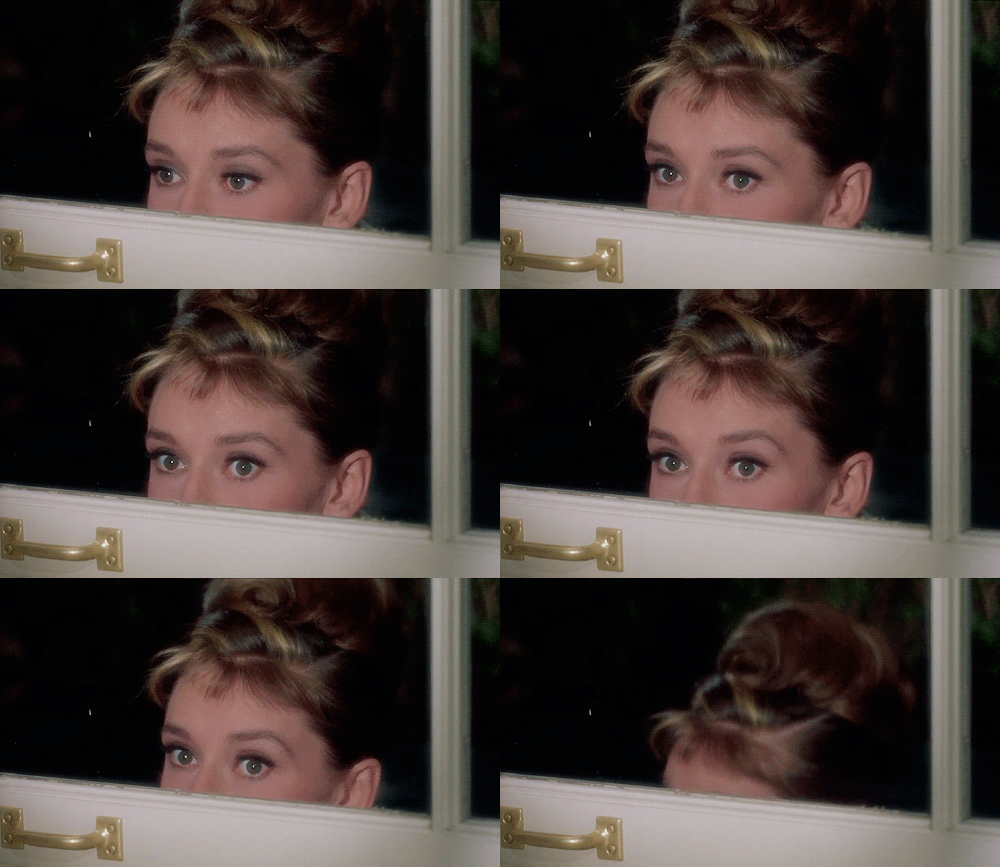
Capote is definitely not the writer who should take the word (and are there such writers?), But this does not mean that all his words should be neglected. (Here you can recall one of his letters from 1964, which says: “... Yes, Holly was a real girl - but the events described in the story, at least, are fictitious.”) Apparently, the mysterious Anna Kogan belonged to the number of women who occupied the hood: secular, bright, rich, seductive, living beautiful life. Therefore, in Holly, if you wish, you can see something from her-along with something from a good dozen other young ladies and ladies. But nothing indicates their close literary relationship, so Denis Zakharov’s readiness to make it our compatriot seems touching, but in vain.
In order not to end this part on such a discouraging note, we will try to help the researcher answer the researcher to answer one of the questions occupying him. He sounds like this: “In his letters to the editor of New Yorker, Kapota called this essay the“ daughter of the Russian revolution ”, probably hinting at Anna Kogan. But did this secular pro -Western girl have a real attitude towards the hero of the October Revolution or is it just a figure of speech? ” The sons and daughters of the Russian Revolution Capote calls all the participants of the circle of Anna Kogan, comparing them with the children of American immigrants who went beyond the cultural horizons of their parents. The participants in this circle, all, except one, - the grandchildren and granddaughters of the peasants, "shone with a gloss of a developed taste, which were deprived of their" home -made "fathers." The father of Anna Kogan, as we recall, was a "specialist in aeronautics"; Having combined these circumstances with each other, we can confidently say that in front of us is the figure of speech, which is so glorious by Kapote.
Unless, of course, the question is not whether the future specialist in aeronautics waved in the thunderstorms with a saber on the Kolchakovsky fronts. So far, we cannot answer such a question.
II
The essay “Muse is heard” and the manuscript of the “daughter of the Russian revolution” are not the only sources related to the stay of the hood in the USSR. They also include a number of publications in the American press, one of which, taking this opportunity, we will quote:
"New York Herald Tribun", November 18, 1956
Maurice Dolbier
Capote in Russia
The news that Trumen Capota is going to the Soviet Union to write several notes about the troupe of the Porga and Bess troupe, which was published, caused several smiles and a certain number of those conceived, but not too ridiculous, but Mr. Capota shame his critics, showing one of the most insightful and witty reports to us by the Americans from Moscow: “Muse heard ”(“ Random House ”).
Mr. Capote is satisfied. So pleased that, according to him, he intends to devote at least part of his career to journalism. “Such an exciting genre,” he says. -I wrote some things about different places, but it probably was not quite journalism ... The difficulty here is to convey everything completely verbatim ... In a fictional narrative, it is easy to find points of connection and make easy transitions, in the report-no ... "
The Russians as a whole seemed to him very stiff people. He tried to violate this stiffness by giving the editor of “Foreign Literature” the book of Mickey Spillein. The editor read it and said: “It is very funny. What, in America, is this spillein considered a serious writer? " There was no answer. About the Russian theater: "Well ... excellent productions happen, but - no adventures, and all this splendor" as if spinning in a vacuum "." When he was there, the premiere of the new play took place, “the three of us went to the virgin lands” ( the premiere of the play by Nikolai Pogodin in the production of Anatoly Efros and Maria Knebel took place on November 5, 1955; the Porgy and Bess troupe arrived in December. - D. Kh.), In which Soviet methods criticized. The day after the premiere, she was defeated in Pravda ( the article “The serious failure of the playwright. About the play by N. Pogodin“ We went to the virgin lands ”” was published on January 5, 1956. - D. Kh.); Two days later, the author apologized. Speaking in the Union of Soviet writers, Mr. Capote raised this topic, which was met with an awkward silence, after which the presenter confidentially asked: “Maybe you want to discuss this topic later, by private order?”