
Translated material
Russian roulette of the German bank
Deuteche Bank took off a fine of $ 630 million for dubious transactions with Russian money
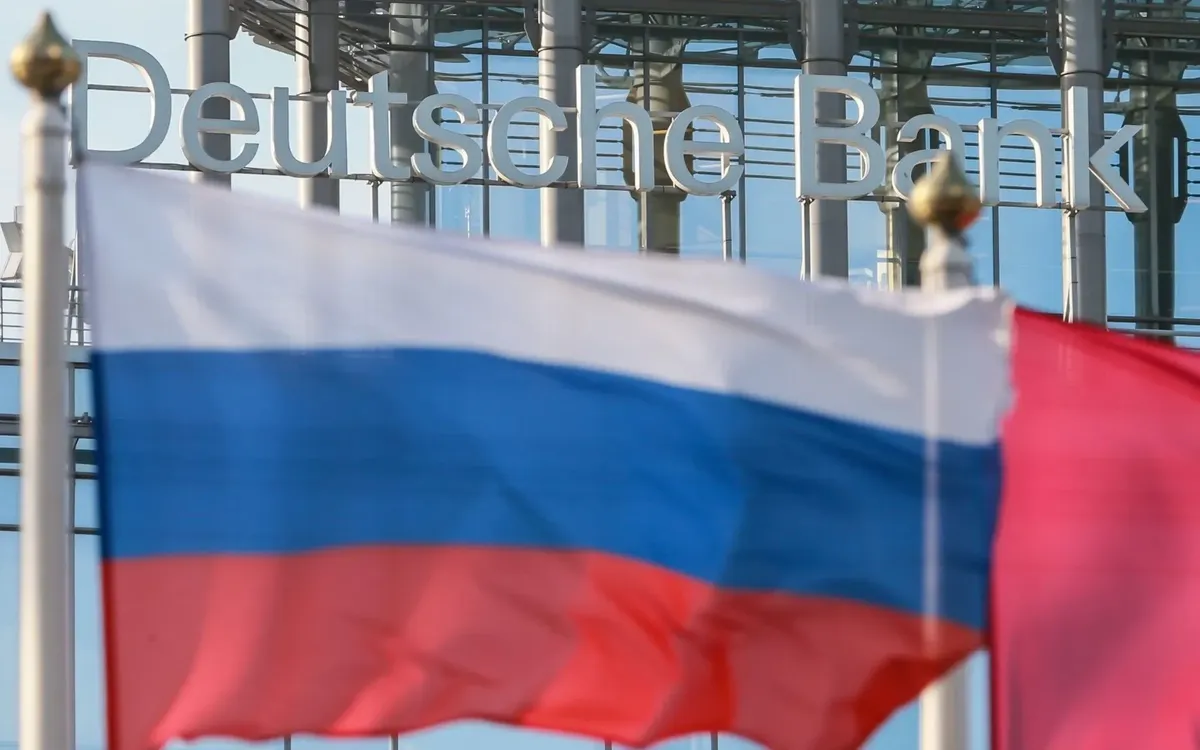
The American authorities, in the person of the Department of Financial Services of the state of New York, imposed on the largest financial institution of Germany Deutsche Bank (DB), penalties in the amount of $ 425 million. Another 205 million fine from the British financial regulator should be added to this amount. German bankers received such punishment for the laundry of "dirty" money from Russia.
The story with the participation of the Moscow office of DB in dubious financial transactions began in 2011, when employees of the investment department of the bank under the leadership of American Tim Wezella began the active practice of “mirror transactions”. Such a definition was fixed among foreign financiers for peculiar transactions for the purchase and sale of securities bypassing traditional exchange trading. In Russia, they were called simply “converting”.
The essence of the "mirror transaction" was as follows. On behalf of Russian customers, German bankers bought stocks and derivatives (securities of the second level) for rubles, while Russian companies and immediately sold them in London and New York, but for dollars, pounds of sterling and euro. At the same time, the seller and the buyer often represented the same person hiding under the names of different offshore firms.
The German banking "Laundry" worked in Moscow until April 2015. With its help, according to international supervisory financial authorities, it was possible to wash and legalize more than $ 10 billion in the West.
Strange transactions in the fall of 2014 attracted the attention of the Central Bank of the Russian Federation, which recommended German colleagues to conduct an audit. The reason for the concern of the Russian side was that just at that time licenses were revoked by a number of credit and brokerage companies that had previously carried out regular financial transactions with DB.
The leadership of the Deutsch of the Bank, trying to not endure the IC from the hut from the long -haired crisis and other high -profile scandals, only six months later it was forced to admit that the Moscow branch was involved in unscrupulous transactions. As a result of the internal investigation, they were removed from work, and then several DB employees in Moscow were fired, including Tim Wezella. Its department was disbanded, the bank generally stopped working with Russian securities.
Despite the fact that the national supervisory financial authorities of the United States, England and Germany joined the investigation of the scams to launder Russian money, the question was still open, whose capital was withdrawn from Russia with the help of German bankers?
This gave rise to various speculations in the press. So, The New Yorker, citing an unnamed Russian banker, claimed that most of the money belonged to the Chechens with the Kremlin ties. In turn, the FINANCIAL TIMES publication suggested that the main beneficiaries of “mirror deals” could be the brothers of Rotenbergs close to President Putin. In other publications, the surname of the shadow financier Alexander Grigoryev, suspected of illegal withdrawal abroad, flashed 46 billion dollars.
However, bankers and investigators, without confirming or refuting journalistic information, strictly kept silence. While the media was wondering about the money belonging, the DB leadership led intensive negotiations with the Americans and the British in order to lick the scandal and turning another dirty page of their history as soon as possible.
It looks like they succeeded.
“Deutsche Bank”, having received financial punishment from supervisory authorities, is now entitled, referring to banking secrets, to ignore all the requests of journalists about laundering Russian money. It is also doubtful that the official Russian bodies will show zeal in the search for all participants in “converting” rubles to Western currency. In extreme cases, the whole thing may be limited to switchcakes.
True, there is still hope for an investigation by the US Ministry of Justice, who has not yet commented on the decision of the New York Department of Financial Services. Although it is ghostly in the light of a successful permission for German bankers to pay a record amount for participation in 2008 in mortgage fraud that entailed the global financial crisis. Instead of previously indicated record 14 billion, DB will pay $ 3.1 billion to the American budget and will compensate for another 4.1 billion for five years to injured legal entities and individuals.