
Translated material
Tagged hacker?
The version is discussed: the detained man in the case of the "Shali-Bolti" Colonel of the FSB could be an agent of foreign intelligence

To date, it is known that six people involved in the activities of the Khaltai-Boltai hacker group have already been arrested. More and more new information is “flowing into the press: about the personalities of the detainees or about, for example, that three dozen high -ranking officials became victims of hackers. It seems that someone periodically opens the gateways of the information dam, splashing a little details of the criminal case.
This is similar to a special operation, whose goal is to shift the accents: to force to discuss not a “spy” scandal, but a “hacker”.
Thus, distracting public attention from the key figure of this story-the head of the 2nd operational department of the Center for Information Security (QIB) of the FSB, Colonel Sergey Mikhailov, against whom a criminal case has been instituted under Art. 275 of the Criminal Code of the Russian Federation (state treason) and the “accomplice” of Mikhailov-the senior operative of the 2nd department of the operational department of the QIB FSB of Russia, Major Dmitry Dokuchaev.
Moreover, almost all other defendants are charged with Art. 272 of the Criminal Code (illegal access to computer information), the maximum punishment for which is “only” seven years in prison. And indeed, where is the blackmail of officials, and where is the Stateismman?
At that time, while Russia is discussing the activities of Shaltay-Boltya, the USA is more and more talking about the “espionage” component of the arrest of officers of the QIB FSB and a group of hackers.
Brian Krebs (Brian Krebs) is the largest cybercrime specialist, since 2005, the leading section of Security Fix in the newspaper The Washington Post, the author of the KrebsonSecurity.com blog about computer security, the audience of which exceeds one million readers, - commented on the scandal and us that it was exactly what exactly Sergei Mikhailov was one of his sources, who passed him thousands of confidential documents on cyberlade in Russia. And it was these documents that formed the book by Krebs Spam Nation, which became a bestseller in the United States.
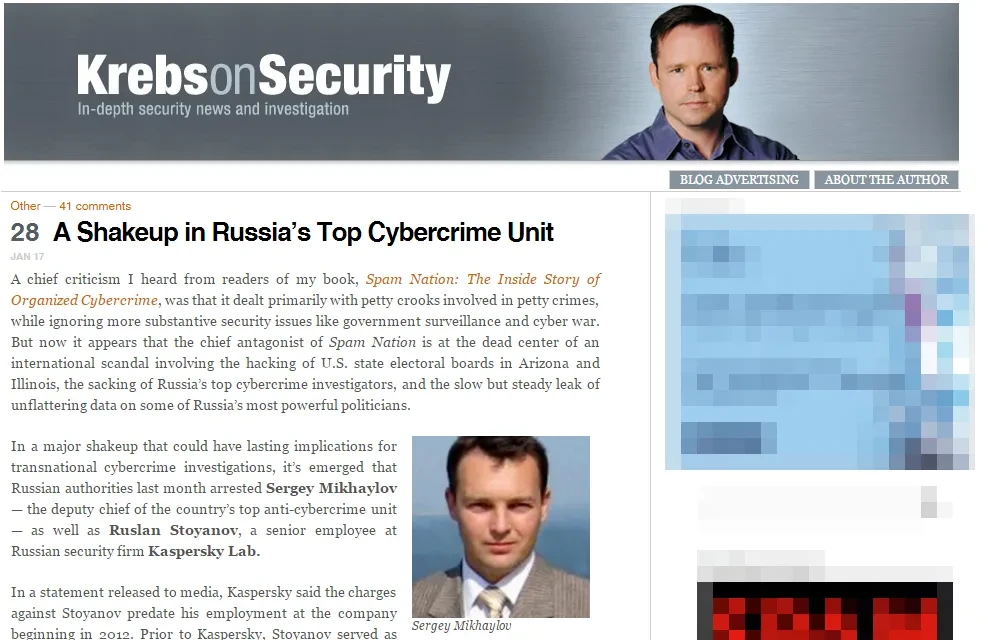
Krebs said that Sergey Mikhailov and Ruslan Stoyanov knew about the frauds of Sergei Mikhailov 5 years ago. Due to employment, Stoyanov was the owner of the Indrik Laboratory and specialized in DDOS attacks and protection from them. Indrik and Stoyanov personally had close contacts with Kimberly Zenz, a famous cybercrime analytic who worked at the Russian Front in Idefence (which, in turn, belongs to the notorious Verisign, actively cooperating with the American intelligence services).
But what Brian Krebs did not write about. As if Stoyanov’s partner at Indrik and his close friend, Dmitry Levashov, who was Cimberti Zenz's common husband. It was through Levashova and Stoyanova that Zenz allegedly received information from Mikhailov, and then from Dokuchaev, with whom Stayanov introduced her.
And, apparently, it was no coincidence that Kimberly Zenz was the first to talk about the “Russian cybermafia”, back in 2007, provoking the Western press interest in the St. Petersburg company of the Russian Business Network (RBN), which provided hosting services. Over the amount of $ 600 per month, RBN provided the customer with a dedicated server and provided any technical assistance. In October 2007, the Washington Post published a resonant article in which the Russian Business Network was accused of promoting Fisher, spammers and other cybercriminals. In the publication, this example was given: only one of the phishing groups, which worked through the Russian Business Network, abducted about 150 million US dollars.
After the publication, the Washington Post Russian Business Network has stopped working. “Closed” the company now arrested Sergey Mikhailov.
One of the key newsmakers of publication, in addition to Kimberly Zenz, was someone Dmitry Alperovich, who left Russia in the mid-2000s and settled in the United States. In September 2016, it was Alperovich, who holds the post of technical director of Crowdstrike, who was the first to accuse the Russian hackers related to special services, of a hacker attack on the servers of the National Committee of the Democratic Party of the United States and the kidnapping of confidential documents, among which there was supposedly a dossier for Donald Trump.
Our sources confidently assume that the officers of the QIB Mikhailov and Dokuchaev were in contact not only with Zenz, but also with Alperovich.
But that's not all. A few years ago, when a certain large Russian IT company had a “misunderstanding” from the deputy head of the QIB, the security service of the commercial structure began to collect “compromising” on Mikhailov. As a source working in this company told us, retired senior officers of the SVR, the FSB, the Ministry of Internal Affairs who worked for it approached work professionally. In particular, they found out that Mikhailov-from Belarus, came to Russia in the mid-90s (and then, as you know, the mess in the special services was terrible), and adopted Russian citizenship.
The “security guards” of the IT companies decided to make certificates of childhood and youth Mikhailov, went to Belarus-and did not find evidence that Mikhailov was really born and raised in Belarus. There was a suspicion that Mikhailov - maybe not Mikhailov?
Realizing that they went too far, the retirees of the special services did not further “dig”, only made a certificate of their “discovery” and handed it to the FSB.
When the two independent sources told the version that the “spy” article is charged with Mikhailov precisely because, perhaps, he is an employee of foreign intelligence, I asked an obviously suggestive question:
-Not a single intelligence of the world will allow his agent to engage in “muddy” matters that can bring him to failure, and Mikhailov’s connection with “Shalay-Boltai” is very muddy.
The answer seemed logical to me: if the German leadership instructed Stirlitsa to crank the “muddy” operation, he would also not be able to dodge. Entering Mikhailov’s development “Shaltai-Boltya”, and then, perhaps, the coordination of the information “plums”, the FSB leadership could not even guess who would perform such a scrupulous operation.
If it has a reason that the VIB -FSB deputy leader is an agent of foreign intelligence, it will make a good “exchange material”. On social networks, the United States is already discussing the theoretical possibility of exchange of Sergei Mikhailov, for example, for a Russian citizen Viktor Buta, who is serving in the United States, a 25-year prison term for weapons trafficking.