
Translated material
Five naive financial questions
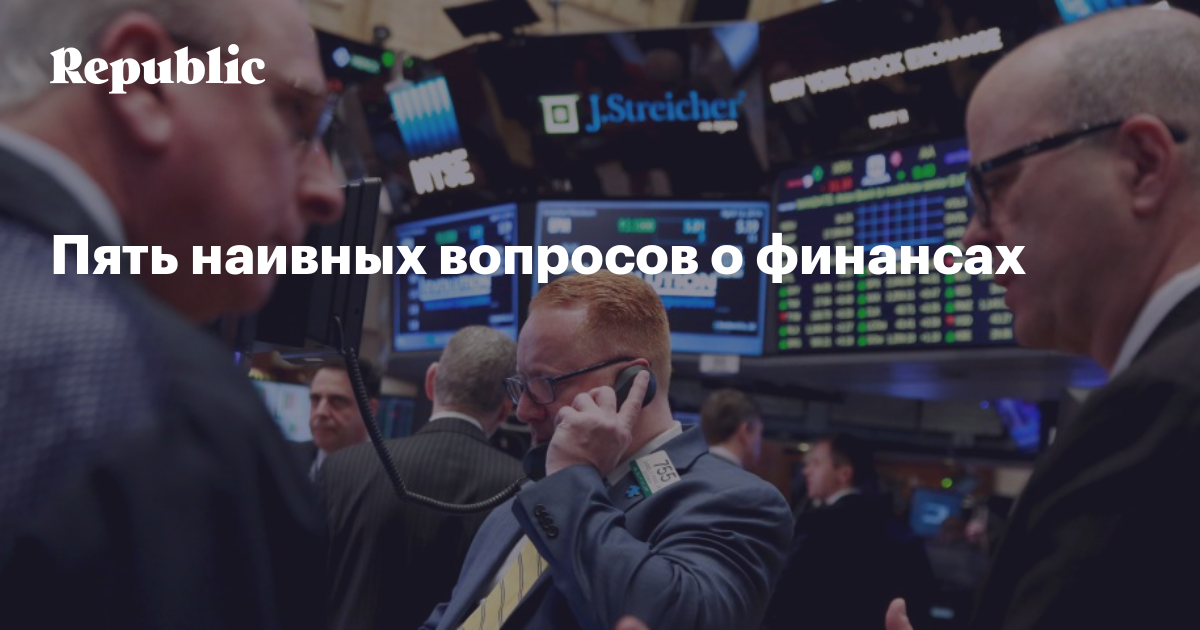
Many things in the economy seem to be granted, but it is sometimes useful to take a step back and think about whether everything is really so obvious. Here are the five questions that we at the Slon Magazine editors asked ourselves when choosing topics for articles.
1. Why in 2004 oil cost $ 30–40 per barrel, as now, and the dollar was only 28 rubles?
The cost of the dollar, like any product, depends on demand and supply. While high oil prices were held on the global market, a large amount of foreign exchange earnings was received in Russia - there was no shortage of dollars, and the national currency rate remained stable. In mid -2014, energy prices collapsed, the currency revenue of Russian enterprises declined. Accordingly, the amount of foreign currency in the economy fell, and the ruble exchange rate began to decline.
Then, at the end of 2014, the Bank of Russia canceled the so -called currency corridor, that is, the limits of fluctuations in the exchange rate, when the Central Bank went out for which the Central Bank usually began to sell dollars and euros to support the ruble. The Central Bank decided to save reserves instead of burning a billion dollars a day. So the ruble went into free swimming.
The demand for rubles also fell due to the fact that investors began to believe less in the country: when foreign companies, banks and private entrepreneurs expect growth of the economy, they sell currency (which was abroad) to open new factories and sales offices in Russia. (Russian businessmen in this sense are not very different from foreigners - they also store money abroad.) In 2004, investors put on growth, in 2014-15 - took a wait -and -see position or left the market.
Finally, do not forget that in the 2000s the ruble depreciated much faster than the dollar and the euro-due to inflation. From 2004 to 2015, consumer prices in Russia rose more than two and a half times, in Europe and the USA - only by a quarter. That is, for a certain amount of rubles, for which in 2004 it was possible to purchase an average basket of goods and services in Russia, at the end of 2015, 36% of this basket could be bought. In the euro and in the USA - 80%. The refusal of the Central Bank and continue to maintain a course of national currency simply brought the situation in line with these realities.
“How much prices have risen, the dollar rate has grown so much,” says Valery Mironov, chief economist of the Development Center Institute.
2. Why do Russian banks do not give the population and business loans in euros under 5% per annum, as in Europe, because the currency is the same?
The rate on loans does not depend on the currency, but on the risk of non -return and betting on deposits. “The risks associated with lending are much higher in Russia than in Europe,” says Rash Finance Professor Alexei Goryaev.
Banks do not borrow the money of their owners, but the money attracted from investors through the issuance of bonds or funds of their depositors. Accordingly, the more credit organizations are forced to pay all these people and companies, the more percentage it will be beneficial for them to give loans.
“Russian borrowing banks in euros are much more expensive than European. Especially after the imposition of sanctions, ”says Goryaev.
3. The capitalization of Gazprom with all its factories and deposits is six times less than that of Facebook. At the same time, the revenue and net profit of the Russian company are many times superior to similar indicators of the social network. How did it happen?
Gazprom and Facebook work in fundamentally different sectors, and therefore their exchange value (capitalization) is formed from different expectations. The gas industry is a traditional and currently experiencing far from the best times due to falling energy prices. Roughly speaking, no one expects that in a couple of years the profit of gas companies will increase at times: God forbid, if it remains at the current level or grows a bit.
Facebook is in a completely different situation - its value is based not so much on the amount of assets and cash flows now, but on the promise that his business model is the future. Facebook has access to 1.5 billion users around the world and demonstrates the ability to squeeze more and more money from this advantage.
“This example clearly shows how interesting to investors are high -tech companies that generate new ideas. The demand for the shares will be high while the social network is in the leaders, ”writes Nikolai Melnichuk, a trader analyst by the“ investment technology laboratory ”in response to Slon Magazine.
At the same time, Facebook capitalization, like many other IT companies, can range in a wider range than the cost of Gazprom. The current rise in the social network may well be followed by a collapse, as, for example, this happened with Twitter. After the company IPO in November 2013, its cost in a couple of months jumped by 66%, however, when the hopes of investors did not justify, it collapsed more than four times to the current level. “Nothing is eternal, and the amazing company of Mark Zuckerberg in the future will have a fight against new interesting IT projects,” Melnichuk notes.
4. Why are Russian Ministry of Finance and the Central Bank buy American government bonds if they bring such a small income, and the diplomatic relations between Russia and the United States leave much to be desired?
In the formation of its reserves, Russia makes three basic requirements to the assets: reliability, liquidity (that is, the opportunity to quickly sell the asset at an affordable price) and profitability. In this triad, reliability is in the first place, says Anton Tabah, chief economist of the Russian Rating agency.
“Where else to invest, except American papers, so that it is reliable and liquid? Nowhere. It’s good that something is paid, because, for example, the rate is negative for German relatively short bonds, ”the expert argues.
After a deterioration in relations with the United States and the exchange of sanctions with Western countries in Russia, calls to stop buying American securities periodically, as this is supposedly “financing the American economy”. In fact, the Russian state, as a rule, buys bonds of its geopolitical opponent in the secondary market. In other words, someone has already borrowed this money to the States to Russia.
You can, of course, boycott Western papers for political reasons, but this is unlikely to harm the American budget: Russia holds less than 2% of American state -owners. For comparison: in China and Japan - about 20%. In addition, it is necessary to remember the structure of the American economy.
“The proportion of private companies in the United States is quite large, which means you cannot put an equal sign between the purchase of government bonds and the financing of the economy as a whole,” Tabah recalls.
As a result, despite the unfavorable political climate, Russia continues to increase its assets in the form of American papers. From January 2015 to January 2016, the country's investment in Trezheris grew by 18% to $ 97 billion.
5. Gold is just a chemical element with an atomic mass of 197. Why do states and people still keep money in it?
The popularity of gold can be explained by several reasons laid down in it with chemical and physical properties.
Firstly, it is convenient to store gold, as it is inert and fairly dense metal: it does not oxidize, does not “deteriorate”, and the condition of one family, expressed in gold, can be easily fitted in the suitcase (you would try to crank the same with oil or wheat.)
Secondly, the amount of gold in the world is limited, added by Alexander Abramov added by the professor of the Department of the Stock Market and the Higher Supervisory Institution of the NRU. The production of gold can not grow or fall. If you melt all the gold of the world, at the moment, including ingots, jewelry and a tutankhamun mask, you will get a cube with a rib of about 20 meters.
Thirdly, the quality of the gold ingot is very easy to install with great accuracy, not relying on subjective assessments, as often happens when evaluating precious stones.
Fourth, gold is little used in industry (with the exception of jewelry), unlike platinum and silver, which provides additional stability of metal prices. The gold, which goes to the manufacture of jewelry, can be melted and entered again into the "appeal".
Ultimately, the value of gold, as well as the value of modern fiat money like a dollar or euro, is based on the fact that people agreed to consider it value, and its chemical properties were ideally suited for this. But only if the value of the dollar is provided by the federal reserve system of the United States, then nature itself creates the basis for the value of yellow metal. In addition, unlike the American currency, the cost of which was untied from gold provision less than half a century ago, a conditional social agreement regarding the value of gold for thousands of years: people are simply used to considering it value.
“Poophrasing Churchill , gold is the worst possible form of currency, except for everyone else,” summarizes the BBC journalist Justin Rowlatt.
You can, of course, present a hypothetical situation when the level of trust between countries and individuals on the planet has grown so much that everyone could agree to change gold to some cryptocurrency: instead of ingots, everyone would have records in electronic accounts. Then the cost of gold would be determined exclusively in demand for it from the jewelry industry, and there would be no additional load in the price of yellow metal.